Intermediate Statistical Mechanics
eBook - ePub

Intermediate Statistical Mechanics

  1. 440 pages
  2. English
  3. ePUB (mobile friendly)
  4. Available on iOS & Android
eBook - ePub

Intermediate Statistical Mechanics

About this book

-->

In this new textbook, a number of unusual applications are discussed in addition to the usual topics covered in a course on Statistical Physics. Examples are: statistical mechanics of powders, Peierls instability, graphene, Bose-Einstein condensates in a trap, Casimir effect and the quantum Hall effect. Superfluidity and super-conductivity (including the physics of high-temperature superconductors) have also been discussed extensively.

The emphasis on the treatment of these topics is pedagogic, introducing the basic tenets of statistical mechanics, with extensive and thorough discussion of the postulates, ensembles, and the relevant statistics. Many standard examples illustrate the microcanonical, canonical and grand canonical ensembles, as well as the Bose-Einstein and Fermi-Dirac statistics.

A special feature of this text is the detailed presentation of the theory of second-order phase transitions and the renormalization group, emphasizing the role of disorder. Non-equilibrium statistical physics is introduced via the Boltzmann transport equation. Additional topics covered here include metastability, glassy systems, the Langevin equation, Brownian motion, and the Fokker-Planck equation.

Graduate students will find the presentation readily accessible, since the topics have been treated with great deal of care and attention to detail.

-->

Request Inspection Copy

-->
0 Readership: Graduate students and academics focusing on statistical mechanics. -->Bose-Einstein Statistics, Fermi-Dirac Statistics, Boltzmann Transport Equation, Peierls Instability, Casimir Effect, Quantum Hall Effect, Langevin Equation, Brownian Motion, Phase Transitions0
Trusted by 375,005 students

Access to over 1 million titles for a fair monthly price.

Study more efficiently using our study tools.

Information

Publisher
WSPC
Year
2016
eBook ISBN
9789813201163

1

Statistical Mechanics: The Basics

1.1From Micro to Macro

Thermodynamics describes the state of a system in terms of macroscopic variables like pressure, volume, temperature, energy, entropy etc. The laws of thermodynamics relate changes in these macroscopic variables. In the process thermodynamics requires some inputs from elsewhere. The best known example is that of an equation of state (i.e., relation between macroscopic variables) for an ideal gas, written as PV = nRT, where P is the pressure and V the volume of n moles of the gas. The temperature of the gas is T and R is the gas constant. Similarly for a non ideal gas the pressure is given by Van der Waals equation of state. One also needs to know that the molar specific heat of an ideal monatomic gas at constant volume is (3/2)R. Thermodynamics cannot calculate the pressure or the specific heat. This is because these calculations entail a microscopic picture that depends on the details of inter-molecular interactions. To calculate the pressure one needs to know what is the force exerted by the gas molecules on the walls of the container. This question has to do with knowledge of the dynamics of each of the particles. In principle this dynamics can be specified if one knows how a given molecule interacts with all the other molecules. All the other molecules mean an Avogadro number of them i.e. of the order of 1023. In practice then, one would not dream of doing this calculation. How does one arrive at an answer?
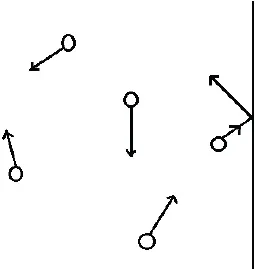
Let us consider the wall which is parallel to the yz plane as shown in Fig.1.1. The container is rectangular and the surface shown is the right hand edge. The molecule which strikes it must have a positive x-component of velocity (vx > 0). Collisions with the wall are elastic and hence the collision with the wall shown in Fig.(1.1) will result in a change of momentum of 2mvx (m is the mass of the molecule) in the negative x-direction. This change of momentum of the molecule caused by the wall will result in an equal and opposite effect that produces the pressure. Since the gas is taken to be ideal (i.e., non interacting) the molecule will not change its momentum on its way to the wall. But constancy of velocity of a given molecule does not imply that velocities of all molecules are equal. In fact the gas will contain molecules with all possible velocities with the number of molecules in a given velocity range given by a definite distribution function. Interestingly enough, this distribution will be seen to be the outcome of interactions (however weak) between the gas molecules! Our ignorance of the exact dynamics of the gas molecules forces us to take recourse to the existence of this distribution function. This is the statistical description that we take recourse to whenever an exact description becomes impossible in practice (not in principle) and that sets up the subject of statistical mechanics.
image
Figure 1.1: Molecules colliding with a wall.
To calculate the force on the area δA of the wall, we need to how much momentum transfer occurred in unit time. This means we need to know how many collisions occurred in unit time. For the molecules with vx as the x-component of the velocity, the number of collisions per unit time is the number of molecules with x-velocity of vx that lie in a cylinder of cross-section δA and height vx. This number is
image
where n(vx) is the density of molecules with a x-velocity of vx and the factor of
image
comes from the fact that we ne...

Table of contents

  1. Cover
  2. Halftitle
  3. Title
  4. Copyright
  5. Preface
  6. Acknowledgments
  7. Contents
  8. 1 Statistical Mechanics: The Basics
  9. 2 The Microcanonical Ensemble
  10. 3 Other Ensembles
  11. 4 Non-interacting Systems
  12. 5 Interacting Classical Systems
  13. 6 Quantum Statistics
  14. 7 Fermi Distribution: Examples
  15. 8 Electrons in a Magnetic Field
  16. 9 Bose-Einstein Distribution: Examples
  17. 10 Superconductivity
  18. 11 Phase Transitions
  19. 12 Landau Theory and Related Models
  20. 13 The Renormalization Group
  21. 14 Disordered Systems
  22. 15 Transport Equation – I
  23. 16 Transport Equation – II
  24. 17 Transport Equation – III
  25. 18 Transport Equation – IV
  26. 19 Metastable States
  27. 20 Langevin Equations
  28. 21 Fokker-Planck Equations
  29. 22 Fluctuation Dissipation Theorem
  30. References
  31. Index

Frequently asked questions

Yes, you can cancel anytime from the Subscription tab in your account settings on the Perlego website. Your subscription will stay active until the end of your current billing period. Learn how to cancel your subscription
No, books cannot be downloaded as external files, such as PDFs, for use outside of Perlego. However, you can download books within the Perlego app for offline reading on mobile or tablet. Learn how to download books offline
Perlego offers two plans: Essential and Complete
  • Essential is ideal for learners and professionals who enjoy exploring a wide range of subjects. Access the Essential Library with 800,000+ trusted titles and best-sellers across business, personal growth, and the humanities. Includes unlimited reading time and Standard Read Aloud voice.
  • Complete: Perfect for advanced learners and researchers needing full, unrestricted access. Unlock 1.4M+ books across hundreds of subjects, including academic and specialized titles. The Complete Plan also includes advanced features like Premium Read Aloud and Research Assistant.
Both plans are available with monthly, semester, or annual billing cycles.
We are an online textbook subscription service, where you can get access to an entire online library for less than the price of a single book per month. With over 1 million books across 990+ topics, we’ve got you covered! Learn about our mission
Look out for the read-aloud symbol on your next book to see if you can listen to it. The read-aloud tool reads text aloud for you, highlighting the text as it is being read. You can pause it, speed it up and slow it down. Learn more about Read Aloud
Yes! You can use the Perlego app on both iOS and Android devices to read anytime, anywhere — even offline. Perfect for commutes or when you’re on the go.
Please note we cannot support devices running on iOS 13 and Android 7 or earlier. Learn more about using the app
Yes, you can access Intermediate Statistical Mechanics by Jayanta Bhattacharjee, Dhruba Banerjee in PDF and/or ePUB format, as well as other popular books in Physical Sciences & Condensed Matter. We have over one million books available in our catalogue for you to explore.