Mechanical Engineering And Control Systems - Proceedings Of The 2016 International Conference On Mechanical Engineering And Control System (Mecs2016)
eBook - ePub

Mechanical Engineering And Control Systems - Proceedings Of The 2016 International Conference On Mechanical Engineering And Control System (Mecs2016)

Proceedings of the 2016 International Conference on Mechanical Engineering and Control System (MECS2016)

  1. 636 pages
  2. English
  3. ePUB (mobile friendly)
  4. Available on iOS & Android
eBook - ePub

Mechanical Engineering And Control Systems - Proceedings Of The 2016 International Conference On Mechanical Engineering And Control System (Mecs2016)

Proceedings of the 2016 International Conference on Mechanical Engineering and Control System (MECS2016)

About this book

-->

The 2nd Annual 2016 International Conference on Mechanical Engineering and Control System (MECS2016) was successfully held in Wuhan, China in 2016.

The MECS2016 is one of the leading international conferences for presenting novel and fundamental advances in the fields of Mechanical Engineering and Control System attended by more than 80 participants from China, South Korea, Taiwan, Japan, Malaysia, and Saudi Arabia. The MECS2016 program includes 4 keynote speeches, 98 oral and poster presentations, covering a wide spectrum of topics from mechanics engineering, control engineering and technology, to automation and mechatronics. However, after reviewed and careful consideration, only 70 articles are included in this proceedings.

-->
-->
Contents: Mechanics Engineering;Control Engineering and Technology; -->
--> Readership: Researchers and graduate students interested in mechanical engineering and control systems. -->
Mechanics Engineering, Control Engineering, Automation, Mechatronics0

Frequently asked questions

Yes, you can cancel anytime from the Subscription tab in your account settings on the Perlego website. Your subscription will stay active until the end of your current billing period. Learn how to cancel your subscription.
No, books cannot be downloaded as external files, such as PDFs, for use outside of Perlego. However, you can download books within the Perlego app for offline reading on mobile or tablet. Learn more here.
Perlego offers two plans: Essential and Complete
  • Essential is ideal for learners and professionals who enjoy exploring a wide range of subjects. Access the Essential Library with 800,000+ trusted titles and best-sellers across business, personal growth, and the humanities. Includes unlimited reading time and Standard Read Aloud voice.
  • Complete: Perfect for advanced learners and researchers needing full, unrestricted access. Unlock 1.4M+ books across hundreds of subjects, including academic and specialized titles. The Complete Plan also includes advanced features like Premium Read Aloud and Research Assistant.
Both plans are available with monthly, semester, or annual billing cycles.
We are an online textbook subscription service, where you can get access to an entire online library for less than the price of a single book per month. With over 1 million books across 1000+ topics, we’ve got you covered! Learn more here.
Look out for the read-aloud symbol on your next book to see if you can listen to it. The read-aloud tool reads text aloud for you, highlighting the text as it is being read. You can pause it, speed it up and slow it down. Learn more here.
Yes! You can use the Perlego app on both iOS or Android devices to read anytime, anywhere — even offline. Perfect for commutes or when you’re on the go.
Please note we cannot support devices running on iOS 13 and Android 7 or earlier. Learn more about using the app.
Yes, you can access Mechanical Engineering And Control Systems - Proceedings Of The 2016 International Conference On Mechanical Engineering And Control System (Mecs2016) by Jinjia Wei in PDF and/or ePUB format, as well as other popular books in Technology & Engineering & Automation in Engineering. We have over one million books available in our catalogue for you to explore.
Chapter 1
Mechanics Engineering
Research of the stress-strain relationships of metal thin-walled tube
Yu-Han Li and Jian-Wei Liu*
Department of Experiential Practice,
Guilin University of Electronic Technology,
Guilin, Guangxi, China

*E-mail: [email protected]
Stress-strain relationships not only can be used to describe the basic information of material deformation process, but also is the precondition of the plastic finite element simulation technology for metal materials processing. Firstly, the development of the methods for determining the stress-strain relationships is reviewed in the manuscript. Therewith, from the aspects of the hypothesizing, the off-line measuring and the on-line measuring respectively, the methods for determining the stress-strain relationships of tubular materials based on hydraulic bulge test are described, and the above methods are summarized in detail. Finally, some typical approaches for verifying the stress-strain relationships are presented. The present work provides significant reference for the research and development for building the stress-strain relationships in Tube Hydro-forming (THF) technology.
Keywords: Thin-walled tube; stress-strain relationships; hydraulic bulge test; material deformation process;
1. Introduction
Lightweight structure[1] is one of the development trends of advanced manufacturing technology at present. The metal thin-walled tubes are realized with lightweight structure, because they can be replaced by solid structures with hollow structures under the premise of ensuring the strength. Nowadays, they have been widely used in automotive and aircraft industries, household appliances and other components. In the forming process of thin-walled tube, the tubular plastic stress-strain relationships not only have important implications for the whole forming process [2], but also are the precondition of the finite element simulation technique for metal materials processing [3].
In this paper, the development of the methods for determining the stress-strain relationships of tubular materials is introduced,and the methods for establishing stress-strain relationships based on hydraulic bulge test are described detailedly. Finally, some typical approaches for verifying the stress-strain relationships are presented. This paper has a guiding significance for building the stress-strain relationships in Tube Hydro-forming (THF) technology.
2. Establishing the Stress-Strain Relationships of Tubular Materials Based on Tensile Test
Li Bo et al.[4] intercepted the parent metal and weld specimen from the SS304 stainless steel tailor-welded tube, and determined plastic hardening parameters under uniaxial tensile test. A mixed material specimen was intercepted from the Q215 stainless steel tailor-welded tube and tensile tests were carried out by Mei Zhan [5] et al., the results show that tensile specimens of sufficient width to include the weld bead, heat affected zone, and parent metal are suitable considering the constraint among the weld bead and parent metal.
However, the tensile test of flat or circular specimen can only reflect the mechanical properties of a certain direction of the tube, and can not get the comprehensive performance of the tube. In order to measure the comprehensive mechanical properties of the pipe more accurately, it is required that the tubes be tested in the biaxial stress state. Thus hydraulic tube bulge test is mostly preferable and recommended.
3. Building the Stress-Strain Relationships of Tubular Materials Based on Hydro-Forming Test
To build reliable and accurate flow stress of thin-walled tubes, hydraulic bulging method based on the real stress state is one of the most reasonable approaches. But the equivalent stress and equivalent strain of tube stress-strain relationship must acquired two important parameters based on curvature of deforming tube[6], namely the meridian radius ρφ and circumferential radius ρz.
3.1. Assuming method
Based on the plastic membrane theory and the incremental theory, Bortot P et al.[7] measured multiple tubes and established the flow stress equation of a thin-walled tube. Measurement method was complicated because the meridian radius ρφ is directly measured in the test, and the test equipment cost is high. Boudeau N et al.[8] assumed that the bulging contour is the circular arc, and calculated ρφ using geometrical relationship, then determined the stress-strain relationships based on related plastic forming theory.
The direct measurement of the radius of the meridian curvature can be avoided by the assumption that the bulging profile curve in advance. It has greatly improved the efficiency of testing, but the error of the actual bulging contour is relatively large, and the accuracy of the stress-strain relationships is reduced.
3.2. Off-line measuring method
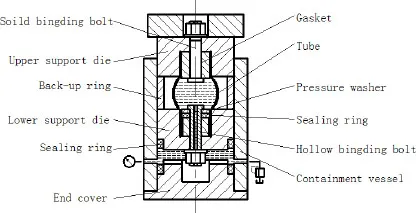
Based on the plastic membrane theory and static equilibrium equations, a hydro bulging approach is proposed by Yang LF et al.[9]with curve-fitting of the experimental data to establish the flow stress equation of a thin-walled tube in THF process, where the site measurements of stress and strain distribution. The hydro-bulging test tooling is shown in Fig. 1.
images
Fig. 1. Schematic of experimental set-up for the hydraulic bulge test.
The method obtained bulging date by off-line measuring, constructed the equation of bulging generatrix, and the bulging shape of the pipe is made credibly. It had good application value, but its measurement task was complicated, and its measuring accuracy directly affected the solution of the axial curvature radius.
3.3. On-line measuring method
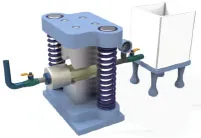
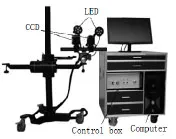
A unique on-line measurement approach based on digital speckle correlation method is put forward by Liu Jian-wei et al.[6] to determine flow stress of thin-walled tube in THF process. The bulging experiment device and measuring device is shown in Fig. 2 and Fig. 3.
images
Fig. 2. Hydro-forming experiment device.
images
Fig. 3. 3-D strain measurement system.
M. Saboori et al.[10] has carried out ...
Table of contents

  1. Cover
  2. Halftitle
  3. Title
  4. Copyright
  5. Preface
  6. Committees
  7. Technical Program Committee
  8. Keynote Speakers
  9. Contents
  10. Chapter 1: Mechanics Engineering
  11. Chapter 2: Control Engineering and Technology
  12. Author Index