![]()
Chapter 1
From Concept to Conundrum
“… Trying to find a computer simulation of physics, seems … an excellent program to follow … I’m not happy with all the analyses that go with just the classical theory, because nature isn’t classical, … and if you want to make a simulation of nature, you’d better make it quantum mechanical …”, R. Feynman [1].
The concept of quantum computing (QC) is generally credited to ratiocination by Nobelist Richard Feynman during the 1980’s, who saw ‘nothing in the laws of physics that precluded their development’. During the ensuing decades accelerating progress has been made in the ongoing development of quantum logic gates, a variety albeit dearth of algorithms and most assuring a plethora of potentially viable substrates for QC implementation. Proponents generally consider the remaining hurdle preventing bulk universal QC centers on problems associated with decoherence. In this chapter for the purpose of bringing the reader up to speed and a semblance of self-containment, a precis of the dominant platforms under development is given; each platform is unique in substrate technology, implementation format and scaling challenges. This also prepares the reader for later chapters where we move from qubits to a new class of relativistic qubits (r-qubits) whereby additional degrees of freedom are deemed essential for crossing the ‘semi-quantum limit’ into the realm of Unified Field Mechanics (UFM) allowing routine violation of the Quantum Uncertainty Principle and thereby supervening decoherence.
1.1Preamble – Bits, Qubits and Complex Space
A classical Turing bit (short for binary digit) is the smallest unit of digital data and is limited to the two discrete binary states, 0 and 1; but a quantum bit (qubit) can additionally enter an entangled superposition of states, in which the qubit is effectively in both states simultaneously. While a classical register made up of n binary bits can contain only one of 2n possible numbers, the corresponding quantum register can contain all 2n numbers simultaneously. Thus in theory, a QC could operate on seemingly infinite values simultaneously in parallel, so that a 30-qubit QC would be comparable to a digital computer capable of performing 1013 (trillion) floating-point operations per second (TFLOPS) which is comparable to currently fastest supercomputers.
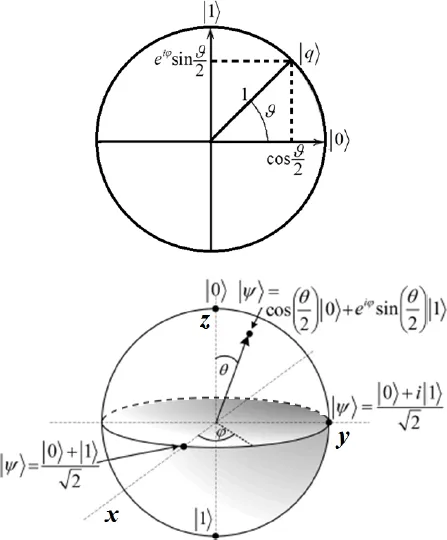
Fig. 1.1. Geometrical qubit representations. a) The qubit resides on the complex circle in the Hilbert space of all possible orientations of
. The complex unit circle is called the Hilbert space representation. In the logical basis, the two degrees of freedom of the qubit are expressed as two angles geometrically interpreted as Euler angles. b) The Bloch sphere in spin space showing the geometric representation of a qubit where
for orthogonal eigenstates
and
of a single qubit on opposite poles, with superpositions located on the sphere’s surface. Adapted from [
2].
The qubit, a geometrical representation of the pure state space of a 2-level quantum mechanical system, is described in Dirac’s ‘bra-ket notation’ by the state
where
α and
β are complex numbers satisfying the absolute value parameter |
α|
2+|
β|
2 = 1; such that measurement would result in state
with probability
and
with probability
. Formally, a qubit is represented in the 2D complex vector space, ℂ
2 where the
can be represented in the standard orthonormal basis as
for the ground state or
for the excited state, or on the Bloch sphere as in
Fig. 1.1b.
A qubit is shown in Fig. 1.1 in both its SU(2) Hilbert space representation (top), and the same qubit on the Bloch sphere in its O(3) representation (bottom). The SU(2) and O(3) representations are homomorphic, i.e. mapping preserves form between the two structures.
Vincenzo itemized what he felt were the major requirements for implementing practical bulk QC [3]:
•Physically scalable, allowing the number of qubits to be sufficiently increased for bulk implementation.
•Qubits must be able to be initialized to arbitrary values.
•Quantum gates that operate faster than the decoherence time.
•A universal gate set for running quantum algorithms.
•Qubits that can be easily read correctly.
None of Vincenzo’s requirements are yet fulfilled; some are further along than others; system decoherence is among the most challenging aspects remaining. Recently, the fundamental basis of quantum information systems is undergoing an evolution in terms of the nature of reality with radical changes in the nature of the measurement problem. The recent introduction of parameters for relativistic information processing (RIP), including relativistic r-qubits, has brought into question the historical sacrosanct basis of ‘locality and unitarity’ in terms of Bell’s inequalities, overcoming the no-cloning theorem [4,5]. The epistemic view of the Copenhagen Interpretation is challenged by ontic considerations of objective realism and additionally as merged by W. Zurek’s epi-ontic blend of quantum redundancy in quantum Darwinism [6].
1.2Panoply of QC Architectures and Substrates – Limited Overview
The following list represents many prominent QC architectures and substrates currently under development. It seems useful to briefly review the challenges and merits of each system as distinguished by the computing model and physical substrates used to implement qubits.
•Quantum Turing Machine
•Quantum Circuit Quantum Computing Model
•Measurement Based Quantum Computing
•Adiabatic Quantum Computing
•Kane Nuclear Spin Quantum Computing
•QRAM Models of Quantum Computation
•Electrons-On-Helium Quantum Computers
•Fullerene-Based ESR Quantum Computer
•Superconductor-Based Quantum Computers
•Diamond-Based Quantum Computer
•Quantum Dot Quantum Computing
•Transistor-Based Quantum Computer
•Molecular Magnet Quantum Computer
•Bose–Einstein Condensate-Based Quantum Computer
•Rare-Earth-Metal-Ion-Doped Inorganic Crystal Quantum Computers
•Linear Optical Quantum Computer
•Optical Lattice Based Quantum Computing
•Cavity Quantum Electrodynamics (CQED) Quantum Computing
•Nuclear Magnetic Resonance (NMR) Quantum Computing
•Topological Quantum Computing
•Unified Field Mechanical Quantum Computing
1.2.1Quantum Turing Machine
The quantum Turing machine (QTM) generalizes the classical Turing machine (CTM); the internal states of a CTM are replaced by pure or mixed states in a Hilbert space; The QTM is an idealistic platform not currently being developed. A QTM is a simple universal quantum computer used for modeling all the powerful parameters of quantum computing.
The QTM was proposed by Deutsch where he suggested that quantum gates could function similarly to traditional binary digital logic gates [7]. QTMs are not usually used for analyzing quantum computation; the quantum circuit model (QCM) is a more commonly used for such purposes.
1.2.2Quantum Circuit Computing Model
The quantum circuit model (QCM) computes sequences of quantum gates which are reversible transformations on a quantum mechanical analog of a classical n-bit register. The QCM has only two observables, preparation of the initial state and observation of the final state in the same basis for the same variable at the end of the computation [8].
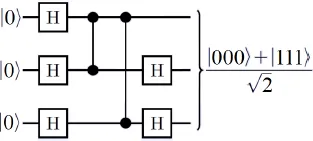
Fig. 1.2. Quantum circuit for 3 qubits using Hadamard gates.
1.2.3Measurement Based Quantum Computing
The measurement based quantum computer (MBQC) model is...