![]()
Chapter 1
Choosing a Postdoc
Do you really need to do a(nother) postdoc?
You have worked hard at academic study all your life through high school, undergraduate and possibly masters level degrees, and you are now entering the final throes of your PhD. The postdoc is the next obvious step, but is it the right one? It can be surprisingly easy to drift into being a postdoc but you need to consider the end game. Where do you hope to be in 5 years’ time? You may not have a firm idea yet; however, if you do and are planning to join the family business then there may be better ways to add to your CV. If you are considering another postdoc, then read on!
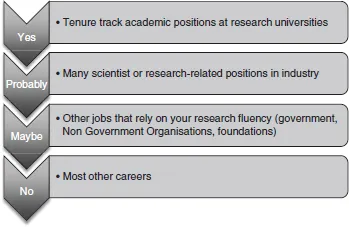
A postdoc is a job and is not a continuation of your student status. It is a research role combined with training in the professional skills needed to be a researcher. It is true that some Principal Investigators (PIs) might still insist on being called your supervisor, but they are now your manager. A postdoc is the space in which you build your CV for the future — stacking it with papers, grant contributions and teaching experience so that you can meaningfully apply for fellowships, lectureships and beyond. It is also a first step on the employment ladder for many, and prior job experience (rather than just your student experience) may be important to some future employers. The table below summarises when it might be useful to have been a postdoc (adapted from Ryan Wheeler, Manager, Career & Postdoctoral Services, TSRI).
Not all career routes require postdoc experience
It should be noted that very few successful PhD candidates make it to “tenure track.” According to The Royal Society report “The Scientific Century: securing our prosperity” only around 3.5% of PhD holders in Science Technology Engineering Maths (STEM) subjects make it to permanent academic research positions (lecturers and beyond). The majority enter the exciting array of “other” employment sectors.
Postdoc drift
The act of moving from PhD to postdoc as an automatic, natural next step without realising this is a real and pivotal career moment.
Current postdocs who were asked about why they chose to do a postdoc commented:
•“Just the necessary step and next step after a PhD.”
•“I thought that’s the pathway I’m supposed to take and I have to take.”
•“For me, I just sort of rolled into it. It hasn’t been like a career choice with a capital ‘C’”
•“Natural progression from a PhD.”
All at sea? Don’t succumb to postdoc drift.
There are many benefits of being a postdoc. Your time as a postdoc can give you the opportunity to:
work with new people, and build networks and collaborations,
enhance your research skills,
experience academic life as a member of staff,
take on further responsibilities (teaching, supervision, grant writing),
enhance your transferable skills (see the chapter on skills),
build up a body of evidence for the next academic stage.
However, undertaking a postdoc does need to be a conscious and considered decision. For someone with a PhD there are many job options but often the sheltered cosiness of academic research calls: we know it, we know the rules. We may moan about it but we know how it operates so it seems easier to stay within this world than to venture into untested territory.
Moving out from the academic world after a lifetime of schooling, degrees and academic endeavour can be viewed as:
•challenging,
•exciting,
•terrifying,
•a betrayal of all that has been invested in you,
•a sense of failure that you did not make the grade (also see imposter syndrome),
•“giving up after all that training” and with a sense of bewilderment by family and friends,
•“getting a ‘proper’ job at last” by friends and family.
Society needs intelligent, numerate, literate people capable of independent problem solving in many areas of work, so it is important to study your options at the end of your PhD. It is obviously a fraught time of writing up and finishing off your research, but time must be made to plan your next career move. Take time to see what employment options are open to someone with your skill set. Many corporate graduate roles may still be open to you. Technical firms may view the PhD as a bonus and for others you may need to translate what having a PhD really means in terms of your suitability for a role — see exploring careers outside academia later in this book. As a student you will still have access to your institution’s career service, use this to help you explore options to make sure that you are making an active decision to undertake a postdoc position and are not succumbing to postdoc drift.
We are not trying to put you off! But just so you are under no illusions, please note:
A postdoc is not a career
It is a stepping stone to the next stage in your career, which could be within academia or in other sectors. If staying in academic life, the next stage may be a personal fellowship, teaching post or a lecturing post. If planning to move on after your postdoc, the world could be your oyster with the right set of skills and experiences useful to employers in general (known as transferable skills). It is common for researchers to undertake a second postdoc contract, but this should only be considered if it adds something to your CV that the first did not (new skills, further publications). A chain of postdoc positions may give you employment for several years but these will be overshadowed by worries over contracts and you will become increasingly expensive for grant holders to employ as your experience builds.
There is a decades-old tradition that “the postdoc is a training ground for a tenure-track position, that this is the metric for success for young scientists,” says Cathee Phillips, executive director of the National Postdoctoral Association (NPA). “Postdocs have heard this for years, which causes them not to think about their own strategic career plan, because they think the postdoc will naturally flow into a tenure-track position.”
If you are unsure what to do, NOW would be the time to stop and think rather than use the (next) postdoc phase as a time to assess what you want. Postdoc life is hard work with rewards often linked to the amount of time and effort you put in. Coasting through the first year of a postdoc to decide if academia is for you, really doesn’t help as it has not given you a true idea of what it would take to be an academic. Even non-academic employers in the future will want to know whether you have been successful during your postdoc years.
✱Your reasons for doing a postdoc.
✱Your reasons for not doing a postdoc.
Choosing a postdoc
So, we haven’t put you off and you have made an active decision to seek a postdoc; where to start? Research is a global business and your field will have hotspots of excellence in institutions far and wide. You will need to go where the openings are; so, an understanding of who has a big grant in the pipeline, knowing which institution has just opened a new centre in your field, ensuring your network is aware that you are actively seeking a postdoc, and scanning the relevant academic job webpages are an initial set of actions. By letting people know what type of projects you are interested in, you open up the possibility of a PI employing you to work on something specific, perhaps even creating the opportunity for you to do so. If no one knows what exactly you are looking for this cannot happen.
But, given a choice of more than one, how can you make the best choice for yourself? Firstly, you may well need to appl...