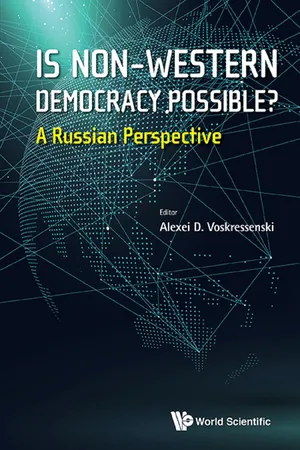
This book, with theoretical and practical analyses of comparative political systems of Eastern countries (Asia and Africa), their political process and political cultures, describes and analyses the influence of political culture on political process in the Eastern world. It gives readers an opportunity to make a comparative appraisal of maturity of civil society in these countries as well as their specifics in political interactions and internal political competition seen through the eyes of a group of distinguished Russian researchers. The book concentrates also on specifics of political-economic and political modernization in the East, and assesses the prospects of an emergence of a Western as well as a non-Western democracy in the framework of Eastern political transformations. It also explains why the one-dimensional spread of democracy - completely negating or neglecting regional political-cultural specifics - may lead to war among civilizations instead of the formation of a more just and fair system of democratic governance.
eBook - ePub
Is Non-western Democracy Possible?: A Russian Perspective
A Russian Perspective
- 768 pages
- English
- ePUB (mobile friendly)
- Available on iOS & Android
eBook - ePub
Is Non-western Democracy Possible?: A Russian Perspective
A Russian Perspective
About this book
Information
Subtopic
DemocracyComparative Analyses of Political Systems and Political Cultures: Clarification of Concepts
Chapter 1
The Eastern and Western Political Worlds and Classifications of World Political Systems
Alexei D. Voskressenski
For the countries of the East, the political vector of modernization is an extension of a search for satisfactory paths of socioeconomic and political development, maintenance of cultural independence, self-determination and, at the same time, as an alternative to economic stagnation, the realization of a model of “catch up” development or accelerated modernization, i.e., in the final analysis, the vector and pace of modernization are associated with the adequacy of the political system, the effectiveness of a given political regime and its political institutions in accomplishing this aim. The specifics of a political system are determined by concrete historical developments, the particulars of the given civilization, and the specifics of its political culture. Without the study of the specifics of political process, political systems, and political cultures, it is impossible to formulate an adequate representation of the character and essence of the concrete political life of the countries of Asia and Africa. Not only does an understanding of the specifics of political culture of Eastern societies form a foundation for the practical establishment of mutually beneficial relationships with the countries of the East, but it also bears a not insubstantial significance for understanding the paths of historical transformation of the political institutions of Russia itself,22 i.e., the material analyzed in the present work possesses not only a theoretical, but also an applied character.
The adequate application of international experience in Studies of the East (formerly known as Oriental Studies) and the supplementing of it with preliminary domestic findings are directly connected with the methodological debates in Eastern Studies, which is transforming today, right under our very eyes, into a field of World Regional Studies — a comprehensive, integrated, socio-economic discipline that examines the laws of the process governing the formation and function of the socio-economic systems of the world’s regions (i.e., of the East and of the regions of the East as parts of the system of the world’s regions), taking into consideration the particulars of their historical-cultural, demographic, national, religious, ecological, political-legal, and natural resources, their place and role in the international division of labor and in the system (and subsystems) of international relations.23 The influence of this new complex discipline,24 just as on sociopolitical science in general, so on issues in Comparative Political Science and International Relations more specifically, is indisputable.
However, before moving on to a discussion of the evolution of the political systems of the East, and to a concrete analysis of these systems in their full complexity and multifaceted nature, it is essential to define the methodological positions which structure the logic of such analysis and make it possible to construct practical outcomes and make conclusions of an applied nature. In connection with this, we will need to define the following questions:
- what are the methodological approaches toward social phenomena and how does the systemic analysis of political processes correspond to a comparative one;
- how may the comparative method be generally defined, in both the broad and the narrow senses, in particular; what may be the methodologically correct types of comparison and, correspondingly, what aberrations may result in drawing conclusions from methodologically incorrectly drawn questions, how may such aberrations be connected with issues of correct comparative analysis of political systems;
- does a “spatial” organization of material in connection with the regional specifics make sense and if so, what does it consist in; i.e., in what way may the “Eastern” material be “spatially” grouped (in the Political Science sense of the word) for the purpose of its analysis and presentation;
- how, in connection with this, may the relationships be determined between the general and specific (regional/country-specific) laws, within the framework of systems and comparative approaches, and what may be the connection in the relationship between the general and specific features of issues governing international systems, and correspondingly, what is the influence of this relationship on the results and speed of modernizing processes;
- how may the features of non-Western and Eastern types of societies (as components of the non-Western type) be specifically formulated, as distinct from Western types;
- how may our understanding of the mechanisms of the functioning of the political systems in Eastern societies be deepened, what may be the degree of practical application of such an understanding, and how may models of non-Western Asian democracy be deduced on the basis of such a conception.
A Systemic Approach to Society and Politics
In order for a phenomenon to be subjected to systemic analysis, it is essential to differentiate it into a system (i.e., interrelated elements, which cohere into an established whole that is not simply equivalent to a collection of the comprising elements) and the medium (i.e., all that surrounds the given system). Thereby, the principle features of any system may be determined as: the interconnection between the system and the medium (the external characteristics of the system) determining its internal properties (internal characteristics); integrity — its internal unity, the principle of the irreducibility of the qualities of the system to the sum of the qualities of the elements comprising it; homeostasis — the presence of a certain dynamic equilibrium, guaranteeing the maintenance of the parameters within a set range; informational content — methods of embodying the informational essence of signals and means of coding the messages communicated by the system (the system’s semantics and semiotics). Yet another important property of a system is its stability. The concept of stability has two facets: external, determining the action of the object on the medium, and internal, characterizing the properties of the object’s resistance in relationship to the effects of the system. In this way, external security is the ability of the system to interact with the medium in such a way that there not occur any irreversible changes or violations of the most important parameters, conditioning the permissible state of the system. Internal stability — a characteristic of the system’s integrity — is the ability of the system to maintain its normal functioning under the influence of external and internal factors. From this, it follows that the task of the property of stability is determining the threat of the system’s disintegration, with the goal of simultaneously exerting measures to prevent this process.25 Such a conception of a system permits us not only to distinguish microregions on the basis of their general structure (as special subsystems of the global system of relations), but also to define the nature of basic (civil and democratic) and reserve or special means (in most cases, but not always of a military-authoritarian type) of guaranteeing the stability of the social system depending on the type of political order in effect.
The systemic approach represents the central accomplishment of the Social Sciences in the 20th century since the decade of the 1950s.26 It is also clear that many of the propositions of Political Science that fall under the systemic approach had been worked out at an earlier date. However, the systems idea gained particularly broad dissemination in the wake of the works of the classics of Political Science, such as those of Talcott Parsons and David Easton, in which the political system was presented as the totality of its relations, placed in uninterrupted interaction with its external medium through the mechanisms of “inputs” and “outputs,” in accordance with the basic ideas of cybernetics.27 Correspondingly, Parsons and Easton attempted to create a complex theory of social activity, in which the political system, represented in the guise of a “black box,” the internal structure of which was of no particular importance, whereas everything else represented the political medium with which the political system was in interaction.
Simultaneously, the researchers established that the Social (and the political, in its role as a component part) Sciences possess their own specific nature — first and foremost, their purpose is the study of political relations, i.e., part of social relations, and therefore, on the whole, the study of the social system. For this reason, these must be evaluated as complex adaptive systems the analysis of which is impossible by analogy with the analysis of the models of mechanical systems. These, as a rule, belong to a type of open and weakly organized systems, i.e., such systems are usually difficult to delimit within precise boundaries and, consequently, submit the system to analysis separate from its medium, and vice versa. The spatial boundaries of such systems are marked by a substantially provisional character. They represent not simply certain analytical objects, but specific relations between real-world, existing social (and political) generalities, the interrelationships of which possesses certain features of systemic organization. One other feature of the political system of relations and of the parts comprising it is connected with the fact that its basic elements are represented by social (political) generalities (including particular individuals), i.e., they are social systems of a particular type, possessing a weak degree of integration of the elements into a unified whole, retaining a significant autonomy of its elements.
Easton had already modified Parsons’s model in this way, in order to show that a political system (which may be understood to be the totality of social relations associated with political power, as well as the complex of institutions connected with political values), with the aid of regulating mechanisms, produces reactions in response to impulses acting upon it from the medium. This conception was soon after expanded upon by Gabriel Almond, who introduced the role of political culture,28 upon which depend the contents of the formal and informal interactions that together produce it. It is precisely political culture (i.e., points of view and the positions of people and their groups relative to the political system or, in its narrower conception — the system of values in the sphere of power and authority),29 that according to Almond represents the integrative origin of society. Moreover, the political process may also be defined in its macro- and micro-dimensions from the perspective of macroanalysis as a dynamic characteristic of the entire political system as a whole, and from the perspective of microanalysis as the totality of all the political microprocesses.30
The systemic approach exerted such a strong influence on Political Sciences that, in its current form, the category of political system has come to displace the categories of government, governmental institutions, governing authorities, etc. that constitute it. The systemic approach and the category of the political system have been applied to societies of a variety of types, including traditional, non-Western, Eastern ones, etc., which makes them an attractive methodological tool for any research political scientist. It is precisely this that we will attempt to illustrate in the following chapters on the basis of specific case studies.
Principles of Comparative Analysis of Political Systems
The next issue that arises is: how may such a conception of political systems be reconciled not just with the comparative method, but more concretely, how may different political systems, situated in different spatial systems of coordinates, which are incomparable in real life, especially political systems of a different type (Western and non-Western), be compared, without succumbing to the danger or temptation of biasing oneself relative to a political system of one or another type?
The purpose of any comparison is aimed toward a solution of two problems: it must uncover evidence of the genesis of and to offer a historical explanation of the phenomenon (phenomena). Logical-mathematical methods are used to establish the basic principle for any comparison: only those subjects may be comparable that possess similar features. The mathematical analog for this principle is the following proposition of the theory of sets: if two objects do not contain coinciding elements, then they are not equivalent.
Upon this principle, correspondingly, are based two operations of comparison:
- the operation of unifying, i.e., the identification of coincidental factors. In accordance with this operation, only equivalent concepts, which reflect comparable objects and phenomena (and for geographic objects — only those that are on a single scale), may be compared;
- the operation of differentiation, i.e., the establishment and explication of differences.
In accordance with which operation is utilized, the comparison may be complete (if it consists of two operations — comparison and differentiation) or incomplete (if it only consists of the operation of unifying only).
In carrying out a comparison, the following two rules must be observed:
- before quantitative (i.e., based on mathematical, statistical methods) differentiation, it is essential to carry out a qualitative unification;
- the phenomena to be compared must be juxtaposed firstly according to their most essential features.
The comparisons may exist in three planes:
(1)spatial (revealing of spatial distinctions);
(2)temporal: comparison with the past (retrospective comparison), with the future, or prognosis, which may be of two types — historical (i.e., aimed at revealing common tendencies and lines of development) and international (i.e., aimed at revealing differences for the purpose of investigating the essence of an international phenomenon);
(3)spatial-temporal.
The methods of the construction of typologies are tightly connected with the method of comparison, i.e., the clarification of the generalized features of the collection of objects, wherein the objects are grouped according to their qualitative traits (functions) and classifications (i.e., abstractions and generalizations based on the grouping of objects according to their quantitative attributes). Typology and classification help us to look beyond the differences of distinct solitary objects and to concentrate on establishing their identity on the basis of a single feature or the interconnected totality of their traits. Typologies and classifications likewise possess their own rules, which are essential to follow in the process of constructing them.
The issues of comparative Political Science have come to the fore in political theory at the end of the 20th century.31 Just as for the exact sciences, the experimental method is basic and essential, for the Political Science — the systemic and comparative methods are; moreover, in the practice of Political Science research, it is precisely the second of these that becomes foundational and concretely applicable.
The actual political life of an actual country calls forth a serious challenge for Comparative Political Science: on the one hand, a substantially large collection of methods, mechanisms, and techniques are understood to fall under the heading of comparative, which in their totality are representative of Comparative Politics; on the other hand, an extensive amount of research exists on specific countries which is also called comparative (especially in World Regional Studies).
The main problem of Comparative Politics consists precisely in the fact that it is necessary to understand how each of these approaches is utilized, so that the specific material and the concrete features of the various countries are not vanish in the haze of overarching generalization, and so that the parts and the complex of features do not “swallow up” the conception of the existence of general laws.32 In this way, the first difficulty of Comparative Politics and of the comparative method in Political Science consists in the conjunction of the specifics and the generalization, wherein the specifics are not lost beyond the generalization, nor yet do the specifics contradict the presence of unifying general laws.
The second problem of comparative approaches consists in the necessity of achieving a skillful coupling or interaction between the configurative and statistical (quantitative) approaches (methods). In configurative research, the emphasis is placed on several case studies at once in such a way that it is possible to understand the logic of political life within the framework of a limited number of settings.33 The logic of such a study is that it will go “in-depth” and include interpretive methods and techniques. Doing configurative research, one concentrates on comparisons of political institutions and macropolitical variables in conjunction with the cultural, social and/or economic context of political life. Within the framework of this approach, the focus of analysis is either a single country or a group of neighboring countries. As part of the study of a single country in the approach of this type, not only the interpretive but even the intuitive method becomes predominant and therefore, in comparative studies of this type, it is difficult to draw a clear border between Comparative Political Science and Comparative Political History.34
Statistical approaches within Comparative Political Science are based on an entirely different logic. In studies of this type, a single hypothesis (or their limited number) is tested statistically with the use of the entire wealth of materials representing the largest feasible number of countries. Moreover, the specifics of the material for each country are absolutely unimportant and may only either support or refute the initial hypothesis (or group of hypotheses). In explanations of the statistical type, it is absolutely essential that the factors from approaches of a different type be measured and their importance be deemed relevant. However, in statistical approaches, a contradictory attempt at “measurement” may be undertaken, for example, of cultural factors, so as to be able to include them within the group of initial hypotheses and to subject them to a statistical cross-cultural and cross-country analysis. In approaches of the statistical type, a country is presented not as “a living country,” but as a group of statistical variables, which may be subjected to statistical (quantitative) analys...
Table of contents
- Cover
- Halftitle
- Title
- Copyright
- About the Book
- Contents
- Editor and Authors of Forewords and Afterword
- Contributors
- Foreword by Kevin Rudd
- Foreword by Adam Przeworski
- Introduction
- Part I: Comparative Analyses of Political Systems and Political Cultures: Clarification of Concepts
- Part II: Political Systems and Political Cultures of the States of Africa and the Greater Middle East
- Part III: Political Systems of the States of Greater Eastern Asia
- Part IV: General Rules and Regional Specifics
- Conclusion
- Afterword: To Each His Own? Democratic Aspirations and Institutional Evolution in the Non-Western World
- Notes
- Index
Trusted by 375,005 students
Access to over 1.5 million titles for a fair monthly price.
Study more efficiently using our study tools.
Frequently asked questions
Yes, you can cancel anytime from the Subscription tab in your account settings on the Perlego website. Your subscription will stay active until the end of your current billing period. Learn how to cancel your subscription
No, books cannot be downloaded as external files, such as PDFs, for use outside of Perlego. However, you can download books within the Perlego app for offline reading on mobile or tablet. Learn how to download books offline
Perlego offers two plans: Essential and Complete
- Essential is ideal for learners and professionals who enjoy exploring a wide range of subjects. Access the Essential Library with 800,000+ trusted titles and best-sellers across business, personal growth, and the humanities. Includes unlimited reading time and Standard Read Aloud voice.
- Complete: Perfect for advanced learners and researchers needing full, unrestricted access. Unlock 1.5M+ books across hundreds of subjects, including academic and specialized titles. The Complete Plan also includes advanced features like Premium Read Aloud and Research Assistant.
We are an online textbook subscription service, where you can get access to an entire online library for less than the price of a single book per month. With over 1.5 million books across 990+ topics, we’ve got you covered! Learn about our mission
Look out for the read-aloud symbol on your next book to see if you can listen to it. The read-aloud tool reads text aloud for you, highlighting the text as it is being read. You can pause it, speed it up and slow it down. Learn more about Read Aloud
Yes! You can use the Perlego app on both iOS and Android devices to read anytime, anywhere — even offline. Perfect for commutes or when you’re on the go.
Please note we cannot support devices running on iOS 13 and Android 7 or earlier. Learn more about using the app
Please note we cannot support devices running on iOS 13 and Android 7 or earlier. Learn more about using the app
Yes, you can access Is Non-western Democracy Possible?: A Russian Perspective by Alexei D Voskressenski in PDF and/or ePUB format, as well as other popular books in Politics & International Relations & Democracy. We have over 1.5 million books available in our catalogue for you to explore.