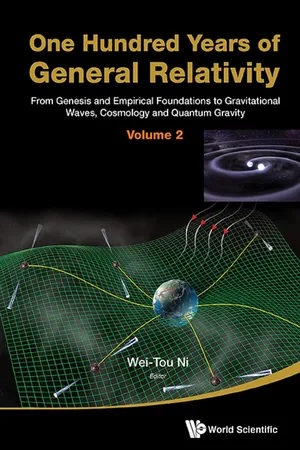
The aim of this two-volume title is to give a comprehensive review of one hundred years of development of general relativity and its scientific influences. This unique title provides a broad introduction and review to the fascinating and profound subject of general relativity, its historical development, its important theoretical consequences, gravitational wave detection and applications to astrophysics and cosmology. The series focuses on five aspects of the theory:Genesis, Solutions and EnergyEmpirical FoundationsGravitational WavesCosmologyQuantum GravityThe first three topics are covered in Volume 1 and the remaining two are covered in Volume 2. While this is a two-volume title, it is designed so that each volume can be a standalone reference volume for the related topic.
eBook - ePub
One Hundred Years of General Relativity
From Genesis and Empirical Foundations to Gravitational Waves, Cosmology and Quantum Gravity
- 636 pages
- English
- ePUB (mobile friendly)
- Available on iOS & Android
eBook - ePub
One Hundred Years of General Relativity
From Genesis and Empirical Foundations to Gravitational Waves, Cosmology and Quantum Gravity
About this book
Information
Topic
Ciencias físicasSubtopic
Astronomía y astrofísicaChapter 13
General relativity and cosmology
Martin Bucher†,‡ and Wei-Tou Ni§
†Laboratoire APC, Université Paris 7/CNRS,
Bâtiment Condorcet, Case 7020,
75205 Paris Cedex 13, France
[email protected]
Bâtiment Condorcet, Case 7020,
75205 Paris Cedex 13, France
[email protected]
‡Astrophysics and Cosmology Research Unit and
School of Mathematics, Statistics and Computer Science,
University of KwaZulu-Natal, Durban 4041, South Africa
School of Mathematics, Statistics and Computer Science,
University of KwaZulu-Natal, Durban 4041, South Africa
§Center for Gravitation and Cosmology,
Department of Physics, National Tsing Hua University,
Hsinchu, Taiwan 30013, Republic of China
[email protected]
Department of Physics, National Tsing Hua University,
Hsinchu, Taiwan 30013, Republic of China
[email protected]
This year marks the 100th anniversary of Einstein’s 1915 landmark paper “Die Feldgleichungen der Gravitation” in which the field equations of general relativity were correctly formulated for the first time, thus rendering general relativity a complete theory. Over the subsequent hundred years, physicists and astronomers have struggled with uncovering the consequences and applications of these equations. This paper, which was written as an introduction to six chapters dealing with the connection between general relativity and cosmology that will appear in the two-volume book One Hundred Years of General Relativity: From Genesis and Empirical Foundations to Gravitational Waves, Cosmology and Quantum Gravity, endeavors to provide a historical overview of the connection between general relativity and cosmology, two areas whose development has been closely intertwined.
Keywords: General relativity; cosmology; centennial connection.
PACS Number(s): 04, 98.80.−k
One hundred years ago, the best model of the universe summarizing the state of the observations at that time was the Kapteyn universe, which consists of a system of stars distributed more or less uniformly within a disk about 10 kpc in diameter and 2 kpc thick. In this model, the Sun is situated near the center of the disk. In 1917, Einstein1 proposed a static cosmological model based on the “cosmological principle,” a generalization of the Copernican principle postulating that the homogeneity and isotropy of space in the large should be extended to include the time dimension as well. Using distance determinations to about 100 globular clusters, Shapley in 1918 pushed back the boundaries of the measured universe and concluded that the Sun lies near the edge of this distribution. As a result of rapid improvements in astronomical observations, the size of our observed universe soon grew to extend almost to our causal horizon.
This next group of chapters comprising Part IV of GR100 book deals with Cosmology, applying Einstein’s theory of general relativity to the universe as a whole. Cosmology considers the universe on very large scales and evolving over very long times, comparable to the age of the universe. Cosmology today is often described as being a “precision” science and the insistence on this term reflects that cosmology had not always been seen as such. When Einstein formulated his general theory of relativity, little was known about the universe beyond our own galaxy, and although distant galaxies had been observed as “nebulous” unresolved spiral blotches, it was not at all clear that these “nebulae” consisted of numerous stars much like our own galaxy.
A glimpse of the state of affairs slightly after the formulation of general relativity may be gained by reading the written summaries2 of the “Great Debate” held at the Smithsonian institution in 1920, where Harlow Shapley and Heber Curtis sparred over the question of the “scale of the universe.” The former argued that the “nebulae” were simply clouds lying on the periphery of our own galaxy, whereas the latter maintained that the observations at the time suggested that the “nebulae” were distant “island universes” much like our own galaxy. A key observation that helped settle this question in favor of the latter point of view was the discovery by Edwin Hubble of Cepheid variable stars in the Andromeda galaxy, which established that Andromeda lies far beyond the confines of our own galaxy.
On the observational side, as telescopes and other observational techniques greatly improved, our view of the universe progressively expanded to greater and greater distances. Once it had been established that the universe was populated by galaxies of different sizes, a recurrent question became whether the universe was homogeneous and isotropic on the largest observable scales, and it is only recently that galaxy surveys sufficiently deep and with sufficient statistics became available to settle this question definitively. An excellent historical account of these early debates and their role of the development of modern cosmology can be found in Peebles’ 1980 book3 (see also Ref. 4).
The theory underlying the hot big bang model as we know it today was developed before the observational issues mentioned above had been settled. The geometry and time evolution of the universe as predicted by Einstein’s theory are given by what is now known as the Friedmann–Lemaître–Robertson–Walker (FLRW) model, which describes the solutions to Einstein’s field equations for a spatially homogeneous and isotropic universe whose scale factor varies with time. This solution to the Einstein field equations was first put forward by Alexander Friedmann in 19225,6 and later independently by Georges Lamaître7 (see also Ref. 8). Robertson9 and Walker10 subsequently showed that this was the only solution to the field equations consistent with spatial homogeneity and isotropy. As discussed above, in 1917 Einstein1 had put forth a theory of a static universe — a solution of the general relativity field equations that is not only homogeneous and isotropic in the three spatial dimensions but also homogeneo...
Table of contents
- Cover
- Halftitle
- Title
- Copyright
- Foreword
- Contents
- Color plates
- Part IV. Cosmology
- Part V. Quantum Gravity
- Subject Index
- Author Index
Trusted by 375,005 students
Access to over 1.5 million titles for a fair monthly price.
Study more efficiently using our study tools.
Frequently asked questions
Yes, you can cancel anytime from the Subscription tab in your account settings on the Perlego website. Your subscription will stay active until the end of your current billing period. Learn how to cancel your subscription
No, books cannot be downloaded as external files, such as PDFs, for use outside of Perlego. However, you can download books within the Perlego app for offline reading on mobile or tablet. Learn how to download books offline
Perlego offers two plans: Essential and Complete
- Essential is ideal for learners and professionals who enjoy exploring a wide range of subjects. Access the Essential Library with 800,000+ trusted titles and best-sellers across business, personal growth, and the humanities. Includes unlimited reading time and Standard Read Aloud voice.
- Complete: Perfect for advanced learners and researchers needing full, unrestricted access. Unlock 1.5M+ books across hundreds of subjects, including academic and specialized titles. The Complete Plan also includes advanced features like Premium Read Aloud and Research Assistant.
We are an online textbook subscription service, where you can get access to an entire online library for less than the price of a single book per month. With over 1.5 million books across 990+ topics, we’ve got you covered! Learn about our mission
Look out for the read-aloud symbol on your next book to see if you can listen to it. The read-aloud tool reads text aloud for you, highlighting the text as it is being read. You can pause it, speed it up and slow it down. Learn more about Read Aloud
Yes! You can use the Perlego app on both iOS and Android devices to read anytime, anywhere — even offline. Perfect for commutes or when you’re on the go.
Please note we cannot support devices running on iOS 13 and Android 7 or earlier. Learn more about using the app
Please note we cannot support devices running on iOS 13 and Android 7 or earlier. Learn more about using the app
Yes, you can access One Hundred Years of General Relativity by Wei-Tou Ni in PDF and/or ePUB format, as well as other popular books in Ciencias físicas & Astronomía y astrofísica. We have over 1.5 million books available in our catalogue for you to explore.