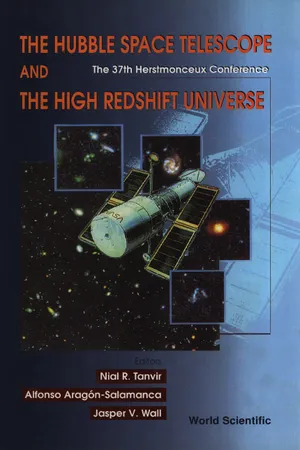
Since the successful refurbishment mission, the Hubble Space Telescope has made dramatic and exciting progress in unravelling the nature of sources at high redshift. The upcoming installation of the next generation of instruments will give further impetus to the field, particularly in the infrared spectral region.The proceedings of this landmark meeting review the results of the first three years of post-repair data, including the deepest astronomical images ever obtained: the Hubble Deep Field. This was the first presentation of these exciting results at a major international conference. The interface between HST and ground-based facilities and planned programmes with forthcoming HST instruments are also extensively discussed.
eBook - PDF
Hubble Space Telescope And The High Redshift Universe, The - Proceedings Of The 37th Herstmonceux Conference
Proceedings of the 37th Herstmonceux Conference
- 496 pages
- English
- PDF
- Available on iOS & Android
eBook - PDF
Hubble Space Telescope And The High Redshift Universe, The - Proceedings Of The 37th Herstmonceux Conference
Proceedings of the 37th Herstmonceux Conference
About this book
Trusted by 375,005 students
Access to over 1.5 million titles for a fair monthly price.
Study more efficiently using our study tools.
Information
Table of contents
- Contents
- Foreword
- Participants
- Introduction
- After Dinner Mince
- Section 1 Field Galaxy Evolution & The Hubble Deep Field
- Testing Galaxy Evolution Models with Deep HST Images
- Star-forming Galaxies at Redshifts z ~ 3
- Keck Spectroscopy of the Hubble Deep Field
- Galaxy Formation and Evolution: Outstanding Problems
- Quantitative Morphology of Faint Field Galaxies
- The Ultraviolet Morphology of Galaxies
- Constraints on Galaxy Formation from Deep Galaxy Redshift Surveys and Quasar Absorption Line Studies
- Galaxy Counts, Colours and Redshifts in The Hubble and Herschel Deep Fields
- HST Observations of Field Galaxies to z ~ 1: Clues to Galaxy Evolution
- Galaxies at z > 4.5
- Internal Kinematics of a Sample of Galaxies at z =0.25-0.45
- Old Galaxies at High Redshift
- The HST/LAS Campanas Extragalactic Background Light Program
- A VLA Survey of the Hubble Deep Field
- Consequences of a Non-detection of Forming Galaxies by an Infrared Survey
- The Universe at z > 5: When and How Did The 'Dark Age' End?
- The TTF Survey of Galaxy Populations
- The Absence of Diffuse Gas Around Leo I
- Candidate Primeval Galaxies in the Hubble Deep Field
- Extracting Physical Parameters of Galaxies from Broadband Photometry
- Star-forming Galaxies at Redshift z > 3 in the QSO BR 1202-07 Field
- Global Chemical Evolution
- Unresolved Blue Objects in the Hubble Deep Field: Bursting Dwarfs?
- Constraints on Galaxy Mergers at Moderate Redshifts from Their Observed Luminosity and Spatial Distribution Functions
- Linear Reconstruction of the Hubble Deep Field
- Detection of Hα in a z = 1 Star-forming Spiral Galaxy
- Optical Identifications of Faint Radio Sources
- The Redshift Distribution and Luminosity Functions of the Hubble Deep Field
- The Two-point Correlation Function And Morphological Segregation in the Optical Redshift Survey
- The Redshift Distribution in the Hubble Deepfield
- K-band Number Counts and the K-band Hubble Diagram: How to Disentangle Geometrical and Evolutionary Effects
- The Surface Brightnesses of Galaxies in the Hubble Deep Field
- The Delayed Formation of Dwarf Galaxies
- Keck Observations of Compact Galaxies in the HDF Flanking Fields
- Keck Spectra of Galaxies at Redshift z ~ 3 in The Hubble Deep Field
- On the Application of Evolutionary Synthesis of Stellar Population
- Photometric Analysis of the Hubble Deep Field
- Photometric Redshifts and the Luminosity Functions of Galaxies in the HDF
- Quantitative Morphology of Moderate Redshift Galaxies
- Automated Morphological Classification In Deep HST Fields: Rapidly and Passively Evolving Faint Galaxy Populations
- Constraint on Galaxy Evolution from Faint Observations
- A Deep 20 cm Radio Mosaic of the ESP Galaxy Redshift Survey
- Diagnostic Methods for Emission-line Galaxies in Redshift Surveys
- Photometric Redshifts in the Hubble Deep Field
- Optical Rotation Curves of Distant Galaxies: Kinematics and Evolution Out to z ~1
- Tests of Morphological Peculiarity Indices For Distant and Local Galaxies
- The Luminosity Function And Mean Density of Galaxies from the ESO Slice Project (ESP) Redshift Survey
- Section 2 Galaxies in Distant Clusters
- HST Observations of Distant Clusters: Implications for Galaxy Evolution
- The Evolution of Elliptical Galaxies in Clusters to z ~ 0.55 from the Hubble Space Telescope
- Surface-brightness Evolution of Cluster Galaxies
- The Fundamental Plane in Intermediate Redshift Clusters: the Evolution of M/L Ratio
- Clusters of Galaxies at z > 1
- Nature of E+A Galaxies in Distant Clusters
- The Butcher-Oemler Effect in the Clusters 0303+17 (z=0.42) and 1447+26 (z=0.37)
- High-resolution Rich Cluster Simulations
- The Properties of the Galaxy Distributions of Four Nearby Clusters
- Color Evolution in Moderate Redshift Galaxy Clusters
- The X-ray Structure of the Butcher-Oemler Clusters AC114 and AC118
- Infrared Imaging of a Galaxy Cluster at z=2.39
- Clusters of Galaxies at Intermediate Redshifts: A Sample Selected at Radio Wavelength
- Measuring the Evolution of Elliptical Galaxies with the Mgb-σ Test
- Section 3 Gravitational Lensing
- Gravitational Lensing and the Redshift Distribution of B> 25 Galaxies
- Weak Gravitational Lensing
- Probing Galaxy Halos in Cluster-lenses First Results for AC114
- Spectroscopic Verification of Redshifts Predicted by Gravitational Lensing
- Redshift Survey of Gravitational Arclets In Abell 2390
- Submillimetre-wave Gravitational Lensing
- Distribution of Mass and Light in High-Redshift E (lens) Galaxies
- Strong and Weak Gravitational Lensing in The Hubble Deep Field
- Galaxy-Galaxy Gravitational Lensing in The Hubble Deep Field
- Optical Einstein Rings as Probes of The High-Redshift Universe
- Keck Spectra of "lenses" in the Hubble Deep Field
- HST WFPC & Near-IR Study of the Cluster-lens Abell 2390
- The Giant Proto-galaxy cB58; an Artifact Of Gravitational Lensing?
- A Search for Optical Einstein Rings: Galaxy Selection
- Section 4 Quasar Absorbers
- Quasar Absorption Lines: Reflections and Views
- Quasars, Deuterium and Cosmology
- A Global Perspective on Star Formation
- The HST Quasar Absorption Line Survey and the Relationship of Absorbers to Large Scale Structures
- Chemical Evolution of Damped Lyman-Alpha Galaxies
- Seeing Double: Probing the Universe with Quasar Pairs
- Hierarchical Clustering and Metal Absorption from Galaxies in the Process of Formation
- A Search for QSO Absorption Lines from Nearby Starburst Galaxies
- Lyα Absorbers in the Nearby Universe
- Evolution of the Quasar Metallic Absorption Systems
- Properties of the Lyα Absorbing Systems at High-z
- GHRS Spectroscopy of Q0302-003
- Intergalactic Helium Absorption at High Redshift
- Constraints on the Spatial Uniformity of Lyman Alpha Forest Clouds at z = 1
- The UV Absorption Line Spectrum of HS 1307+4617
- Weak Line Analysis from Lyman-α Cloud Simulations - Profile Distortions from Internal Velocity Fields
- The Damped Lyα System at z=1.66 in front of the double QSO HE 1104-1805 AB
- Modeling the Evolution of the Lyman-Alpha Forest
- Measuring Ωbaryon and the Ionizing Radiation Background from the Opacity of the Lyman Alpha Forest
- Observing Galaxy Formation in Damped Lyα Absorbers
- Ionization of Metal Absorption Systems
- Massive Stars and the Ionising Background
- Nitrogen Abundances in DLA Systems and Chemical Evolution at High Redshift
- Section 5 Quasars & Active Galactic Nuclei
- The Redshift One 3CR Radio Galaxies
- UV and Ly-α Imaging of 4C41.17 at z = 3.800
- The Host Galaxies of Distant Radio Sources
- HST Imaging of High-Redshift Quasars
- Hubble Space Telescope Images of a Sample of Twenty Nearby Luminous Quasars
- Metal Abundances in High Redshift QSOS
- Shocks in Powerful Radio Galaxies
- The Kinematics and Morphology of the Peculiar Active Galaxy IRAS 04210+0400
- Simulated Spectra of Quasar Host Galaxies Observed by Subaru Coronagraphic Spectrometer
- The Space Density of Quasars at Z > 4 Using Their k-band Magnitudes
- The Spectrum of Monopolar Hydrogen
- Spectroscopic Observations of Quasar Candidates from a Deep Multicolor Survey
- High Resolution HST Imaging of BL Lacertae Objects
- Emission-line Properties of z>4 QSOs
- Faint AGN/STARBURST Nuclei in MDS Galaxies
- Radio Galaxies from the 5 Ghz MG Catalog
- MgII & FeII Emission of a High-z Quasar B1422+231
- Wavelength Dependent Polarimetry of High Redshift Quasars
- Section 6 The Future of HST & the Next Generation Space Telescopes
- The Future of HST and the Planning for a Next Generation Space Telescope
- Use of the Space Telescope Imaging Spectrograph (STIS) for Studying the High Redshift Universe
- The Scientific Capabilities of NICMOS
- Parallel Observations with STIS and NICMOS
- The Advanced Camera for the Hubble Space Telescope
- Gravitational Wave Detection: An Optical Approach
- Index of Authors
Frequently asked questions
Yes, you can cancel anytime from the Subscription tab in your account settings on the Perlego website. Your subscription will stay active until the end of your current billing period. Learn how to cancel your subscription
No, books cannot be downloaded as external files, such as PDFs, for use outside of Perlego. However, you can download books within the Perlego app for offline reading on mobile or tablet. Learn how to download books offline
Perlego offers two plans: Essential and Complete
- Essential is ideal for learners and professionals who enjoy exploring a wide range of subjects. Access the Essential Library with 800,000+ trusted titles and best-sellers across business, personal growth, and the humanities. Includes unlimited reading time and Standard Read Aloud voice.
- Complete: Perfect for advanced learners and researchers needing full, unrestricted access. Unlock 1.5M+ books across hundreds of subjects, including academic and specialized titles. The Complete Plan also includes advanced features like Premium Read Aloud and Research Assistant.
We are an online textbook subscription service, where you can get access to an entire online library for less than the price of a single book per month. With over 1.5 million books across 990+ topics, we’ve got you covered! Learn about our mission
Look out for the read-aloud symbol on your next book to see if you can listen to it. The read-aloud tool reads text aloud for you, highlighting the text as it is being read. You can pause it, speed it up and slow it down. Learn more about Read Aloud
Yes! You can use the Perlego app on both iOS and Android devices to read anytime, anywhere — even offline. Perfect for commutes or when you’re on the go.
Please note we cannot support devices running on iOS 13 and Android 7 or earlier. Learn more about using the app
Please note we cannot support devices running on iOS 13 and Android 7 or earlier. Learn more about using the app
Yes, you can access Hubble Space Telescope And The High Redshift Universe, The - Proceedings Of The 37th Herstmonceux Conference by Nial R Tanvir, Alfonso Aragon-salamanca, Jasper V Wall in PDF and/or ePUB format, as well as other popular books in Biological Sciences & Science General. We have over 1.5 million books available in our catalogue for you to explore.