![]()
Part 1
Background
![]()
CHAPTER 1
Lake Victoria
Lake Victoria (also known as Nam Lolwe in Luo; Nalubaale in Luganda; Nyanza in Kinyarwanda and some Bantu languages) is one of the African Great Lakes. With a surface area of 68800 km2 [13], it is the largest lake in Africa and the largest tropical lake in the world. Among freshwater lakes it is second largest; Lake Superior in the United States is the largest.
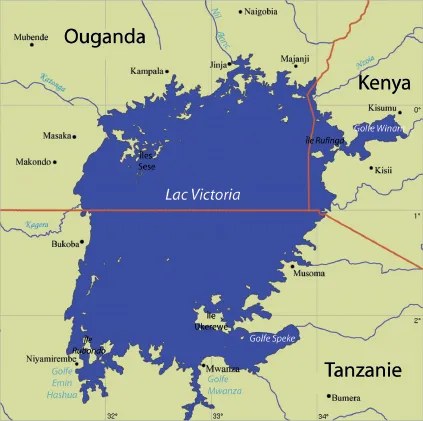
Three countries have shoreline on Lake Victoria: Kenya has about 6% of the shoreline, Uganda about 45% and Tanzania the remaining 49% [11]. The Lake is drained only by the Nile River and is filled by direct rainfall and a large number of streams. As such, its catchment is quite large and includes, in addition to Kenya, Uganda and Tanzania, the nations of Burundi and Rwanda.
In this chapter we give a necessarily very brief overview of various aspects of Lake Victoria and its surrounding areas, emphasizing those that are revisited and studied later in this book. There are many useful references for understanding what we describe below. We relied on the informative and thorough [2].
1.1Humans around Lake Victoria
The Baganda, the native people on the north of the lake, called the lake Nalubaale or “Home of the Spirit”. The Baganda are a Bantu ethnic group native to Buganda, a sub-national kingdom within Uganda. Traditionally composed of 52 tribes, the Baganda are the largest ethnic group in Uganda, comprising 16.9% of the population. The early history of the people is unclear but, since they are a Bantu-speaking people, it is most likely they originated as a people in Western Africa and moved to their current location during the great Bantu Migration [3].
Long before European exploration of the region, Arab traders were active along the East African coastline and along inland routes in search of gold, ivory, other precious commodities and slaves. An excellent map, known as the Al Idrisi map, after the calligrapher who developed it, dated from the 1160s, clearly depicts an accurate representation of Lake Victoria, and attributes it as the source of the Nile. The Arab name for the lake was Ukerewe.
The first European to see the lake was the British explorer John Hanning Speke in 1858. Hanning embarked on an expedition with Richard Francis Burton to discover the source of the Nile River. Due to its size, he believed the Lake was the source of the Nile River and so he named it after Queen Victoria. We pause to remark that this name has been a source of frustration to many people in the region and there has long been a general desire to change the name to something less “foreign” [2]. This movement has yet to succeed, in part, because of the diversity of the people who live near and around the Lake and the diversity of names that have been given to the Lake throughout history
FIGURE 1.1.A map of the Lake Victoria region. Taken from Wikipedia [5] under reuse license.
The population of the three countries that border the Lake in 2014 was estimated to be 135 million; in 2013 the basin was estimated to have a population of about 40 million. The largest ethnic groups dwelling around Lake Victoria are the Luo, Samia, and Suba people in Kenya; the Buganda and Busoga in Uganda; and the Luo, Kuria, Zanaki, Ruli, Haya, Hangaza, Nyambo, Subi, Sukuma, Kerewe, Jita, Kara, and Zinza people in Tanzania [2].
Currently the Basin supports one of the densest and poorest rural populations in the world. The growth rate for the whole Basin is estimated to be 3% per year and in towns and municipalities the rate is estimated to be 7% per year.
1.2Challenges facing Lake Victoria
In this book we attempt to model some of the challenges facing Lake Victoria and the people who live in its basin. The challenges that we will describe mathematically are environmental and medical in nature. In particular, we focus on the plants and fish that live in the Lake and the diseases faced by the people that live in the region. We now give some broader context to some of these topics.
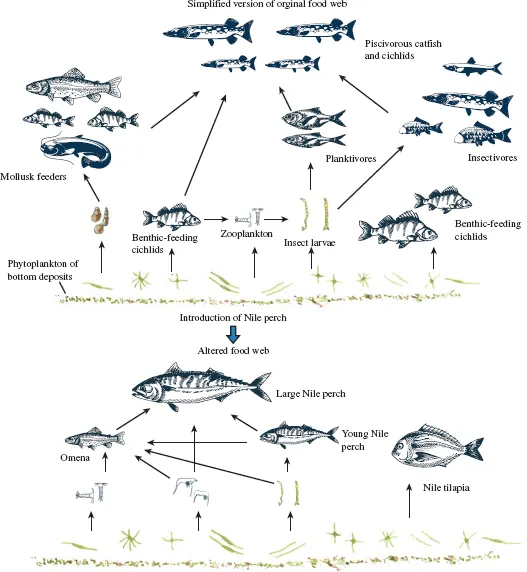
Water. The Lake provides a great deal of fresh water to the region. The water serves many purposes but the ones that are most relevant to us are that it provides drinking water for both humans and livestock and habitats for various types of flora and fauna. In the 1960s the ecosystem of Lake Victoria changed drastically with the introduction of the Nile perch. See Figure 1.2 for an illustration of the Lake’s food web before and after the introduction of this invasive fish.
FIGURE 1.2.A food web of the major organisms in Lake Victoria. The first picture illustrates the food web before the introduction of the invasive Nile Perch in the 1960s and the second picture illustrates the food web since the introduction of the fish.
The waters of the Lake have been damaged in recent years. Sewage comes from ever-growing cities, human and animal waste flows into the Lake, and water is being contaminated as a result of direct uses of the water (e.g., fishing and dams). The worsening condition of water has caused, among several negative consequences, increased health risks to humans from tropical diseases such as malaria, cholera, typhoid, dysentery, and bilharzia.
Fisheries. There is a big demand worldwide for the fish that inhabit the Lake: filleted Nile perch, tilapia and dagaa are the most commonly exported. The exportation of fish is a large part of the region’s economy. Fishing generates direct income for thousands of people and secondary income for thousands more. In addition, it provides protein-rich food for the people living in the Lake’s basin. Fish production in Lake Victoria had reached 400,000 to 500,000 metric tons in 2006, with Tanzania accounting for 40%, Uganda 25% and Kenya 35%.
In all cases, fishing continues largely at an artisanal level with very limited use of outboard engines. In recent years, though, large fishing companies have started appearing in the Lake and there is a fear that the smaller independent artisanal fishermen will be swallowed up by these larger companies. This is relevant to the questions we will ask later because the smaller independent local fisherman have accumulated wisdom and knowledge of the cycles of the fish populations. They know when to fish aggressively and when not. These large companies often have no interest in the conservation of the Lake’s fish biodiversity [2, p. 33].
In recent years there has been a protracted decline in the number of fish being caught on the Lake. It is likely that this trend is the result of over-fishing. The Nile perch catches have decreased in number and the individual fishes being caught have decreased in size. More young Nile perch are being removed from the Lake, reducing the population of that fish even more. Additionally, the Nile perch itself has no natural predators and so is proportionally overpopulating the Lake. This leads to them decimating the population of the fish they prey on; now that the Nile perch are being overfished, it is not clear how the populations of smaller fish will respond. The interconnectedness bet...