Engineering Optics with MATLAB®
eBook - ePub

Engineering Optics with MATLAB®

  1. 51 pages
  2. English
  3. ePUB (mobile friendly)
  4. Available on iOS & Android
eBook - ePub

Engineering Optics with MATLAB®

About this book

-->

This invaluable second edition provides more in-depth discussions and examples in various chapters. Based largely on the authors' own in-class lectures as well as research in the area, the comprehensive textbook serves two purposes. The first introduces some traditional topics such as matrix formalism of geometrical optics, wave propagation and diffraction, and some fundamental background on Fourier optics. The second presents the essentials of acousto-optics and electro-optics, and provides the students with experience in modeling the theory and applications using a commonly used software tool MATLAB ®.

-->

Request Inspection Copy

-->
Contents:

  • Geometrical Optics
  • Wave Propagation and Wave Optics
  • Beam Propagation in Inhomogeneous Media and in Kerr Media
  • Acousto-Optics
  • Electro-Optics

--> -->
Readership: First-year/senior graudate students in engineering and physics; scientists and engineers keen in the basics of acousto-optics and electro-optics.
-->Keywords:MATLAB;Optics;Acousto-Optics;Electro-Optics;Fourier OptisReview:0

Frequently asked questions

Yes, you can cancel anytime from the Subscription tab in your account settings on the Perlego website. Your subscription will stay active until the end of your current billing period. Learn how to cancel your subscription.
At the moment all of our mobile-responsive ePub books are available to download via the app. Most of our PDFs are also available to download and we're working on making the final remaining ones downloadable now. Learn more here.
Perlego offers two plans: Essential and Complete
  • Essential is ideal for learners and professionals who enjoy exploring a wide range of subjects. Access the Essential Library with 800,000+ trusted titles and best-sellers across business, personal growth, and the humanities. Includes unlimited reading time and Standard Read Aloud voice.
  • Complete: Perfect for advanced learners and researchers needing full, unrestricted access. Unlock 1.4M+ books across hundreds of subjects, including academic and specialized titles. The Complete Plan also includes advanced features like Premium Read Aloud and Research Assistant.
Both plans are available with monthly, semester, or annual billing cycles.
We are an online textbook subscription service, where you can get access to an entire online library for less than the price of a single book per month. With over 1 million books across 1000+ topics, we’ve got you covered! Learn more here.
Look out for the read-aloud symbol on your next book to see if you can listen to it. The read-aloud tool reads text aloud for you, highlighting the text as it is being read. You can pause it, speed it up and slow it down. Learn more here.
Yes! You can use the Perlego app on both iOS or Android devices to read anytime, anywhere — even offline. Perfect for commutes or when you’re on the go.
Please note we cannot support devices running on iOS 13 and Android 7 or earlier. Learn more about using the app.
Yes, you can access Engineering Optics with MATLAB® by Ting-Chung Poon, Taegeun Kim;;; in PDF and/or ePUB format, as well as other popular books in Technology & Engineering & Acoustical Engineering. We have over one million books available in our catalogue for you to explore.

Chapter 1

Geometrical Optics

When we consider optics, the first thing that comes to our minds is probably light. Light has a dual nature: light is particles (called photons) and light is waves. When a particle moves, it processes momentum, p. And when a wave propagates, it oscillates with a wavelength, λ. Indeed, the momentum and the wavelength is given by the de Broglie relation
image
where h ≈ 6.2 × 10⁻³⁴ Joule-second is Planck’s constant. Hence from the relation, we can state that every particle is a wave as well.
Each particle or photon is specified precisely by the frequency v and has an energy E given by
image
If the particle is traveling in free space or in vacuum, the frequency is ν = c/λ, where c is a constant approximately given by 3 × 10⁸m/s. The speed of light in a transparent linear, homogeneous and isotropic material, which we term u, is again a constant but less than c. This constant is a physical characteristic or signature of the material. The ratio c/u is called the refractive index, n, of the material.
In geometrical optics, we treat light as particles and the trajectory of these particles follows along paths that we call rays. We can describe an optical system consisting of elements such as mirrors and lenses by tracing the rays through the system.
Geometrical optics is a special case of wave or physical optics, which will be mainly our focus through the rest of this chapter. Indeed, by taking the limit in which the wavelength of light approaches zero in wave optics, we recover geometrical optics. In this limit, diffraction and the wave nature of light is absent.

1.1Fermat’s Principle

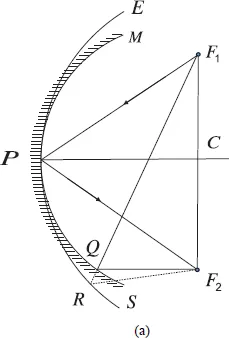
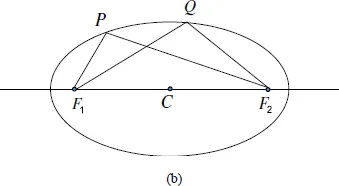
Geometrical optics starts from Fermat’s Principle. In fact, Fermat’s Principle is a concise statement that contains all the physical laws, such as the law of reflection and the law of refraction, in geometrical optics. Fermat’s principle states that the path of a light ray follows is an extremum in comparison with the nearby paths. The extremum may be a minimum, a maximum, or stationary with respect to variations in the ray path. However, it is usually a minimum. In Figs. 1.1a and b, we show the situations for a maximum and being stationary, respectively (the situation for a minimum will be discussed when we talk about the laws of reflection and refraction in the next section).
image
Fig. 1.1. (a) Spherical mirror.
image
Fig. 1.1. (b) Elliptical mirror.
In Fig. 1.1a, we inspect reflection from a spherical mirror (M). Point C represents the center of curvature of the spherical mirror and the distance CP is the radius of curvature of the mirror. We also construct an ellipse (E) passing through P with foci F1 and F2. Now consider light starting from F1 and reaching F2 upon reflection from P. The ray’s path length is F1P + PF2. Now consider another path length F1Q + F2Q, where Q is another point on the spherical mirror. Since QR + RF2 > QF2, where R is the point on the ellipse when we extend line F1Q to intercept the ellipse, F1Q + QR + RF2 > F1Q + QF2. So F1R + RF2 > F1Q + QF2. Now from the property of an ellipse, we know F1P + PF2 = F1R + RF2. Hence F1P + PF2 > F1Q + QF2, i.e., the ray of an actual ray path is always longer than a neighboring path and this case represents that the extremum is a maximum. Figure 1.1b shows an elliptical mirror on the top half of the ellipse with foci F1 and F2. We can see that any ray starting from one of the foci, say F1, after being reflected from any point (P or Q) on the mirror will pass through the other focus, F2. From the property of an ellipse, F1P + PF2 = F1Q + QF2. Hence all rays after reflection have the same path length and this is the case that that the extremum...
Table of contents

  1. Cover
  2. Halftitle
  3. Title
  4. Copyright
  5. Dedication
  6. Preface
  7. About the Authors
  8. Contents
  9. 1. Geometrical Optics
  10. 2. Wave Propagation and Wave Optics
  11. 3. Beam Propagation in Inhomogeneous Media and in Kerr Media
  12. 4. Acousto-Optics
  13. 5. Electro-Optics
  14. Index