![]()
Chapter 1
Land Transportation
1.Introduction
For the past five decades, Singapore has experienced unprecedented development in its transportation landscape. What was once a small colonial settlement with few public transport options has spawned into a first-world transport system with extensive railway lines, comprehensive bus services to complement the railways and an intricate web of public roads.
This was possible given the government’s huge emphasis on having an efficient transport system as a facilitator of economic growth and development, combined with the engineering ingenuity of her city planners.
Unlike many other major cities, Singapore does not have the luxury of having much land space and access to natural resources. Faced with such difficulties, city planners and engineers have had to explore innovative and ground-breaking ways to overcome these limitations.
1.1.Brief history in time
1970s
During the early years of independence, there only existed a small transportation unit within the Public Works Department (PWD) that oversaw the development of transportation in Singapore. Back then, public transportation was largely by bus and there were many bus services that worked independently from each other.
In a bid to improve the transportation landscape in Singapore to cope with her rapid population growth and economic needs, the government rolled out an enormous developmental project known as the State and City Planning (SCP) project. Work on SCP began in 1962 and took place over a span of 14 years, during which the master plan for land transport up to 1992 was developed.
1980s
One recommendation of the SCP was for railway systems to be constructed, with detailed studies to be conducted to assess when and how it should be deployed. The Comprehensive Traffic Study, completed in 1981, reported that an all-bus system would be insufficient to meet our future transportation demands. Plans for a Mass Rapid Transit (MRT) system were then introduced, and major expressways such as the Pan-Island Expressway (PIE) and Bukit Timah Expressway (BKE) were built to improve road connectivity within the island.
1990s
In the early 1990s, different aspects of land transportation were concurrently overseen by four separate organisations:
•Registry of Vehicles managed all road vehicles in Singapore;
•MRT Corporation developed and managed the MRT system;
•Road and Transportation Division of the PWD developed roads and managed traffic, and;
•Land Transportation Policy Division of the Ministry of Communications oversaw all land transport-related policies.
Eventually, the Land Transport Authority (LTA) was formed in 1995 as the single agency responsible for all matters related to land transportation, including policy-making, land transport planning, land transport development and related regulatory functions.
2000s to present
New additions and extensions were made to the MRT system network, such as the construction of the North–East Line, Sengkang–Punggol Light Rapid Transit (LRT), Changi Airport Extension and Circle Line. In addition, there were comprehensive reviews on land transport governance and operational policies to further improve the efficiency and sustainability of our land transportation system.
2.Engineers’ Contributions Towards Public Transport
Today, an approximate 7 million trips are made each day on the public transport system, with an average daily ridership of more than 4 million and 3 million for buses and rail transportation, respectively.
As the government tightly controls the percentage of private car ownership in land-scarce Singapore, the public transport network is designed to provide Singaporeans with a convenient, affordable, and efficient alternative. Throughout the years, engineers have contributed their expertise and effort to every part of the system, from the smallest components to the largest systems, from conception to fruition, toiling alongside their peers from various fields and domains to make life easier for all Singaporeans.
2.1.The MRT system
The first major revolution in Singapore’s public transport system since independence was the introduction of MRT, a comprehensive network of railway systems that was conceptualised under the SCP project. Being a small island nation, there was a need to balance the use of land for roads vis-à-vis the use for housing and other developments.
Despite opposition from some members of the government due to the heavy investments involved (estimated to be around S$5 billion), the independently-conducted Comprehensive Transport Study revealed that putting more buses on the roads would lower traffic efficiency and result in more congestion. The MRT network was hence necessary to solve the nation’s need for reliable public transportation as well as a sustainable solution to meet the increasing demands that accompany rapid population growth.
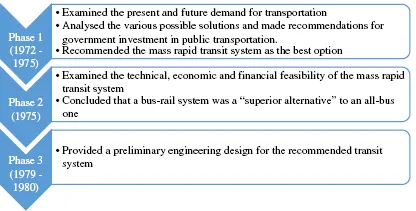
The construction of the then-largest public works project began in 1982 after three phases of study by the engineering and development team (Fig. 1). Priority was given to the North–South Line as it served central Singapore, which had a high demand for public transport.
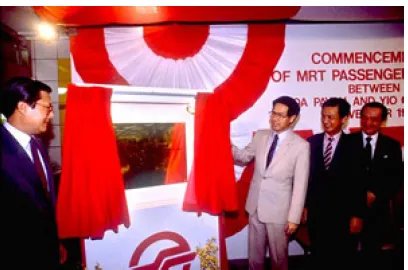
On 7 November 1987, the first 6 km of the North–South Line (NSL) from Yio Chu Kang to Toa Payoh was officially opened for operation. The opening ceremony was inaugurated by then-Minister of Communications, the late Mr Ong Teng Cheong.
Fig. 1. Timeline of the three phases of development of MRT.
Fig. 2. Mr Ong inaugurating the MRT system in the opening ceremony.
This was followed by the stations from Novena to Outram Park, opened by then-Deputy Prime Minister Goh Chok Tong.
With the opening of a further six stations from Tiong Bahru to Clementi on the East–West Line (EWL) with City Hall and Raffles Place becoming interchange stations between the two lines, the system was officially launched on 12 March 1988 by then-Prime Minister, the late Mr Lee Kuan Yew.
2.1.1.Expanding the rail network
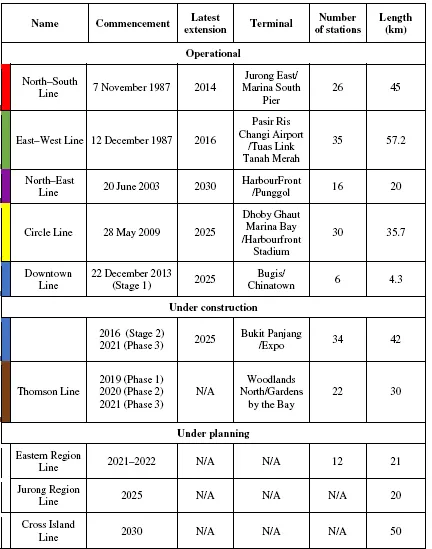
The NSL and EWL remained the backbone of Singapore’s rail network for some 15 years until 2003, when the North–East Line commenced operations. In addition to these three lines, LTA is in the midst of expanding the MRT network further, with plans to establish more than 360 km worth of railways by 2030. The expansion will increase the projected daily ridership to approximately 6 million and help to strengthen the case for public transport as a choice mode of travel (Figs. 3 and 4).
2.1.2.Integrated communication system
An essential component to the smooth operation of the MRT system is its Integrated Communication System (ICS). ICS provides the means for carrying voice and data for smooth transit operations daily. This complex electronic engineering project is one of the important parts of a railway transportation system and is often updated to include the latest innovations in railway communications. In the case of Singapore, ST Electronics undertook the milestone project of our MRT ICS from conceptual design to commissioning.
Fig. 3. Additional lines under MRT expansion.
A brief overview of the ICS follows:
1.Transmission System
An optical fibre transmission system, equipped with fail-safes, serves as the backbone for all major communications within the MRT network. A system is connected to this backbone for audio and data transmission.
2.Electronic Private Automatic Exchange (EPAX) System
A 10...