![]()
![]()
HOW DO I MONITOR
WITHOUT “SPYING”?:
A BALANCED APPROACH
When it comes to technology-parenting tip, a balanced approach includes fostering our tween/teen’s awareness of media and self, embracing quality media usage, selective single-tasking, carving out times and places to disconnect, and nurturing relationships and face-to-face conversation with our teens. Howard Gardner and Katie Davis15 point out that media and technology can be especially beneficial when used to form deeper relationships, to allow for creativity and exploration, and to explore identity.
There is a difference between spending time using technology to create digital worlds, hone photography or music skills, or engage in meaningful discussions of important issues and being a passive consumer of content or using technology as a way to distance oneself from social relationships. It is recommended that a healthy digital lifestyle could and should incorporate thoughtful and intentional uses of media and technology.
What is a balanced approach? It calls for prioritizing and focusing on a single task and it is not about multi-tasking with school work or on a social level. A balanced approach calls for essential face-to-face communication on top of online communication with one another to support rich social relationships, be it with our teens, between teens and among our friends, too. Parents can help teens to manage their media uses. As discussed earlier, being a role model of balanced media use ourselves as well as co-engaging media with our teens and having conversations about best media-related practices, strategies and ethical dilemmas with our teens set the relationship and tone right. Parents can also advise on setting limits and drawing up good use of time for what, where, when, why and how to use media. Once these are done, parents can then be their teens’ “media mentors”.
Additionally, parents would love to ensure that their tweens/teens are safe when engaging in online activities. There are no one-size-fits-all solutions as each and every child is unique and different. But, we can monitor without looking bad. Here are some tips:
1.Establish a relationship with your tween/teen that you are the one to go to with any inappropriate or unsettling problem that happens online with the Facebook posts, Twitter or Instagram account.
2.Have a good heart-to-heart chat as you would with a friend and discuss non-judgmentally about the apps and websites they love. Ask them to share with you what they enjoy doing and show them you are genuinely interested in what goes beyond their school activities and grades.
3.Establish a good rapport with your tweens/teens and encourage them to use social media responsibly especially when they are such sophisticated users of technology. Gently remind them of the dire consequences of irresponsible use as they have such unprecedented access to media and technology.
4.Be a good digital role model to your tween/teen. Let them see the right netiquette behavior. If possible, you may request for the password or to add him or her and their friends on Facebook if you wish to monitor their online accounts. But, that said, it is easier to be good friends with them and their friends and have them see the kind of behavior you would want them to look up to and emulate as good netiquette behavior.
Here are some good netiquette behaviors for your tween/teen:
•Do not flame or name others to shame them. Think of how you would feel if others were to do the same to you;
•Consider reading through once again and also getting a fellow friend or family member to read before posting. This is to ensure no negativity and rebound of feedback and response from others;
•Be sensitive and do not engage in discrimination — not being a racist or share crude jokes about other religions or cultural practices and beliefs;
•Check that tone used is not that of sarcasm as that would invite more sarcastic remarks and feedback. This would be a vicious cycle that is hard to break;
•Do not treat social media as an anger-venting machine to vent pent-up frustration at someone.
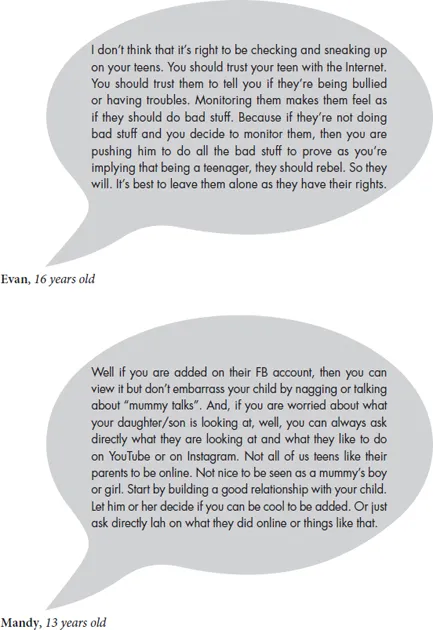
What some teens say:
![]()
SHOULD I FRIEND
OR UNFRIEND MY TWEENS/
TEENS ON SOCIAL MEDIA?
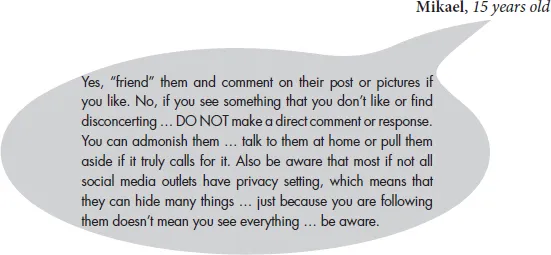
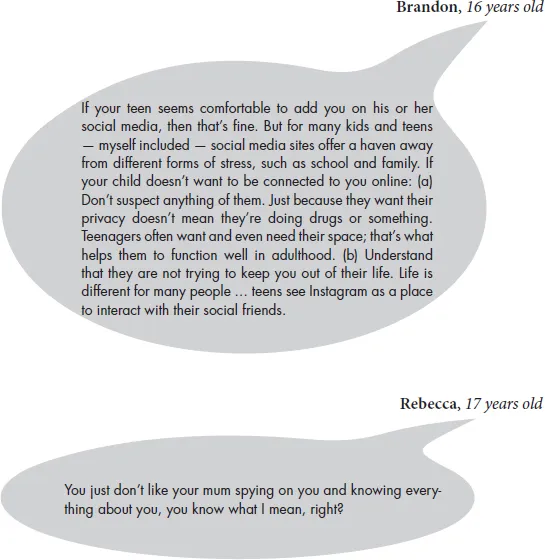
You can ask, but do not insist on it. Some families are connected on social media and it works for them. Some tweens/teens do not want their parents to see everything on their pages (and will block you from seeing things, which kind of defeats the purpose of being friends). Following your tweens/teens online opens up a can of worms, and you will have to figure out how to negotiate that new relationship. If your tweens/ teens let you friend or follow them, stay in the background (do not comment or “like” their posts unless they want you to), pick your battles, and make sure to address anything important face to face, not on their pages in front of their friends.
What some teens say:
Reassuringly, however, according to the interviews with the teens, the majority of teens, that is, 60% of them, said they would tell their parents if something online made them feel very uncomfortable especially the younger ones aged 11 to 14. Additionally, those who received pornographic junk emails, would either tell their friend or parent(s). In essence, some degree of mutual understanding and having good rapport/relationship and open communication are essential to enable such discussions.
![]()
WHAT APPS ARE GOOD
FOR LEARNING?: PROS
AND CONS?
With the proliferation of social media and Internet use, we are surrounded by all things techie and there is also no avoiding of these technologies in the learning context too. From guitar to grammar, teens can learn just about anything online through videos, tutorials, how-to’s, lectures, and all kinds of different apps. The types of online lessons vary in terms of quality and costs: Some are free; and some have to be paid upfront while some offer a dedicated time, teacher, and subject; and some are simply self-directed (available when you feel like learning something), and of course there are Google and wiki that tell and explain all the questions and definitions.
With the exception of formalized online school, online learning most often happens when tweens/teens search for something they want to learn and check on a video or a wiki to get more information. It is as simple as that to be part of a learning community. The following are some pros and cons of online learning:
Pros:
•It is driven by their passion;
•There is a wide variety of topics to learn from;
•It costs less than a real-world class;
•There is flexibility — at any time and at any place; short or long term;
•Online learning can bring out the best especially for socially shy teens;
•There is flexibility in learning progress — one can rewind, fast-forward, and pause at any pace.
Cons:
•The quality varies;
•The lack of human interaction could contribute to a feeling of isolation;
•Due to the Internet downtimes, it can lead to decreasing interest and quitting midway or a procrastination in learning;
•It needs discipline and it takes a lot to be a self-directed learner;
•There is potential for inappropriate content;
•There is tendency of distractions with all kinds of pop-up advertisements or side bars of comments and URL links.
Nevertheless, here are a few resources for online learning:
•For an unlimited and fun mathematics learning session, here are some websites — http://www.isingaporemath.com/, http://www.kungfu-math.com/, http://www.mceducation.us/math-buddies/ or http://www.thesingaporemaths.com/
•To learn about Literature online, try http://alap.bookcouncil.sg/
•For live online music lessons for all age groups and levels at “Live Music Tutor”, access at https://www.livemusictutor.com/
•To learn a language in three months, you can try being “Fluent in 3 Months” — http://www.fluentin3months.com/free-links/
•To learn useful skills on YouTube, try http://tubechum.com/7-useful-skills-you-can-learn-on-youtube/
•To explore various DIY skills — http://courses.diy.org/
•To view a site for teenage girls containing celebr...