ASEAN Environmental Law, Policy and Governance
eBook - ePub

ASEAN Environmental Law, Policy and Governance

Selected Documents(Volume I)

  1. 736 pages
  2. English
  3. ePUB (mobile friendly)
  4. Available on iOS & Android
eBook - ePub

ASEAN Environmental Law, Policy and Governance

Selected Documents(Volume I)

About this book

-->

News:
The 2012 Elizabeth Haub Prize for Environmental Law is awarded to Emeritus Professor Koh Kheng-Lian in recognition of her important and pioneering contributions to the development and evolution of environmental law in Singapore and in the whole ASEAN region. Her contributions have been particularly significant in the areas of capacity building and scholarship in the field of ASEAN environmental law.

ASEAN Environmental Law, Policy and Governance: Selected Documents, in two volumes, contains a judicious compilation of relevant ASEAN environmental instruments. These documents deal with ASEAN's progressive development of environmental law, policy and governance. Volume I consists of two parts. Part I — “Setting the Stage for ASEAN Environmental Cooperation, Harmonization and Integration” — contains documents which are directly or indirectly related to various aspects of the environment, including their potential impact. The scope of environmental law is wide-ranging and its interrelationship straddles the three mutually reinforcing ASEAN pillars, namely, security, economic and socio-cultural. Part II deals with the “General Legal Frameworks on the Environment”. It is subdivided into (A) Programmes, Strategies, Plans of Action and Blueprints; and (B) Declarations, Resolutions and Accord.

The forthcoming Volume II will deal with key sectoral areas including nature conservation and biodiversity; water resources management; animal and human health; climate change and energy; transboundary pollution; and disaster management and emergency response.

The book will be of interest to all ASEAN government officials, diplomats and its peoples; ASEAN dialogue partners; entities associated with ASEAN; comparative environmental lawyers and every ASEAN watcher.

-->

This book is also available as a set with ASEAN Environmental Law, Policy and Governance (Volume II).

Errata(s)
Errata (37 KB)

Foreword
Foreword (71 KB)

Sample Chapter(s)
Introduction (75 KB)
Chapter 1: The Asean Declaration (84 KB)


--> Contents:

  • Part I: Setting the Stage for ASEAN Environmental Cooperation, Harmonization and Integration:
    • 1967: The ASEAN Declaration (Bangkok Declaration)
    • 1976: Declaration of ASEAN Concord
    • 1976: Treaty of Amity and Cooperation in Southeast Asia, Protocol Amending the Treaty of Amity and Cooperation in Southeast Asia (1987), Second Protocol Amending the Treaty of Amity and Cooperation in Southeast Asia (1998)
    • 1987: Manila Declaration
    • 1994: Chairman's Statement on the First Meeting of the ASEAN Regional Forum (with Annex and Protocol)
    • 1995: Treaty on the Southeast Asia Nuclear Weapon-Free Zone
    • 1995: The ASEAN Regional Forum: A Concept Paper
    • 1997: ASEAN Vision 2020
    • 2001: Joint Communique of the 34th ASEAN Ministerial Meeting
    • 2002: Joint Statement of the Ministers Responsible for Environment of the Member States of ASEAN to the World Summit on Sustainable Development
    • 2003: Declaration of ASEAN Concord II (Bali Concord II)
    • 2005: Chairman's Statement of the 11th ASEAN Summit “One Vision, One Identity, One Community”
    • 2005: Kuala Lumpur Declaration on the East Asia Summit, Kuala Lumpur
    • 2005: Chairman's Statement of the First East Asia Summit, Kuala Lumpur
    • 2005: Kuala Lumpur Declaration on the Establishment of the ASEAN Charter
    • 2006: ASEAN Obtains Observer Status in the United Nations
    • 2006: Joint Communique of the 39th ASEAN Ministerial Meeting (AMM)
    • 2007: Chairperson's Statement of the 12th ASEAN Summit H. E. the President Gloria Macapagal-Arroyo
    • 2007: Cebu Declaration Towards One Caring and Sharing Community
    • 2007: Chairman's Statement of the 13th ASEAN Summit, “;One ASEAN at the Heart of Dynamic Asia&rdquo”
    • 2007: Joint Statement on the Commission for the Treaty on the Southeast Asia Nuclear Weapon-Free Zone
    • 2007: Cebu Declaration on the Acceleration of the Establishment of an ASEAN Community by 2015
    • 2007: ASEAN Convention on Counter Terrorism
    • 2007 Cebu Declaration on the Blueprint of the ASEAN Charter
    • 2007: Charter of the Association of Southeast Asian Nations (including Annexes 1–4)
    • 2007 Singapore Declaration on the ASEAN Charter
    • 2007: Chairman's Statement of the Second East Asia Summit
    • 2007: Chairman's Statement of the 3rd East Asia Summit
    • 2007: Declaration on the ASEAN Economic Community Blueprint
    • 2007: Joint Declaration of the ASEAN-EU Commemorative Summit
    • 2007: Joint Communique of the 40th ASEAN Ministerial Meeting (AMM) “One Caring and Sharing Community”
    • 2007: Chairman's Statement of the 6th ASEAN-India Summit
    • 2007: Chairman's Statement, 15th ASEAN Regional Forum
    • 2007: Co-Chairs' Statement of the 4th ASEAN-Canada Dialogue
    • 2007: Joint Declaration on ASEAN-Australia Comprehensive Partnership
    • 2007: Co-Chairs Statement ASEAN-Canada Dialogue
    • 2008: Singapore Declaration on the 15th ASEAN Regional Forum
    • 2008: Joint Communique of the 41st ASEAN Ministerial Meeting “One ASEAN at the Heart of Dynamic Asia”
    • 2008: Statement by Mr George Yeo, Minister for Foreign Affairs of Singapore and Chairman of the 41st ASEAN Standing Committee at the Closing Ceremony of the 41st ASEAN Ministerial Meeting and Handing Over of the ASEAN Standing Committee
    • 2008: ASEAN Charter Enters into Force Next Month
    • 2009: Chairman's Statement of the 14th ASEAN Summit “ASEAN Charter for ASEAN Peoples”
  • Part II: General Legal Frameworks On The Environment:
    • A. General: Programmes, Strategies, Plans of Action and Blueprints:
      • 1978–1982: ASEAN Sub-Regional Environment Programme, Phase I
      • 1983–1987: ASEAN Sub-Regional Environment Programme, Phase II
      • 1988–1992 ASEAN Sub-Regional Environment Programme, Phase III
      • 1994–1998: ASEAN Strategic Plan of Action on the Environment
      • 1999–2004 Hanoi Plan of Action
      • 2004–2010: Vientiane Action Programme (VAP)
      • 2004: ASEAN Security Community Plan of Action (with Annex)
      • 2005: The ASEAN Socio-Cultural Community (ASCC): Plan of Action (with Appendix A)
      • 2007–2010: 2nd ASEAN-Canada Joint Cooperation Work Plan
      • 2007–2017: ASEAN Plus Three Cooperation Work Plan
      • 2008: Plan of Action to Implement the Joint Declaration on ASEAN-Australia Comprehensive Partnership
      • 2009: Initiative for ASEAN Integration (IAI) Strategic Framework and IAI Work Plan 2 (2009–2015)
      • 2009: ASEAN Political-Security Community Blueprint
      • 2009: Blueprint for the ASEAN Socio-Cultural Community (2009–2019)
    • B. Declarations, Resolutions and Accord:
      • 1981: Manila Declaration on the ASEAN Environment
      • 1984: Bangkok Declaration on the ASEAN Environment
      • 1987: Jakarta Resolution on Sustainable Development
      • 1990: The Kuala Lumpur Accord on Environment and Development Issued by the ASEAN Ministers for the Environment at the Fourth ASEAN Ministers for the Environment Meeting
      • 1992: Singapore Resolution on Environment and Development (with Annex)
      • 1994: Bandar Seri Begawan Resolution on Environment and Development
      • 1997: Jakarta Declaration on Environment and Development
      • 2000: Kota Kinabalu Resolution on the Environment
      • 2003: Yangon Resolution on Sustainable Development
      • 2006: Cebu Resolution on Sustainable Development
      • 2007: ASEAN Declaration on Environmental Sustainability
      • 2009: Cha-am Hua Hin Declaration on the Roadmap for an ASEAN Community (2009–2015)
      • 2009: Joint Declaration on the Attainment of the Millennium Development Goals in ASEAN

-->
--> Readership: Researchers and teachers of environmental law in ASEAN; policy makers, administrators, diplomats, comparative environmental lawyers, think tanks, NGOs, civil societies and other stakeholders with an interest in the ASEAN region. -->
Keywords:Environmental Law in ASEAN;Environmental Policy in ASEAN;Environmental Governance in ASEAN;Selected ASEAN DocumentsReview: Key Features:

  • Represents the first up-to-date compilation of selected ASEAN documents on environmental law, policy and governance
  • A timely publication, given that the environment has taken centre stage not only in the ASEAN region but globally
  • Serves to enhance capacity building in environmental law in the ASEAN region
Frequently asked questions

Yes, you can cancel anytime from the Subscription tab in your account settings on the Perlego website. Your subscription will stay active until the end of your current billing period. Learn how to cancel your subscription.
No, books cannot be downloaded as external files, such as PDFs, for use outside of Perlego. However, you can download books within the Perlego app for offline reading on mobile or tablet. Learn more here.
Perlego offers two plans: Essential and Complete
  • Essential is ideal for learners and professionals who enjoy exploring a wide range of subjects. Access the Essential Library with 800,000+ trusted titles and best-sellers across business, personal growth, and the humanities. Includes unlimited reading time and Standard Read Aloud voice.
  • Complete: Perfect for advanced learners and researchers needing full, unrestricted access. Unlock 1.4M+ books across hundreds of subjects, including academic and specialized titles. The Complete Plan also includes advanced features like Premium Read Aloud and Research Assistant.
Both plans are available with monthly, semester, or annual billing cycles.
We are an online textbook subscription service, where you can get access to an entire online library for less than the price of a single book per month. With over 1 million books across 1000+ topics, we’ve got you covered! Learn more here.
Look out for the read-aloud symbol on your next book to see if you can listen to it. The read-aloud tool reads text aloud for you, highlighting the text as it is being read. You can pause it, speed it up and slow it down. Learn more here.
Yes! You can use the Perlego app on both iOS or Android devices to read anytime, anywhere — even offline. Perfect for commutes or when you’re on the go.
Please note we cannot support devices running on iOS 13 and Android 7 or earlier. Learn more about using the app.
Yes, you can access ASEAN Environmental Law, Policy and Governance by Kheng-Lian Koh in PDF and/or ePUB format, as well as other popular books in Law & Environmental Law. We have over one million books available in our catalogue for you to explore.

Information

Publisher
WSPC
Year
2009
eBook ISBN
9789814468459
Topic
Law
Index
Law
PART I
SETTING THE STAGE FOR ASEAN ENVIRONMENTAL COOPERATION, HARMONIZATION AND INTEGRATION

CHAPTER 1

THE ASEAN DECLARATION

(Bangkok Declaration)

Bangkok, 8 August 1967

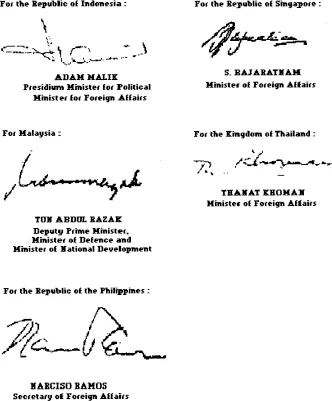
The Presidium Minister for Political Affairs/Minister for Foreign Affairs of Indonesia, the Deputy Prime Minister of Malaysia, the Secretary of Foreign Affairs of the Philippines, the Minister for Foreign Affairs of Singapore and the Minister of Foreign Affairs of Thailand:
MINDFUL of the existence of mutual interests and common problems among countries of South-East Asia and convinced of the need to strengthen further the existing bonds of regional solidarity and cooperation;
DESIRING to establish a firm foundation for common action to promote regional cooperation in South-East Asia in the spirit of equality and partnership and thereby contribute towards peace, progress and prosperity in the region;
CONSCIOUS that in an increasingly interdependent world, the cherished ideals of peace, freedom, social justice and economic well-being are best attained by fostering good understanding, good neighbourliness and meaningful cooperation among the countries of the region already bound together by ties of history and culture;
CONSIDERING that the countries of South-East Asia share a primary responsibility for strengthening the economic and social stability of the region and ensuring their peaceful and progressive national development, and that they are determined to ensure their stability and security from external interference in any form or manifestation in order to preserve their national identities in accordance with the ideals and aspirations of their peoples;
AFFIRMING that all foreign bases are temporary and remain only with the expressed concurrence of the countries concerned and are not intended to be used directly or indirectly to subvert the national independence and freedom of States in the area or prejudice the orderly processes of their national development;

DO HEREBY DECLARE:

FIRST, the establishment of an Association for Regional Cooperation among the countries of South-East Asia to be known as the Association of South-East Asian Nations (ASEAN).
SECOND, that the aims and purposes of the Association shall be:
1.To accelerate the economic growth, social progress and cultural development in the region through joint endeavours in the spirit of equality and partnership in order to strengthen the foundation for a prosperous and peaceful community of South-East Asian Nations;
2.To promote regional peace and stability through abiding respect for justice and the rule of law in the relationship among countries of the region and adherence to the principles the United Nations Charter;
3.To promote active collaboration and mutual assistance on matters of common interest in the economic, social, cultural, technical, scientific and administrative fields;
4.To provide assistance to each other in the form of training and research facilities in the educational, professional, technical and administrative spheres;
5.To collaborate more effectively for the greater utilization of their agriculture and industries, the expansion of their trade, including the study of the problems of international commodity trade, the improvement of their transportation and communications facilities and the raising of the living standards of their peoples;
6.To promote South-East Asian studies;
7.To maintain close and beneficial cooperation with existing international and regional organizations with similar aims and purposes, and explore all avenues for even closer cooperation among themselves.
THIRD, that to carry out these aims and purposes, the following machinery shall be established:
(a)Annual Meeting of Foreign Ministers, which shall be by rotation and referred to as ASEAN Ministerial Meeting. Special Meetings of Foreign Ministers may be convened as required.
(b)A Standing committee, under the chairmanship of the Foreign Minister of the host country or his representative and having as its members the accredited Ambassadors of the other member countries, to carry on the work of the Association in between Meetings of Foreign Ministers.
(c)Ad-Hoc Committees and Permanent Committees of specialists and officials on specific subjects.
(d)A National Secretariat in each member country to carry out the work of the Association on behalf of that country and to service the Annual or Special Meetings of Foreign Ministers, the Standing Committee and such other committees as may hereafter be established.
FOURTH, that the Association is open for participation to all States in the South-East Asian Region subscribing to the aforementioned aims, principles and purposes.
FIFTH, that the Association represents the collective will of the nations of South-East Asia to bind themselves together in friendship and cooperation and, through joint efforts and sacrifices, secure for their peoples and for posterity the blessings of peace, freedom and prosperity.
DONE in Bangkok on the Eighth Day of August in the Year One Thousand Nine Hundred and Sixty-Seven.
Source: http://www.aseansec.org/1212.htm
Accessed date: 26 January 2006
Publisher: ASEAN Secretariat
Country: Jakarta
Date of Publication: 2004

CHAPTER 2

DECLARATION OF ASEAN CONCORD

Indonesia, 24 February 1976

The President of the Republic of Indonesia, the Prime Minister of Malaysia, the President of the Republic of the Philippines, the Prime Minister of the Republic of Singapore and the Prime Minister of the Kingdom of Thailand:
REAFFIRM their commitment to the Declarations of Bandung, Bangkok and Kuala Lumpur, and the Charter of the United Nations;
ENDEAVOUR to promote peace, progress, prosperity and the welfare of the peoples of member states;
UNDERTAKE to consolidate the achievements of ASEAN and expand ASEAN cooperation in the economic, social, cultural and political fields;

DO HEREBY DECLARE:

ASEAN cooperation shall take into account, among others, the following objectives and principles in the pursuit of political stability:
1.The stability of each member state and of the ASEAN region is an essential contribution to international peace and security. Each member state resolves to eliminate threats posed by subversion to its stability, thus strengthening national and ASEAN resilience.
2.Member states, individually and collectively, shall take active steps for the early establishment of the Zone of Peace, Freedom and Neutrality.
3.The elimination of poverty, hunger, disease and illiteracy is a primary concern of member states. They shall therefore intensify cooperation in economic and social development, with particular emphasis on the promotion of social justice and on the improvement of the living standards of their peoples.
4.Natural disasters and other major calamities can retard the pace of development of member states. They shall extend, within their capabilities, assistance for relief of member states in distress.
5.Member states shall take cooperative action in their national and regional development programmes, utilizing as far as possible the resources available in the ASEAN region to broaden the complementarity of their respective economies.
6.Member states, in the spirit of ASEAN solidarity, shall rely exclusively on peaceful processes in the settlement of intra-regional differences.
7.Member states shall strive, individually and collectively, to create conditions conducive to the promotion of peaceful cooperation among the nations of Southeast Asia on the basis of mutual respect and mutual benefit.
8.Member states shall vigorously develop an awareness of regional identity and exert all efforts to create a strong ASEAN community, respected by all and respecting all nations on the basis of mutually advantageous relationships, and in accordance with the principles of self-determination, sovereign equality and non-interference in the internal affairs of nations.

AND DO HEREBY ADOPT

The following programme of action as a framework for ASEAN cooperation:

A. Political

1.Meeting of the Heads of Government of the member states as and when necessary.
2.Signing of the Treaty of Amity and Cooperation in Southeast Asia.
3.Settlement of intra-regional disputes by peaceful means as soon as possible.
4.Immediate consideration of initial steps towards recognition of and respect for the Zone of Peace, Freedom and Neutrality wherever possible.
5.Improvement of ASEAN machinery to strengthen political cooperation.
6.Study on how to develop judicial cooperation including the possibility of an ASEAN Extradition Treaty.
7.Strengthening of political solidarity by promoting the harmonization of views, coordinating position and, where possible and desirable, taking common actions.

B. Economic

1.Cooperation on Basic Commodities, particularly Food and Energy
i)Member states shall assist each other by according priority to the supply of the individual country’s needs in critical circumstances, and priority to the acquisition of exports from member states, in respect of basic commodities, particularly food and energy.
ii)Member states shall also intensify cooperation in the production of basic commodities particularly food and energy in the individual member states of the region.
2.Industrial Cooperation
i)Member states shall cooperate to establish large-scale ASEAN industrial plants particularly to meet regional requirements of essential commodities.
ii)Priority shall be given to projects which utilize the available materials in the member states, contribute to the increase of food production, increase foreign exchange earnings or save foreign exchange and create employment.
3.Cooperation in Trade
i)Member states shall cooperate in the fields of trade in order to promote development and growth of new production and trade and to improve the trade structures of individual states and among countries of ASEAN conducive to further development and to safeguard and increase their foreign exchange earnings and reserves.
ii)Member states shall progress towards the establishment of preferential trading arrangements as a long t...

Table of contents

  1. Cover Page
  2. Title
  3. Copyright
  4. Foreword
  5. Preface
  6. Contents
  7. Acknowledgments
  8. Introduction
  9. Part I: Setting the Stage For Asean Environmental Cooperation, Harmonization and Integration
  10. Part II: General Legal Frameworks On the Environment