Problems Book for Probabilistic Methods for the Theory of Structures with Complete Worked Through Solutions
eBook - ePub

Problems Book for Probabilistic Methods for the Theory of Structures with Complete Worked Through Solutions

  1. 252 pages
  2. English
  3. ePUB (mobile friendly)
  4. Available on iOS & Android
eBook - ePub

Problems Book for Probabilistic Methods for the Theory of Structures with Complete Worked Through Solutions

About this book

-->

The first edition of the combined monograph and textbook Probabilistic Methods in the Theory of Structures was published by Wiley-Interscience in 1983. 1n 1999, Dover Publications, Inc. published its second edition under shorter title Probabilistic Theory of Structures. Now, World Scientific has expanded into a 3rd edition to include Problems with Complete Worked-Through Solutions. This compendium of solutions was written in response to requests by numerous university educators around the world, since it has been adopted as a textbook or an additional reading for both undergraduate and graduate courses.

The author hopes that the availability of such solutions manual will further help to establish the courses dealing with probabilistic strength of materials, design, random buckling, and random vibration. The material itself was developed by author for various undergraduate and graduate courses, during years 1972–1989 at the Technion — Israel Institute of Technology, in Haifa, Israel, at the Delft University of Technology in the Netherlands, year 1979/80 at the University of Notre Dame, Indiana, USA and at the Florida Atlantic University, USA since 1994.

Already since mid-eighties, the author was informed that the book was adopted in numerous universities worldwide. Besides complete solutions to more than one hundred problems, additional material and remarks are included as Chapter 12, bringing some ideas down to the "number" level.

It is strongly hoped that this manual will promote much wider dissemination of probabilistic methods' courses at universities, and ultimately, in engineering practice worldwide.

-->

Request Inspection Copy

-->
Contents:

  • Preface
  • Probability Axioms
  • Single Random Variable
  • Examples of Probability Distribution and Density Functions. Functions of a Single Random Variable
  • Reliability of Structures Described by a Single Random Variable
  • Two or More Random Variables
  • Reliability of Structures Described by Several Random Variables
  • Elements of the Theory of Random Functions
  • Random Vibration of Discrete Systems
  • Random Vibration of Continuous Structures
  • Monte Carlo Method
  • Additional Example Problems and Comments

--> -->
Readership: Researchers and academics into the theory of structures.
-->Keywords:Mechanical Engineering;Theory of Structures;Strength of Materials;Random Vibrations;Random BucklingReview:0
Frequently asked questions

Yes, you can cancel anytime from the Subscription tab in your account settings on the Perlego website. Your subscription will stay active until the end of your current billing period. Learn how to cancel your subscription.
No, books cannot be downloaded as external files, such as PDFs, for use outside of Perlego. However, you can download books within the Perlego app for offline reading on mobile or tablet. Learn more here.
Perlego offers two plans: Essential and Complete
  • Essential is ideal for learners and professionals who enjoy exploring a wide range of subjects. Access the Essential Library with 800,000+ trusted titles and best-sellers across business, personal growth, and the humanities. Includes unlimited reading time and Standard Read Aloud voice.
  • Complete: Perfect for advanced learners and researchers needing full, unrestricted access. Unlock 1.4M+ books across hundreds of subjects, including academic and specialized titles. The Complete Plan also includes advanced features like Premium Read Aloud and Research Assistant.
Both plans are available with monthly, semester, or annual billing cycles.
We are an online textbook subscription service, where you can get access to an entire online library for less than the price of a single book per month. With over 1 million books across 1000+ topics, we’ve got you covered! Learn more here.
Look out for the read-aloud symbol on your next book to see if you can listen to it. The read-aloud tool reads text aloud for you, highlighting the text as it is being read. You can pause it, speed it up and slow it down. Learn more here.
Yes! You can use the Perlego app on both iOS or Android devices to read anytime, anywhere — even offline. Perfect for commutes or when you’re on the go.
Please note we cannot support devices running on iOS 13 and Android 7 or earlier. Learn more about using the app.
Yes, you can access Problems Book for Probabilistic Methods for the Theory of Structures with Complete Worked Through Solutions by Isaac Elishakoff in PDF and/or ePUB format, as well as other popular books in Tecnología e ingeniería & Ingeniería civil. We have over one million books available in our catalogue for you to explore.

Information

chapter 5
Reliability of Structures Described by a Single Random Variable
PROBLEM 5.1
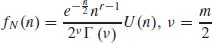
The loads acting on different machine components often have a chi-square distribution with m degrees of freedom, as was shown by Serensen and Bugloff,
image
Find the reliability of the bar under random tensile force. Table 5.1 contains the values of
image
where
image
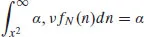
fN(n)dn = α for α = 0.995, 0.99, 0.975, 0.05, 0.025, 0.01, 0.005, and ν = 1, 2,..., 30 (see figure).
SOLUTION 5.1
Notes to lecturer
Note 1. The chi-square distributed random variable X with
image
is nondimensional. For it to represent an axial force, we will use the transformation
image
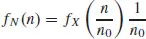
where n0 is a constant with the dimension of force. Then (see Equation 4.46)
image
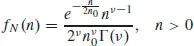
and
image
If N is measured in say, kilonewtons, we can choose n0 = 1 kN, which yields the formula given in the problem.
Note 2. This problem can be designed in three forms; σ ’s the first, the second or the third basic problem of the probabilistic strength of materials.
First problem: Lecturer should specify the cross-sectional area of the bar “a”, yield stress σY and required reliability r, as well as “m” the number of degrees of freedom of x2-distribution. The reliability is:
image
Table 5.1 lists the values of x2α, ν, so that
image
Now
image
Thus if σYa is chosen such that
image
we have
image
if 1 − α > r, the strength requirement is met, and violated otherwise.
For the numerical values to be valid, the following set of data should be given to student (as an example):
image
Then σYa = 6 · 5.695 = 34.17,
image
which means that strength requ...

Table of contents

  1. Cover
  2. Halftitle
  3. Title
  4. Copyright
  5. Contents
  6. Preface
  7. Chapter 2. Probability Axioms
  8. Chapter 3. Single Random Variable
  9. Chapter 4. Examples of Probability Distribution and Density Functions. Functions of a Single Random Variable
  10. Chapter 5. Reliability of Structures Described by a Single Random Variable
  11. Chapter 6. Two or More Random Variables
  12. Chapter 7. Reliability of Structures Described by Several Random Variables
  13. Chapter 8. Elements of the Theory of Random Functions
  14. Chapter 9. Random Vibration of Discrete Systems
  15. Chapter 10. Random Vibration of Continuous Structures
  16. Chapter 11. Monte Carlo Method
  17. Chapter 12. Additional Example Problems and Comments