Electromagnetic Analysis Using Transmission Line Variables
eBook - ePub

Electromagnetic Analysis Using Transmission Line Variables

  1. 652 pages
  2. English
  3. ePUB (mobile friendly)
  4. Available on iOS & Android
eBook - ePub

Electromagnetic Analysis Using Transmission Line Variables

About this book

-->

This latest edition continues the evolution toward the ultimate realization of a new technique for solving electromagnetic propagation problems. The technique combines the classical and intuitive use of a transmission line matrix (TLM) while striving for consistency with the guideposts demanded by quantum mechanics and the essential structure of electromagnetic theory. The matrix then becomes a useful vehicle for examining both coherent and noncoherent electromagnetic waves. The goal is a mathematical tool capable of solving problems related to the propagation of transient, high-speed, complex waveforms containing both symmetric and plane wave components. For such waveforms, standard classical electromagnetic theory is unable to provide a truly accurate solution since it does not properly account for the correlations among the various TLM cells. The correlations among neighboring TLM cells allow the cell waves to sense one another and to collectively participate as a coherent wave.

For arbitrary signals, e.g., complex, high speed, highly non-uniform signals, the correlation model must be placed on a firmer footing to insure the proper correlation strength based on the close adherence to quantum mechanical principles. The purpose of the Third Edition is to thereby improve the correlation model, and incorporate the model into the simulations. The simulation results thus obtained show great promise in describing the full range of electromagnetic phenomena. Wave divergence and diffraction simulations, employing both composite and shorter range correlation models, have been incorporated. The models employ correlation coefficients which may be linked with quantum mechanical parameters, thus providing a deeper understanding of coherent wave fronts.

--> Contents:

  • Introduction to Transmission Lines and Their Application to Electromagnetic Phenomena
  • Notation and Mapping of Physical Properties
  • Scattering Equations
  • Corrections for Plane Wave and Grid Anisotropy Effects
  • Boundary Conditions and Dispersion
  • Cell Discharge Properties and Integration of Transport Phenomena into the Transmission Line Matrix
  • Description of TLM Iteration (includes Correlation/Decorrelation Effects)
  • SPICE Solutions

-->
--> Readership: Graduate students and researchers in applied physics and electrical engineering. -->
Keywords:Transmission Line Matrix;Electromagnetics;Plane Waves;Wave Correlations;Light Activated Semiconductor;Picosecond Electromagnetic SignalsReview: Key Features:

  • Unique approach offering the potential for more accurate solutions compared to the standard approaches, especially in the treatment of fast risetime (picosecond) devices and transmitters, that may eventually supplant present standard electromagnetic methods, which have limited validity for very fast phenomena
  • Employs the TLM method, that is very intuitive and physically appealing; thus providing a convenient means for incorporating correlation/decorrelation effects, which are relatable to quantum mechanical parameters
  • Lists the Program Statements giving the reader a "hands-on" approach to the simulations, which will encourage readers to observe the effects of their own changes in the program
Frequently asked questions

Yes, you can cancel anytime from the Subscription tab in your account settings on the Perlego website. Your subscription will stay active until the end of your current billing period. Learn how to cancel your subscription.
No, books cannot be downloaded as external files, such as PDFs, for use outside of Perlego. However, you can download books within the Perlego app for offline reading on mobile or tablet. Learn more here.
Perlego offers two plans: Essential and Complete
  • Essential is ideal for learners and professionals who enjoy exploring a wide range of subjects. Access the Essential Library with 800,000+ trusted titles and best-sellers across business, personal growth, and the humanities. Includes unlimited reading time and Standard Read Aloud voice.
  • Complete: Perfect for advanced learners and researchers needing full, unrestricted access. Unlock 1.4M+ books across hundreds of subjects, including academic and specialized titles. The Complete Plan also includes advanced features like Premium Read Aloud and Research Assistant.
Both plans are available with monthly, semester, or annual billing cycles.
We are an online textbook subscription service, where you can get access to an entire online library for less than the price of a single book per month. With over 1 million books across 1000+ topics, we’ve got you covered! Learn more here.
Look out for the read-aloud symbol on your next book to see if you can listen to it. The read-aloud tool reads text aloud for you, highlighting the text as it is being read. You can pause it, speed it up and slow it down. Learn more here.
Yes! You can use the Perlego app on both iOS or Android devices to read anytime, anywhere — even offline. Perfect for commutes or when you’re on the go.
Please note we cannot support devices running on iOS 13 and Android 7 or earlier. Learn more about using the app.
Yes, you can access Electromagnetic Analysis Using Transmission Line Variables by Maurice Weiner in PDF and/or ePUB format, as well as other popular books in Physical Sciences & Condensed Matter. We have over one million books available in our catalogue for you to explore.

Information

Publisher
WSPC
Year
2017
eBook ISBN
9789813225053
1. Introduction to Transmission Lines and Their Application to Electromagnetic Phenomena
In recent years, an exciting new branch of research activity has emerged, dealing with extremely fast phenomena in semiconductors and gases. The introduction of high speed instrumentation and devices, with time scales often in the 1 to 1000 picosecond range, has prompted the investigation of a variety of fast phenomena, including the generation of electromagnetic pulses and light, photoconductivity, avalanching, scattering, fast recombination, and many other physical processes. The research has been driven by several applications [1], [2]. These include ultra-wideband imaging and radar, as well as ultra-wideband communications (thus avoiding the use of wires or optical fibers). In addition, the availability of new, high speed instrumentation has provided researchers with a valuable tool for learning the fundamental properties of materials. In all the aforementioned applications, a central feature is the generation of electromagnetic pulses with either a narrow pulse duration or a fast risetime (or both). The short time interval involved (in either the risetime or the pulse duration), insures that a wide frequency spectrum is produced, a property which is essential for the cited applications.
The understanding of fast phenomena and ultra-wideband electromagnetic sources is made more complicated by the very fast risetimes and by the fact that the wavelength of the signals being produced are often smaller or comparable to the characteristic length of the device or experimental configuration under study. As a result the use of lumped circuit variables is inappropriate and we must use either transmission line variables or Maxwell’s equations directly.
Electromagnetic signals with very short wavelength may be generated by a sudden transition in the conductivity of the medium. Suppose, for example, an electric field bias first is applied to the medium and that subsequently the conductivity of a portion of the medium is suddenly increased (for example, by photoconductivity or avalanching). The sudden change in conductivity will generate electromagnetic pulses with very steep risetimes, thus producing short wavelength signals. In cases where light is produced (for example, when carriers recombine), the wavelength naturally will be smaller or at least comparable to the device size. In any event, the analyses often used to describe devices and experimental configurations do not adequately address the short wavelength signals which are generated, and subsequently dispersed throughout the device and the surrounding space. One should not underestimate the importance of the electromagnetic energy dispersal (which includes light signals). Often the physics of underlying processes are misunderstood because the electromagnetic energy dispersal, which delivers the physics to the detector, is not taken into account properly, particularly for fast phenomena. It is hoped the ensuing discussion will help to correct this deficiency and lead to a better understanding of the dispersal of ultra-wideband electromagnetic signals and associated phenomena.
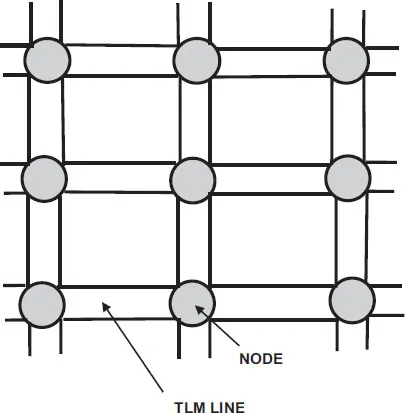
In this volume we endeavor to describe fast electromagnetic phenomena, relying on iterative rate equations which use transmission line matrix (TLM) variables. As with comparable numerical techniques, such as the finite difference method, the transmission line element must be made very small in order to attain accuracy, and solutions at a given time step depend on a knowledge of solutions at a previous time step. In terms of physical interpretation and intuition, however, the TLM method is far superior to that of finite differences or other similar numerical techniques. The physical appeal of the TLM method may be viewed, in a conceptual way, from the two basic components which comprise the TLM matrix: the transmission lines and the nodes which form the intersection of the lines, as noted in Fig. 1.1. TLM lines may be regarded as having spatial extent, whereas the nodes are regarded as infinitely small. With this model, we can conceptually separate the physics and energy dispersal of a given problem in electromagnetics. Using a simple picture, the nodes represent the physics, and the physical processes (such as conductivity changes) are mapped onto the nodes, which then control the flow of energy in the TLM lines. The TLM lines then are responsible for the energy distribution and storage. (However, as we shall see in later Chapters, the TLM lines are not entirely devoid of physics since the fields in these lines “interact” with one another, using quantum mechanical ideas, which affect propagation behavior).
image
FIG. 1.1 CONCEPTUAL VIEW OF TRANSMISSION LINE (TLM) MATRIX CONSISTING OF NODES AND TLM LINES. IN MOST CASES, THESE TWO COMPONENTS HAVE SEPARATE FUNCTIONS: THE TLM LINES DISTRIBUTE THE ELECTROMAGNETIC ENERGY AND THE NODES CONTROL THE PHYSICS.
Within the electrical engineering community the use of transmission line variables to treat one dimensional electromagnetic problems has gained in popularity over the years. As a result, a certain comfort level has been attained by engineers in the use of transmission line terminology. The carryover of the TLM description to two and three dimensional electromagnetic problems, however, has not received the same attention. This may not be surprising, since the 2D and 3D treatments are more complicated and the 1D must be augmented and revised to a considerable degree. For example, the boundary conditions at the nodes, for the 2D and 3D problems, result in more complicated scattering behavior. In addition the incorporation of concepts such as plane wave correlation and corrections for grid anisotropy, have not been applied to standard TLM theory, thus making the TLM approach, for 2D and 3D problems, less valuable. The necessary revisions for removing these defects, for 2D and 3D models, are described in detail in the ensuing Chapters. The revised theory retains the benefits of ease of interpretation in solving electromagnetic problems. If the required transmission line elements (and the associated nodes) are not too large in number, then certain classes of problems, such as one dimensional microwave transformers and non-uniform TLM lines, as wel...

Table of contents

  1. Cover
  2. Halftitle
  3. Title
  4. Copyright
  5. Dedication
  6. Preface
  7. Notes on Third Edition
  8. 1. Introduction to Transmission Lines and their Application to Electromagnetic Phenomena
  9. 2. Notation and Mapping of Physical Properties
  10. 3. Scattering Equations
  11. 4. Corrections for Plane Wave and Grid Anisotropy Effects
  12. 5. Boundary Conditions and Dispersion
  13. 6. Cell Discharge Properties and Integration of Transport Phenomena into the Transmission Line Matrix
  14. 7. Description of TLM Iteration
  15. 8. Spice Solutions
  16. Index
  17. About the Author