![]()
Chapter 1
The State Affairs of the Celestial Empire in the Late 19th Century
1.1China and the World in a Turbulent Era
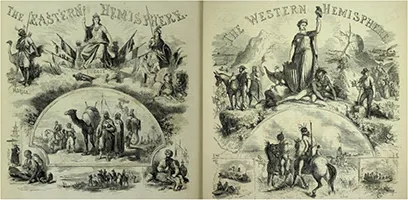
Eastern Hemisphere and Western Hemisphere. Ballou’s Pictorial, Dec. 29, 1855, pp. 408–409.
On December 29, 1855, Ballou’s Pictorial Drawing-Room Companion published a double-spread drawing by the renowned artist Hammatt Billings (1818–1874) of Boston, which fully reflects the global outlook of Americans in the mid-19th century. In the Western Hemisphere, the US naturally occupied a leading position with its alpine scenery, mighty river, and arduous pioneers. While the war with the natives was raging on, the Indian warrior had succumbed to the feet of the goddess of liberty and American bald eagle. Sitting at the center of the Eastern Hemisphere and flanked by a black warrior from Africa and an Arabic princess from Asia as her honor guards, Europe was engraved as an exquisite female sovereign, holding a scepter of world power while wearing the crown of civilization. The lower part of the artwork depicts the Crimean War, African camel, Asian elephant, an intoxicated Turk, and a snake charmer from India. A Chinese man with straw hat and bamboo umbrella in the lower left corner symbolizes the so-called Far East. The editor further commented: “Separated from its nearest point by a thousand leagues of ocean, we are apt to look on it less as an integral portion of the common heritage of humanity than as another world. It is, in common parlance, the old world — another planet, as it were. Its distance lends it that enchantment which belongs ever to the remote in space and time.”
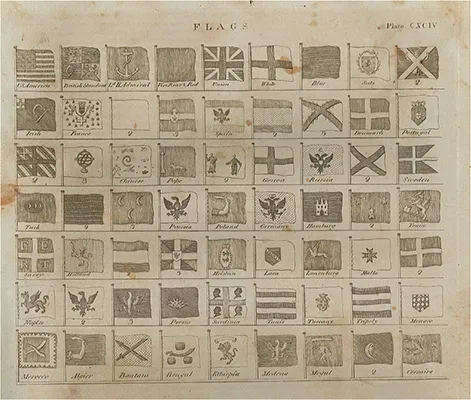
Flags. Dobson’s Encyclopædia (1798), Vol. 7, Plate 194, p. 292.
Dobson’s Encyclopædia was the first encyclopedia to be released in the newly independent United States of America. Published by Thomas Dobson (1751–1823) from 1789 to 1798, the 18-volume set was largely a reprint of the third edition of the Encyclopædia Britannica. Plate 194 in Volume 7 depicts the flags of the world powers then, including the USA, UK, France, Spain, Germany, Russia, and Turkey. However, the source and meaning of the Chinese flag pictured here were unclear. This not only reflects merely the lack of understanding of the mysterious Middle Kingdom by the Westerners, but at that time, there was no Chinese state flag in existence in the modern sense.
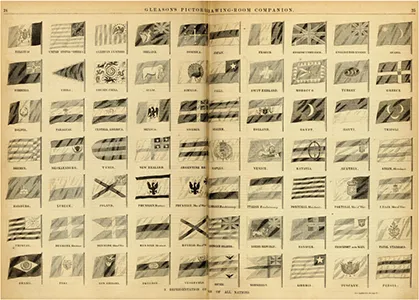
A Representation of Flags of All Nations. Gleason’s Pictorial Drawing-Room Companion, Jan. 14, 1854, pp. 24–25.
Half a century later, the Chinese flag had evolved into a pennant in the Gleason’s Pictorial Drawing-Room Companion, albeit still incomprehensible, with the banner of Cochin-china from southern Vietnam rendering flying dragons among others.
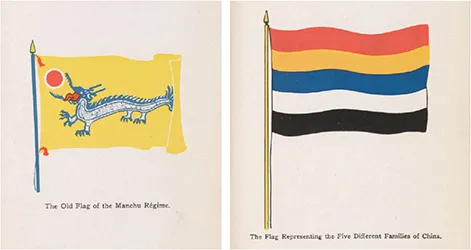
Old Flag of the Manchu Regime; The Flag Representing Five Different Families of China. Angel Island (1917), pp. 41, 49.
The first official flag of the Qing Empire appeared during the reign of Tongzhi (1861–1875). As the Chinese interior was further intruded after the Second Opium War (1856–1860), foreign warships began to sail along the Yangtze River. Since there was no uniform banner among the Chinese fleet, they were at a severe disadvantage when facing the Western naval powers. Therefore, Prince Gong suggested using the yellow dragon as the official banner for the Chinese state. However, no specifications were outlined. When Anson Burlingame led the first Chinese diplomatic mission to the US in 1868, the former American envoy to China made a number of triangle dragon banners and used them as the Chinese national flag. After the overthrow of the Qing Dynasty, the new Republic of China adopted a five-color flag representing the unification of the Chinese, Manchurian, Mongolian, Muslim, and Tibetan nationalities. Both flags pictured here appeared in Mary Bamford’s Angel Island published in 1917.
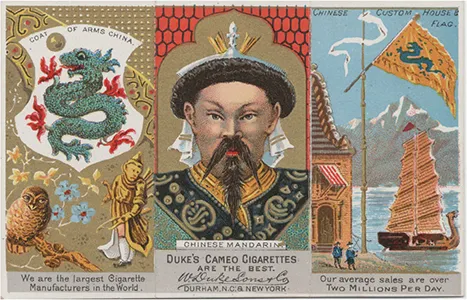
Coat of Arms China; Chinese Mandarin; Chinese Custom House & Flag. Duke’s Cameo Cigarettes (1888).
In 1888, W. Duke, Sons & Co., one of the world’s largest tobacco manufacturers, launched a series of cigarette labels that featured rulers, coats of arms, and flags of the top 50 nations in the world. The Chinese drawing includes a Manchu official with sinning facial hairs and almond-shaped eyes. On top of a bamboo pole in front of the Chinese Custom House is a yellow dragon flag, and plum flowers, owl, monkey king, and the coat of arms with blue dragon that are designed to enhance the alleged Chinese characteristics.
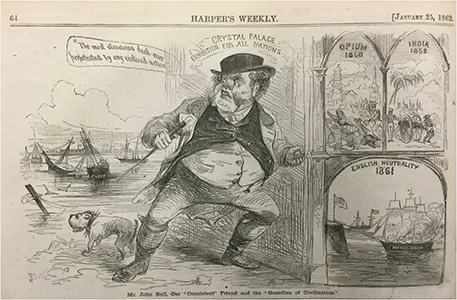
Mr. John Bull, Our “Consistent” Friend, and the “Guardian of the Civilization.” Harper’s Weekly, Jan. 25, 1862, p. 64.
A cartoon appeared on January 25, 1862 issue of the Harper’s Weekly, mocking the hypocrisy of the British colonialism. Around that time, the Crystal Palace was completed and the Great Exhibition was successfully held. The British regarded themselves as the leader of the industrialized nations. Although United Kingdom claimed to be neutral on the rampant American Civil War, it still condemned the blockade of Southern ports by the Union force as a barbaric act that civilized nations would despise. Enraged American media fought back, pointing out that the British had condoned the burning of American merchantman Harvey Birch in the English Channel by the Confederate steamer a year ago, and its triumph in the First Opium War of 1840 in China and the conquest of the Indian Rebellion in 1858 made Mr. John Bull “our ‘Consistent’ friend and the ‘Guardian of world Civilization.’”
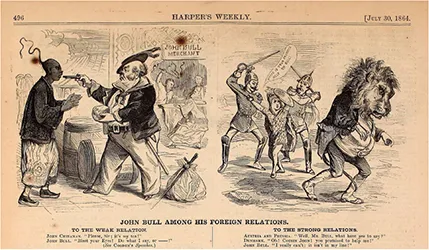
John Bull among His Foreign Relations. Harper’s Weekly, July 30, 1864, p. 796.
Harper’s Weekly in 1864 continued its sharp criticism on the bully nature and double standards of the British foreign policies in the mid-19th century. While John Bull was unwilling to face the intimidation of Austria and Prussia, he was eager to rob the pigtailed Chinese and pay with the opium only.
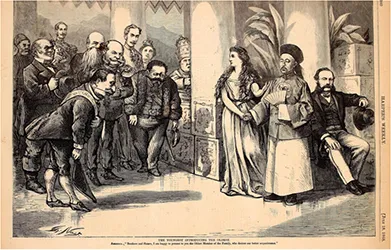
The Youngest Introduced the Oldest. Harper’s Weekly, July 18, 1868, p. 460.
The 1868 mission to visit Western countries was a milestone event in the history of China’s foreign relations, signified the imperial Qing court’s willingness to abandon its complacency position, and the beginning of active engagement with other countries in the world. On the occasion of the Burlingame mission to the US, Harper’s Weekly published a piece by the well-known American political cartoonist Thomas Nast, which featured Columbia holding Prince Gong and introducing China to the world powers. Pictured from left to right are: Sultan Abdulazis Oglu Mahmud II of Turkey; John Bull, representing Great Britain; Tsar Alexander II of Russia; Chancellor Otto Von Bismarck of Prussia; Emperor Napoleon III of...