![]()
PART 1
INTRODUCTION
![]()
Chapter 1
Research Theme, Framework and Summaries of Each Chapter
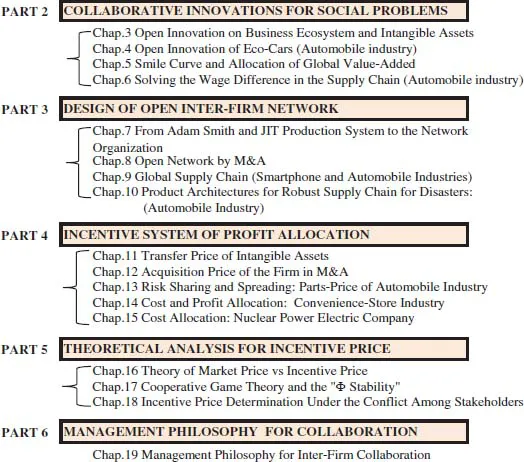
This chapter outlines the contents of each chapter of the book for the readers to first grasp the contents quickly. The readers can pick up and begin with any chapter that interests them, and then proceed to the nearby or other topics of this book gradually. Figure 1 below shows the framework of the book, and important keywords are emphasized in the titles of each chapter.
The author’s research methodology is to develop theoretical propositions through case studies of actual industrial companies, such as automobile, smartphone, semiconductor, convenience store and electricity companies, etc. Thus the following chapter titles show the names of industries which have been used for its case studies. However, the ultimate purpose of this research lies in finding the theoretical logic, especially in the various techniques of the incentive systems (i.e. incentive prices) for profit allocation, and the author has theorized the logic mainly based on basic cooperative game theory.
1.1.The Theme and Framework of This Book
Let the author explain the theme and framework of this book according to the Fig. 1. Chapters 1 and 2 form PART 1 and are omitted from Fig. 1. Therefore, the author describes the theme and framework of this book starting with PART 2.
Fig. 1Theme and Framework of the Book
Before entering the framework of the whole book, let me briefly point the research theme of this book by a simple message:
“‘Good-bye’ to the traditional market price for balancing the supply and demand and ’hello’ to the incentive price for motivating the collaborations in the inter-firm network”.
Although this message will be explained in Chapter 2, the in-depth reasons of the message will be given in Part 2 to Part 5. Let me further summarize the contents of Part 2 through Part 5, before we get into the outlines of each chapter contained in each Part.
1.1.1.Part 2: Collaborative Innovations
1.1.1.1Innovation by Inter-Firm Collaborations
The price theory in traditional economics states that the price of an individual merchandise will adjust according to the changes in supply or demand in a perfectly competitive market, and thus the demand and supply quantities will be automatically balanced. As a result, either the demand shortage or the supply shortage will disappear automatically. In other words, traditional price theory assumes that the market has a spontaneous resilience power toward the recovery of the balance in supply and demand.
In the real world, however, the supply and demand of a merchandise will seldom be balanced by the price mechanism. One of the biggest reasons lies in the existence of the product life-cycle. Any kind of merchandise, once introduced to the market, follows the process of its life-cycle through infancy, growth, maturity and final decline. Once the product reaches the declining stage, it can never be rejuvenated even though its price is reduced. Therefore, no merchandise has spontaneous resilience power for recovery of the supply and demand equilibrium, except the shrunken balance of both supply and demand that results in terrible financial performance.
However, if there is innovation which leads to development of a new attractive product that satisfies the customers, then new demand for this attractive customer-pleasing product will emerge and the company can recover the balance between total revenue and total expense, and the company can thereby continue to have better financial performance (profits) for survival. This is the business rejuvenation effect of innovation.
Here the innovation implies business regeneration (rejuvenation) or rebirth from the old product or business to a new product or business, which also realizes the economy of scope by the complementarity between the multi-brands of products, and also the risk-spreading by the diversification of multiple businesses or multiple brands of products. For providing the innovation, both the inter-firm network and the incentive price as mutually complementary instruments can be useful in the real world as shown in Fig. 1 and explained below.
1.1.1.2Inter-Firm Collaboration
Innovation in modern times can be achieved through open inter-firm collaborations. Such inter-firm collaborations are often done through the M&A (mergers and acquisitions) of other firms because the exploration of the new knowledge for innovation can be achieved through the interchange of the partners’ knowledge. This will create a synergy effect and achieve innovative ideas thanks to the mutual contribution to achieve the network’s common goal.
1.1.2.Part 3: Open Inter-Firm Network
The inter-firm network is a group of multiple allied firms which work as an organization. Further, the open inter-firm network always has access to the firms in the market, and the network organization can call on any firm in the market when necessary and also spin off the intra-firm whose performance ails. Thus the boundary of the open inter-firm network is vague.
1.1.3.Part 4: Incentive System by Profit Allocation
In Fig. 1, the term incentive payment, which is the payment for an inducement, will be made by the incentive system or profit allocation (or loss allocation in case of the common joint loss).
Now, as stated above, the price theory in traditional microeconomics has basically explained how the market price in a perfectly competitive market will balance the supply and demand. However, traditional economics has rarely studied another function of the price, which is for profit allocation (or incentive allocation) between firms in the network for the purpose of motivating inter-firm cooperation and performance evaluation. As a matter of fact, traditional economics lacks a way to handle such an incentive price.
That is why the author has decided to propose and explore a new concept of the price, for which the author has coined the term incentive price for motivation and performance evaluation. Both the profit allocation method and the amount of price itself are entirely different from the market price.
The incentive price will take into account not only the transfer price of the inter-divisional company, but also indicate the price of transferring the goods or services within the inter-firm network organization. Various fields of application for incentive prices will be shown below. The author’s main research interest in this book is to propose a variety of techniques (tools) for profit allocation using incentive prices.
1.1.4.Part 5: Theoretical Analysis of Incentive Prices
The theoretical background of various incentive prices raised in this book lies in the simple formula:
This formula represents the individual rationality condition of cooperative game theory which originated from the great research of mathematician John von Neumann and economist Osker Morgenstern, published as von Neumann and Morgenstern (1947).
1.2.Summaries of Each Chapter of This Book
1.2.1.Part 2: Collaborative Innovations for Social Problems
Outline of Chapter 3: Open Innovation Based on the Business Ecosystem and Intangible Assets
Under the current more severe globalized competition, when the product life-cycle enters the stage of decline, the company should seek innovation or business regeneration (i.e. evolution in biological terms) of the merchandise or business. This will be in turn achieved by open innovation, which is the innovation through alliances with other firms. Such an introduction of other firms will form an open inter-firm network organization, and the alliance will be motivated further by the incentives in the form of royalty allocation, which is the payment of the price for using the intellectual property such as patents originally owned by other firms.
Evolution in biology is based on replication of DNA which carries genetic information from the parents. Although the literal meaning of replication is a kind of exact copying, when making a replication, a tiny error or a mutation will sometimes appear over a longer period of time. The essence of evolution is such a creation of variants, out of which a new variant which is able to adapt to the new environment survives. A mutant or a new variant is similar to the new product developed through business innovation. In both worlds, the cooperation or symbiosis in the ecosystem is indispensable for evolution or innovation.
The business ecosystem is the set of mutually complementary firms. The business ecosystem is composed of the core company as a keystone and the many niche players who provide special technologies, though they co-exist in the same system.
Open innovation refers to the new value-creation activities that introduce external technologies and knowledge via alliances with out-side companies. Three types of alliances exist.
(1)The license-in of patents or know-how from other firms; i.e. the use of outside technology;
(2)The license-out of their own patents or know-how to the other firms; and
(3)The cross-license, a mixture of approaches (1) and (2) above.
The licenser firm of the intellectual property will often take a capital alliance with the licensee firm in the forms of a 100% subsidiary company, not less than 50% subsidiary, or a joint venture, or the less than 20% ownership, etc. Further the licenser might be a provider of the goods or services to the licensee firm. In these cases several forms of profit allocations will motivate the member firms of their organizational network. These types are:
(1)The royalty revenues as license fee.
(2)The revenue based on the transfer prices for the transfer of goods or facilities: Such relation is seen in the supply chain, which is in many cases a multi-national group companies.
(3)The dividends revenue: The licenser will also be a parent company and the licensee will be a subsidiary company. In such relation the licenser will receive the dividends and the licensee will pay the div...