Quantum Techniques in Stochastic Mechanics
eBook - ePub

Quantum Techniques in Stochastic Mechanics

  1. 276 pages
  2. English
  3. ePUB (mobile friendly)
  4. Available on iOS & Android
eBook - ePub

Quantum Techniques in Stochastic Mechanics

About this book

-->

We introduce the theory of chemical reaction networks and their relation to stochastic Petri nets — important ways of modeling population biology and many other fields. We explain how techniques from quantum mechanics can be used to study these models. This relies on a profound and still mysterious analogy between quantum theory and probability theory, which we explore in detail. We also give a tour of key results concerning chemical reaction networks and Petri nets.

--> Contents:

  • Stochastic Petri Nets
  • The Rate Equation
  • The Master Equation
  • Probabilities vs Amplitudes
  • Annihilation and Creation Operators
  • An Example from Population Biology
  • Feynman Diagrams
  • The Anderson–Craciun–Kurtz Theorem
  • An Example of the Anderson–Craciun–Kurtz Theorem
  • A Stochastic Version of Noether's Theorem
  • Quantum Mechanics vs Stochastic Mechanics
  • Noether's Theorem: Quantum vs Stochastic
  • Chemistry and the Desargues Graph
  • Graph Laplacians
  • Dirichlet Operators and Electrical Circuits
  • Perron–Frobenius Theory
  • The Deficiency Zero Theorem
  • Example of the Deficiency Zero Theorem
  • Example of the Anderson–Craciun–Kurtz Theorem
  • The Deficiency of a Reaction Network
  • Rewriting the Rate Equation
  • The Rate Equation and Markov Processes
  • Proof of the Deficiency Zero Theorem
  • Noether's Theorem for Dirichlet Operators
  • Computation and Petri Nets
  • Summary Table

-->
--> Readership: Graduate students and researchers in the field of quantum and mathematical physics. -->
Keywords:Stochastic;Quantum;Markov Process;Chemical Reaction Network;Petri NetReview: Key Features:

  • It's a light-hearted introduction to a deep analogy between probability theory and quantum theory
  • It explains how stochastic Petri nets can be used in modeling in biology, chemistry, and many other fields
  • It gives new proofs of some fundamental theorems about chemical reaction networks

Frequently asked questions

Yes, you can cancel anytime from the Subscription tab in your account settings on the Perlego website. Your subscription will stay active until the end of your current billing period. Learn how to cancel your subscription.
No, books cannot be downloaded as external files, such as PDFs, for use outside of Perlego. However, you can download books within the Perlego app for offline reading on mobile or tablet. Learn more here.
Perlego offers two plans: Essential and Complete
  • Essential is ideal for learners and professionals who enjoy exploring a wide range of subjects. Access the Essential Library with 800,000+ trusted titles and best-sellers across business, personal growth, and the humanities. Includes unlimited reading time and Standard Read Aloud voice.
  • Complete: Perfect for advanced learners and researchers needing full, unrestricted access. Unlock 1.4M+ books across hundreds of subjects, including academic and specialized titles. The Complete Plan also includes advanced features like Premium Read Aloud and Research Assistant.
Both plans are available with monthly, semester, or annual billing cycles.
We are an online textbook subscription service, where you can get access to an entire online library for less than the price of a single book per month. With over 1 million books across 1000+ topics, we’ve got you covered! Learn more here.
Look out for the read-aloud symbol on your next book to see if you can listen to it. The read-aloud tool reads text aloud for you, highlighting the text as it is being read. You can pause it, speed it up and slow it down. Learn more here.
Yes! You can use the Perlego app on both iOS or Android devices to read anytime, anywhere — even offline. Perfect for commutes or when you’re on the go.
Please note we cannot support devices running on iOS 13 and Android 7 or earlier. Learn more about using the app.
Yes, you can access Quantum Techniques in Stochastic Mechanics by John Baez, Jacob D Biamonte in PDF and/or ePUB format, as well as other popular books in Physical Sciences & Probability & Statistics. We have over one million books available in our catalogue for you to explore.

Information

Chapter 1 Stochastic Petri Nets

Stochastic Petri nets are one of many different diagrammatic languages people have evolved to study complex systems. We’ll see how they’re used in chemistry, molecular biology, population biology and queuing theory, which is roughly the science of waiting in line. Here’s an example of a Petri net taken from chemistry:
image
It shows some chemicals and some reactions involving these chemicals. To make it into a stochastic Petri net, we’d just label each reaction by a positive real number: the reaction rate constant, or Petri net for short.
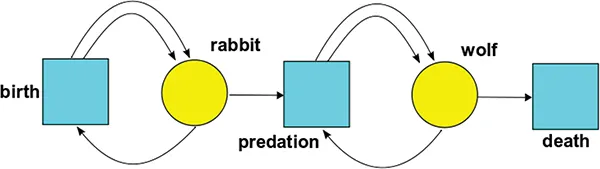
Chemists often call different kinds of chemicals ā€˜species’. In general, a Petri net will have a set of species, which we’ll draw as yellow circles, and a set of transitions, which we’ll draw as blue rectangles. Here’s a Petri net from population biology:
image
Now, instead of different chemicals, the species really are different species of animals! And instead of chemical reactions, the transitions are processes involving these species. This Petri net has two species: rabbit and wolf. It has three transitions:
• In birth, one rabbit comes in and two go out. This is a caricature of reality: these bunnies reproduce asexually, splitting in two like amoebas.
• In predation, one wolf and one rabbit come in and two wolves go out. This is a caricature of how predators need to eat prey to reproduce. Biologists might use ā€˜biomass’ to make this sort of idea more precise: a certain amount of mass will go from being rabbit to being wolf.
• In death, one wolf comes in and nothing goes out. Note that we’re pretending rabbits don’t die unless they’re eaten by wolves.
If we labelled each transition with a number called a rate constant, we’d have a ā€˜stochastic’ Petri net.
To make this Petri net more realistic, we’d have to make it more complicated. We’re trying to explain general ideas here, not realistic models of specific situations. Nonetheless, this Petri net already leads to an interesting model of population dynamics: a special case of the so-called ā€˜Lotka–Volterra predatorprey model’. We’ll see the details soon.
More to the point, this Petri net illustrates some possibilities that our previous example neglected. Every transition has some ā€˜input’ species and some ā€˜output’ species. But a species can show up more than once as the output (or input) of some transition. And as we see in ā€˜death’, we can have a transition with no outputs (or inputs) at all.
But let’s stop beating around the bush, and give you the formal definitions. They’re simple enough:
Definition 1. A Petri net consists of a set S of species and a set T of transitions, together with a function
image
saying how many copies of each species shows up as input for each transition, and a function
image
saying how many times it shows up as output.
Definition 2. A stochastic Petri net is a Petri net together with a function
image
giving a rate constant for each transition.
Starting from any stochastic Petri net, we can get two things. First:
• The master equation. This says how the probability that we have a given number of things of each species changes with time.
Since stochastic means ā€˜random’, the master equation is what gives stochastic Petri nets their name. The master equation is the main thing we’ll be talking about in future chapters. But not right away!
Why not?
In chemistry, we typically have a huge number of things of each species. For example, a gram of water contains about 3 Ɨ 1022 water molecules, and a smaller but still enormous number of hydroxide ions (OHāˆ’), hydronium ions (H3O+), and other scarier things. These things blunder around randomly, bump into each other, and sometimes react and turn into other things. There’s a stochastic Petri net describing all this, as we’ll eventually s...
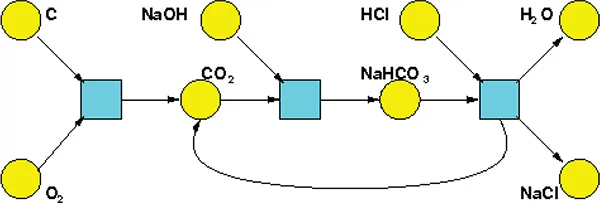
Table of contents

  1. Cover
  2. Halftitle
  3. Title
  4. Copyright
  5. Preface
  6. Contents
  7. 1 Stochastic Petri Nets
  8. 2 The Rate Equation
  9. 3 The Master Equation
  10. 4 Probabilities vs Amplitudes
  11. 5 Annihilation and Creation Operators
  12. 6 An Example from Population Biology
  13. 7 Feynman Diagrams
  14. 8 The Anderson–Craciun–Kurtz Theorem
  15. 9 An Example of the Anderson–Craciun–Kurtz Theorem
  16. 10 A Stochastic Version of Noether’s Theorem
  17. 11 Quantum Mechanics vs Stochastic Mechanics
  18. 12 Noether’s Theorem: Quantum vs Stochastic
  19. 13 Chemistry and the Desargues Graph
  20. 14 Graph Laplacians
  21. 15 Dirichlet Operators and Electrical Circuits
  22. 16 Perron–Frobenius Theory
  23. 17 The Deficiency Zero Theorem
  24. 18 Example of the Deficiency Zero Theorem
  25. 19 Example of the Anderson–Craciun–Kurtz Theorem
  26. 20 The Deficiency of a Reaction Network
  27. 21 Rewriting the Rate Equation
  28. 22 The Rate Equation and Markov Processes
  29. 23 Proof of the Deficiency Zero Theorem
  30. Further Directions
  31. 24 Noether’s Theorem for Dirichlet Operators
  32. 25 Computation and Petri Nets
  33. 26 Summary Table
  34. Index