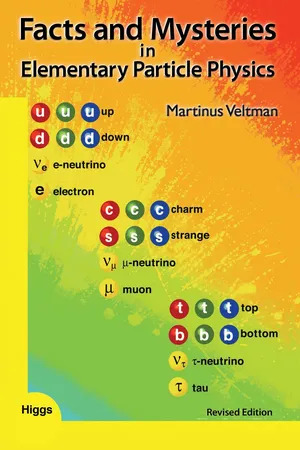
Facts and Mysteries in Elementary Particle Physics
eBook - ePub

Facts and Mysteries in Elementary Particle Physics

  1. 352 pages
  2. English
  3. ePUB (mobile friendly)
  4. Available on iOS & Android
eBook - ePub

Facts and Mysteries in Elementary Particle Physics

About this book

-->

This book provides a comprehensive overview of modern particle physics accessible to anyone with a true passion for wanting to know how the universe works. We are introduced to the known particles of the world we live in. An elegant explanation of quantum mechanics and relativity paves the way for an understanding of the laws that govern particle physics. These laws are put into action in the world of accelerators, colliders and detectors found at institutions such as CERN and Fermilab that are in the forefront of technical innovation. Real world and theory meet using Feynman diagrams to solve the problems of infinities and deduce the need for the Higgs boson.

Facts and Mysteries in Elementary Particle Physics offers an incredible insight from an eyewitness and participant in some of the greatest discoveries in 20th century science. From Einstein's theory of relativity to the spectacular discovery of the Higgs particle, this book will fascinate and educate anyone interested in the world of quarks, leptons and gauge theories.

This book also contains many thumbnail sketches of particle physics personalities, including contemporaries as seen through the eyes of the author. Illustrated with pictures, these candid sketches present rare, perceptive views of the characters that populate the field.

The Chapter on Particle Theory, in a pre-publication, was termed "superbly lucid" by David Miller in Nature (Vol. 396, 17 Dec. 1998, p. 642).

--> Contents:

  • Introduction
  • Preliminaries
  • The Standard Model
  • Quantum Mechanics. Mixing
  • Energy, Momentum and Mass-Shell
  • Detection
  • Accelerators and Storage Rings
  • The CERN Neutrino Experiment
  • The Particle Zoo
  • Particle Theory
  • Finding the Higgs
  • Quantum Chromodynamics
  • Epilogue
  • Addendum

-->
--> Readership: Students, lay people and anyone interested in the world of elementary particles. -->
Keywords:Particle Physics;Quantum Mechanics;Relativity;Quarks;Leptons;Gauge Theories;Higgs ParticleReview:

Reviews of the First Edition:

"Veltman's life spans the history of particle physics, from Antiparticles to Z bosons. So does his crystal clear book, which tells all you want to know about the strange sub-nuclear world and the stranger scientists that study it... a thrilling tale about the world's tiniest things."

Sheldon Glashow
Nobel laureate
Boston University

"I must congratulate you! The book you have written is truly a masterpiece. Not only have you explained the physics of the world of elementary particles to the young aspiring student, but you have made it available to the intelligent layman. On top of that you gave it the humanity it deserves; reading this book brought me back to the most exciting period of my life in which every day brought a new discovery and we all fought for recognition. I can truly say that there is no book like this."

Melvin Schwartz
Nobel laureate
Columbia University

"Veltman's... transparent explanations of the abstract theories of quantum mechanics and special relativity, his lucid accounts of esoteric subjects in particle physics, such as scaling, Higgs particle and renormalizability... are very impressive. The book will interest anyone who is interested in the view of the physical world held by contemporary fundamental physicists." T Y Cao
Boston University

"I greatly enjoyed finally reading a book that goes into the details I always wanted... Veltman has the courage to try a deeper level about what we understand and what is simply fact... Even if you have read books popularizing physics before, you have to read this one..."

CERN Courier

"Veltman seamlessly combines historical and thematic descriptions of particle physics, an approach that allows the reader to appreciate how experiment and theory interrelate... I found the book to be immensely entertaining, and I recommend it highly to anyone looking for insight into the nature of elementary particle physics."

American Scientist

"Veltman gives an excellent impression of how science works and how the desire to penetrate into the unknown is what fires the enthusiasm of scientists. He also manages to explain the most abstract intricacies of particle theory without using any mathematics whatsoever... I can fully recommend this book to students and interested lay readers, who will gain a fascinating insight into the sub-nuclear world — from a theoretical experimental and personal point of view."

Physics World

"... the wonderful feature of the book is that it should be extremely useful to almost anyone with an interest in this field, ranging from high school students and interested laypersons to physicists in other fields. Enthusiastically recommended as an addition to any library."

Choice

"Students and lay people will find Facts and Mysteries in Elementary Particle Physics superbly enlightening."

SirReadaLot.org

"... students and researchers in elementary particle physics should seriously consider having this book in their personal library, partly to be able to look at the many pictures and brief biographies of their favorite elementary particle physicists, and partly to learn Veltman's incisive thinking on obscure or unsettled areas in particle physics... there are plenty of popular books on dark matter, dark energy, black holes, and cosmology, but relatively few straightforward yet fascinating popular books on elementary particle physics, so in this sense Veltman's book is exactly what is needed." "

American Journal of Physics

"As an original scientist with decided views on matters, the author provides us with define insights into the conceptual framework and history of elementary particle physics. The whole book is enlivened by a series of vignettes, with photographs, including potted biographies of important participants in this part of science or personal recollections of them."

Mathematical Reviews
"It is perceptive, thought-provoking, and unfailingly original. The sketches of physicists who built our perception of the 'facts and mysteries' adds an appealing human touch."
Chris Quigg
Fermi National Accelerator Labs.

"All JSE readers, from the merely curious to the expert in the field of modern particle physics, should read this book... For the layman, the book is very readable and fascinating. For the expert, it is just plain fun... I would strongly recommend it to theoretical physics graduate students, even though they may be familiar with much of the content. Like other points of a fine jewel not seen before, Veltman's engaging style of writing will remind students of the value of looking at physics through another's well-trained eye. His style will also pique the layman's interest in the most fundamental discoveries of physics in modern times."

Journal of Scientific Exploration

"The author's clear and transparent explanation of the abstract theories of quantum mechanics and special relativity without using any mathematics makes the book very impressive... The book also contains many thumbnail sketches with pictures of particle physics personalities including contemporaries as seen through the eyes of the author."

Zentralblatt MATH
0

Frequently asked questions

Yes, you can cancel anytime from the Subscription tab in your account settings on the Perlego website. Your subscription will stay active until the end of your current billing period. Learn how to cancel your subscription.
At the moment all of our mobile-responsive ePub books are available to download via the app. Most of our PDFs are also available to download and we're working on making the final remaining ones downloadable now. Learn more here.
Perlego offers two plans: Essential and Complete
  • Essential is ideal for learners and professionals who enjoy exploring a wide range of subjects. Access the Essential Library with 800,000+ trusted titles and best-sellers across business, personal growth, and the humanities. Includes unlimited reading time and Standard Read Aloud voice.
  • Complete: Perfect for advanced learners and researchers needing full, unrestricted access. Unlock 1.4M+ books across hundreds of subjects, including academic and specialized titles. The Complete Plan also includes advanced features like Premium Read Aloud and Research Assistant.
Both plans are available with monthly, semester, or annual billing cycles.
We are an online textbook subscription service, where you can get access to an entire online library for less than the price of a single book per month. With over 1 million books across 1000+ topics, we’ve got you covered! Learn more here.
Look out for the read-aloud symbol on your next book to see if you can listen to it. The read-aloud tool reads text aloud for you, highlighting the text as it is being read. You can pause it, speed it up and slow it down. Learn more here.
Yes! You can use the Perlego app on both iOS or Android devices to read anytime, anywhere — even offline. Perfect for commutes or when you’re on the go.
Please note we cannot support devices running on iOS 13 and Android 7 or earlier. Learn more about using the app.
Yes, you can access Facts and Mysteries in Elementary Particle Physics by Martinus J G Veltman in PDF and/or ePUB format, as well as other popular books in Physical Sciences & Physics. We have over one million books available in our catalogue for you to explore.

Information

Publisher
WSPC
Year
2018
eBook ISBN
9789813237070
images
Preliminaries
1.1Atoms, Nuclei and Particles
All matter is made up from molecules, and molecules are bound states of atoms. For example, water consists of water molecules which are bound states of one oxygen atom and two hydrogen atoms. This state of affairs is reflected in the chemical formula H2O.
There are 92 different atoms seen in nature (element 43, technetium, is not occurring in nature, but it has been man-made). Atoms have a nucleus, and electrons are orbiting around these nuclei. The size of the atoms (the size of the outer orbit of the electrons) is of the order of 1 100 000 000 cm, the nucleus is 100 000 times smaller. The atom is therefore largely empty. Compare this: suppose the nucleus is something like a tennis ball (about 2.5 inch or 6.35 cm diameter). Then the first electron circles at a distance of about 6.35 km (4 miles). It was Rutherford, in 1911, who discovered that the atom was largely empty by shooting heavy particles (α particles,a emanating from certain radioactive materials) at nuclei. These relatively heavy particles ignored the very light circling electrons much like a billiard ball would not notice a speck of dust. So they scattered only on the nucleus. Without going into detail we may mention that Rutherford actually succeeded in estimating the size of the nucleus.
images
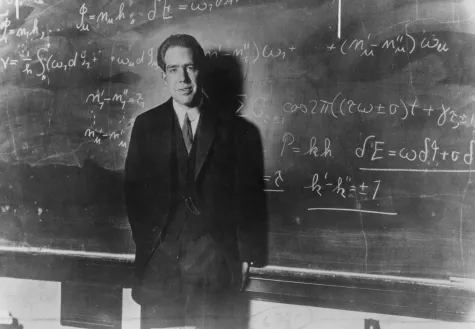
Niels Bohr (1885–1962). In 1913 he proposed the model of the atom, containing a nucleus orbited by electrons. In the period thereafter he was the key figure guiding the theoretical development of quantum mechanics. While Heisenberg, Schrödinger, Dirac and Born invented the actual mathematics, he took it upon himself to develop the physical interpretation of these new and spooky theories. Einstein never really accepted it and first raised objections at the Solvay conference of 1927. This led to the famous Bohr-Einstein discussions, where the final word (at the 1930 Solvay conference) was Bohr’s, answering Einstein using arguments from Einstein’s own theory of gravitation. Even if Bohr had the last word, Einstein never wavered from his point of view.
It should be mentioned that Bohr started his work leading to his model at Manchester, where Rutherford provided much inspiration. Bohr’s famous trilogy of 1913, explaining many facts, in particular certain spectral lines of hydrogen (Balmer series), may be considered (in Pais’ words) the first triumph of quantum dynamics.
Bohr received the Nobel prize in 1922. In World War II, after escaping from Denmark, he became involved in the American atomic bomb project. After the war he returned to Copenhagen, and as a towering figure in Europe he played an important role in the establishment of CERN, the European center for particle physics. In fact he became the first director of the theory division, in the beginning temporarily located at his institute in Copenhagen.
The nucleus contains protons and neutrons, also called nucleons. The proton has an electric charge of +1 (in units where the charge of the electron is −1), the neutron is electrically neutral. The number of electrons in an atom equals the number of protons in the nucleus, and consequently atoms are electrically neutral. It is possible to knock one or more electrons off an atom; the remainder is no longer electrically neutral, but has a positive charge as there is then an excess number of protons. Such an object is called an ion, and the process of knocking off one or more electrons is called ionization. For example electric discharges through the air do that, they ionize the air.
images
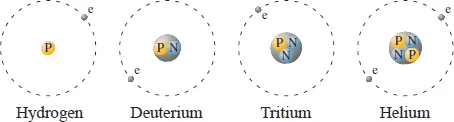
The lowest mass atom is the hydrogen atom, with one electron and a nucleus consisting of just one proton. The nucleus of heavy hydrogen, called deuterium, has an extra neutron. If both hydrogen atoms in a water molecule are deuterium atoms one speaks of “heavy water”. In natural water one finds that about 0.015% of the molecules contains one or two deuterium atoms. Tritium is hydrogen with two extra neutrons in the nucleus. Helium is the next element: two electrons and a nucleus containing four nucleons, i.e. two protons and two neutrons.
Nuclear physics is that branch of science that covers the study of atomic nuclei. The nuclear experimenter shoots electrons or other projectiles into various nuclei in order to find out what the precise structure of these nuclei is. He is not particularly interested in the structure of the proton or neutron, although nowadays the boundary between nuclear physics and elementary particle physics is becoming blurred.
images
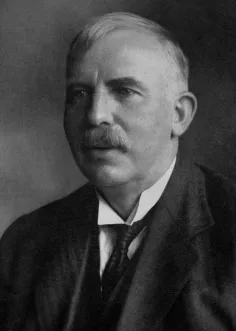
Ernest Rutherford (1871–1937). He investigated and classified radioactivity. He did the first experiments exhibiting the existence of a nucleus. In 1908 he received the Nobel prize in chemistry, “for his investigations into the disintegration of the elements, and the chemistry of radioactive substances”. He is surely one of the rarest breed of people, doing his most important work after he received the Nobel prize. I am referring here to the scattering of alpha particles from nuclei. The actual experiment was done by Geiger (of the Geiger-MĂŒller counter, actually initiated by Geiger and Rutherford) and Marsden, under the constant influence of Rutherford. Later, Rutherford produced the relevant theory, which is why we speak today of Rutherford scattering.
He was the first to understand that there is something peculiar about radioactivity. Anyone listening to a Geiger counter ticking near a radioactive source realizes that there is something random about those ticks. It is not like a clock. That was the first hint of the undeterministic behavior of particles. Rutherford noted that.
Rutherford was a native of New Zealand. He was knighted in 1914 and later became Lord Rutherford of Nelson. His importance goes beyond his own experimental work. His laboratory, the Cavendish (built by Maxwell), was a hotbed of excellent physicists. Chadwick discovered the neutron there (Nobel prize 1935) and in 1932 Cockcroft and Walton (Nobel prize 1951) constructed a 700 000 Volt generator to make the first proton accelerator. Some laboratory!
A proton, as we know now, contains three quarks. There are quite a number of different quarks, with names that somehow have come up through the years. There are “up quarks” (u) and “down quarks” (d), and each of them comes in three varieties, color coded red, green and blue (these are of course not real colors but just a way to differentiate between the quarks). Thus there is a red up quark, a green up quark and a blue up quark, and similarly for the down quark. A proton contains two up quarks and a down quark, all of different colors, while a neutron contains one up quark and two down quarks likewise of different colors. The figures show a symbolic representation of the up and down quarks, and the quark contents of the proton and the neutron. Just to avoid some confusion later on: sometimes we will indicate the color of a quark by a subscript, for example ur means a red up quark.
images
It should be emphasized that while we shall draw the quarks (as well as electrons and others) as little balls, it is by no means implied that they are actually something like that. For all we know they are point-like. No structure of a quark or electron has ever been observed. We just draw them this way so that we can insert some symbol, give them a rim in case of an antiparticle and color them.
Protons and neutrons can be observed as free particles. For example, if we strip the electron from a hydrogen atom we are left with a single proton. Single neutrons decay after a while (10 minutes on the average), but live long enough to be studied in detail. However, the quarks never occur singly. They are confined, bound within proton or neutron. The way these quarks are bound in a proton or neutron is quite complicated, and not fully understood. Statements about the quark content of proton and neutron must be taken with a grain of salt, because in addition there are particles called gluons which cause the binding and which are much more dominantly present than for example photons in an atom (the atomic binding is due to electromagnetic forces, thus photons do the job of binding the electrons to the nucleus). In fact, much of the mass of a proton or a neutron resides in the form of energy of the gluons, while the energy residing in the electric field of an atom is very small.
For all we know electrons and quarks are elementary particles, which means that in no experiment has there anything like a structure of these particles been seen. They appear point-like, unlike the proton, neutron, nucleus and atom that have sizes that can be measured. It is of course entirely possible that particles that are called elementary today shall turn out to be composite; let it be said though that they have been probed quite extensively. This book is about elementary particles. The aim is to know all about them, their properties and their interactions. The idea is that from this nuclear physics, atomic physics, chemistry, in fact the whole physical world derives. Thus particles and their interactions are the very fundamentals of nature. That is the view now. An elementary particle physicist studies primarily these elementary particles and not the larger structures such as protons, nuclei or atoms.
The main laboratory for elementary particle research in Europe has been named CERN (Conseil Européen pour la Recherche Nucléaire), now officially called European Organization for Nuclear Research and that is a misnomer. In principle no nuclear physics is being done there. In the days (1953) when CERN came into being nuclear physics was a magic word if money was needed! Strangely enough, the organization called Euratom is one that studies nuclei and not atoms. Another important laboratory is DESY, Deutsches Elektronen-Synchrotron, in Hamburg, Germany. In the US there are several laboratories, among them BNL, Brookhaven National Laboratory (at Long Island near New York), Fermi National Laboratory (near Chicago) and SLAC National Accelerator Laboratory (near San Francisco).
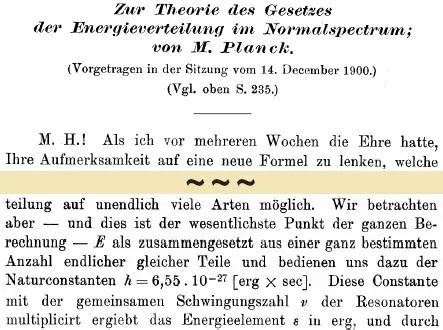
Papers that changed the world: Planck’s quantum.
Verh. Deutsch. Phys. Ges. 2 (1900) 237
images
In this paper Planck tries to find an explanation of his successful formula for blackbody radiation. He succeeds in that by introducing energy quanta and he proposes (in words) the equation ∈ = hΜ. The modern value for h is 6.626 × 10⁻²⁷. Surprisingly close!
On the theory of the Energy Distribution Law of the Normal Spectrum
by M. Planck
Gentlemen: when some weeks ago I had the honor to draw your attention to a new formula

images

 We consider however — this is the most essential point of the whole calculation — E to be composed of a well-defined number of equal parts and use thereto the constant of nature h = 6.55 × 10⁻²⁷ erg sec. This constant multiplied by the common frequency Μ of the resonators gives us an energy element ∈ in erg, and 

1.2Photons
In 1905 Einstein proposed the daring idea that electromagnetic radiation is quantized and appears only in precisely defined energy packets called photons. It took 15 years before this idea was accepted and initially it was considered by many as a bad mistake. But in 1921 Einstein was awarded the...

Table of contents

  1. Cover Page
  2. Title
  3. Copyright
  4. Table of Contents
  5. Introduction
  6. 1 Preliminaries
  7. 2 The Standard Model
  8. 3 Quantum Mechanics. Mixing
  9. 4 Energy, Momentum and Mass-Shell
  10. 5 Detection
  11. 6 Accelerators and Storage Rings
  12. 7 The CERN Neutrino Experiment
  13. 8 The Particle Zoo
  14. 9 Particle Theory
  15. 10 Finding the Higgs
  16. 11 Quantum Chromodynamics
  17. 12 Epilogue
  18. 13 Addendum
  19. Name Index
  20. Subject Index
  21. Photo Credits