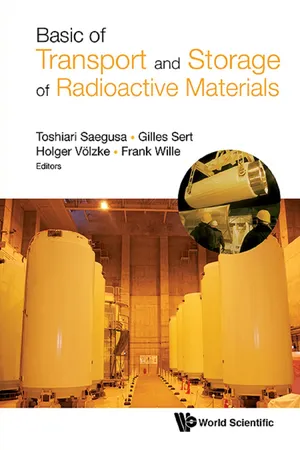
Basic of Transport and Storage of Radioactive Materials
eBook - ePub

Basic of Transport and Storage of Radioactive Materials

  1. 400 pages
  2. English
  3. ePUB (mobile friendly)
  4. Available on iOS & Android
eBook - ePub

Basic of Transport and Storage of Radioactive Materials

About this book

-->

Safe and secure transport and storage of radioactive materials are essential for sustainable nuclear fuel cycle. The basic technologies are matured, but they have been progressively developed to make transport and storage safer and more secure. Safe and secure culture that encourages a questioning and learning attitude and that discourages complacency should be fostered and maintained. This book provides current basis of safe and secure transport and storage so that those technologies can be readily traced, improved, or modified, if necessary, for and by the future generations.

This book overviews current available information in the literature. It also covers advanced technology on similar subjects in the literature. On top of that, new and valuable subjects are introduced for readers to grasp the wide spectrum of the safe and secure transport and storage technology. The contents are arranged and divided into three sections, I: Safety of Transport, II: Safety of Storage, III: Security of Transport and Storage.

--> Contents:

    • Introduction (T Saegusa)
  • Transport:
    • Safety of Transport (G Sert and K Sorenson)
    • Performance of UF 6 Packages Under Water Immersion (C Itoh and T Saegusa)
    • Performance of UF 6 Packages Under Fire Accident Conditions (G Sert, K Shirai and M Wataru)
    • Radiological and Toxic Impacts and Preparedness for Transport Accidents Involving Release of UF 6 (G Sert)
    • Performance of Packages with Transport Frame Under Drop Accidents (C Itoh and T Saegusa)
    • Internal Cask Content Collision During Drop Tests (V Ballheimer, T Quercetti and F Wille)
    • Codification of Ductile Cast Iron Cask (T Saegusa and T Arai)
    • SNF and HLW Package Assessment Under Fire Impac (G Sert and B Eckert)
    • Performance of SNF and HLW Packages Under Immersion Accident (C Itoh and T Saegusa)
    • Aging Management for Transport (Post-Storage Transport of Dual Purpose Package for Spent Fuel) (T Saegusa Chapte)
    • Probabilistic Risk Assessment of Transport of Spent Nuclear Fuel (D J Ammerman)
    • Internal Pressure Build-up of Waste Packages with Wet Contents Under Fire Impact (M Nehrig and F Wille)
    • Radiological Impact of Sea Transport Accident (D Tsumune)
    • Design Loads and Allowable Stresses in Package Attachment Points (G Sert and M Moutarde)
    • Experience Feedback for Assessment of Transport Package Design Safety Reports (G Sert and M-T Caillard-Lizot)
  • Security of Transport and Storage:
    • Security of Transport and Storage (M Hirose, O Loiseau and G Sert)
    • Enhancement of Physical Protection Measures Reflecting the Accident of Fukushima Daiichi NPP and INFCIRC/225/Revision 5 (T Iida, K Tanuma, K Ochiai and T Yamaguchi)
  • Safety of Storage:
    • Safety of Storage (T Saegusa)
    • Long-term Metal Seal Performance (H Völzke and D Wolff)
    • Aging Management Program for Spent Fuel Storage (T Saegusa)
    • Chloride Induced Stress Corrosion Cracking (M Wataru, K Shirai, J Tani, M Goto and T Saegusa)
    • Advanced Monitoring of Containment of Canister (H Takeda)
    • Probabilistic Risk Assessment of Spent Nuclear Fuel Storage (G Bjorkman and T Saegusa)

-->
--> Readership: Advanced graduate students and researchers in the field of nuclear engineering and nuclear waste management. -->
Keywords:Transportation;Storage;Security;Radioactive Material;Technical Basis;Package;CaskReview: Key Features:

  • This book was written by international experts to provide most advanced technologies with understandable contents for readers
  • This book describes security and safety of transport and storage, which are rarely discussed and written in the same book
  • This book covers existing literature in the beginning and provides new and advanced information so that readers are introduced to wide spectrum of the technologies

Frequently asked questions

Yes, you can cancel anytime from the Subscription tab in your account settings on the Perlego website. Your subscription will stay active until the end of your current billing period. Learn how to cancel your subscription.
No, books cannot be downloaded as external files, such as PDFs, for use outside of Perlego. However, you can download books within the Perlego app for offline reading on mobile or tablet. Learn more here.
Perlego offers two plans: Essential and Complete
  • Essential is ideal for learners and professionals who enjoy exploring a wide range of subjects. Access the Essential Library with 800,000+ trusted titles and best-sellers across business, personal growth, and the humanities. Includes unlimited reading time and Standard Read Aloud voice.
  • Complete: Perfect for advanced learners and researchers needing full, unrestricted access. Unlock 1.4M+ books across hundreds of subjects, including academic and specialized titles. The Complete Plan also includes advanced features like Premium Read Aloud and Research Assistant.
Both plans are available with monthly, semester, or annual billing cycles.
We are an online textbook subscription service, where you can get access to an entire online library for less than the price of a single book per month. With over 1 million books across 1000+ topics, we’ve got you covered! Learn more here.
Look out for the read-aloud symbol on your next book to see if you can listen to it. The read-aloud tool reads text aloud for you, highlighting the text as it is being read. You can pause it, speed it up and slow it down. Learn more here.
Yes! You can use the Perlego app on both iOS or Android devices to read anytime, anywhere — even offline. Perfect for commutes or when you’re on the go.
Please note we cannot support devices running on iOS 13 and Android 7 or earlier. Learn more about using the app.
Yes, you can access Basic of Transport and Storage of Radioactive Materials by Toshiari Saegusa, Gilles Sert, Holger Völzke, Frank Wille in PDF and/or ePUB format, as well as other popular books in Technology & Engineering & Nuclear Physics. We have over one million books available in our catalogue for you to explore.

1

Introduction

Toshiari Saegusa
Central Research Institute of Electric Power Industry,
1646 Abiko, Abiko, Chiba, 270-1194, Japan
[email protected].
[email protected]

1.Introduction

Safe and secure transport and storage of radioactive materials are essential for sustainable nuclear fuel cycle. The basic technologies have matured, but they have been progressively developed to make transport and storage more safe and secure. Safe and secure culture that encourages a questioning and learning attitude and that discourages complacency should be fostered and maintained.
Transport and storage of radioactive materials are indispensable for every country with policy of either closed or open nuclear fuel cycle. The related technologies have been established by accumulation of experiences and researches including demonstrative tests using full scale specimens and analyses. Those are essential before commercialization, but are often costly and time consuming. Such demonstrative works should not be repeated meaninglessly, but can be shared through this kind of book and used by readers and the future generations to advance the technology effectively. This book systematically provides findings from lots of valuable researches on safety of transport and storage of radioactive materials under normal and accident conditions that have an impact on basis of safe regulations, designs, and operations.
This book provides the current basis of safe and secure transport and storage so that those technologies can be readily traced, improved, or modified, if necessary, for and by the future generations.

2.Scope

This book gives an overview of currently available information in the literature. Given the review, this book covers advanced technology on the similar subjects in the literature. On top of that, new and valuable subjects are introduced for readers to grasp the wide spectrum of the safe and secure transport and storage technology.
The contents are arranged and divided into three topics with related subjects as follows:

Topic One: Safety of Transport

This part covers safety of transport packages of UF6, spent nuclear fuel, high level radioactive wastes, etc. under accidental test conditions including immersion test, fire test, and drop tests. In addition, ageing management of transport/storage casks, probabilistic risk assessment, and other valuable subjects are addressed.

Topic Two: Security of Transport and Storage

This part covers security of transport and storage. Safety measures and security measures have in common the aim of protecting human life and health and the environment. Safety measures and security measures must be designed and implemented in an integrated manner so that security measures do not compromise safety and safety measures do not compromise security.1

Topic Three: Safety of Storage

This part covers safety of storage with subjects including long-term storage, stress corrosion cracking and monitoring of stainless canister, and probabilistic risk assessment.

Reference

1.Fundamental Safety Principles, No. SF-1, IAEA (2006).
Topic One:
Transport

2

Safety of Transport

Gilles Sert
Retired from Institut de radioprotection et de sûreté nucléaire (IRSN),
BP17, 92262 Fontenay aux-Roses Cedex, France
[email protected]
Ken Sorenson
Retired from Sandia National Laboratories (SNL), Albuquerque
New Mexico, USA
[email protected]
After preliminary analysis of transportation risks in the late 1950s, a regulatory framework was developed that focused on design requirements to provide the desired level of safety for transport activities throughout the world. The regulatory review process introduced additional requirements of such nature to increase confidence in compliance of all activities related to transport safety to predefined conditions and requirements. The adopted approach led to an excellent safety record. In parallel, improvements in calculation techniques and assessment methodologies resulted in significant decrease in risk assessment results thanks to large improvements in computer technology, databases and assessment methods. To complete the general approach of defence-in-depth applied to the transport of radioactive materials, work continues to improve the capacity to respond, and the effectiveness of the response, to accidents that cannot be excluded in the general context of transportation. It is anticipated that the increase of awareness of the defence-in-depth principles will contribute in maintaining the excellent transport safety record.

1.Introduction

As mentioned in Ref. 1:
“The transportation of radioactive materials usually only comes to the fore at the time of incidents or accidents of a greater or lesser severity, which to a very general degree take place in public places and whose media impact is great, even when the health or environmental impact is insignificant.
[An] example of this was the contamination of the spent fuel casks, which filled the headlines in May 1998 and brought about the stoppage of all transportation of this type for several months [in a few European countries]. The cleanliness measures taken by the operator resulted in a considerable reduction of the frequency and intensity by which the standards were being exceeded. […] This example, together with other similar ones, showed the usefulness for transportation of a systematic approach to safety, by means of an approach of defence in depth, which is defined by the three principles of safety in design, of operational reliability and of effectiveness of intervention.”
Developments about the concept of transport safety are provided in Section 3 of this chapter.
Research on safety of transport of radioactive materials have also been performed in specific technical areas in the recent years. The outcome of some of them is described in Chapters 3 to 16.
Chapters 3, 4 and 5 are devoted to the performance of packages designed to contain uranium hexafluoride under accident conditions of water immersion or fire, and to the specific arrangements to be planned and taken to mitigate the consequences of these accidents.
Chapters 6 to 10 are devoted to the performance of packages designed to contain spent nuclear fuel (SNF) or high level wastes (HLW) under accident conditions of mechanical impact, water immersion or fire.
Chapter 11 is dedicated to the aging management of SNF packages which are used for both storage and transport.
Chapter 12 is dedicated to the probabilistic risk assessments of transport of SNF packages with consideration to any kind of event, accidental or not.
Chapter 13 addresses the specific issue of pressure buildup in packages carrying wet contents under circumstances with fires.
Chapter 14 describes the radiological impact to transport accidents occurring at sea.
Chapter 15 explains the new recommendations for designing the attachment points of packages that have to withstand the mechanical loads applied during routine transports.
Chapter 16 addresses some of the major difficulties that have been encountered when drafting the package design safety reports that are required to support the applications for package design approvals.

2.Preceding information in the literature — Justification of the safety of transporting “radioactive materials”

2.1.Background

The safety of the transport of radioactive materials is an area that has been worked on internationally for the past sixty years. Since the payload is hazardous and could have serious consequences to the environment and public health if a breach in containment were to occur, it is incumbent on those associated in this industry to strive to make sure that the safest packaging possible is used to transport radioactive materials. However, no one can guarantee 100% safety for any human activity. Since some element of risk is always involved, how does the industry assure itself and the public that packaging used to transport radioactive material provide a level of safety commensurate with the risk involved in transport?
Over the last sixty years, this industry has used a combination of engineered component tests, full-scale packaging tests, accident rate and severity data analyses, and computer analyses to estimate the safety and level of risk for specific and generic packaging designs. This broad based approach has included mechanical and thermal loadings applied to transport packagings during Normal Conditions of Transport (NCT), as well as Hypothetical Accident Conditions (HAC) and extra-regulatory or severe accident conditions.
This continuous evaluation of transport safety started ...

Table of contents

  1. Cover
  2. Halftitle
  3. Title
  4. Copyright
  5. Glossary
  6. Preface
  7. Contents
  8. Chapter 1 - Introduction
  9. Topic One: Transport
  10. Topics Two: Security of Transport and Storage
  11. Topic Three: Safety of Storage
  12. Index