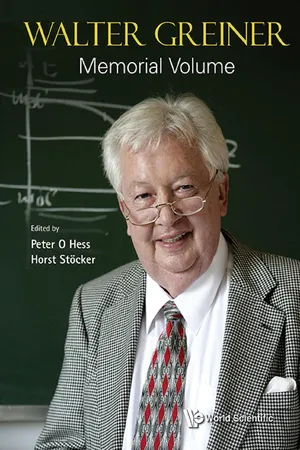
Walter Greiner Memorial Volume
eBook - ePub

Walter Greiner Memorial Volume

  1. 388 pages
  2. English
  3. ePUB (mobile friendly)
  4. Available on iOS & Android
eBook - ePub

Walter Greiner Memorial Volume

About this book

-->

Walter Greiner (1935–2016) was a German physicist of the Goethe University, Frankfurt, well-known for his many contributions in scientific research and developments, in particular the field of nuclear physics. He was a well-respected science leader and a teacher who had supervised batches of young collaborators and students, many of whom are now leaders in both academics and industry worldwide. Greiner had a wide interest of science which covered atomic physics, heavy-ion physics, and nuclear astrophysics. Greiner co-founded GSI, the Helmholtz Centre for Heavy Ion Research, and the multi-disciplinary research center, FIAS (Frankfurt Institute for Advanced Studies). Besides numerous professorship with universities worldwide, including the University of Maryland, Greiner received many prestigious prizes in honor of his outstanding contributions, among others are the Otto Hahn Prize and the Max Born Prize.

This memorial volume is a special tribute by Greiner's former colleagues, students, and friends honoring his contributions and passion in science. The volume begins with a writing by Greiner about his early days in science. The subsequent articles, comprising personal and scientific reminiscences of Walter Greiner, serve as timely reviews on various topics of current interest.

--> Contents:

  • Preface
  • Reflections on My Youth and Early Years in Science (Walter Greiner)
  • The Early Work of Walter Greiner (1960–1968) (Şerban Mişicu)
  • Photon Scattering off Nuclei (Hartmuth Arenhövel)
  • The QCD Phase Diagram from Statistical Model Analysis (Marcus Bleicher, Jan Steinheimer and Reinhard Stock)
  • Why May Hydrodynamics Work for Classical Radiation Field? (Tamás S Biró)
  • Chiral Symmetry Restoration and Deconfinement in Heavy-Ion Collisions (E L Bratkovskaya, W Cassing, P Moreau and A Palmese)
  • The Physics Case for the √ S NN ≈ 10 GeV Energy Region (J Cleymans)
  • Untangling Simple Patterns in Intricate Atomic Nuclei (Jerry P Draayer, Kristina D Launey, Tomáš Dytrych, Alison C Dreyfuss, Grigor H Sargsyan and Robert B Baker)
  • Can One Determine the Neutrino Mass by Electron Capture? (Amand Faessler)
  • Open and Hidden Charm in My Collaboration with Walter Greiner (Mark I Gorenstein)
  • Dark Mater Compact Stars in Pseudo-Complex General Relativity (D Hadjimichef, G L Volkmer, R O Gomes and C A Zen Vasconcellos)
  • Some Aspects of Nuclear Structure (J H Hamilton, A V Ramayya and E H Wang)
  • The Power of the Geometrical Model of the Nucleus (Peter O Hess)
  • Pseudo-Complex General Relativity: Theory (Peter O Hess and Thomas Boller)
  • Observational Tests of the Pseudo-Complex Theory with Black Hole Imaging (Thomas Boller and Peter O Hess)
  • From Strangeness Enhancement to Quark–Gluon Plasma Discovery (Peter Koch, Berndt Müller and Johann Rafelski)
  • Time-Dependent Perturbation Theory as a Basis for Combined Many-Body-Perturbation and QED (Ingvar Lindgren)
  • The Fullerene-Like Structure of Superheavy Element Z = 120 (Greinerium) — A Tribute to Walter Greiner (Ş Mişicu and I N Mishustin)
  • Cluster Radioactivity — Past and Future (D N Poenaru and R A Gherghescu)
  • Nuclear Mean-Field Models and Super-Heavy Elements (P-G Reinhard)
  • The Octupole Collective Hamiltonian. Does It Follow the Example of the Quadrupole Case? (Stanislaw G Rohozinski and Leszek Próchniak)
  • Modeling Hybrid Stars (S Schramm)
  • Elliptic Flow and the Nuclear Equation of State (W Trautmann and H H Wolter)
  • Black Holes and High Energy Physics: From Astrophysics to Large Extra Dimensions (Michael Florian Wondrak, Marcus Bleicher and Piero Nicolini)

-->
--> Readership: Students and researchers in nuclear and particle physics. -->
Keywords:Heavy Ion Physics;Nuclear Physics;Nuclear Fission;Nuclear Structure;Nuclear ReactionReview:0

Frequently asked questions

Yes, you can cancel anytime from the Subscription tab in your account settings on the Perlego website. Your subscription will stay active until the end of your current billing period. Learn how to cancel your subscription.
No, books cannot be downloaded as external files, such as PDFs, for use outside of Perlego. However, you can download books within the Perlego app for offline reading on mobile or tablet. Learn more here.
Perlego offers two plans: Essential and Complete
  • Essential is ideal for learners and professionals who enjoy exploring a wide range of subjects. Access the Essential Library with 800,000+ trusted titles and best-sellers across business, personal growth, and the humanities. Includes unlimited reading time and Standard Read Aloud voice.
  • Complete: Perfect for advanced learners and researchers needing full, unrestricted access. Unlock 1.4M+ books across hundreds of subjects, including academic and specialized titles. The Complete Plan also includes advanced features like Premium Read Aloud and Research Assistant.
Both plans are available with monthly, semester, or annual billing cycles.
We are an online textbook subscription service, where you can get access to an entire online library for less than the price of a single book per month. With over 1 million books across 1000+ topics, we’ve got you covered! Learn more here.
Look out for the read-aloud symbol on your next book to see if you can listen to it. The read-aloud tool reads text aloud for you, highlighting the text as it is being read. You can pause it, speed it up and slow it down. Learn more here.
Yes! You can use the Perlego app on both iOS or Android devices to read anytime, anywhere — even offline. Perfect for commutes or when you’re on the go.
Please note we cannot support devices running on iOS 13 and Android 7 or earlier. Learn more about using the app.
Yes, you can access Walter Greiner Memorial Volume by Peter O Hess, Horst Stöcker in PDF and/or ePUB format, as well as other popular books in Physical Sciences & Nuclear Physics. We have over one million books available in our catalogue for you to explore.

Information

Publisher
WSPC
Year
2018
eBook ISBN
9789813234291

Untangling Simple Patterns in Intricate Atomic Nuclei

Jerry P. Draayer,1 Kristina D. Launey,1 Tomáš Dytrych,1, 2
Alison C. Dreyfuss,1 Grigor H. Sargsyan1 and Robert B. Baker1
1Department of Physics and Astronomy, Louisiana State University,
Baton Rouge, LA 70803, USA
2Nuclear Physics Institute, Academy of Sciences of the Czech Republic,
250 68
images
Czech Republic
In this review, we present a symmetry-guided strategy that utilizes exact as well as partial symmetries for enabling a deeper understanding of and advancing ab initio studies for determining the microscopic structure of atomic nuclei. These symmetries are critical toward untangling simple patterns within an overarching complexity that defines nuclei, and naturally provide a physically relevant basis. Such basis, for large-scale calculations, allows the model space size to be reduced through a very structured selection of the basis states, and guides extensions of the ab initio theory beyond current limitations. This is key to facilitating studies of the structure and reactions of isotopes across the nuclear chart, using QCD- inspired interactions and high performance computing (HPC) resources. This, in turn, can guide explorations of orderly patterns in nuclei and how they emerge from first principles.

1.Introduction

Pattern recognition and deviations thereof are key features in understanding complex structures and phenomena. For nuclear physics, this translates into the identification and exploitation of symmetries, exact and partial. The field of nuclear physics has advanced with successes of models proffered to describe regularly occurring patterns, such as the Liquid Drop Model for the description of fission phenomena, or the Geometric Collective Model of Greinera for the depiction of collective modes, and early renditions of the Independent-particle Shell Model, all within the dawn of the field. Since then, various layers of complexity were added to these earliest models. However, the most promising of the more evolved theories could not be tested against a growing repository of high-quality experimental data until the advent of high-performance computing (HPC) resources in the late 90s that ushered in an era of computational nuclear physics.
Today, aided by the availability of petascale computing resources and looking ahead to next-generation exascale facilities, a new dawn in our understanding of nuclear physics is unfolding before us. Theories advanced through the last decades of the 20th century can now be tested and refined against a vast body of data that probes more widely and deeply into the structure of atomic nuclei and the universe that resided within nucleons themselves. Again two primary branches of theoretical physics dominate the landscape: Quantum Chromodynamics (QCD) for gaining a much deeper understanding of the strong interaction, and ab initio nuclear theory, with the No-core Shell Model (NCSM)1, 2 being a successful example, that seeks to test and explore the effective interactions that bind nucleons into nuclei.
This review focuses on the ab initio symmetry-adapted no-core shell-model (SA-NCSM),3 which utilizes the SU(3) symmetry and its embedding Sp(3,
images
) group, with results that corroborate and are complementary to those enabled within the framework of the NCSM. These symmetries are used to facilitate ab initio applications to challenging lower ds-shell nuclei and reveal that bound states of light nuclei are dominated by high-deformation and low-spin configurations.4 The applicable symmetries reveal the nature of collectivity in such nuclei and provide a description of bound states in terms of a relatively small fraction of the complete space when the latter is expressed in an (LS)J coupling scheme with the spatial configurations further organized into irreducible representations of SU(3). That SU(3) plays a key role tracks with the seminal work of Elliott,5 and is further reinforced by the fact that SU(3) also underpins the microscopic symplectic model,6, 7 which provides a microscopic framework for understanding collective phenomena in atomic nuclei.810 Furthermore, we discuss the use of a schematic microscopic interaction in a no-core shell-model framework, which preserves the Sp(3,
images
) symmetry and reduces to the Elliott SU(3) model5 in the single-shell limit, augmented by the SU(3)-symmetry breaking spin-orbit interaction. We show that it reproduces characteristic features of the low-lying 0+ states in 12C, including the elusive Hoyle state,11 as well as ground-state rotational bands in p and sd-shell nuclei (from Be to Si),1214 while further confirming the mechanism of shape coexistence.1518 An implication of the latter is that efforts to reproduce the structure of 12C using a ‘bottom up’ ab initio effective interaction theory may benefit from ‘top down’ algebraic considerations that serve to expose emergent properties in terms of simple interaction forms that seem to dominate the structure of deformed nuclei.
Overview of approaches t...

Table of contents

  1. Cover
  2. Halftitle
  3. Title
  4. Copyright
  5. Preface
  6. Contents
  7. Reflections on My Youth and Early Years in Science
  8. The Early Work of Walter Greiner (1960–1968)
  9. Photon Scattering off Nuclei
  10. The QCD Phase Diagram from Statistical Model Analysis
  11. Why May Hydrodynamics Work for Classical Radiation Field?
  12. Chiral Symmetry Restoration and Deconfinement in Heavy-Ion Collisions
  13. The Physics Case for the Energy Region
  14. Untangling Simple Patterns in Intricate Atomic Nuclei
  15. Can One Determine the Neutrino Mass by Electron Capture
  16. Open and Hidden Charm in My Collaboration with Walter Greiner
  17. Dark Matter Compact Stars in Pseudo-Complex General Relativity
  18. Some Aspects of Nuclear Structure
  19. The Power of the Geometrical Model of the Nucleus
  20. Pseudo-complex General Relativity: Theory
  21. Observational Tests of the Pseudo-complex Theory with Black Hole Imaging
  22. From Strangeness Enhancement to Quark-Gluon Plasma Discovery
  23. Time-Dependent Perturbation Theory as a Basis for Combined Many-Body-Perturbation and QED
  24. The Fullerene-like Structure of Superheavy Element Z = 120 (Greinerium) — A Tribute to Walter Greiner
  25. Cluster Radioactivity — Past and Future
  26. Nuclear Mean-Field Models and Super-Heavy Elements
  27. The Octupole Collective Hamiltonian. Does It Follow the Example of the Quadrupole Case?
  28. Modeling Hybrid Stars
  29. Elliptic Flow and the Nuclear Equation of State
  30. Black Holes and High Energy Physics: