![]()
Chapter 1
The Solar System
In this chapter we review the basic properties of the solar system, with emphasis on the planetary bodies. The central body of the solar system, the Sun, will be described in a separate chapter. Detailed information about planets can be only obtained for solar system planets, and therefore they serve as proxy planets for all other known exoplanets.1 Also the interaction with stellar activity can be studied in detail in the case of the solar system.
1.1Objects of the solar system: An overview
The solar system consists of the Sun as the central star, 8 planets, dwarf planets, asteroids, comets and other small solar system bodies and particles. Whereas the main mass of the solar system is comprised inside the Sun (about 99.8%), the main angular momentum is distributed over the orbiting planets. The orbits of the planets are almost coplanar. These facts provide some important hints for the solar system formation.
1.1.1The planets
There are three groups of planets in the solar system:
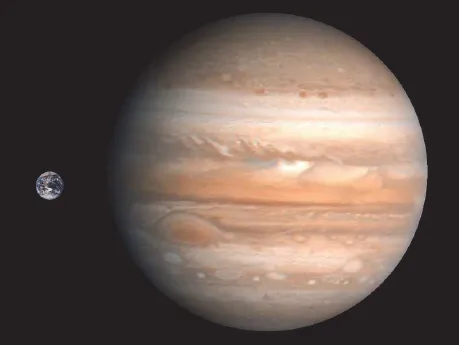
•Gas giants: Jupiter (radius about 70,000 km, its mass exceeds twice that of all other known planets) and Saturn (radius about 60,000 km); both giant planets possess a rocky core with a mass of about 10 Earth masses. In Fig. 1.1 a comparison between the size of Earth and Jupiter is shown. Note the aligned clouds of Jupiter’s atmosphere parallel to its equator. Jupiter and Saturn are mostly composed of hydrogen and helium.
Fig. 1.1Comparison of Earth and Jupiter. Credit: NASA.
•Ice giants: Uranus and Neptune; these planets contain large amounts of water and ammonia, NH3, methane, CH4 and silicates/rock. The radii of Uranus and Neptune are about 25,000 km.
•Terrestrial planets: Mercury, Venus, Earth and Mars. Earth and Venus have radii larger than 6,000 km. Mars has a radius of approximately 3,500 km and Mercury of about 2,500 km. All terrestrial planets have an atmosphere. The atmosphere of Mercury is extremely thin in comparison to the atmosphere of Venus which is extremely thick. In the case of Venus, we can study the interaction of solar energetic particles (SEPs) with it’s atmosphere since Venus does not have a magnetic field. We on Earth are shielded from charged solar particles by a magnetic field.
Some basic planetary data are listed in Table 1.1. Distances in the solar system are given in Astronomical Units (AU).
1 AU denotes the mean Sun–Earth distance = 150 × 106 km.
Mass units are often given in Earth masses (M⊕), and the radius is also given in units of the Earth’s radius (R⊕). For larger exoplanets, units are given in units of Jupiter’s mass (MJ) or Jupiter’s radius RJ.
Table 1.1.Some important parameters of the planets in the solar system. D denotes the distance from the Sun, P the period of revolution about the Sun, R the planetary radius and PRot the rotation period of the planet.
1.1.2Moons
Except for Venus and Mercury all planets have moons. Jupiter’s moon Ganymede and Saturn’s moon Titan are slightly larger than planet Mercury. In Fig. 1.2 some selected large moons and Earth are shown for comparison.
The four largest satellites of Jupiter, namely Io, Europa, Ganymede and Callisto, are also called Galilean satellites, since Galileo Galilei first detected them in 1609 with his telescope. Some of these moons are especially interesting objects for astrobiologists since there is evidence for the existence of a liquid ocean below an icy crust (Jupiter’s moon Europe for example, see Singer et al. [2009]). The icy surface of Europa is shown in Fig. 1.3. Such a subsurface ocean remains liquid because of tidal heating: the planet’s satellite becomes continuously deformed and stretched by the tidal forces of its nearby giant planet. This is illustrated in Fig. 1.4. The strongest effect of tidal heating can be seen on Jupiter’s satellite Io. The surface of Io is covered by several active volcanoes. Io is about the same distance from Jupiter as the Moon is from the Earth; however, Io experiences much stronger tidal stretching because Jupiter is over 300 times more massive than the Earth. Io’s rocky surface bulges up and down by as much as 100 m!
One of the first papers dealing with tidal heating and a subsurface ocean of Europa was Reynolds et al. [1987].
Tidal heating leads to the concept of a habitable zone around a giant planet (see Chapter 5 about habitable zones). A satellite in such a tidally heated habitable zone could be a possible candidate for life.
Io’s orbit is kept from being exactly circular due to the gravitational influence of its Galilean neighbor Europa and the more distant Ganymede. Io, Europa and Ganymede are in 4:2:1 orbital resonance that keeps their orbits elliptical. This means that for every four orbits of Io, Europa orbits twice and Ganymede orbits once.
Fig. 1.2Selected moons of planets and the Earth for comparison. Credit: NASA.
Fig. 1.3Icy surface of Jupiter’s moon Europa. Credit: NASA.
Fig. 1.4Tidal heating. A satellite on an elliptical orbit is heated by tidal forces.
In Barnes et al. [2013] so-called tidal Venuses are discussed. These are hypothetical terrestrial planets orbiting low-mass stars. They are tidally heated, and this heating induces a runaway greenhouse effect. If this effect is of long duration, all of the hydrogen can escape, and therefore no longer does water exists on such a planet. Without water, there will be no life.
1.1.3Dwarf pl...