"There is definitely no shortage of entrepreneurship books. To find one that is comprehensive enough, in both breadth and depth and yet at the same time, written in a clear and easy way for readers to judiciously absorb the very rich lessons, is quite rare. Making it even more unique, is to find one that also provides detailed guidance of how to use the book, that is firmly supported by a conceptual framework on 'Reading Order for Entrepreneurship.'"from the Foreword by Dr Hooi Den HuanVice-President, Asian Council for Small BusinessSupervisor, Executive Board, Asia Marketing FederationAssociate Professor, Nanyang Technological University, Singapore"... well-written and resourceful book, which is a great contribution to knowledge. Readers will find much to stimulate their thinking and learning. This book is unique in that it links theory and practice."from the Foreword by Dr Joanna PaliszkiewiczProfessor, Warsaw University of Life Sciences – SGGW"This book works very well both for professionals and students as a good source of the key factors of start-up business. I do hope that this will find its way to many hands in the start-up world."from the Foreword by Pekka Kess, (Dr. Sc., Dr. Eng.)Professor, University of Oulun yliopistoIndustrial Engineering and Management, Siikalatva, FinlandPeople like to have their own business, but few succeed. In this book, we show you what the process and procedures are to start-up your own business. Around 100 real cases featuring SMEs in Asia are introduced to show how businesses are run in the real world. From these practice cases, we can find rules to make a business sustainable.After reading this book, you will be able to find out what your advantages and disadvantages are, especially if you are keen to start a business in Asia. This book might even help you decide whether it is time for you to start-up your own business or not.
eBook - ePub
Entrepreneurial Management Theory and Practice
With Cases of Taiwanese Business
- 584 pages
- English
- ePUB (mobile friendly)
- Available on iOS & Android
eBook - ePub
About this book
Information
Subtopic
E-CommerceIndex
BusinessPart I
Operations Management
Chapter 1
Product and Service Innovation
Learning Objectives
1.Understand the meaning of innovation.
2.Understand the meaning of product and service.
3.Understand the application of product and service innovation.
4.Case studies on the application of product and service.
Introduction
A product is not just a specific commodity, an intangible service is also a product. Hence, physical goods, service, experiences, people, places, rights, concepts, and creative ideas are all part of a product. Section 1.2 of this chapter discusses the procedures entrepreneurs should adopt in commercializing a product during the development process of a new product. Section 1.3 presents the service-related issues and introduces service quality model. Case studies are then used to discuss how different companies use science and technology to improve service quality. Finally, section 1.4 introduces two research methods, KANO model and TRIZ theory. We introduced these two research methods because KANO model can be used to analyze the relationship between product attributes and customer satisfaction; and the TRIZ theory helps to provide a systematic and theoretical framework for solutions to the problems (Domb, 1998). At the same time the TRIZ theory also helps researchers and innovators to develop more feasible results (Ruchti and Livotov, 2001; Su et al., 2008). These two methods are useful scientific analysis methods for the development phase of product and service innovation when starting a business.
1.1.The Meaning of Innovation
Innovation means “change,” which is to apply a new concept on a product or service (Huang and Hong, 2005). Robbins and Coulter (2002) pointed out that innovation is the process of translating new ideas into useful products and services. Certo (2003) believed that innovation is the integration of technological and management innovation, by merging new ideas into products, processes, and organizational policies. In addition, Huang and Hong (2005) pointed out that innovation is a form of value conviction. With information technology (IT) and other technologies, innovation turns creativity into specific ideas, and then creates special products, technologies, and services. We may sum up the three characteristics of innovation, as follows:
1.Innovation is a concept, an idea.
2.Innovation is transformed into products, services, processes, and so on with the help of technology.
3.Innovation can be applied on various levels including intangible services, processes, policies, or tangible products and equipment.
Porter’s (1991) Five Forces Analysis shows that the competitive advantage of a corporation in the marketplace is not only affected by their own ability, but also by upstream companies, downstream companies, competitors, and potential competitors. When companies come up with innovative ideas, they seek suggestions through discussions within the organization or outside the organization. If the innovative ideas of a company are decided via discussions within the organization, it is called closed innovation. On the other hand, a company will be affected by the flow of the organization’s internal staff, the stimulation of the organization’s external partners and the number of upstream and downstream companies. When a company is affected by the above factors, it promotes a company from closed innovation into open innovation.
As the market environment is rapidly changing, enterprises need to be able to adjust their strategy and layout accordingly and timely in order to become more competitive in the market. Therefore, companies cannot be cut off from external resources, but must be able to keep up the interaction with the outside world for providing more added value to the company’s products (Li et al., 2012). The concept is similar with open innovation which advocates that companies make use of external resources to create higher value (Chesbrough, 2007).
Case 1 IBM embracing free software Linux
Chesbrough (2003) pointed out that IBM was known for its internal technology development and therefore, appeared to people as a mysterious company. With the changes in the market environment, IBM changed its attitude and started to accept external partners such as free software Linux. After IBM accepted Linux, IBM received hundreds of software patents, and their annual patent licensing income went up to US$10 billion.
1.2.The Meaning of Product
1.2.1.The meaning of product
Kotler and Armstrong (2004) pointed out that a product can meet consumers’ desire or need. A product is anything that we can buy and use from the market which includes physical goods, services, experiences, worlds, people, places, interests, and creative ideas. Under the broad meaning of a product, we will introduce the levels, classification, and development processes of a product accordingly.
1.2.1.1.Levels of product
Kotler (1999) pointed out that a product can be divided into five levels according to their form and meaning, namely, core benefit product, basic product, expected product, augmented product, and potential product. In terms of graphical representation see Figure 1.1, followed by the description of the five points:
1.Core benefit product
The core benefit of a product refers to the fundamental core attributes that make a customer purchase and use the product. For example, when consumers buy mobile phones, the function of the phone is part of the core benefit of the product. Or when a consumer purchases a travel package, the safety of the customer’s journey is part of the core benefit of the product.
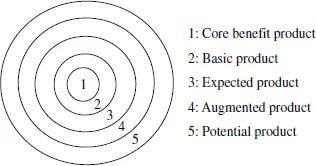
Figure 1.1Levels of a product
2.Basic product
A basic product refers to products that can turn the core benefit into a product with specific features. Using the same example of the mobile phone, the basic product of a mobile phone is its high call quality and aesthetic design.
3.Expected product
Expected product is the expected extra benefit when consumers purchase a product. For instance, when a customer buys a mobile phone the aesthetic design and product warranty are its expected product.
4.Augmented product
Augmented product is a product’s differentiation. For instance, sales can provide gifts and consulting services to attract consumers to buy a specific mobile phone.
5.Potential product
A potential product is a product that can meet consumers’ additional and future needs. For instance, if we combine mobile phones and solar power so that customers can rely on both the power charge and solar charging function, this technology can enhance consumers’ needs to use a phone with long battery life.
From the above we can see that “core benefit product” and “basic product” are the basic elements to meet consumers’ demand for a product or a service. “Expected product,” “augmented product” and “potential product” are the parts which can create added value. Therefore, in establishing new businesses, it is recommended that the design of “core benefit product” and “basic product” are a basic requirement to meet consumers’ demand in design of products and services. If the entrepreneurs want to create more added value for customers, they can focus on “expected product,” “augmented product,” and “potential product.”
Case 2 Snowflake ice: Charmy
Charmy, a food company with 15 franchises in the whole world has established “Charmy House” snowflake ice flagship shop in Kaohsiung. Unlike the traditional ice store, Charmy House consumers can enjoy a comfortable environment with French windows and green streets. You can say that consumers not only eat the delicious ice cream, but also enjoy a comfortable atmosphere when they visit the shop.
Snowflake ice which is as fine as snowflake is made of smashed ice. Charmy is successful in producing this kind of ice. If consumers hold a tray filled with fine ice pieces and breathe out through their mouth, the ice will dance like snowflakes. It shows how meticulously Charmy makes the ice.
Another innovation is that snowflake ice itself has added flavors. Consumers can have red or yellow snowflake ice besides the white snowflake ice. In addition, Charmy developed salty ice cream with such flavors as meat floss and ham. All the innovations on snowflake ice enhanced the added value for consumers when they taste it.
Currently Charmy is planning to develop a packed snowflake ice service for customers to enjoy DIY at home. What makes this packed service special is that consumers can buy packed ice only and freeze it in their refrigerator. Whenever they want to have a taste of snowflake ice, they just need to add fruits, jams, and other seasonings to it and they can have a taste of a unique homemade snowflake ice.
Charmy offers a variety of flavored snow ice, comfortable dining space, and convenient DIY snowflake ice, undoubtedly enhancing the product’s added value to consumers.
In this case, Charmy satisfied consumers’ basic requirements (i.e, “core benefit product,” “basic product”) on food products, f...
Table of contents
- Cover
- Halftitle
- Title
- Copyright
- Dedication
- Contents
- Preface
- Foreword by Den Huan Hooi
- Foreword by Pekka Kess
- Foreword by Dr Joanna Paliskiewicz
- Foreword by Yuli Deng
- How to Use This Book
- Part I: Operations Management
- Part II: Marketing Management
- Part III: Human Resource Management
- Part IV: Financial Management
- Part V: Hot Topics
- Index
Trusted by 375,005 students
Access to over 1.5 million titles for a fair monthly price.
Study more efficiently using our study tools.
Frequently asked questions
Yes, you can cancel anytime from the Subscription tab in your account settings on the Perlego website. Your subscription will stay active until the end of your current billing period. Learn how to cancel your subscription
No, books cannot be downloaded as external files, such as PDFs, for use outside of Perlego. However, you can download books within the Perlego app for offline reading on mobile or tablet. Learn how to download books offline
Perlego offers two plans: Essential and Complete
- Essential is ideal for learners and professionals who enjoy exploring a wide range of subjects. Access the Essential Library with 800,000+ trusted titles and best-sellers across business, personal growth, and the humanities. Includes unlimited reading time and Standard Read Aloud voice.
- Complete: Perfect for advanced learners and researchers needing full, unrestricted access. Unlock 1.5M+ books across hundreds of subjects, including academic and specialized titles. The Complete Plan also includes advanced features like Premium Read Aloud and Research Assistant.
We are an online textbook subscription service, where you can get access to an entire online library for less than the price of a single book per month. With over 1.5 million books across 990+ topics, we’ve got you covered! Learn about our mission
Look out for the read-aloud symbol on your next book to see if you can listen to it. The read-aloud tool reads text aloud for you, highlighting the text as it is being read. You can pause it, speed it up and slow it down. Learn more about Read Aloud
Yes! You can use the Perlego app on both iOS and Android devices to read anytime, anywhere — even offline. Perfect for commutes or when you’re on the go.
Please note we cannot support devices running on iOS 13 and Android 7 or earlier. Learn more about using the app
Please note we cannot support devices running on iOS 13 and Android 7 or earlier. Learn more about using the app
Yes, you can access Entrepreneurial Management Theory and Practice by Tzong-Ru Lee in PDF and/or ePUB format, as well as other popular books in Business & E-Commerce. We have over 1.5 million books available in our catalogue for you to explore.