![]()
Chapter 1
Fundamental Spectroscopic and Analytical Processes in Atomic Absorption Spectrometry
1.1.Introduction
1.2.Main Processes Occurring in an ET Atomizer: Atomization and Excitation
1.3.Spectroscopic Transitions
1.3.1.Transition Probability or Transition Strength
1.3.2.Selection Rules
1.3.3.Einstein Coefficients
1.3.4.Oscillator Strength
1.3.5.Excited-State Lifetime
1.4.Broadening of the Spectral Lines
1.5.Analytical Signals
1.6.Noise
1.7.Signal-to-Noise Ratio
References
1.1.Introduction
The use of electrothermal (ET) atomization in combination with atomic absorption spectrometry (AAS) has made this technique, electrothermal atomic absorption spectrometry (ETAAS), an indispensable tool for the determination of elements at trace and ultratrace levels, particularly in complex matrices (environmental, biological, chemical, industrial, food, etc.). In comparison with flames and plasmas, ET atomizers allow the sample under analysis to be given thermally controlled handling before and during the vaporization and atomization stages. In this way, better separation between analyte and matrix components (and so a lower likelihood of interference), some economy in sample size, relatively lengthy analyte residence times in the vapor phase, and high absolute atomization efficiencies are possible. The success obtained in the analytical applications of ETAAS has been due to the incorporation of different instrumental and methodological developments [L’vov (1970, 1978); Lundberg and Frech (1981); Welz et al. (1992); Aller (1998, 2003)], mainly including: new atomizer designs, rapid devices for data gathering, more efficient background correction methods, use of chemical modifiers, and employment of integrated absorbance.
1.2.Main Processes Occurring in an ET Atomizer: Atomization and Excitation
As a consequence of several physical and chemical transformations of the sample components, during the ET heating, a cloud of free analyte atoms is produced (atomization process). The usually occurring physico-chemical processes behind the analyte atomization are the following:
•dissociation of molecular species on the graphite surface and subsequent vaporization of the atoms formed,
•vaporization of molecular species from the graphite surface and subsequent dissociation,
•vaporization and condensation of molecular species and subsequent re-vaporization as free atoms.
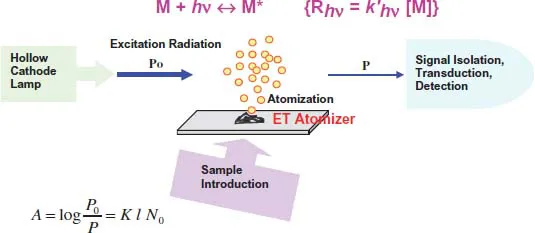
Once the gas phase analyte atoms are formed, they need to be excited by absorbing photons proceeding from a radiation source, normally a hollow cathode lamp (HCL) (Fig. 1.1). In this case, the lamp radiation shows an emission line coincident with the analytical absorption line and in theory only the analyte atoms selectively absorb photons.
Fig. 1.1.Schematic representation of the ET atomization and absorption processes.
At the atomization temperatures, a background continuum radiation is emitted by the graphite tube surface, particularly when purged with monoatomic gases (like Ar) [Schwab and Lowett (1990)]. However, absorption of this radiation contributes in much less extension to the excitation of the analyte atoms. Similarly, at the temperatures usually employed in ETAAS (≤3000 K), electron collisions are unlikely to make a significant contribution to the analyte excitation process.
The atomization and excitation mechanisms are regulated by diverse thermodynamic and kinetic aspects (Chapter 7).
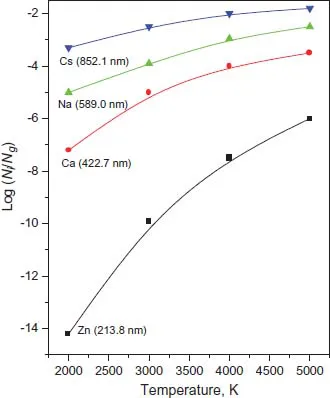
All chemical species present in an ET atomizer can only achieve a total balance if atomization is carried out at a constant high temperature [Frech et al. (1985)]. However, if the time spent in liberating the energy is too short compared to the transport time and temperature change, we can consider that in the graphite tube a thermal equilibrium (TE) state has been reached in each volume element within the time unit. Each volume element would be in local thermal equilibrium (LTE) if it is characterized by a constant temperature value [Alkemade et al. (1982)]. In other words, if LTE conditions would exist in the graphite tube during atomization, the energy distribution associated with: (i) the kinetic energy of electrons and atomic and molecular species; (ii) the rotational and vibrational energy of the molecules; (iii) the excitation and ionization of the atoms; and (iv) the spectral distribution of the background radiation from the tube wall, could be described by the same temperature value. This is in accordance with the expressions of Maxwell, Boltzmann, Saha and Planck. Under LTE conditions, chemical species are thermally distributed according to the Boltzmann’s distribution law [Boumans (1968)] (Fig. 1.2)
Fig. 1.2.Distribution ratio between two energy levels, Ni (higher energy) and Ng (lower energy) as a function of the temperature for the resonance lines of Cs (852.1 nm; gi/gg = 2), Na (589.0 nm; gi/gg = 2), Ca (422.7 nm; gi/gg = 3), and Zn (213.8 nm; gi/gg = 3).
where
is the population of the excited state “
i” of energy
Ei (J),
Nt is the total number of analyte atoms in all states at time
t,
Q(
T) is the partition function or state sum at the absolute temperature
T(K) of the vapor phase prevailing in the atomizer,
gi is the statistical weight, and
k (1.38 × 10
–23 J K
–1) is the Boltzmann constant. However, the
existence of LTE conditions in an ET atomizer still needs to be proved. Deviations from LTE conditions are predominantly due to losses of energy as non-absorbed radiation.
The transmitted radiation at the analytical wavelength is isolated by the monochromator, then reaching the detector. In order to isolate and quantify the transmitted analytical radiation from the continuum radiation arising from the tube, modulation of both radiations is mandatory. Recording the transmitted energy in the absence (P0) and the presence (P) of the gas phase analyte atoms allows us to deduce the absorbance (A) value which constitutes the analytical signal. The relationship between absorbance and analyte concentration or the analyte atoms (N0) introduced into the atomizer (Fig. 1.1), is regulated by Beer’s law, which is the basis of the practical quantitative analysis.
1.3.Spectroscopic Transitions
If free analyte atoms are excited by light, a change from one energy state to another ...