![]()
CHAPTER 1
Autonomous Systems
1.What Is an Autonomous System (AS)?
$300 million for 3 milliseconds. That is what Spread Networks paid to lay fiber between New York and Chicago to allow their client’s ASs to make billions of dollars. Watson’s creator was hired by a large hedge fund to take the next step in developing autonomous trading systems. Google’s AS, a driverless car, is well documented, but what is not well documented is how the entire automotive supply chain is slowly changing to support a day when driverless cars are commonplace. The states of California, Florida, and Nevada became the first states to allow driverless cars testing on their roads but are behind the UK and the rest of Europe with driverless car adoption. IBM has spent millions of dollars to create an autonomous health-care system, namely, using Watson to analyze a cancer patient’s genome to determine a precise, genetic approach to attacking that person’s tumor, an approach that would not work for another person with the same cancer. And the CEOs of banks, insurance companies, logistic providers, healthcare companies, and legal firms have all said that they are really, now, technology companies. Their business processes are becoming automated as is their relationship with suppliers, key vendors, and customers. This automation necessarily involves technology, both hardware and software, and for the first time, an AS is capable of capturing data, interpreting it, and rendering a decision with no human intervention. The shift from humans making all the decisions to machines making decisions has begun.
Autonomous systems define our future. They will become embedded in our lives, much like electricity, to ensure the safety of the food supply. They will become our personal assistant avatar that can do tasks for us during the day, leave us alone when we want, and be there to talk with us when we are receiving a cancer treatment to tell us they agree with the procedure the doctors are performing based on all the research available from the past 60 years. Your avatar might even find another avatar from a cancer patient to talk with you about what to expect.
Autonomous systems will also cause disruptions to existing business models, forever changing how supply chains work and how humans work. Let us take the driverless car as an example. And ask the following question: if driverless cars become ubiquitous, does that change a car dealership, the linchpin for the automotive industry? We argue below that the car dealership business model evolves into a model that resembles a rental car agency but with greater value added. However, rental car agencies will become competitors to dealerships, setting up a major disruption to the customer-facing end of the automotive supply chain. This occurs because if cars drive themselves, consumers would be able to subscribe to a service that sends them the car they need on demand. In the mornings, a car can take you to work and drop you off but in the evening a pickup truck comes for you because you need to haul mulch from the nursery. When you are done with the mulch delivery the pickup truck leaves. Coupled with a mobile app, this sounds like the current services that Uber and Lyft operate with human drivers. Except the human drivers will not be needed in the future.
The presence of ASs could be the nexus for changes of the magnitude experienced during the first and second industrial revolutions. Prior to the 1700s, humans made all the decisions while humans and animals did all the work. Since then, there have been two industrial revolutions that resulted in machines displacing first the animals and now the humans. Humans still made most of the decisions throughout these two revolutions, while the animals were relegated to become part of the human food supply. Now, we are approaching a point where machines will begin to displace humans in the decision-making space. The next industrial revolution can be thought of occurring when machines displace humans from doing the work and from making the decisions. However, we do not think humans will be relegated to some AS “food supply chain” as is popular in science fiction.
So how do we define an AS? It is a term that we started using over 7 years ago when we started to perform research on how these systems will impact business models. We have settled on a definition that is in no way official but was empirically arrived at through our work. An AS is defined to consist of three components and one process. The components are (1) an analytics repository, (2) an artificial intelligence (AI) service, and (3) sensors that generate content, or, as is in vogue, the latter is referred to the Internet of Things (IoT). Robots are ASs with actuators. The process required is a decisionmaking process that enables the AS to act based on its AI service leveraging the analytics repository that is created with content generated by the IoT.
2.Analytics
The usefulness of ASs will be based on the quality and quantity of the data present to train an AS to be used to support one and eventually multiple processes. Autonomous systems make decisions using data that informs a software program that uses one of the many AI algorithms. AI algorithms are not very complex. The usefulness of an AI program comes from the data used to train it, not the algorithm itself. The work being done now in Deep Learning has reinforced this point. The Deep Learning algorithm is not complex and can be written down in one page or less. It is the petabytes of data that sets apart different implementations. It is the breadth and depth of data about a specific topic (a database of 100 million cats) that is of high quality and complete enough (quantity) to train an AI to recognize cats in any other image taken ever again.
The term “big data” is still out there can mean many things to business and technology practitioners. We define big data as collections of structured and unstructured data in various states of transformation requiring new approaches to data architecture to support any and all business process. The data transformation process takes data in its rawest form as input and produces information for quantitative analysis as its output. It is the size and velocity of the data and transformation process that forces a change to the traditional data architecture. There is no well-defined number that says that you need a big data architecture if your data needs exceed some number of terabytes or petabytes and typically, to make this investment useful for executive decision-making, many terabytes of data appear to be the minimum necessary. This book conflates the term “big data” and analytics because at the end of the day, it is the analytics, i.e., the information that enables decisions to be made, that is most important.
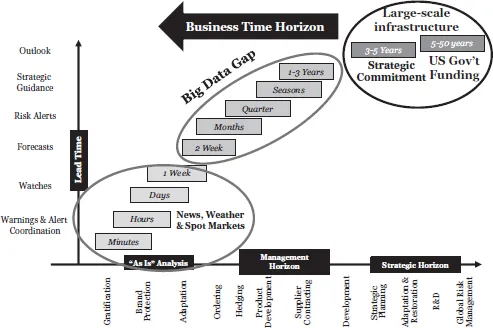
In Chapter 2 we take a deeper dive into analytics. As an introduction, we quantify the idea of data transformation to include a dimension of time, namely, what is the characteristic timescale for the data. This is shown further in Figure 1.1. Data can be relevant for a few seconds (a tweet), minutes (breaking news), or hours (market prices). Data can also be relevant for decades (the map of Chicago streets). However, data that is relevant for many weeks or growing seasons or 1–3 years are not as ubiquitous as the short of very long duration data even though these intermediary data sets from the backbone for an AS. Also, data at different timescales result in different AS capabilities, The challenge to creating and maintaining an AS depends on the quality of the data but also the relevant timescales of the data.
As an example of the gap problem, let’s take a look at a farm growing corn and soybeans in Illinois. Illinois is second to Iowa in corn production, but is number one in soybean production. Both states rank in the top 10 when compared to the production of other countries. Therefore, the investment in farm management is substantial, especially in the area of automation. For years, Caterpillar and John Deere have manufactured farm machinery capable of fairly autonomous operations with specific functions in tilling fields, seed planting, fertilization, and harvesting. Putting all this together to completely automate farm management end to end requires an understanding of the fields, weather, seed capabilities, harvesting, futures leveraging, regulations, financing, and so on, that is acquired over time and will be relevant for intermediate periods of time.
Figure 1.1:The relevancy of data. Data has a useful lifespan ranging from a few seconds to a century. It is the data in the gap that is relevant to ASs and not ubiquitous enough.
This data gap can also be thought of as the data needed to training AS to support business processes that have similar durations. The relevant time horizons for a food company are driven by its new product development and supply chain timescales. Much of that is driven by agricultural processes. A drought is an example of data that is months to years in duration and can be identified with the right types of data. However, this data typically does not show up in the supplier contracting, new supplier development, or strategic planning of a food producer. An AS that supports new product development and supply chain will need this type of data if true farm automation is to be realized as part of a process that supports a food supply chain.
We discuss in detail the most important dimension of analytics, namely, data fusion. Data fusion is the integration of IoT data in its myriad forms, customer data, distribution channel data, machine and human operations data, and partner data. Decisions require a synergistic view of these data. Other important dimensions we discuss are scale and velocity. Cloud architectures have storage that is cheap, and information is free or if it does not exist, less difficult to find or create. Cloud architectures provide enough compute services that processing speed is no longer an economic constraint.
3.Sensors or the IoT
We are surrounded by sensors that document our lives and the rest of the physical world around us. While this has been done to some degree since the invention of the camera, the amount of data collected and the rate at which it is collected provide not just content but now the context within which the content was captured. As with all other technological terms, the word IoT can have many meanings. We extend the use of the term IoT in a McKinsey study.a The McKinsey study uses a definition that includes sensors and actuators connected by networks to computing systems. This definition is necessarily a passive collection of data with no overt processing. The definition we adopt for this book is that the IoT includes indivisible physical objects that provide services to the world with which they can share self-generated content, context definition on their surroundings, and interoperate with a larger network of sensors, computers, and networked devices. We include the modifier “indivisible” to prevent collections of IoT devices from being considered an IoT (e.g., a driverless car is an AS to us though some might call it an IoT or even consider it one big sensor).
McKinsey estimates that by 2025, the economic impact of IoT will be in excess of $4 trillion and possibly as high as $11 trillion. Much of the value from the IoT will come from business to business (B2B) interactions between IoT devices and not business to consumer (B2C). A key reason for this is that it is in B2B applications that the data generated will find value and not fall on the cutting room floor. The increasing use of data, today estimated to be just 1% of what the IoT generates, is the source of the value and change to business models.
The IoT provides the senses for an AS. With IoT, an AS can capture audio, video, context information, unstructured information, and structured information. The IoT populates the analytics repositories needed to train and operate the AS and can respond to service requests from the AS. There is sometimes an implicit belief that devices in the IoT are not programmable other than to perform their base functions. In the future the miniaturization of transistors, CPUs, GPUs, and other processing elements implies that even for a simple camera, a small circuit board can have a neural network running with significant amounts of data resident. It is this dynamic that drives our definition that an IoT system. It is really a service provider rather than a sensor for passive content creation. The key to getting an AS to work well is to control the data collection process. Therefore, all of the IoT used must be controllable and configurable in an auditable manner by humans and machines. The IoT is the source of value to a business model and is also its worst enemy. We discuss the different classes of IoT and how some of these can be considered to be an AS.
A key component to IoTs are the software platforms built to manage simple and complex networks of IoTs. These software platforms are used as platforms as a service (PaaS). The platforms implement services and micro-services to enable and mange collection and analysis of data from the IoTs embedded in industrial machines and ASs. There are a few of these software platforms available now, such as GE Predix, AWS IoT Core, Azure IoT Suite, AT&T IoT Platform, and IBM Watson. These platforms are as important a decision to end users because they are essentially the operating system for the IoTs that companies use. A company cannot change to another platform once they choose a platform regardless of what vendors say or imply.
4.Artificial Intelligence
We discuss AI in greater detail in the next chapter at a level appropriate for business leadership. As an introduction to that deeper dive, we define AI to be an agent that acts rationally.1 It acts so as to achieve the best outcome or the best expected outcome given its inputs. These acts can be reflexive in nature or involve inference. An example of the former is that an airplane will always avoid another airplane if the planes get within a certain distance of one another. An example of the latter: as the plane encounters turbulence, it sees other planes in front of it descending 1000 feet. Its analysis of radio transmissions amongst pilots of planes that are descending suggests that they are discussing encountered turbulence. Therefore, in this example, the AI infers that the turbulence is getting worse and can decide to descend without being instructed to by a human controller.
This book adopts the viewpoint that AI will always be about computational statistics and the models derived from improvements in model development. AI software will accrete greater capabilities and speed and that the software will always appear to be intelligent but will never actually be intelligent. AI will never have their own minds or common sense; they will not be self-aware (at least for a very long time). The AI component of the autonomous system discussed in this book is what is always referred to as conforming to the Weak AI hypothesis. A Weak AI model will only at its best simulate intelligence but never be intelligent in the same way that humans are intelligent. AIs will act as if they are intelligent but not have actual minds or common sense. No matter how much words and perspectives describe an AI as being self-aware and sentient, the software will simply be that, software based on computational statistics that is used to created models that can help make decision by human beings or other machines at ever-increasing speeds.
For the foreseeable future, any AI will have narrow capabilities. An AI that can defeat any human or other computer in chess will probably get defeated in a few moves of checkers by a 5-year old whose grandfather spent the better part of an afternoon teaching his grandchild how to play checkers. An AI that is effective for ASs is similarly narrow in scope, and it is important to realize that an AI trained for one function cannot be repurposed for another function, at least not easily. This will force any AS created to be very narrow in scope as well.
The scope of the AI that we can reasonably expect to see in our future can be categorized according to their capabilities. There are three generally accepted definitions of AS scope:
1.NARROW OR WEAK. These are software programs that can support a process and are the AI that will power an AS as we know them. It is important to note that these systems have no intelligence or common sense. In fact the use of the term AI t...