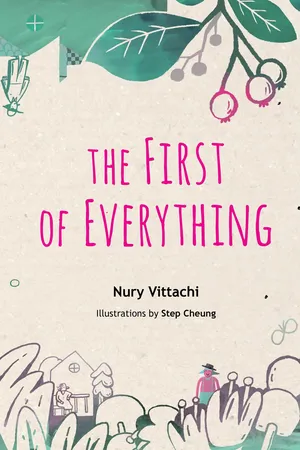
Sam Jam sat in a school library and challenged the school community to ask him about the origin of anything at all — and pledged to use library resources to answer within 60 minutes. Children and adults delivered clever, funny, unexpected questions: Who owned the first pet dog? Who invented toilets? What was the first song? Were the first newspapers really made of rock? And who was the first human, anyway?
Seeking answers, he and his young assistants discovered remarkable true tales:
The tamer of wolves
The tape measure that reached the moon
The first instant message
The man who took a picture of a sound
The first newspaper — which actually WAS made of rock!
And dozens more remarkable true stories.
The result is a fun story collection about the origins of a huge range of things — which also introduces young readers to the art and science of academic research. In these times of fake news, information overload, and too much homework, the ability to conduct fast, accurate research is one of the best skills any student can have — and you can learn it in these pages.
Contents:
The Library Lunch Challenge
Six Tales of Prehistoric People
Eight Tales from the Dawn of History
Seven Stories from a Seriously Long Time Ago
Seven Stories from the Mediterranean's Golden Age
Seven Tales from the New Calendar
Seven Stories from a Modernizing World
Seven Tales from Practically Yesterday
The Art and Science of Research
Readership: Children 6–12 years old. Key Features:
One of the very few books on the "first of everything"
Stories are presented in a fun and child-friendly format
Makes the themes of research and history more accessible to children
Wow, that’s a challenging question to tackle so early in this project.
With my scientist-philosopher hat on, I would say the answer might be what some people call “The Universe” or “God” or the “spirit of evolution” or what a famous scientist named Max Planck called “The Matrix Mind” (which are probably all terms for the same thing). Who knows for sure? We could argue that nature itself should count as a sentient being, since it is organic and alive and parts of it think moderately well, especially after a morning coffee!
But given her age, I think it’s likely that Sally wants to know about the first person who was just like ourselves — so let’s make that our focus.
To the library bookshelves!
To the library computers!
We find huge numbers of reports about “early humans” in books, science magazines and on the web. (We’re looking up “prehistory” and “anthropology”). They show pictures of hairy creatures that don’t look like people at all, to be honest. To
10 The First of Everything
ordinary folk like you and me, they look more like varieties of apes.
So are the experts right? Or ordinary people?
Further reading and a discussion with teachers and other members of the team reveals that the answer is both.
Specialists use the word “human” for many creatures physically related to us. These beings may look ape-like, but there are subtle signs in the shapes of their heads and other parts of their bodies that show them evolving to become more like us, so the experts are not wrong.
But most folk use the word “human” for people exactly like us, which is also not an unreasonable point of view — and probably what Sally meant.
So who were the first folk exactly like us? We found that information easily too, both in books and on the Internet.
People who physically looked like us have been around for at least 180,000 years. People who looked like us AND thought and behaved and acted like us are much more recent. (If you want to read about them, the first group is called “anatomically modern humans,” and the second group is called “behaviorally modern humans”).
The second group, the folk just like us, were definitely widespread and active 40,000 years ago. When did they first appear? Many specialists say it was about 50,000 years ago, while others say there
Six Tales of Prehistoric People 11
are signs of sporadic appearances even before that.
We found some write-ups discussing the first individuals who thought like us and had our story ready for the end of the library lunch break.
The girl who saw what wasn’t there...
Her name was Seer. And she was a misfit. People thought she was very odd, but they also found her intriguing.
In those days, people had labels rather than names. It’s likely that Seer would have been called Seer or something similar, because she would have seen things that other people didn’t.
Now this story would have happened about 50,000 years ago, so we don’t have many details. All we know is that there is plenty of evidence that a dramatic “cognitive development” (that means an advancement in the way our brains processed ideas) became widespread at that time. It moved through members of a two-legged creature called Homo sapiens, which is a scientific name for people like us.
Scientists think it would likely first have been noticed in a child or a group of children.
What had Seer developed?
An imagination! Until then, if the people wanted to talk about a buffalo, they would find one and point to it.
Seer, however, could sit at home and see one clearly in her head. She could make a sound that signified “buffalo” and could scratch lines into the ground that formed a picture of a buffalo.
12 The First of Everything
Scientists call this symbolic thinking, because a sound or a picture or a gesture symbolizes something which is not actually there.
As part of this development, Seer could also ponder abstract ideas. Abstract concepts are things that are very real and often very important, but you can’t pick them up and put them in your pocket. Happiness is an example, and so are love and friendship and loneliness and freedom and sorrow and hope. Seer may have expressed these abstract ideas by using complex language, or even by singing or dancing or painting.
When people died, others saw a still body. Seer saw a missing soul. Her people started to have regular burial rituals.
She and others like her who came along would have had to develop complex language to describe what was in their heads. Seer likely grew up to become a shaman, which is an early community’s person of wisdom. They often have the qu...
Table of contents
Cover
Halftitle
Title
Copyright
Contents
Introduction: The Library Lunch Challenge
Chapter 1: Six Tales of Prehistoric People
Chapter 2: Eight Tales From the Dawn of History
Chapter 3: Seven Stories From a Seriously Long Time Ago
Chapter 4: Seven Stories From the Mediterranean’s Golden Age
Chapter 5: Seven Tales From the New Calendar
Chapter 6: Seven Stories From a Modernizing World
Chapter 7: Seven Tales From Practically Yesterday
Chapter 8: The Art and Science of Research
Trusted by 375,005 students
Access to over 1.5 million titles for a fair monthly price.
Study more efficiently using our study tools.
Frequently asked questions
Yes, you can cancel anytime from the Subscription tab in your account settings on the Perlego website. Your subscription will stay active until the end of your current billing period. Learn how to cancel your subscription
No, books cannot be downloaded as external files, such as PDFs, for use outside of Perlego. However, you can download books within the Perlego app for offline reading on mobile or tablet. Learn how to download books offline
Perlego offers two plans: Essential and Complete
Essential is ideal for learners and professionals who enjoy exploring a wide range of subjects. Access the Essential Library with 800,000+ trusted titles and best-sellers across business, personal growth, and the humanities. Includes unlimited reading time and Standard Read Aloud voice.
Complete: Perfect for advanced learners and researchers needing full, unrestricted access. Unlock 1.5M+ books across hundreds of subjects, including academic and specialized titles. The Complete Plan also includes advanced features like Premium Read Aloud and Research Assistant.
Both plans are available with monthly, semester, or annual billing cycles.
We are an online textbook subscription service, where you can get access to an entire online library for less than the price of a single book per month. With over 1.5 million books across 990+ topics, we’ve got you covered! Learn about our mission
Look out for the read-aloud symbol on your next book to see if you can listen to it. The read-aloud tool reads text aloud for you, highlighting the text as it is being read. You can pause it, speed it up and slow it down. Learn more about Read Aloud
Yes! You can use the Perlego app on both iOS and Android devices to read anytime, anywhere — even offline. Perfect for commutes or when you’re on the go. Please note we cannot support devices running on iOS 13 and Android 7 or earlier. Learn more about using the app
Yes, you can access The First of Everything by Nury Vittachi, Step Cheung in PDF and/or ePUB format, as well as other popular books in Education & Early Childhood Education. We have over 1.5 million books available in our catalogue for you to explore.