![]()
While once chatting with one of my grandchildren I was faced with a probing question. “Grandpa” he asked, “where did you come from? Not just your father and mother and your grandparents, but before them?” Surprised, but gratified that one of my grandchildren was interested in his genealogy I informed him that while I had no immediate answer to his question, I’d try my best to find one.
Browsing on the Internet, I was intrigued to discover resources such as MyheritageDNA, KinCore.org and AncestryDNA; entities that offer genealogical searches based on examination of one’s DNA — for a fee of course. The last-mentioned organization touts: Discover the family story your DNA can tell. Uncover your ethnic mix, discover distant relatives, and find new details about your unique family history with a simple DNA test.
Then the thought struck me: “How much does the average non-biologist know about DNA and genes in the first place?” Further web surfing about these topics was not especially encouraging. Online information about DNA and genes is scattered, incomplete and all too often presented at a level that is likely beyond the comprehension of most (if not all) non-biologists.
All life forms on earth ranging from the tiniest bacteria to elephants, and even plants, possess genes. Genes determine the fact that you may have the same color eyes and/or hair as your mother or father and/or some of your children, and may resemble them in other physical characteristics and even non-physical attributes.
Most people are aware that all living things are endowed with genes and that these entities determine much of what you are and how you function as a living organism. But unless you have had a course in biology or genetics it’s entirely possible that you know very little if anything about genes and the substance they are made of, called DNA, an abbreviation for a complex biological compound that we’ll consider in more detail in a later chapter. This book is intended to fill that gap in your general knowledge by informing you what genes are, where in your body they are located, how they function, the dire consequences for your health and sometimes for your offspring if they fail to function normally, how they can be damaged and sometimes repaired — and much more.
Like most intellectual disciplines, biology is a huge field with a vast vocabulary, making it difficult (if not impossible) for non-biologists to understand much (if anything) about genes. However, in my considered opinion there is no a priori reason why much of the vocabulary of biology cannot be translated into plain English that any reasonably attentive reader can comprehend. This book was written to achieve that goal. Accordingly, throughout the book I have strived to convey biological concepts and explanations in terms that non-biologists can readily comprehend; essentially to inform you about genes in plain English.
The study of DNA and genes is part of an intellectual discipline called genomics, a subject that deals with the structure and function of genes. This is formally distinct from the more familiar subject that you may have heard or read about called genetics, a topic that primarily focuses on the study of heredity; how characteristics of living beings are inherited from one generation to the next. This distinction notwithstanding, genomics and genetics are closely related subjects, both words being derived from the Greek genno, meaning “to give birth,” and in the course of reading this book you will learn that the disciplines of genomics and genetics overlap to a significant extent.
* * *
Many of the discoveries in genomics took place over a period of about 35 years, beginning in the 1940s. Another 15 years or more were required before new and more sophisticated technologies would permit the isolation and characterization of individual genes, including those of complex organisms like you and me. Accordingly, the period between the early 1940s and the end of the 1980s constituted a golden age in the world of genomics. These impressive gains notwithstanding, much remains to be learned about our genes.
As a professor who introduced several generations of students to the mysteries and wonders of both biology and medicine, I found it useful to present biology in a historical context; a framework that traces the emergence and elaboration of new knowledge over time, thereby offering a deeper understanding and appreciation of how the disciplines of biology and medicine evolved. Accordingly, Learning About Your Genes is presented with a chronological perspective, a perspective that is intended to provide you with a sense of how our knowledge about genes evolved over time, beginning well before the word “gene” was even invented.
The book will also introduce you to some of the many scientists whose fertile ideas and ingenious experiments in the laboratory led to our current understanding about genes. The book includes explanations of several groundbreaking experiments relevant to our comprehension of genes and their function; explanations and insights that will provide you with a sense of how thoughtfully conceived and informative experiments in genomics are executed in the research laboratory. The book also contains a comprehensive glossary that might help the reader understand and remember new biological terms and their meaning. Regardless of my efforts to explain the attributes of genes in simple language, if you stumble along the way feel free to contact me at
[email protected]. I’m always available to help your comprehension of genes.
![]()
| 2 | A Brief History of the Discovery of Genes |
The first documentation of the existence of genes came from studies carried out about 160 years ago by Gregor Johann Mendel, a monk at St. Thomas Abbey in the city of Brono, Czechoslovakia. Mendel was born in 1822 with the Christian name Johann. The more familiar name Gregor was added when he joined St. Thomas Monastery years later.
Mendel was the only son of Anton and Rosine Mendel. He had two sisters and the family lived on and worked a farm they had owned for generations. As a child Mendel toiled in the garden and also studied beekeeping, activities that cultivated in him a progressively deepening interest in the biological sciences.
* * *
Most textbooks on genetics render a mere glimpse of Mendel’s early life, leading one to wonder how a friar working in an abbey could have gained sufficient knowledge and expertise to carry out genetic experiments. But in fact Mendel received a stellar formal education. At the age of eleven, a local schoolmaster noted his scholarly aptitude and suggested to his parents that he be sent to secondary school to continue his education. The move was a financial strain on his family and was often a difficult experience for Mendel himself, who was prone to bouts of depression for much of his life. Regardless, he excelled in his studies and in 1840 he graduated from secondary school with honors.
Mendel subsequently enrolled in a two-year program at the University of Olmütz in Brno, where he again distinguished himself academically. He also tutored students in his spare time to augment his meager financial status. When he joined the Faculty of Philosophy at the University of Olmütz, the head of the Department of Natural History and Agriculture was conducting research on hereditary traits (characteristics) in plants and animals, notably sheep, and it’s likely that he influenced Mendel’s interest in inheritance. Despite suffering from bouts of depression that more than once caused him to temporarily abandon his studies, Mendel graduated from the program in 1843. That same year, against the wishes of his father, who expected him to take over the family farm, Mendel began studying to be a monk. He joined the Augustinian order at the St. Thomas Abbey in Brno, where he was given the familiar name Gregor.
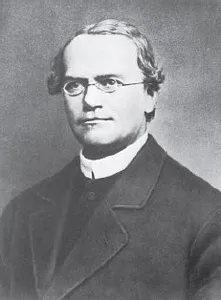
Fig. 2-1. Gregor Mendel.
As a student at the university, Mendel had struggled financially to pay for his studies and he became a friar at St. Thomas’s Abbey primarily to take advantage of the free education offered at the abbey. The monastery was then a cultural center for the region and Mendel was frequently exposed to the research and teaching of its members. He also gained access to the monastery’s extensive library and experimental facilities. Mendel eventually became an Augustinian Monk, a religious order in the Roman Catholic Church.
* * *
Those in charge of St. Thomas’s Abbey were sufficiently impressed with Mendel’s intellectual aptitude that in 1851 they gained him entrance to the University of Vienna at their expense in order to support his continued studies in the sciences. While In Vienna, Mendel studied mathematics and physics under the famous Austrian physicist Christian Doppler, who in 1842 had described the Doppler effect; a physical phenomenon that eventually led to the use of Doppler radar, currently used in weather forecasting. Mendel also studied botany under Franz Unger, an Austrian botanist who had begun using a microscope in his studies, and who was a proponent of a pre-Darwinian version of evolutionary theory. Clearly, Mendel’s university education 160-odd years ago was at the cutting edge.
At the university, Mendel exhibited a talent for teaching, though he surprisingly twice failed the teaching certificate examination! He was quiet and shy and perhaps found the oral part of the examination nerve-wracking. Upon completing his studies in Vienna, Mendel returned to the monastery in Brno and was granted a teaching position at a secondary school, a position that he retained for more than a decade. It was during this time that he began the breeding experiments for which he is posthumously famous.
Mendel began his studies on breeding using mice. He bred them in his two-room apartment at the monastery, attempting to discern what sort of offspring would arise when normal-looking mice were mated with those lacking pigmentation (albinos). Would the baby mice have coats marked with traces of each parent, or would one be dominant? Mendel never had an opportunity to answer this question because his bishop, who took offense at the idea of a priest having anything to do with sex, ordered him to discontinue these studies. It was then that Mendel turned to pea plants, pleased that the bishop did not understand that plants also have sex!
* * *
Mendel examined the inheritance of seven traits in pea plants: seed shape (round or wrinkled), pea color (yellow or green), flower color (purple or white), flower position (terminal or axial), plant height (tall or short), pod shape (inflated or constricted) and pod color (yellow or green). He noted whether the offspring of pea plants with round seeds mated to peas plants with wrinkled seeds were round or wrinkled, and the offspring of yellow pea plants mated to green pea plants were yellow or green, and so on for each of the seven traits he had selected for study. Between 1856 and 1863 he is said to have cultivated and examined some 28,000 plants, 40,000 flowers and nearly 400,000 seeds, during what is considered the first well-controlled study in genetics. At the conclusion of this seven year study Mendel speculated that there are two “factors” for each inherited characteristic and that one factor is inherited from each parent.
Two years later, Mendel presented the results of his work to the Brno Society for Natural Science. His presentation, entitled Experiments on Plant Hybridization was published the following year. While his work was appreciated for its thoroughness, no one grasped its significance. The work was simply too ahead of its time; too contrary to popular beliefs about heredity such as the notion of “blending” inheritance subscribed to by ancient philosophers and natural historians. Hippocrates, for example, considered the founder of medical science, had propounded a theory according to which minute particles from every part of the body entered the “seminal substance” of the parents and by their fusion gave rise to a new individual exhibiting the traits of both of them. But, regardless of the poor reception to his studies, Mendel is quoted as having confidently stated: “My scientific studies have afforded me great gratification; and I am convinced that it will not take long before the whole world acknowledges the results of my work.” His conviction was well founded!
* * *
Mendel did little to promote his own work and the few references to his studies indicate that much of it had been misunderstood. Furthermore, his findings were not thought to be generally applicable. In fact, Mendel himself surmised that they only applied to certain types of inherited traits. It was not until decades later, when Mendel’s research informed the work of several noted geneticists, botanists and biologists conducting research on heredity, that its significance was more fully appreciated, and his studies began to be referred to as Mendel’s Laws.
The Law of Segregation: a law that states that each genetic trait is defined by a pair of factors. Parental factors are randomly separated to sex cells, now usually called germ cells — sperm cells in males and ova (eggs) in females — so that sex cells contain only one of the pair of parental factors. When sex cells unite during fertilization of an egg cell by a sperm cell, offspring inherit one genetic form from each parent.
The Law of Independent Assortment: a law that states that factors for different genetic traits are sorted separately from one another, i.e., the inheritance of one trait is not dependent on the inheritance of another.
The Law of Dominance: a law that states that an organism with alternate forms of a factor (dominant or recessive) will express the form that is dominant.
If the generality of Mendel’s laws sound familiar you can surely appreciate how close to the truth he was 160-odd years ago!
* * *
In 1900, three celebrated early geneticists independently duplicated Mendel’s experiments and results, allegedly discovering after the fact that both Mendel’s data and his general theory had been published in 1866. Questions arose about the validity of the claims that the trio of botanists were not aware of Mendel’s previous results, but they soon credited Mendel with priority. Even then, however, his work was sometimes marginalized by respected biologists of the day.
As genetic theory continued to develop, the relevance of Mendel’s work fell in and out of favor, but his research and theories are ultimately considered fundamental to any understanding of the field we now call genetics, and he is thus deservedly considered the “father of modern genetics.”
It took more than 30 years before Mendel’s work was fully acknowledged — a time when he was no longer alive to celebrate the recognition of his groundbreaking labors. But his legacy has not been lost. Most, if not all, genetics courses in schools, colleges and universities around the world teach his work, and contemporary geneticists often use the term “Mendelian genetics” when discussing our present understan...