Spectroscopic Identification of Organic Molecules
eBook - ePub

Spectroscopic Identification of Organic Molecules

  1. 204 pages
  2. English
  3. ePUB (mobile friendly)
  4. Available on iOS & Android
eBook - ePub

Spectroscopic Identification of Organic Molecules

About this book

Researchers in the fields of organic synthesis, pharmaceutical research as well as cosmetic and agrochemicals industries need to confirm the structures of products they obtain. This was previously a time-consuming a process that took up much time. Spectroscopic methods however, made it easier, and initially R and UV helped chemists conclude structures one way or another. Initially 1D NMR, 2D NMR and sophisticated NMR measurements like COESY and NOESY were of great assistance. We demonstrate principles to conclude structures of our simple molecules, mainly heterocycles of interest for researchers in fields indicated above.

However, it is insufficient to only understand the principles, and one should also master problem solving and thinking. We demonstrate simple problems like the utility of coupling constants, NOE, COESY and NOESY and show how firm conclusions are obtained in real life. Most NMR books usually demonstrate these principles utilizing a pit sophisticated examples. The methodology suggested by us is simpler and quite useful for researchers in heterocyclic chemistry where combination of proton and carbon NMR should be dealt together.

Our research results previously been used intensively (Cf. citations in Google Scholar) and still draw attention. Students in the fields indicated will find this book of value to sign the spectra of the molecules they synthesize. Researchers in the field of heterocyclic chemistry as well as instructors in the field of structure proof utilizing spectroscopic identification will also find this book of interest.


Contents:

  • Solving Research Problems Prior to Use of Spectroscopy
  • Utility of X-Ray Diffraction
  • Classical NMR as a Tool for Elucidating Structures
  • Diastereotopic Protons
  • Science Policy: Personal Experience


Readership: Graduate students and researchers on heterocyclic chemistry.
Key Features:

  • Scientific Departments particularly in Science and Pharmacy institutes
  • Research & development departments all over the world

Frequently asked questions

Yes, you can cancel anytime from the Subscription tab in your account settings on the Perlego website. Your subscription will stay active until the end of your current billing period. Learn how to cancel your subscription.
No, books cannot be downloaded as external files, such as PDFs, for use outside of Perlego. However, you can download books within the Perlego app for offline reading on mobile or tablet. Learn more here.
Perlego offers two plans: Essential and Complete
  • Essential is ideal for learners and professionals who enjoy exploring a wide range of subjects. Access the Essential Library with 800,000+ trusted titles and best-sellers across business, personal growth, and the humanities. Includes unlimited reading time and Standard Read Aloud voice.
  • Complete: Perfect for advanced learners and researchers needing full, unrestricted access. Unlock 1.4M+ books across hundreds of subjects, including academic and specialized titles. The Complete Plan also includes advanced features like Premium Read Aloud and Research Assistant.
Both plans are available with monthly, semester, or annual billing cycles.
We are an online textbook subscription service, where you can get access to an entire online library for less than the price of a single book per month. With over 1 million books across 1000+ topics, we’ve got you covered! Learn more here.
Look out for the read-aloud symbol on your next book to see if you can listen to it. The read-aloud tool reads text aloud for you, highlighting the text as it is being read. You can pause it, speed it up and slow it down. Learn more here.
Yes! You can use the Perlego app on both iOS or Android devices to read anytime, anywhere — even offline. Perfect for commutes or when you’re on the go.
Please note we cannot support devices running on iOS 13 and Android 7 or earlier. Learn more about using the app.
Yes, you can access Spectroscopic Identification of Organic Molecules by Mohamed Hilmy Elnagdi, Kamal Usef Sadek;Ramadan Ahmed Mekheimer in PDF and/or ePUB format, as well as other popular books in Physical Sciences & Pharmacology. We have over one million books available in our catalogue for you to explore.

Information

Publisher
WSPC
Year
2018
eBook ISBN
9789813271302
1

Solving Research Problems Prior to Use of Spectroscopy

1.1.General Considerations

During a stay in Japan, one of us studied the reactivity of 4-arylhydrazonopyrazolidin-3,5-dione (2) upon cyanoethylation. Equimolecular amounts of reactants afforded mono cyanoethylation products. The problem was that the researcher hesitated because he was unsure if the product was structure 2 or 3, but he was more inclined to 3 as hydrolysis did not afford the starting 1 but carboxylic acids 4 instead. However, more confirmatory evidence for this conclusion was required. This could be achieved by synthesis of 3 from the reaction of β-cyanoethylhydrazene (5) with diethyl mesoxalic acid arylhydrazones (6) (Scheme 1).1
Fortunately, this structural assignment was proven to be the correct one as these compounds was reprepared later by chemists at L’Oréal, and their utility for creatinine fiber dyes has been patented.2
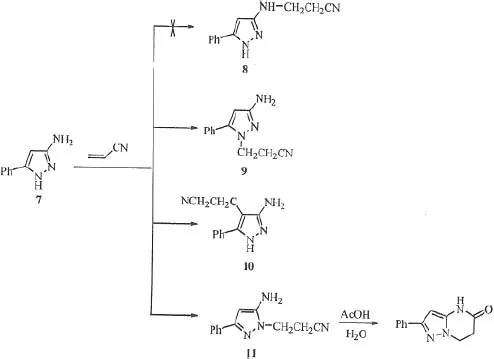
Another similar problem was solved in 1975 by using the same approach. Thus, cyanoethylation of 7 may in fact afford compounds 8–11. Structures 8 and 10 were excluded by synthesizing the same product via condensing benzoylacetonitrile and β-cyanoethylhydrazene (Scheme 2).3,4
The product cyclized on reflux in acetic acid, thus excluding structure 9 as well. In this way, the product could be established as 11 based on its structure. Again, the assignment of 11 to the product was the correct one as this compound has since been resynthesized by Eli-Lilly chemists and patented4 for use. Thus, there is always a way to establish structure without spectroscopy, and structures of many complex molecules, including alkaloids, were established with certainty without utilizing any spectroscopy.5
images
Scheme 1
images
Scheme 2

References

1.M. H. Elnagdi and M. Ohta, Bull. Chem. Soc. Jpn, 16, 1830 (1973).
2.L. Vidal and G. Malle, US patent PCT No. PCT/FR97/00509 (1997).
3.M. H. Elnagdi, D. H. Fleita and M. R. H. Elmoghayer, Tetrahedron, 31, 63 (1975).
4.C. J. Barnelt, R. E. Holmes, L. N. Jungheim, S. K. Sigmund and R. J. Ternary, US Patent PCT No. 1989000418782 (1990).
5.J. Mann, R. S. Davidson, J. B. Hobbs, D. V. Banthrope and J. B. Harborne, Natural Products; The Chemistry and Biological Significance, Longman (1994), Produced through Longman Malaysia WC/01.
2

Utility of X-Ray Diffraction

2.1.General Consideration

This is the most straightforward technique that can help confirm structures in solid state with certainty.
The question is why we did not utilize it prior to 1995?
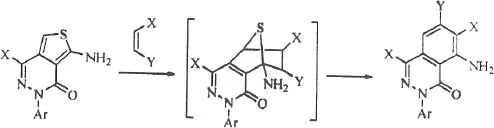
The answer is simple: measurement on a commercial scale is rather expensive. Moreover, one needs to master the art of crystallization. It was originally assumed that large crystals are necessary, which was later proved to be false. Now, owing to the large-scale technical advancement that has recently occurred and the development of a new generation of instruments, such as those in Kuwait University, it is possible to get X-ray diffraction details for any crystal. However, we were forced to use X-ray while supervising the work of a talented Kuwaiti lady in 1994 (H. Al-Awadi). We were undertaking a simple extension of our thieno[3,4-d] pyridazine chemistry,13 one that is well established with plenty of applications, as assessed by us and others16 (Scheme 1).
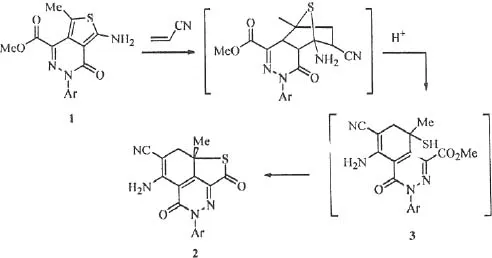
The student treated 1 with acryronitrile and obtained a product for which no simple structure could be concluded (Scheme 2). We sent a sample of the resulting powder to Prof. J. Elguero in Madrid. The powder was crystallized by slow evaporation of a saturated acetic acid solution, and X-ray diffraction proved that it was indeed compound 2 (Fig. 1). It was concluded also from X-ray data that the hetero ring adopts a rather flat, distorted boat confirmation owing to the presence of fused rings.
The formation of NH intramolecular hydrogen bonds to carbonyl atom weakened the C=O bond, which had a bond length of 1.220Å. A comment on X-ray was made by crystallographers in Madrid and, together, we came up with a combined paper.7
images
Scheme 1
images
Scheme 2
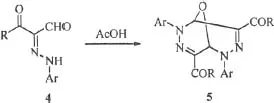
Another unexpected product that needed X-ray data to confirm the structure was the one obtained on refluxing 4 in AcOH, yielding 5 (Fig. 2).8
images
After this, we decided to look back at every structure that we had a doubt in in our previous work and placed emphasis on obtaining X-ray crystal structures for new products for which no decisive structure was reached. Although much succes...

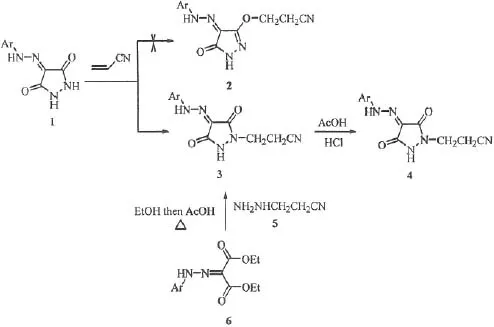
Table of contents

  1. Cover
  2. Halftitle
  3. Title
  4. Copyright
  5. Acknowledgments
  6. Contents
  7. Introduction
  8. Chapter 1 Solving Research Problems Prior to Use of Spectroscopy
  9. Chapter 2 Utility of X-Ray Diffraction
  10. Chapter 3 Classical NMR as a Tool for Elucidating Structures
  11. Chapter 4 Diastereotopic Protons
  12. Chapter 5 Science Policy: Personal Experience
  13. Index