The World According to Quantum Mechanics
eBook - ePub

The World According to Quantum Mechanics

Why the Laws of Physics Make Perfect Sense After All

  1. 500 pages
  2. English
  3. ePUB (mobile friendly)
  4. Available on iOS & Android
eBook - ePub

The World According to Quantum Mechanics

Why the Laws of Physics Make Perfect Sense After All

About this book

Apart from providing a lucid introduction to the mathematical formalism and conceptual foundations of quantum mechanics, we explain why the laws of physics have the form that they do. In addition, we present a new and unique look at the quantum world, steering clear of two common errors: the error of the ψ-ontologists, who reify a calculational tool; and the error of the anti-realists, for whom physical theories are simply devices for expressing regularities among observations.

The new edition of this acclaimed text adds around 200 pages on a variety of topics, such as how the founders sought to make sense of quantum mechanics, Kant's theory of science, QBism, Everettian quantum mechanics, de Broglie–Bohm theory, environmental decoherence, contextuality, nonlocality, and the paradox of subjectivity — the curious fact that the world seems to exist twice, once for us, in our minds, and once by itself, independently of us.


Contents:

  • Overview:
    • Probability: Basic Concepts and Theorems
    • A Brief History of the 'Old' Theory
    • The 'New' Theory
    • The Feynman Route to Schrödinger (Stage 1)
    • Special Relativity in a Nutshell
    • The Feynman Route to Schrödinger (Stage 2)
  • A Closer Look:
    • Quantum Mechanics: A Probability Calculus
    • The Classical Forces: Effects
    • The Classical Forces: Causes
    • Quantum Mechanics Resumed
    • Spin 1/2
    • Angular Momentum and the Hydrogen Atom
    • Composite Systems
    • Contextuality, Locality, Realism, and All That
    • Quantum Statistics
    • Relativistic Particles
  • Making Sense:
    • How the Founders Sought to Make Sense of Quantum Mechanics
    • Quantum Mechanics and Consciousness
    • QBism
    • ψ-Ontology
    • Environment-Induced Decoherence
    • Space, Time, and the Macroworld
    • Questions of Substance
    • Manifestation
    • Why the Laws of Physics are Just So
    • Consciousness and the Physical World
    • Quanta and Vedanta
    • Appendix A: Some Mathematical Tools
    • Appendix B: Solutions to Selected Problems


Readership: Students, lecturers in university undergraduate physics courses related to quantum mechanics.
Key Features:

  • Presents the formalism of quantum mechanics in a clear and compelling manner
  • Useful to both students (undergraduate as well as graduate) and teachers (including higher secondary)
  • Serves as the missing link between the popular literature on quantum mechanics and the academic literature

Frequently asked questions

Yes, you can cancel anytime from the Subscription tab in your account settings on the Perlego website. Your subscription will stay active until the end of your current billing period. Learn how to cancel your subscription.
No, books cannot be downloaded as external files, such as PDFs, for use outside of Perlego. However, you can download books within the Perlego app for offline reading on mobile or tablet. Learn more here.
Perlego offers two plans: Essential and Complete
  • Essential is ideal for learners and professionals who enjoy exploring a wide range of subjects. Access the Essential Library with 800,000+ trusted titles and best-sellers across business, personal growth, and the humanities. Includes unlimited reading time and Standard Read Aloud voice.
  • Complete: Perfect for advanced learners and researchers needing full, unrestricted access. Unlock 1.4M+ books across hundreds of subjects, including academic and specialized titles. The Complete Plan also includes advanced features like Premium Read Aloud and Research Assistant.
Both plans are available with monthly, semester, or annual billing cycles.
We are an online textbook subscription service, where you can get access to an entire online library for less than the price of a single book per month. With over 1 million books across 1000+ topics, we’ve got you covered! Learn more here.
Look out for the read-aloud symbol on your next book to see if you can listen to it. The read-aloud tool reads text aloud for you, highlighting the text as it is being read. You can pause it, speed it up and slow it down. Learn more here.
Yes! You can use the Perlego app on both iOS or Android devices to read anytime, anywhere — even offline. Perfect for commutes or when you’re on the go.
Please note we cannot support devices running on iOS 13 and Android 7 or earlier. Learn more about using the app.
Yes, you can access The World According to Quantum Mechanics by Ulrich Mohrhoff, Manu Jaiswal in PDF and/or ePUB format, as well as other popular books in Physical Sciences & Quantum Theory. We have over one million books available in our catalogue for you to explore.

Information

Publisher
WSPC
Year
2018
eBook ISBN
9789813273719

PART 2

A Closer Look

Chapter 7

Quantum mechanics: A probability calculus

7.1The classical probability calculus

A concise and exhaustive description of a classical physical system at any one time consists of the values of a fixed number N of coordinates and an equal number of momenta. Such a description is usually called the state of the system. The state of a classical system with N degrees of freedom can therefore be represented by a point
figure
in a 2N-dimensional space
figure
known as phase space.
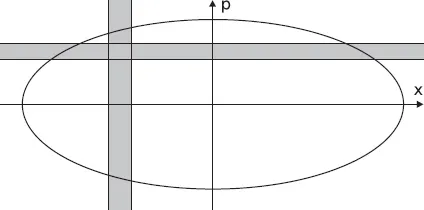
As an example consider the classical harmonic oscillator (Fig. 7.1). It has one degree of freedom, a 2-dimensional phase space, and the following equation of motion:
figure
Problem 7.1. In Fig. 7.1, which way does the oscillator’s state
figure
move? Clockwise or counterclockwise?
The mathematical apparatus of quantum mechanics serves to assign probabilities to the possible outcomes of measurements. With the exception of measurements that have discrete sets of possible outcomes, no real-world experiment has an exact outcome. (Otherwise one could experimentally establish whether the value of a physical quantity with a continuous range of possible values is rational rather than irrational.) If measurement outcomes are digitally displayed, as may reasonably be assumed, then every measurement has a finite number of possible outcomes. A (successful) measurement is therefore equivalent to a finite number of simultaneous elementary tests (one for each outcome), each having two possible outcomes. An elementary test associated with a continuous physical quantity X typically answers the question: does the value of X lie in the interval I? If the possible outcomes of a measurement are the disjoint intervals Ik, k = 1, . . . , n, then the actual outcome of one elementary test will be positive, while the actual outcomes of the remaining n − 1 tests will be negative.
figure
Fig. 7.1Phase space diagram of a harmonic oscillator. Observe that when |x| is at a maximum, p changes its sign (the oscillator reverses its motion), and when x = 0, |p| is at a maximum (the oscillator moves fastest). See the main text for the significance of the gray strips.
In our oscillator example, some of the possible outcomes of elementary tests are intervals of the x axis, and some are intervals of the p axis. In the system’s phase space, the former intervals correspond to vertical strips, the latter to horizontal strips, as indicated in Fig. 7.1. The intersection of a horizontal and a vertical strip also corresponds to the outcome of an elementary test, one that determines the simultaneous truth of the propositions “the value of x lies in the vertical strip” and “the value of p lies in the horizontal strip.” Generalizing this possibility by allowing every subset of phase space to be the possible outcome of an elementary test, we arrive at the following characterization of the classical probability calculus.
An elementary te...

Table of contents

  1. Cover Page
  2. Title Page
  3. Copyright Page
  4. Contents
  5. From the preface to the first edition
  6. Preface to the second edition
  7. Overview
  8. A Closer Look
  9. Making Sense
  10. Appendix A Some mathematical tools
  11. Appendix B Solutions to selected problems
  12. Bibliography
  13. Index