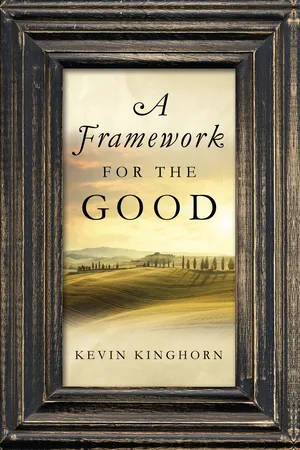
This book provides an ethical framework for understanding the good and how we can experience it in increasing measure. In Part 1, Kevin Kinghorn offers a formal analysis of the meaning of the term "good," the nature of goodness, and why we are motivated to pursue it. Setting this analysis within a larger ethical framework, Kinghorn proposes a way of understanding where noninstrumental value lies, the source of normativity, and the relationship between the good and the right. Kinghorn defends a welfarist conception of the good along with the view that mental states alone directly affect a person's well-being. He endorses a Humean account of motivation—in which desires alone motivate us, not moral beliefs—to explain the source of the normative pressure we feel to do the good and the right. Turning to the place of objectivity within ethics, he concludes that the concept of "objective wrongness" is a misguided one, although a robust account of "objective goodness" is still possible. In Part 2, Kinghorn shifts to a substantive, Christian account of what the good life consists in as well as how we can achieve it. Hume's emphasis of desire over reason is not challenged but rather endorsed as a way of understanding both the human capacity for choice and the means by which God prompts us to pursue relationships of benevolence, in which our ultimate flourishing consists.
- 353 pages
- English
- ePUB (mobile friendly)
- Available on iOS & Android
eBook - ePub
A Framework for the Good
About this book
Information
Publisher
University of Notre Dame PressYear
2016Print ISBN
9780268033309
9780268203559
eBook ISBN
9780268084653
Topic
Theology & ReligionSubtopic
Christian TheologyPart One
Placing the Good within an Ethical Framework
CHAPTER ONE
The Meaning of Good
1.1 OUR PRO-ATTITUDE TOWARD THE GOOD
One of the primary concerns of moral philosophers for the past two and a half millennia has been to provide an analysis of the “good.” Philosophers have been right to have this concern. No construction of a framework for ethics can get off the ground without an understanding of the good. And if one’s aim is to make a comparative study of competing ethical frameworks, one will need to understand how proponents of each framework understand the nature of the good (i.e., which things in our world are good) and perhaps also the meaning of good (i.e., what we are doing when we call something “good”).
Our everyday conversations bear out W. D. Ross’s observation that “there is a wide diversity of senses in which the word [good] is used” (1930, 65). We make references to a good knife, a good steak, a good painting, a good mother, a good set of lungs, and many other things we call good. Many philosophers have looked for a commonality within these uses. Is there, as Aristotle asked, “the same account of good” that will “turn up in all” uses of the term, “just as the same account of whiteness turns up in snow and in chalk?” (1999, 1096b).
Aristotle for one did not think that there is such a single idea corresponding to every use of the term good. He remarked that “honor, prudence, and pleasure have different and dissimilar accounts, precisely insofar as they are goods” (1999, 1096b). Aristotle is certainly correct that, for example, prudence and pleasure each can have full rein only at the expense of the other. When we praise an action as prudentially good, we typically acknowledge that there were alternative actions that afforded more pleasure (at least, more immediate pleasure). Yet, from the fact that there are single actions that cannot be good both from prudential considerations and from considerations of pleasure, does Aristotle’s conclusion follow that “the good is not something common corresponding to a single Idea” (1999, 1096b)?
In looking for commonality among our uses of the term good, we can begin by considering the etymology of good and its cognate sisters. Ross observes that the original connotation of the word good seems to be one of “indefinite commendation” (1930, 66).1 Perhaps the more complete observation would be that the original use of the term soon gave rise to the connotation of indefinite commendation. Alasdair MacIntyre, in his Short History of Ethics, comments that the term stems from a particular usage within early Greek society, which placed heavy emphasis on one’s performance of one’s socially allotted function. More specifically, “The word ἀγαθός, ancestor of our good, is originally a predicate specifically attached to the role of a Homeric nobleman” (1998, 6). MacIntyre notes that ἀγαθός was a commendatory word; but this was simply because it was interchangeable with the words (e.g., for “brave,” “skilful,” “successful in war and peace”) that characterized the qualities of the Homeric ideal:
Αγαθός is not like our word good in many of its Homeric contexts, for it is not used to say that it is “good” to be kingly, courageous, and clever—that is, it is not used to commend these qualities in a man, as our word good might be used by a contemporary admirer of the Homeric ideal.… In our ordinary English use of good, “good, but not kingly, courageous, or cunning” makes perfectly good sense; but in Homer, “ἀγαθός, but not kingly, courageous, or clever” would not even be a morally eccentric form of judgment, but as it stands simply an unintelligible contradiction. (1998, 6)
The gap between evaluation and description would soon appear, however. MacIntyre goes on to tell that, once societal roles and expectations changed, the conceptual link was lost between ἀγαθός and the particular qualities of the Homeric ideal. Conflicting opinions naturally emerged as to when one should make the evaluation that someone is ἀγαθός, or good.
Given these differing opinions, and given that the term good remained evaluative, the term obviously could not remain conceptually linked to any narrow, descriptive set of attributes. It seems easy to imagine at this point how the accepted meaning of good came to be something along the lines of general commendation. So I think we can safely allow with Ross that there exists a long and ongoing history of good carrying the connotation of general commendation.
Setting aside for a moment the question of whether, in today’s usage, the term good always expresses some kind of commendation, we can at least note that it typically does so. And this points up a phenomenon that needs explaining. Commending something seems to involve a pro-attitude toward that which is commended. People who agree that a knife is good will (in standard cases, at least) have a pro-attitude toward the knife. But what explains the phenomenon that each person should have this same kind of attitude toward the knife?
To see more clearly what it is that needs explaining, consider the way in which words can describe various objects or events. We can attribute or predicate the word sharp to a knife, or the word juicy to a steak, or the word colorful to a painting.2 But such descriptions do not necessarily mean that I will have a pro-attitude toward these objects. I may view sharp knives as too dangerous to have around the house, juicy steaks as not sufficiently cooked, and colorful paintings as not subtle enough to be enjoyed on repeated viewings. However, when I describe a knife or steak or painting as “good,” this commendation does (at least typically) carry with it a pro-attitude toward the object I describe.3 And anyone else who describes the object as “good” also (typically) has this pro-attitude toward the object.
It is fairly straightforward to explain the shared attitude of people who refer to an object as “heart-rending” or “funny” or “sickening.” We humans seem capable of experiencing similar feelings of poignant sadness, of amusement at an unexpected event, and of a churning in the stomach. Anyone who experiences these feelings can become a competent user of the terms heart-rending, funny, and sickening. Given that people typically have a pro-attitude toward that which they describe as good, the term good seemingly must be connected in some way with people’s positive mental experiences. Cognitivists and noncognitivists may debate whether, in calling something good (at least, morally good), we are merely giving expression to our own emotions or attitudes. But even cognitivists will need to acknowledge that we have a pro-attitude toward those objects we believe to have the property of goodness. And this suggests that in recognizing an object’s goodness we are referencing in some way some internal, positive feeling or experience of ours. So how are we to characterize this positive feeling or experience, which is common to all of us and which allows us each to be a competent user of the term good?
1.2 FLOURISHING AND THE GOOD
From an early age, humans experience a wide variety of both positive and negative feelings. We know what it feels like to be hungry, and we know what it feels like to have our stomachs full. We know what it is to be in pain and to be physically comfortable. We know what it is to feel alone and to feel connected to others. We become familiar with things like fear, guilt, and depression—and with the opposite feelings of safety, pride, and joy. There is a commonality to all these experiences. They are experiences of our lives either being enhanced or being damaged.
The term experience can be understood in two senses; and it is important to clarify the sense in which I will be using it in this discussion. We commonly use the term experience to describe some activity or event in which we participate. So, for instance, we might talk about our experience of visiting Paris or riding a horse or having a shoulder massage. As we engage in these activities, there is another sense in which we “experience” them. Certain mental states—which we might describe as having particular feeling tones—arise: for example, we feel a sense of wonder when seeing Paris, or a sense of exhilaration when riding a horse, or a certain sense of pleasure stemming from the stimulation of nerve endings by the masseur.4 An experience in the first sense (of participation in an activity) may give rise to quite different feeling tones that we associate with mental experiences. For instance, a shoulder massage from a spouse may lead to feelings of relaxation, while a massage from a kidnapper will elicit feelings we associate with fear and panic. In pointing to our experiences of flourishing, I mean to focus on the second sense of a mental experience with certain feeling tones.
In the next chapter I will examine in more detail the nature of those mental states on which our well-being depends. But for now the point is that there is a commonality of feeling to those times when our lives are unambiguously going well. And, although there may be borderline cases, we can distinguish these feelings from the alternate feelings associated with those occasions when our lives are not going well in some respect. In offering an analysis of pleasure and pain, James Mill commented that “some sensations, probably the greater number, are what we call indifferent. They are not considered as either painful, or pleasurable. There are sensations, however, and of frequent recurrence, some of which are painful, some pleasurable. The difference is, that which is felt. A man knows it, by feeling it; and that is the whole account of the phenomenon” (1869, 2:184).5 Whatever problems may exist with linking the simple notions of pleasure and pain to human well-being, Mill is correct in that experiences of flourishing (to use my language) are not analyzable in terms of further, more basic concepts. Rather, experiencing one’s own life as flourishing is a basic, or primitive, concept we have as sentient beings.
Philosophers often use the term flourishing when speaking of the thriving of human life in its widest sense. I am indeed interested in this wide sense, which is perhaps sometimes referred to as fullness of life. Flourishing seems as good a word as any. It is difficult, without using terms like good or better, to say more here about the notion of flourishing. But to do so would be circular, for the term good is what we are trying to understand by appealing to our experiences of flourishing. I hope, though, that the phenomenology of our shared experiences is such that my description of life-enhancing and life-damaging experiences will be clear.
People of course may disagree about which experiences ultimately do promote human flourishing. Parents, for example, may disagree about whether the short-term discomfort of corporal punishment will lead to the greater, long-term well-being of their child. Also, individuals will find that a single experience at a given time sometimes contains elements that detract from, as well as elements that promote, the same general aspect of human flourishing. Strenuous exercise, for example, can produce both immediate physical discomfort and an immediate sensation of physical exhilaration. But these issues involve the potential difficulties in identifying which actions really do promote our overall flourishing. Certainly, we have a good grasp of the respective phenomenologies associated with those times when we clearly do and when we clearly do not flourish.
It is this phenomenology of flourishing that allows us to become competent users of the term good. Although some philosophers have viewed the good as a basic, unanalyzable concept, the proposal here is that this concept can be analyzed further. We understand the distinction between the concepts “good” and “bad” by relating it to our contrasting experiences of flourishing and failing to flourish.
The pro-attitude we naturally have toward our own flourishing explains why we will (typically) have a pro-attitude toward those things we view as good.6 We saw earlier that my description of a knife as sharp does not necessarily denote a pro-attitude toward the knife. This is because I may not see a sharp knife as promoting my own flourishing. However, when I describe a knife as good I do (typically) view the knife as promoting, in some instrumental way, my flourishing.
Also, I may describe a knife as good—with an accompanying pro-attitude toward the knife—because I view it as promoting the flourishing of someone else about whom I care. Against the psychological egoist, it seems obvious that we do view some things as good irrespective of whether they promote our own personal flourishing. For example, a person may regard it as good that governments throughout Africa provide future generations of children free, high-quality educations—even if she can think of no way that she personally would benefit from such future programs.
All the same, it remains true that we understand the term good by means of our epistemically prior understanding of our own flourishing.7 In the previous example of high-quality education for children, someone who sees this as a good thing may reflect on her own positive experiences within a solid educational system. If she is herself without a quality education, then she may reflect on what others have told her about their positive educational experiences, relating their descriptions to similar, positive experiences of her own. If such testimonies are also unavailable, then she may use her imagination as to the benefits that surely come from a high-quality education, again relating these imagined benefits to things in her own life that have enhanced her own flourishing. The general point is that, unless she relates the education of underprivileged children to some aspect of her own flourishing, she will have no understanding of why anyone might commend as good—rather than merely describe without evaluation—the education of children.
What has happened in our example is that the natural pro-attitude the person has toward her own flourishing has been extended toward the flourishing of others. We might say that she has made their interests her own. In chapter 3 I will examine in some detail this notion of making someone else’s interests one’s own. For now, it is sufficient just to note that our pro-attitudes toward those objects and events that promote flourishing can arise as we consider others’ flourishing as well as our own. While it is true that we must reference some aspect of our own experiences of flourishing in order to understand that a particular object or event will promote someone’s flourishing, the “someone” whose flourishing elicits our pro-attitude need not necessarily be ourselves. The “someone” can be others about whom we care.
In saying that we identify an object as good only by referencing some aspect of our own flourishing, I do not mean to suggest that this process need always involve conscious and reflective inferences. Sometimes our reactions to objects and events are immediate and noninferential: “knee-jerk reactions,” we sometimes call them. Such reactions may amount to the immediate physical or emotional responses we have when we see an object or hear of an event. For example, the beauty of a sunset might suddenly strike me, eliciting a feeling of wonder (and of course a pro-attitude toward what I see); or the description of an unsanitary cooking method might induce physical nausea (and a negative attitude toward this food preparation procedure). In these cases, it is not as though I consciously reflect on the facts that exposure to beauty helps one to flourish and that unhygienic food tends to undermine one’s flourishing. Rather, it is simply the respective feelings of wonder and revulsion that lead me to the immediate reactions that the sunset is good and that the food preparation procedure is bad.8 Still, experiences of wonder and revulsion are feelings that fall under the phenomenological umbrellas of, respectively, flourishing and failing to flourish. We react to what we see (e.g., a sunset) and hear (e.g., a story about unsanitary cooking) by describing the object or state of affairs in question as “good” or “bad.” Which of these two evaluations we offer is determined by the qualities of the mental experiences we have as we see the object or hear about the state of affairs. And so, whether or not we are consciously reflecting on our mental experiences of flourishing, it remains the case that our appreciation that so...
Table of contents
- Cover
- Title Page
- Copyright
- Dedication
- Contents
- Acknowledgments
- Introduction
- Part One Placing the Good within an Ethical Framework
- Part Two A Christian Framework for Choosing the Good Life
- Notes
- Works Cited
- Index
Trusted by 375,005 students
Access to over 1.5 million titles for a fair monthly price.
Study more efficiently using our study tools.
Frequently asked questions
Yes, you can cancel anytime from the Subscription tab in your account settings on the Perlego website. Your subscription will stay active until the end of your current billing period. Learn how to cancel your subscription
No, books cannot be downloaded as external files, such as PDFs, for use outside of Perlego. However, you can download books within the Perlego app for offline reading on mobile or tablet. Learn how to download books offline
Perlego offers two plans: Essential and Complete
- Essential is ideal for learners and professionals who enjoy exploring a wide range of subjects. Access the Essential Library with 800,000+ trusted titles and best-sellers across business, personal growth, and the humanities. Includes unlimited reading time and Standard Read Aloud voice.
- Complete: Perfect for advanced learners and researchers needing full, unrestricted access. Unlock 1.5M+ books across hundreds of subjects, including academic and specialized titles. The Complete Plan also includes advanced features like Premium Read Aloud and Research Assistant.
We are an online textbook subscription service, where you can get access to an entire online library for less than the price of a single book per month. With over 1.5 million books across 990+ topics, we’ve got you covered! Learn about our mission
Look out for the read-aloud symbol on your next book to see if you can listen to it. The read-aloud tool reads text aloud for you, highlighting the text as it is being read. You can pause it, speed it up and slow it down. Learn more about Read Aloud
Yes! You can use the Perlego app on both iOS and Android devices to read anytime, anywhere — even offline. Perfect for commutes or when you’re on the go.
Please note we cannot support devices running on iOS 13 and Android 7 or earlier. Learn more about using the app
Please note we cannot support devices running on iOS 13 and Android 7 or earlier. Learn more about using the app
Yes, you can access A Framework for the Good by Kevin Kinghorn in PDF and/or ePUB format, as well as other popular books in Theology & Religion & Christian Theology. We have over 1.5 million books available in our catalogue for you to explore.