Offering a fresh approach to one significant aspect of the soteriology of Thomas Aquinas, God's Grace and Human Action brings new scholarship and insights to the issue of merit in Aquinas's theology. Through a careful historical analysis, Joseph P. Wawrykow delineates the precise function of merit in Aquinas's account of salvation. Wawrykow accounts for the changes in Thomas's teaching on merit from the early Scriptum on the Sentences of Peter Lombard to the later Summa theologiae in two ways. First, he demonstrates how the teaching of the Summa theologiae discloses the impact of Thomas's profound encounter with the later writings of Augustine on predestination and grace. Second, Wawrykow notes the implications of Thomas's mature theological judgment that merit is best understood in the context of the plan of divine wisdom. The portrayal of merit in sapiential terms in the Summa permits Thomas to insist that the attainment of salvation through merit testifies not only to the dignity of the human person but even more to the goodness of God.
eBook - ePub
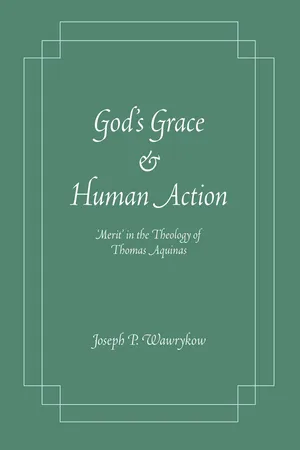
God's Grace and Human Action
'Merit' in the Theology of Thomas Aquinas
- 293 pages
- English
- ePUB (mobile friendly)
- Available on iOS & Android
eBook - ePub
About this book
Information
Topic
PhilosophyChapter 1
The Literature on Merit and Related Concepts
THIS CHAPTER has two principal goals. First, I review the secondary literature on merit in Thomas Aquinas, in order to identify the major problems and disputed questions confronting the interpreter of this aspect of Thomas’s thought. Second, I examine some of the literature on related aspects of Thomas’s theology. One of the gravest flaws of the literature on merit in Aquinas is that it views his teaching on this concept in isolation from the general flow of his thought. As I shall argue, however, it is only in its relation to other doctrines in his theology that Thomas’s teaching on merit can be fully appreciated. In particular, we cannot adequately grasp what Thomas means by ‘merit’ and establish what role it performs in his thought without reading his discussion of merit in terms of and in dialogue with his teachings on grace and hope. Indeed, many of the developments in Thomas’s teaching about merit reflect and incorporate the parallel developments in his thought about grace and hope. Hence in the second part of this chapter, I examine the literature on related themes which I find especially valuable for the correct interpretation of Aquinas’s theology of merit.
Section I. The Literature on Merit
Modern students of Aquinas have by and large neglected Thomas’s teaching on merit.1 Apart from occasional discussions of isolated aspects of Thomas’s analysis of this difficult area of theological discourse, as well as studies which review in passing this part of his soteriology, there have been but three book-length studies of merit in Aquinas in this century, and each of these works is seriously flawed.2 The earliest of these, Die Verdienstlichkeit der menschlichen Handlung nach der Lehre des hl. Thomas von Aquin (1931)3 by J. Weijenberg, is more a neo-scholastic philosophical defense of twentieth-century teaching about merit along Thomist lines than a serious historical treatment of the thought of Thomas himself.4 Indeed, to the extent that Weijenberg incorporates genuine Thomistic insights, it is exclusively to the Thomas of the Summa Theologiae that he has turned. Yet, even his use of the Summa is unsatisfactory, for Weijenberg’s polemic has caused him to distort Thomas’s analysis of merit. For example, Weijenberg directed his argument against contemporary philosophical trends which seek to deny personal freedom (p. 38f.) or to reject objective moral norms which guide human behavior (p. 41f.; pp. 48ff.) As a result, much of Weijenberg’s book rehearses those questions in the Summa (especially in the Prima Secundae) in which Thomas establishes the possibility of the good moral act in conformity with the will of God. And in his own analysis of the ‘meritability’ of human action Weijenberg places the stress on human freedom to do the good, that is, the “subjective” aspects of merit.5 Concomitantly, Weijenberg downplays the role of grace in merit, limiting it to “elevating” the morally good act to the supernatural order, to mere “adorning” of the good act in such a way that it can lay claim to a supernatural reward.6 Thomas, of course, acknowledges that in the present dispensation it is the morally good act done in freedom which is meritorious. But as his discussion of merit in the Summa at the end of the treatise on grace suggests, Thomas puts much greater emphasis than does Weijenberg on the role of grace in establishing the possibility of merit. Thomas’s analysis of grace in the Summa, as the inner effective working of the Holy Spirit on the will, is similarly much more dynamic than Weijenberg allows. In addition to his inadequate treatment of grace in the Summa and his failure to grant grace the leading role in merit, Weijenberg’s value as an interpreter of Thomas on merit is further diminished by his tendency to establish key points of his argument (ostensibly based on the thought of Aquinas) by reference to the explicit statements not of Thomas himself but of early twentieth-century Catholic theologians, who, needless to say, may differ in crucial respects from the teaching of Saint Thomas.7
A more competent study of merit in Aquinas is Prudentius De Letter’s monograph, De Ratione Meriti secundum Sanctum Thomam (1939).8 The book is divided into three chapters, each of which, in the scholastic style, is arranged in a series of articles. The first chapter discusses what De Letter calls the “ratio moralis” of merit in Aquinas, by which he means the ordination of human acts to retribution by divine justice; the second chapter examines the “ratio physica” of merit according to Thomas, that is, grace and charity, the “ontological principles” (p. 49) ordained to a supernatural end; and the final chapter describes the relations between these two rationes in the teaching of St. Thomas. Although De Letter’s work marks an improvement over Weijenberg’s, since De Letter is more careful to base his examination of Thomas’s teaching on what Thomas himself wrote, his treatment of merit too suffers from a number of deficiencies. First, De Letter has introduced a number of terms into his description of Thomas’s position not found in Thomas’s own teaching. As De Letter acknowledges in his conclusion,9 the terms ratio moralis and ratio physica, for example, are not Thomas’s but rather are employed in contemporary Catholic teaching on merit. Used to describe Thomas’s teaching, such terms are somewhat misleading. More grievously, De Letter’s work fails as history because of its incompleteness, inattention to chronology and lack of awareness of the development in Thomas’s treatment of merit. De Letter only examines Thomas’s ex professo discussions of merit in the Scriptum Super Sententiis and the Summa Theologiae. But Thomas discussed merit at some length elsewhere, and there is no reason to assume, as De Letter does, that his teaching remained identical. Additionally, De Letter’s belief that Thomas’s teaching on merit did not undergo development (with one exception) permits him to mix indiscriminately statements from the Scriptum with arguments from the Summa, ignoring not only the decade separating the completion of the Scriptum and the beginning of the Summa but also the methodological inappropriateness of such a procedure.10
De Letter, like Weijenberg, is guilty of distorting the thought of Aquinas on merit. As De Letter observes, in the Scriptum Thomas argues that the form of justice governing theological merit is distributive, while in the Summa, it seems rather to be a kind of commutative justice involved.11 De Letter therefore devotes most of his first chapter to recording the arguments used by Thomas in the Scriptum to establish merit as an instance of distributive justice, and then embarks on his own attempt to identify the species of justice governing merit in the Summa. It is clear that justice is involved to some extent in merit at all stages of Thomas’s career—after all, even in the Summa, merit means the establishment of some kind of claim or right to a reward in justice.12 But unlike De Letter Thomas in the Summa is hardly concerned to identify the species of justice governing this aspect of human-divine relations—it plays no part in his deliberations on merit in I-II 114, and he seems only to have mentioned that it is in fact “commutative” justice in merit in passing, elsewhere in the Summa (II-II 61, 4 ad 1). Thus, by focusing his energies on the precise identification of the kind of justice involved in Thomas’s analysis in the Summa, De Letter has concentrated on a facet of Aquinas’s thought about merit which no longer plays the central role it did in the Scriptum, that is, the determination of the kind of justice involved in merit. What is perhaps even more striking about De Letter’s analysis is that his discussion of the kind of justice involved in merit is not complemented with a study of the cause of Thomas’s changed ideas on justice in relation to merit. De Letter appears unaware of the implications underlying Thomas’s eventual rejection of distributive justice in merit (a justice which requires that God observe a kind of equality of proportion between the divine reward and the merits of various people) in favor, by the time of the Summa, of what can be termed “commutative” justice, which requires a “quantitative” equality between merit and reward. The basic reason that Thomas ascribes merit to commutative justice in the Summa is Thomas’s new emphasis in this work on the role of grace in creating the meritorious act and especially Thomas’s more dynamic conception of grace as the inner action of the Holy Spirit directly upon the will. Whatever “equality” there is between the meritorious act and its reward (and hence the possibility of commutative justice in merit), Thomas argues, is due to the equality of dignity between God’s grace and the divine reward. De Letter acknowledges that for the Thomas of the Summa, it is the action of the Holy Spirit which establishes equality between merit and reward (pp. 12, 18, 30, 93). But he does not follow up this insight with a consideration of how the Summa’s treatment of grace differs from that in the Scriptum, an endeavor which would explain why the Scriptum does not assert a basic equality between merit and reward. Rather, De Letter is content to say (p. 19) that the teaching about the Holy Spirit does not appear in the Scriptum to explain the equality of merit and reward because in this work Thomas looks at merit only in terms of the free will and its actions (admittedly as aided by grace), while in the Summa Thomas looks at the entire reality of the meritorious act, including the ontological aspects of the human person raised by grace to God’s level (see p. 30), and so is enabled to perceive the basic equality of merit and reward. It is not only a change of perspective, however, which accounts for the shift in Thomas’s thought. As we shall see in the discussion of Bouillard and Lonergan in the second part of the chapter, Thomas’s teaching on grace underwent considerable development from the time of the Scriptum to that of the Summa, and the developments in his thought on grace are of direct significance for his teaching on merit. It is unacceptable to assume, as De Letter does, that Thomas always understood grace (and hence merit) in precisely the same way.13
Finally, De Letter’s study of merit in Aquinas is unsatisfactory because it either neglects important questions in Thomas’s account of merit or subjects them to insufficient analysis. For example, De Letter disregards the development in Thomas’s teaching about the possibility of meriting the first grace. Although Thomists have long been aware that the Scriptum lacks the Summa’s adamant denial of the possibility of such meriting, and the Scriptum’s somewhat ambiguous language makes it difficult, as we shall see, to determine Thomas’s own position on this type of meriting in the early part of his career, De Letter has completely ignored this problem in his exposition of Thomas’s teaching.14 Similarly, the problem posed by Thomas’s use of the notion of a divine ordination to establish the possibility of merit in the Summa is a vexing one and has provoked a number of interpretations in the recent literature. However, although the divine ordination is the basis of meritability in the later work, De Letter does not attempt to offer a separate, detailed exposition of this term. He never defines the divine ordination and only mentions it in passing. Even when he uses the term, it is not really clear what he understands by it. In the majority of cases, it is evident that for De Letter the divine ordination refers especially to the “ontological principles,” grace and charity, given to the individual by God to insure the individual’s attainment of salvation (e.g., pp. 16, 23, 34); here the stress is on the intrinsic value of good works done in grace which directs or ordains these good works to the end of eternal life. On the other hand, at times De Letter seems to suggest a more “Franciscan” gloss on this term, speaking of God’s acceptance through the divine ordination of good works done in grace as meritorious (e.g., p. 47). In place, then, of a clarification of the meaning of this crucial term, De Letter simply avoids the issue, using the term when his argument demands it (especially when he cites a text from the Summa in which the term is used) but not bothering to explain precisely what Thomas means when he refers in the Summa to God’s ordination of human activity to the attainment of God.
William D. Lynn’s Christ’s Redemptive Merit (1962)15 addresses a problem debated by twentieth-century Thomists, concerning the manner of Christ’s meritorious causality and, more precisely, why according to Thomas only Christ could merit in a strict or condign sense for others. On the one hand, Thomists such as P. Glorieux16 have argued that Christ’s meritorious causality must be seen in terms of instrumental causality—Christ could merit for Christians because as the instrument of the Divinity, he alone was able to cause in others the dispositions needed to receive grace. Other Thomists, however, refuse to identify meritorious and instrumental causality. For them, Christ’s meritorious activity is strictly speaking simply to be viewed in terms of merit; that is, Christ’s work as human establishes a right to reward, in which right those who are joined to Christ may share. In order to resolve this dispute, Lynn first examines Thomas’s general teaching on merit. His strategy is to identify the formal effect of merit—either to create a disposition needed to receive grace or to establish a right to a reward—and then to apply Thomas’s general teaching on merit to the more obscure problem of the nature of Christ’s redemptive merit for human beings. Though heavily dependent on De Letter’s study in this first part,17 Lynn’s treatment is more satisfactory in a number of ways. First, with respect to the principal concern of the first part of his book, Lynn has enumerated a great number of Thomas’s texts on merit in which merit is discussed in juridical and then in “material” or dispositional terms, and shows conclusively that it is the former that merit entails a title to reward injustice, which is the basic one for St. Thomas (p. 7).18 Second, Lynn’s methodology is more acceptable than De Letter’s, for Lynn is more careful to distinguish statements made in the Scriptum from those in the Summa and he has observed a number of instances in which Thomas’s teaching in the later work seems to differ from that in the earlier (see e.g., p. 23).19 Third, Lynn is also aware that Thomas’s analysis of grace is more dynamic in the Summa, causing him to emphasize more adequately the role of grace in merit in this later work (p. 29). Fourth, unlike De Letter, Lynn acknowledges that by the time of the Summa, Thomas’s interest in categorizing the justice involved in merit had faded (p. 24). Accordingly, Lynn does not replicate De Letter’s exhaustive effort to identify the kind of justice operative in the Summa’s treatment of merit.
Fifth, Lynn not only notes that in the Summa Thomas makes repeated use of the concept of a “divine ordination” to ground merit and that the invocation of the ordination marks a significant improvement ...
Table of contents
- Title Page
- Copyright Page
- Contents
- Preface
- Acknowledgments
- Chapter 1. The Literature on Merit and Related Concepts
- Chapter 2. The Early Teaching on Merit
- Chapter 3. The Mature Teaching on Merit
- Chapter 4. Concluding Observations: Thomas and His Authorities
- Selected Bibliography
Trusted by 375,005 students
Access to over 1.5 million titles for a fair monthly price.
Study more efficiently using our study tools.
Frequently asked questions
Yes, you can cancel anytime from the Subscription tab in your account settings on the Perlego website. Your subscription will stay active until the end of your current billing period. Learn how to cancel your subscription
No, books cannot be downloaded as external files, such as PDFs, for use outside of Perlego. However, you can download books within the Perlego app for offline reading on mobile or tablet. Learn how to download books offline
Perlego offers two plans: Essential and Complete
- Essential is ideal for learners and professionals who enjoy exploring a wide range of subjects. Access the Essential Library with 800,000+ trusted titles and best-sellers across business, personal growth, and the humanities. Includes unlimited reading time and Standard Read Aloud voice.
- Complete: Perfect for advanced learners and researchers needing full, unrestricted access. Unlock 1.5M+ books across hundreds of subjects, including academic and specialized titles. The Complete Plan also includes advanced features like Premium Read Aloud and Research Assistant.
We are an online textbook subscription service, where you can get access to an entire online library for less than the price of a single book per month. With over 1.5 million books across 990+ topics, we’ve got you covered! Learn about our mission
Look out for the read-aloud symbol on your next book to see if you can listen to it. The read-aloud tool reads text aloud for you, highlighting the text as it is being read. You can pause it, speed it up and slow it down. Learn more about Read Aloud
Yes! You can use the Perlego app on both iOS and Android devices to read anytime, anywhere — even offline. Perfect for commutes or when you’re on the go.
Please note we cannot support devices running on iOS 13 and Android 7 or earlier. Learn more about using the app
Please note we cannot support devices running on iOS 13 and Android 7 or earlier. Learn more about using the app
Yes, you can access God's Grace and Human Action by Joseph P. Wawrykow in PDF and/or ePUB format, as well as other popular books in Philosophy & Medieval & Renaissance Philosophy. We have over 1.5 million books available in our catalogue for you to explore.