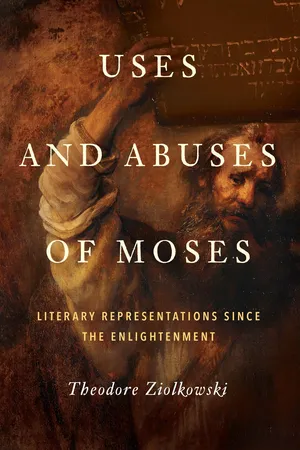
In Uses and Abuses of Moses, Theodore Ziolkowski surveys the major literary treatments of the biblical figure of Moses since the Enlightenment. Beginning with the influential treatments by Schiller and Goethe, for whom Moses was, respectively, a member of a mystery cult and a violent murderer, Ziolkowski examines an impressive array of dramas, poems, operas, novels, and films to show the many ways in which the charismatic figure of Moses has been exploited—the "uses and abuses" of the title—to serve a variety of ideological and cultural purposes. Ziolkowski's wide-ranging and in-depth study compares and analyzes the attempts by nearly one hundred writers to fill in the gaps in the biblical account of Moses' life and to explain his motivation as a leader, lawgiver, and prophet. As Ziolkowski richly demonstrates, Moses' image has been affected by historical factors such as the Egyptomania of the 1820s, the revolutionary movements of the mid-nineteenth century, the early move toward black liberation in the United States, and critical biblical scholarship of the late nineteenth century before, in the twentieth century, being appropriated by Marxists, Socialists, Nazis, and Freudians. The majority of the works studied are by Austro-German and Anglo-American writers, but Ziolkowski also includes significant examples of works from Hungary, Sweden, Norway, the Ukraine, Denmark, the Netherlands, Italy, and France. The figure of Moses becomes an animate seismograph, in Ziolkowski's words, through whose literary reception we can trace many of the shifts in the cultural landscape of the past two centuries.
eBook - ePub
Uses and Abuses of Moses
Literary Representations since the Enlightenment
- 357 pages
- English
- ePUB (mobile friendly)
- Available on iOS & Android
eBook - ePub
About this book
Information
Publisher
University of Notre Dame PressYear
2016Print ISBN
9780268102067
9780268045029
eBook ISBN
9780268098551
ONE
Nineteenth-Century Evolutions
EGYPTOMANIA
Writers in the first half of the nineteenth century were more powerfully affected by the reigning Egyptomania than by developments in biblical scholarship. The scholars, to be sure, were not inactive. The era of rationalism prompted a more critical look at ancient texts and sources than had earlier been the case. Such New Testament scholars as Hermann Samuel Reimarus (1694–1768) and Heinrich E. G. Paulus (1761–1851) began the critical reading of the Gospels that led to David Friedrich Strauss’ path-breaking Life of Jesus (Das Leben Jesu, 1835), which stripped away all the “mythic” elements in order to present a purely human Jesus. The classical philologist Friedrich August Wolf raised questions about the authorship of the Homeric epics in his epoch-making Prolegomena ad Homerum (1795), where he proposed what came to be known as the Liedersammeltheorie (song collection theory), that is, that the Iliad and the Odyssey were not written by one man but assembled from a collection of existing ballads. Inspired by this theory, other scholars applied it to such medieval romances as the Nibelungenlied in an effort to trace their composition.
On the basis of work by Gottfried Eichhorn (1753–1827), professor of biblical studies at Jena and then at Göttingen, who is known as the founder of Old Testament criticism, and in all likelihood influenced by the Liedersammeltheorie, such scholars as Wilhelm Martin Leberecht de Wette (1780–1849), initially in his Dissertatio critico-exegetica (1805), laid the groundwork for the so-called documentary hypothesis, which holds that the Pentateuch, rather than having been written by Moses, resulted from the compilation of several discrete sources. This theory, given its classic formulation by Julius Wellhausen in his Prolegomena to the History of Israel (Prolegemena zur Geschichte Israels, 1883), dominated biblical criticism until the mid-twentieth century.
After his momentous dissertation on the Hebrew Bible, De Wette wrote in his historical-critical “Introduction to the Old and New Testament” (1817) that “it is nonsense to assume that One Man created the epic-historical, rhetorical, and poetic style in its entire breadth as well as the realms of Hebrew literature in content and spirit and left it to all subsequent writers simply to follow him.”1 In the same work he explained that “the following differentiation of the Elohist and Jehovist elements according to Stähelin has a high degree of probability” (181; §151)—a distinction (E and J) to which the documentary hypothesis subsequently added the Priestly Code (P). For the time being, however, these exciting findings remained largely within the scholarly province and appear to have had no broader public or literary impact.
It was a wholly different story with the current Egyptomania.2 Egypt had long, at least since Herodotus, exerted a seemingly irresistible attraction for Western writers. Various works—such as John Greaves’ Pyramidographia (1646) and the studies by the Jesuit polymath Athanasius Kircher (e.g., Œdipus Ægyptus [1652], in which he argued that Adam and Eve spoke Egyptian)—provided ideas and images for the early Egyptophilia evident in the ceremonies of such secret societies as the Freemasons (as in Mozart’s Magic Flute) and in the pyramid placed at the suggestion of such Masonic founders as Benjamin Franklin on the reverse of the Great Seal of the United States (and subsequently on the one-dollar bill).3
But Egyptomania, along with the rudiments of modern Egyptology, began properly as a consequence of Napoleon’s highly publicized campaign in Egypt (1798–1801), which was accompanied by a sizable troupe of artists and scholars. Although Napoleon was soon driven out by the British, the campaign produced such immensely popular works as Vivant Denon’s Travels in Upper and Lower Egypt (1802) and the twenty-three volumes of Description de l’Égypte (1809–28), which included 907 plates encompassing more than 3,000 illustrations. It also resulted in considerable pillaging: both “official,” for European museums, and criminal looting, which provided plentiful Egyptian artifacts for a public newly fascinated by the reports about ancient Egypt—a fascination that lasted at least down to Sigmund Freud, who proudly displayed several such objects on his desk in Vienna’s Bergstrasse.
The publicity was enhanced by Jean-François Champollion’s decipherment of the Rosetta Stone in 1822, which opened the way for the new field of Egyptology, founded in Germany by Karl Richard Lepsius (1810–84) and in England by Sir John Gardner Wilkinson (1787–1875). But only toward the end of the century, with the work of such professionalized archaeologists as W.M. Flinders Petrie, could the field of Egyptology be established as a proper academic discipline.4 The excitement about Egypt rapidly manifested itself in literary works in Germany, France, and England.
PRELUDES IN GERMANY AND ENGLAND
Lesser figures are often more representative of their time than the more famous names because, rather than setting their own course, they flow with the prevailing currents. August Klingemann (1777–1831) is known best to literary history as the presumptive author of the pseudonymously published Romantic satire, Bonaventura’s Nightwatches (Die Nachtwachen des Bonaventura, 1804). From 1814, as a theater director in Brunswick and the author of useful theatrical criticism, he also wrote a number of mainly historical novels and plays that enjoyed popular success but no critical esteem among his classical or romantic contemporaries.5 Yet they exemplify views typical of the age of idealism in Napoleonic and post-Napoleonic Germany, when writers were torn between classicism and romanticism and infected by a revolutionary fervor.
Klingemann, perhaps the most pronounced “Schiller epigone” of his generation,6 shared at the same time the progressive views of his contemporaries. His plays, written in classical iambic pentameter, instead of emulating Schiller’s sophisticated psychological insights, single out and emphasize a single character trait. Thus the hero of his Luther (1809) emerges not so much as the founder of a new religion as a bold socio-political reformer. Similarly, the hero of his Moses (1812) displays neither subtlety nor the uncertainty of such Schillerian heroes as Wallenstein but, as we shall see, bulls his way single-mindedly to his goal despite the opposition of an equally arrogant pharaoh.
At the same time Klingemann’s “Dramatic Poem in Five Acts” displays other characteristics of the age.7 The image on the title page, the statue of a multibreasted Isis standing on a vast plain in front of several pyramids,8 testifies to the prevailing Egyptomania and anticipates the many allusions to Egyptian religion and culture. Then immediately the dedication—“as a token of heartfelt respect” to Israel Jacobsohn, president of the Israelite Consistorium in Cassell, whom Klingemann knew when he was a young man—both signals the author’s view of Moses as “savior, liberator and lawgiver of the Israelite Nation” (Denkmal des Retters, Befreiers und Gesetzgebers der Israelitischen Nazion) and hints at his view of Moses as a Napoleonic figure set on freeing the Hebrews just as Napoleon liberated the Jews in Germany through a Napoleonic edict of 1808.
A lengthy preface characterizes Moses as one of the greatest characters that history has given us. He was shaped—and here Klingemann follows Schiller’s argument—by “the sacred secrets of Isis” (viii: die heiligen Geheimnisse der Isis) at a time when a degenerate priesthood emphasized appearance rather than essence and deceived the people with their tricks. Klingemann, again following Schiller, quotes the renowned inscription from the Temple of Isis at Sais: “I am what is and shall be, and no mortal has raised my veil.” Here he learned the secrets of nature that later enabled him to achieve uncommon effects, not as a magician, but as “an ardent visionary” (x: begeisterter Seher). He recognized in nature “the symbolic shape of Isis” (xii: der symbolischen Gestalt der Isis), and he perceived Jehovah “concealed in the secret of IAO” (“the mystery of the sole deity in the mysteries of Isis,” as later explained in a note [73]).9 It is his fervor for a divine idea combined with his effort to realize it, Klingemann continues, that constitutes the dramatic motive in Moses’ character. At several points in the play itself Moses talks extensively about his experience of the innermost secrets of the Egyptian mysteries, explaining “how one supreme spirit illumines her [nature’s] heart—a spirit that is one and exists through itself and is the wellspring and source of all being.”
Wie ein höchster Geist ihr Herz erleuchtet,
Der einzig ist und durch sich selbst besteht,
Und alles Daseins Quell und letzter Ursprung. (133)
The play begins with a prologue portraying the circumstances of Moses’ birth. His father’s first words, a lament for his people who die while slaving on the pyramids as their children are drowned in the Nile, state the theme: “Who will be your savior from this misery!” (4: Wer wird Dein Retter sein, aus diesem Elend!). Their own son, whom they have successfully hidden for three months, is unwittingly betrayed by a neighbor. Jochebeth and Mirjam take the child to the river, where they see Princess Thermutis, who is captivated by the child and feels her own “Mutterherz” (30) stirring for him. Wanting no part of the “bloody sacrilege” (31: jenem blut’gen Frevel) being carried out by her brother (as a result of his dream that a newly born Hebrew child would overthrow his reign), she decides to keep the child and to be its “second mother,” even though she quickly perceives that Jochebeth is the true mother. She names him Moses because—and here the author footnotes Josephus’ etymology—she drew him out of the water.
The action proper begins years later in Sinai, where Jethro and Zipora gaze up at Moses, standing atop Mount Horeb. He has recently changed, his wife observes, and now appears to her like “a mighty general or king” (48: ein gewalt’ger Feldherr, oder König) and even “mightier than a tribal leader or priest” (51: mächt’ger als ein Stammherr selbst oder Priester). Then Joshua arrives from Egypt and relates the history of the Hebrews in that land down to the present ruler, Sesotris, the mightiest of all pharaohs. But Moses objects: “Not of all. Up yonder reigns a pharaoh who pulverizes his power, before whom Isis and Osiris fall.”
Nicht aller, aller nicht! dort oben herrscht
Ein Pharao, der seine Macht zerstäubt,
Vor dem die Isis und Osiris sinken! (60/61)
He reveals his identity as the notorious Moses, citing his killing of the brutal taskmaster and flight. As he speaks, fire breaks out on Horeb, the earth trembles, and the clouds are alight. When the others leave, lightning strikes the bush, causing Moses to faint. Recovering, he removes his sandals, kneels, and in a monologue promises to proclaim the Jehovah of Israel: not Peon (the deity of Midian), not Isis and Osiris, not the Egyptian IAO (as explained in the cited note). Leaving Jethro and Zipora behind, he departs for Egypt with Joshua.
As act 2 opens, Moses has been back long enough to become reacquainted with Aaron and Mirjam, who have preached and sung his message to the Hebrews. When the Elders join them, Moses reports that he has been sent to lead them back—that they deserted Jehovah, and not vice versa. Only Korah, true to his role as rebel against Moses, disagrees, wondering to himself whether “a second pharaoh is rising for us” (88: Entsteht uns noch ein zweiter Pharao?). Joshua rushes in to tell Moses that guards are coming to arrest him for his killing of the taskmaster. As they chain him and lead him away, lightning frightens the guards. Meanwhile, at the Temple of Isis a grand procession arrives with the captured Ethiopian king, whom Sesotris haughtily liberates. When the chained Moses is brought in, the priests tell Sesostris about his father’s fateful dream. Although they demand Moses’ death, Pharaoh liberates him too, incapable of imagining, in his arrogance, that anyone—Ethiopian king or Hebrew slave—is capable of harming him. Then Moses asks that his people be allowed to go three days into the desert for their sacrifices, which would offend the Egyptians. When Pharaoh refuses, as the music of Isis resounds in the background, Jehovah’s thunder drowns it out.
In act 3 Korah is complaining because the Egyptians are cursing Moses for the plagues that afflict the land, and Pharaoh has increased their labors. Even Aaron believes that the Hebrews have been destroyed by their servitude. But Moses assures him that in his vision on Mount Horeb he comprehended “the sacred highest being” (135: das heilig höchste Wesen) and his plans for Israel. At the palace, meanwhile, Pharaoh is infuriated when the water brought for him to purify his hands is bloody. He sends for Moses as messengers announce that a plague of locusts has destroyed the crops. When Moses and Aaron threaten Pharaoh with further afflictions, he is furious. Moses now warns the priests that he “will rip the veil of Isis and raise into the light the IAO buried beneath the rubble of [their] idolatry.”
Drum will den Isis-Schleier ich zerreissen,
Und den IAO in das Licht erheben,
Den eures Götzenthums Schutt begräbt. (154)
When Pharaoh seizes his scepter to threaten Moses, it breaks in half, and Moses summons a darkness that the priests of Isis are powerless to over-come, while lightning strikes one who threatens Moses. In his desperation Pharaoh finally agrees to let the Hebrews leave.
Soon, of course, he repeals that command, and guards again seek Moses. At the same time many Hebrews, incited by Korah, also rebel against Moses. At this point for the first time Moses displays his humanity: he is reluctant to summon the final horror, to “brandish your sword of vengeance” (170: Dein Racheschwert schwingen), he tells the Lord. Although Korah and his followers threaten to kill him, Moses warns the Hebrews to prepare for the Passover by putting lambs’ blood on their doorways. In the Temple of Isis, as Pharaoh finally orders Moses’ death, he learns that his wife has died of the pestilence along with a priest at the altar and the sacred bull Apis. All his advisers urge Pharaoh to let the Hebrews go, but he ...
Table of contents
- Cover
- Title Page
- Copyright
- Dedication
- Contents
- Preface
- Introduction
- One. Nineteenth-Century Evolutions
- Two. Postfigurations of Moses
- Three. Fin-de-Siècle Variations
- Four. The Jewish Renaissance
- Five. Moses Viewed Askance
- Six. Politicizations of the Twenties
- Seven. Fresh Starts in the Forties
- Eight. Denominational Moses
- Nine. The Fifties and Beyond
- Ten. Toward the Twenty-First Century
- Conclusion
- Notes
- Chronological List of Works Treated
- Bibliography
- Index
Trusted by 375,005 students
Access to over 1.5 million titles for a fair monthly price.
Study more efficiently using our study tools.
Frequently asked questions
Yes, you can cancel anytime from the Subscription tab in your account settings on the Perlego website. Your subscription will stay active until the end of your current billing period. Learn how to cancel your subscription
No, books cannot be downloaded as external files, such as PDFs, for use outside of Perlego. However, you can download books within the Perlego app for offline reading on mobile or tablet. Learn how to download books offline
Perlego offers two plans: Essential and Complete
- Essential is ideal for learners and professionals who enjoy exploring a wide range of subjects. Access the Essential Library with 800,000+ trusted titles and best-sellers across business, personal growth, and the humanities. Includes unlimited reading time and Standard Read Aloud voice.
- Complete: Perfect for advanced learners and researchers needing full, unrestricted access. Unlock 1.5M+ books across hundreds of subjects, including academic and specialized titles. The Complete Plan also includes advanced features like Premium Read Aloud and Research Assistant.
We are an online textbook subscription service, where you can get access to an entire online library for less than the price of a single book per month. With over 1.5 million books across 990+ topics, we’ve got you covered! Learn about our mission
Look out for the read-aloud symbol on your next book to see if you can listen to it. The read-aloud tool reads text aloud for you, highlighting the text as it is being read. You can pause it, speed it up and slow it down. Learn more about Read Aloud
Yes! You can use the Perlego app on both iOS and Android devices to read anytime, anywhere — even offline. Perfect for commutes or when you’re on the go.
Please note we cannot support devices running on iOS 13 and Android 7 or earlier. Learn more about using the app
Please note we cannot support devices running on iOS 13 and Android 7 or earlier. Learn more about using the app
Yes, you can access Uses and Abuses of Moses by Theodore Ziolkowski in PDF and/or ePUB format, as well as other popular books in Literature & Literary Criticism for Comparative Literature. We have over 1.5 million books available in our catalogue for you to explore.