![]()
CHAPTER 1
Unorthodox Methods in the Home Rule Newspaper Wars
Irish Nationalism, Phoenix Park, and the Fall of Parnell
Writing in English is the most ingenious torture ever devised for sins committed in previous lives. The English reading public explains the reason why.
—James Joyce to Fanny Guillermet, September 5, 1918
Most of the previous scholarship on the New Journalism to which James Joyce so objected has focused on the London press, suggesting at least tacitly that the British New Journalism arose in isolation, the brainchild of a few well-positioned English newspapermen.1 As this and the following chapter demonstrate, however, the defining elements of the New Journalism actually emerged out of a complex, interactive circuitry to which a range of metropolitan and regional newspapers across the British archipelago and beyond contributed facts and copy, phraseology, norms, and perspectives.2 This network, in turn, both influenced and was particularly influenced by a series of Dublin- and London-based trials, internal party politics, and interparty debates and negotiations in and out of the House of Commons.
An examination of scandal journalism’s historical context and development is essential to understanding its lasting political and literary effects on the career and work of James Joyce. Many of the changes in technology, capital, the law, and literacy that enabled London-based journalists like W. T. Stead to pursue what he termed “government by journalism” in the mid-1880s also spurred similar transformations in Ireland.3 Yet as this chapter will show, conditions specific to the colonial situation rendered the advanced Irish nationalist press especially radical, innovative, and consequential both within and beyond Ireland during this period.4 These conditions in turn gave birth to the Home Rule scandal wars that eventually brought about the fall of Parnell, as discussed in this chapter, and set the groundwork for the “Maiden Tribute of Modern Babylon,” Dilke, and Oscar Wilde scandals, which are addressed in the next chapter.
In the years just preceding the first manifestations of the new popular journalism in London, Irish politics were undergoing a rapid sea change, led by what A.M. Sullivan described at the time as “a rural generation that has grown to manhood” since the Great Famine of 1845–1849.5 Starting in 1878, Ireland’s agrarian economy was rocked by serial crop failures and the influx of cheap American beef, and Ireland’s rural dwellers responded to waves of agrarian scarcity and an upsurge in evictions with astonishing resolution.6 From 1878 to 1882, Ireland’s small farmers and agrarian workers, in a loose coalition with the remnants of the more radically nationalist Fenian movement, propelled Charles Stewart Parnell and the Land League into a position of unprecedented prominence.7 The new collective agency wielded by Parnell and the Land League was in turn made possible by the spread of literacy and newspapers throughout Ireland. Although there are valid arguments that Ireland’s sense of itself as a nation actually preceded other European nationalisms, the growth of literacy and the proliferation of newspapers in Ireland described by Legg certainly enhanced the simultaneity of group identification and collective affect that Benedict Anderson attributes to a similar critical mass of newspapers and newspaper readers in other emergent nation-states.8
Beyond inspiring a new spirit of national cohesion and political resolve, Irish nationalist newspapers also enabled new forms of political action.9 Whereas in the early nineteenth century Daniel O’Connell sent political messages to the London press through “monster rallies” that made their point through the vast aggregation of bodies, in the late nineteenth century Parnell was doing the reverse: sending heartening, unifying messages to his Irish nationalist constituents through newspaper coverage of his obstructive performances in the House of Commons. In short, the material and social shifts in newspaper production and consumption in Ireland during this period gave rise to new forms of political affiliation, new modes of political expression, and new structures of feeling.10
The Irish, in turn, exerted a strong gravitational pull on British journalism, both as individual writers and editors, many of whom only moved up the ladder to London once they had learned their craft in Irish cities, and as a collective “question” subject to pervasive and passionate debate.11 In exerting this influence, however, Irish attempts to place their case before the British public frequently backfired, leaving them the worse for seeking justice within a system rigged against them. Because of the ambiguously transnational economic and communication networks that converged there, turn-of-the-century Dublin exhibited a labyrinthine complexity that was nicely captured in Irish Labor leader James Larkin’s description of the Dublin newspaper magnate, Catholic nationalist, and union buster William Martin Murphy as an “industrial octopus.”12 Newspapers were one major tentacle system within this transnational tangle. They were also, as Larkin’s figure of an Irish Catholic newspaper owner as controlling hub of a transnational industrial network suggests, a particularly apt emblem for the disguised and far-flung conflicts of interest that could covertly drive complex alliances and enmities during this period. Larkin’s monstrous industrialist cum octopus extended across the British Isles and beyond through a range of economic, political, and social conduits, some more visible than others.13
The tense interpenetration of sometimes conflicting and sometimes coinciding economic, political, and personal interests that characterized networks connecting political leaders across the British Isles offered particular motives and opportunities for scandalmongering. Thus, as it emerged in this context in the early 1880s, the weapon of scandal was an intimate one, most commonly originating between friends, allies, or at least social equals. Parnell, the Land League’s iconic leader, ultimately fell victim to this dynamic, and the echoes of his fall resound across James Joyce’s work.
RADICAL SCANDALING: IRISH NATIONALISTS AND THE NEW JOURNALISM
Throughout the period 1881–1895, on which this study focuses, Irish nationalists devised a number of innovative methods to manipulate the representational discrepancies that the New Journalism was first to challenge and later to exacerbate. In Parliament, Parnell and his colleague Joseph Biggar devised new modes of political performance through an array of obstructionist tactics in the House of Commons that slowed or halted parliamentary business by endlessly providing detailed evidence concerning matters of pressing importance to the Irish but of little or no concern to non-Irish MPs. By calling attention to the incommensurability between matters in Ireland that required state attention and Ireland’s disempowered position within the United Kingdom, Parnell’s obstructive performances powerfully dramatized the need for an independent Irish governing body in which Ireland’s most pressing concerns would not be inappropriate intrusions.
In the House of Commons, Parnell expressed with persistence and dignity an ungentlemanly and elaborate noncompliance with the collective aims of a body of British gentlemen that had, with the utmost civility, repeatedly condemned broad swaths of the Irish population to starvation and death. Parnell’s use of the letter of the law to spectacularly violate the law’s spirit of colonial subservience united nationalist supporters at both ends of the political spectrum and gave new agency to MPs whose numbers and disempowered geopolitical position otherwise entitled them to no power whatsoever.14 Performatively, obstructionism also had a sort of perfect pitch, irresistibly reminding observers with its every eye-catching enactment of the bad faith in which Ireland was bound to the United Kingdom through an Act of Union that the majority of the Irish people had never endorsed. Finally, the noncompliant, aggressive, obstreperous attitude of obstructionism served to channel toward the English some of the frustration and rage that were the inevitable by-products of life under colonial rule. This quality of Parnellite obstruction, its public expression of otherwise silenced resentment, appealed to a broad range of Irish nationalists.15
During the long bout of intense anticolonial conflict that began with the outbreak of the Land Wars in 1878, Irish nationalists of all stripes sought new ways to set forth their grievances and counteract their negative representation in British newspapers. As the rest of this chapter demonstrates, this representational battle was largely fought in the news, propelled by several notable scandals, beginning with the Phoenix Park murders and ending with the scandal that terminated Parnell’s political career. Early in this period, in 1881, two Irish National Party MPs, William O’Brien and Tim Healy, became the editorial team of the party’s new weekly newspaper, the United Ireland. As Land League MPs, both O’Brien and Healy had observed and participated in Parnell and Biggar’s parliamentary strategies for slowing, obstructing, or turning back on itself a stream of British-initiated verbal exchanges and events, and in the pages of the United Ireland they translated these strategies into print. O’Brien and Healy first targeted the private transgressions of colonial administrators as a weak spot in the otherwise impenetrable armature of the colonial apparatus in the United Ireland’s first eighteen months of existence. In so doing, in Klaus Theweleit’s terms, they “substitute[d] a moral battle for a political one,” thereby establishing the conventions of the modern political sex scandal.16 This approach, one among many attempted by the hard-beset nationalists in the early 1880s, was so successful and stood up so well in court that it spawned a new scandal logic that would be purveyed well into the future, encoded in the conventions of the genre that was to define the New Journalism. By successfully compelling mainstream newspapers across the archipelago to cover an Irish grievance, this new scandal logic temporarily shifted the English press’s representations of Ireland away from its habitual fixation on Irish savagery and perfidy. It also eventually led to the scandal that destroyed Parnell and his movement, earning Tim Healy and the newspaper scandal itself the enmity of the young James Joyce.
A spirit of exuberant defiance imbues the United Ireland’s early issues. These issues, like Parnell’s exhaustive readings of the medical conditions of Fenian prisoners before the assembled House of Commons, constituted through their very existence an implicit criticism of their larger discourse context. The earliest object of the new weekly’s implicit criticism was Dublin’s moderate nationalist daily, the Freeman’s Journal, for which the United Ireland’s founding editor, William O’Brien, had previously worked. O’Brien’s defection, coupled with the clear implication that the Land League needed a paper further advanced in its views than the Freeman’s Journal, sent a signal to that publication’s editor, Edmund Dwyer Gray: Land League leaders had noted his lukewarm commitment to the cause and would speak to the nationalist reading public through another paper if they had to. Thus was Gray’s loyalty to Parnell and his movement ensured until Parnell’s final downfall, since Gray feared that further criticism of Parnell might prompt the United Ireland to go daily and take much of the Freeman’s Journal’s readership with it.17
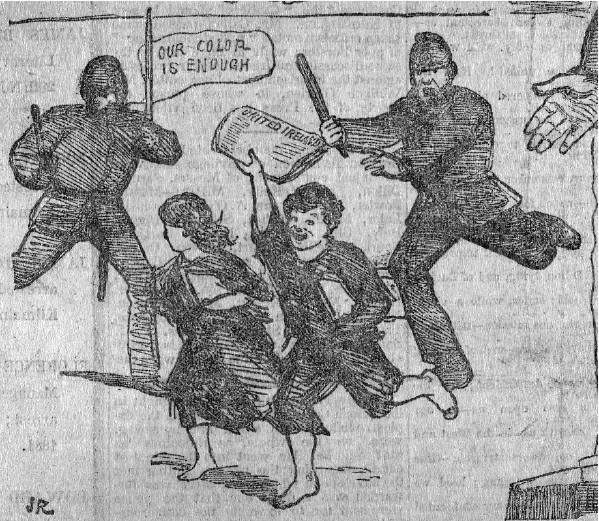
The near-ebullient opposition that the Land League evinced during this period is vividly expressed in some of the United Ireland’s cartoons from the early 1880s depicting the newspaper’s position of noncompliance relative to agents of British coercion. Cartoons and editorials from this period indicate that the newspaper viewed itself as holding an important position in the larger fight for improved tenant rights, land redistribution, and, ultimately, some form of Irish independence. The paper’s position of courageous intransigence registers visually in cartoons depicting the gleeful children who helped to distribute the United Ireland defying the Royal Irish Constabulary’s efforts to suppress the paper (Figure 1.1). Indeed, the newspaper’s bad attitude was likely one factor influencing Gladstone’s decision to imprison Land League leaders and suppress the Land League itself in the months following its establishment. In any case, the newspaper and its creators, O’Brien and Healy, expressed to a great extent the rebellious and brilliantly mischievous spirit of Parnell’s parliamentary activities throughout the period of the Land League’s suppression in 1881–1882. All of this changed radically and abruptly, however, following the Phoenix Park and Maamtrasna murders.
THE PHOENIX PARK MURDERS
Throughout the period of Parnell’s rise and fall, relations between Irish nationalists and colonial authorities were tense, polarized, and subject to frequent escalations to violence on both sides. With a synchronicity of which Joyce was demonstrably aware, the two complexly interlinked societies of Ireland and Britain, deeply agitated by the new affective and social powers of the emerging mass media, were both becoming increasingly reactive, subject to particularly fraught spirals of violence into words and words into violence, a process galvanized through the proliferating newspapers and their expanding audiences. For instance, following the publication of the first issues of the United Ireland in 1881, a series of shocking events with significant implications for the nationalist movement unfurled. Mere months after the paper’s founding, first Land League leader Michael Davitt and subsequently the rest of the party’s leaders, including Parnell, O’Brien, and Healy, were arrested under a new round of coercion legislation in Ireland. Such legislation enabled British agents to shut down avenues of nationalist agitation when these nationalists pushed too effectively for concessions unpopular with British constituencies, forcibly narrowing public discourse by imprisoning leaders, dispersing or suppressing rallies and riots, and targeting advanced nationalist newspapers at will.
Predictably, the imprisonment of Land League leaders prompted outbreaks of agrarian vigilantism and protest. These, in turn, supplied London-based newspapers with a gold mine of lurid details—threatening words and menacing deeds—fueling a stream of anti-Irish bombast that effectively deferred any further reasoned discussion of the Irish question. In Ireland, the nationalist front that Parnell had held together began to polarize. Middle-class nationalists and those who categorically rejected violence sought to dissociate themselves from the mainstream press’s depictions of Irish depravity by further moderating their position, while the Ladies Land League, which had stepped in to fill the vacuum created by the male leadership’s incarceration, openly endorsed the ad hoc violence.18 In early May 1882, when Parnell, Davitt, and the other Land League leaders, including O’Brien and Healy, were released from prison, the fraying nationalist front enjoyed a brief moment of reunification. Parnell had secured the leaders’ release under the terms of the so-called Kilmainham Treaty, in which British prime minister William Gladstone agreed to a series of reforms, and most nationalists greeted this development eagerly, with raised expectations for land reform and new hope for progress toward some form of Home Rule. On May 6, however, this moment’s fragile spirit of Liberal and nationalist cooperation was shattered by a bloody double murder in Dublin’s Phoenix Park: the fatal stabbings of the newly arrived Lord Lieutenant Henry Cavendish and his undersecretary, Thomas Henry Burke, by a shadowy group of Irish radicals called the Invincibles.19
From the standpoint of journalistic representation, the release of the Land League leaders had afforded a brief opportunity to redress a representational imbalance that inaccurately ascribed brute violence exclusively to the Irish side. The Phoenix Park murders blew that opportunity to smithereens. For Parnell and his comrades, the Phoenix Park murders constituted an appalling crisis. Fresh out of prison and facing an internal challenge from the Ladies Land League, they needed a disciplined national movement if they were to advance their aims of land reform and constitutional independence.20 Blindsided from within by the Invincibles’ militant rejection of the Home Rule negotiat...