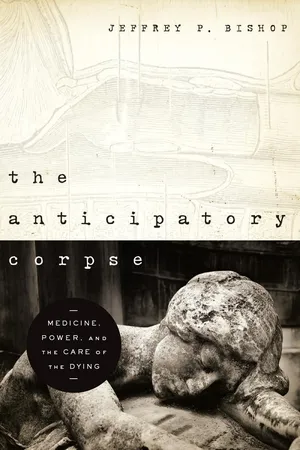
In this original and compelling book, Jeffrey P. Bishop, a philosopher, ethicist, and physician, argues that something has gone sadly amiss in the care of the dying by contemporary medicine and in our social and political views of death, as shaped by our scientific successes and ongoing debates about euthanasia and the "right to die"—or to live. The Anticipatory Corpse: Medicine, Power, and the Care of the Dying, informed by Foucault's genealogy of medicine and power as well as by a thorough grasp of current medical practices and medical ethics, argues that a view of people as machines in motion—people as, in effect, temporarily animated corpses with interchangeable parts—has become epistemologically normative for medicine. The dead body is subtly anticipated in our practices of exercising control over the suffering person, whether through technological mastery in the intensive care unit or through the impersonal, quasi-scientific assessments of psychological and spiritual "medicine." The result is a kind of nihilistic attitude toward the dying, and troubling contradictions and absurdities in our practices. Wide-ranging in its examples, from organ donation rules in the United States, to ICU medicine, to "spiritual surveys," to presidential bioethics commissions attempting to define death, and to high-profile cases such as Terri Schiavo's, The Anticipatory Corpse explores the historical, political, and philosophical underpinnings of our care of the dying and, finally, the possibilities of change. This book is a ground-breaking work in bioethics. It will provoke thought and argument for all those engaged in medicine, philosophy, theology, and health policy.
- 432 pages
- English
- ePUB (mobile friendly)
- Available on iOS & Android
eBook - ePub
About this book
Information
Publisher
University of Notre Dame PressYear
2011Print ISBN
9780268022273
9780268204099
eBook ISBN
9780268075859
Topic
Theology & ReligionSubtopic
Ethics & Moral PhilosophyChapter 1
Birthing the Clinic
As with any project that begins by taking up a thesis of Michel Foucault, one must first discuss Foucault himself. That is, I must give some account of how I understand Foucault’s work, particularly his work on medicine, psychiatry, and the social sciences. Yet placing Foucault is no small task. Foucault has occupied a questionable position as both historian1 and philosopher.2 Historians often reject him as a historian but are willing to entertain him as a philosopher; and philosophers often reject him as a philosopher but entertain his work as a historian. He has been considered a political philosopher,3 a theologian—or at least engaged in tasks that have engaged theologians4—and an enemy of hope.5 I embrace him as both a philosopher of history—where history becomes a philosophical category of analysis—and as a historian of philosophy—where philosophy is an endeavor to understand what animates very particular practices in very particular places at very particular times. Yet Foucault refused the manacle of historian of great ideas,6 and instead of writing histories of great ideas, he wrote the histories of the others of those great ideas. He wrote histories of thought about problems.7 He took for himself the moniker of historian of thought, or historian of problematizations.8
Hubert Dreyfus and Paul Rabinow present Foucault as both historical and philosophical; they think of Foucault as offering an interpretative analytics. Foucault is analytic in the Kantian sense when he searches out the conditions for the possibility of unreason in History of Madness, of medicine in The Birth of the Clinic, and of life, language, and labor in The Order of Things; but he also searches out the sources and legitimate uses of our various types of knowledge.9 His work is interpretative in that it seeks a pragmatic reading of the coherence of our practices—practices in which our knowledge is instantiated.10
Gary Gutting, on the other hand, does not wish to look for easy ways to make Foucault’s work cohere. For instance, Gutting separates Foucault’s works into three distinct eras: (1) archaeology of discourse (including History of Madness, The Birth of the Clinic, The Order of Things, and The Archaeology of Knowledge); (2) genealogy of power relations (including Discipline and Punish and the first volume of The History of Sexuality); and (3) the problematization of ethics (including the second and third volumes of The History of Sexuality, namely, The Use of Pleasure and The Care of the Self).11
Thus, it is difficult to embrace his methodology or take up a thesis from Foucault without first placing his work in some sort of context. In this chapter, I shall first give a brief interpretation of Foucault’s project, fully acknowledging that many interpreters of his various works would reject the possibility of a single Foucauldian project. However, Foucault is essential to my methodology as well as to the thesis of this volume. I shall attempt to give an account of how Foucault gained some of his insights, particularly on medicine, psychiatry, and the social sciences. I shall argue that Foucault describes the shifting ground for the conditions of possibility for medical practice. I shall further argue that these shifts are grounded in a shift in metaphysics. After briefly interpreting his Birth of the Clinic, I shall focus on one of Foucault’s insights, namely, that the dead body is epistemologically normative in medicine.
AT PLAY IN KANTIAN FIELDS
According to the pseudonymous Maurice Florence, “If Foucault is indeed perfectly at home in the philosophical tradition, it is within the critical tradition of Kant, and his undertaking could be called A Critical History of Thought.”12 If we take Foucault at his word—for Foucault wrote this about himself as Maurice Florence—then we shall have to say that insofar as he is a philosopher, Foucault is Kantian. Kant articulated the a priori conditions for the possibility of knowledge, and Foucault is interested in understanding the a priori conditions of knowledge, particularly the knowledge generated by the human sciences, medicine, and psychiatry.
Kant seeks those features of knowledge that exist prior to our experience of whatever occupies our attention. Those a priori features are the pure forms of intuition—space and time. As noted by Beatrice Han in her excellent treatment in Foucault’s Critical Project, Foucault needed to settle a problem presented by Kant, namely, the exact moment when the transcendental theme—the a priori of space and time—came to coincide with Kant’s study of anthropology. The concepts of subjects and objects, and space and time, have occupied much of Foucault’s work.
Foucault’s secondary doctoral thesis of 1961, which was not published during his lifetime, was a commentary on Kant’s Anthropology from a Practical Point of View.13 This thesis was central in forming Foucault’s later questions, for this is precisely the point, early in Foucault’s studies, when he began to seek a relationship between Kant’s anthropology and Kant’s three Critiques of reason and judgment. In his Critiques Kant attempts to articulate the transcendental conditions for the possibility of knowledge, but in Kant’s Anthropology, Foucault argues, there is an ambivalence between the transcendental constituting subject and the already constituted object. Han states: “The object of the Anthropology would therefore be neither the ‘subject in itself’ of the Second Critique, nor the ‘pure I’ as studied in the first, but an ‘object-I’—also ‘subject’—in other words, man in his paradoxical identity as determined and determining.”14 This idea of the constituted subject and the constituting subject—the “empirico-transcendental doublet”—was more clearly articulated by Foucault in The Order of Things.15 So, from early in his career, Foucault was at play in the terrain mapped out by Kant. He was addressing the “crises” or “problematizations” created by Kant, problematizations that manifest themselves in the practices of psychiatry, medicine, and other of the social sciences. These problems will come more fully into relief in this work.
In Foucault’s Introduction to Kant’s Anthropology, we even begin to see some of the problems associated with genealogical studies. He notes that Kant’s Anthropology developed over a thirty-year period and bemoans the fact that no earlier versions of the manuscript, as it developed, are available.16 We can see the outlines of Foucault’s method when he states, “it is impossible to make a clear distinction between the genetic perspective and the structural method in analysis of [Kant’s Anthropology].”17 In other words, in this very early work Foucault concerns himself not only with the subject that becomes its own object of investigation, creating the Kantian problematic, but also with his own method of discovering the conditions of possibility for this problem to emerge as a problem. Here, we see in a very cursory form the outlines of the intersections of Foucault’s genealogical (genetic perspective) and archaeological (structural method) studies. Foucault has a project that plays itself out within a Kantian tradition, precisely because he is concerned with subjects and objects, with what constitutes certain kinds of objects and subjects, and with the conditions of possibility for our present situation.
Han notes that if Foucault has a project, there needs to be an organizing question. That question is: How is it possible to have true knowledge, and what are the necessary conditions of that knowledge?18 This question animates Foucault’s work and is an essentially Kantian one. Furthermore, Foucault attempts to solve the problem of subjectivity while avoiding the transcendental reduction. So the organizing question is about the conditions of possibility for true knowledge; but to address that question, Foucault keeps butting up against questions about subjects, objects, and their constitution, but now not in terms of the pure forms of intuition—space and time—and categories of knowledge, but in terms of historical time and political space and the types of knowledges that are instantiated in our practices.
In an interview, Foucault comments on his interest in the history of thought, which is distinct from the history of ideas (by which he means the analysis of systems of representation), and which is also distinct from the history of mentalities (by which he means the analysis of attitudes and types of action).19 A history of thought is, instead, a history of “what allows one to step back from this way of acting or reacting, to present it to oneself as an object of thought and question it as to its meaning, its conditions, and its goals.”20 The step back is the critical step, a step back to get a good look at a problem and why the problem presents itself in these ways.
In the same interview, Foucault specifically refers to his previous works from all the different periods.21 He notes that in the History of Madness, he is documenting problems presented to what would become psychiatry. William Tuke and Philippe Pinel, he states, solve what appears to be the same problem in different ways. He observes that in Discipline and Punish he is examining eighteenth-century penal practices and how a whole group of solutions emerged to solve the difficulties encountered in the creation of prisons and penal systems in the second half of that century.22 He even cites his later work in the history of sexuality, in which he documents the different solutions proposed by different Hellenistic schools of thought on traditional sexuality.23 Thus, in retrospect, Foucault sees a critical coherency in his project.
In other words, Foucault’s works, in his own view, present a kind of history of the present, in which he identifies a problem in our own time—for example, madness, penal practices, or sexuality—and asks how we got to this point. Our present problems are a consequence of how the problems were addressed in the past, which, in turn, depended upon how these problems were perceived as problems to begin with. Thus, the work of the history of thought is to discover that at the center of the different solutions to problems is “the general form of problematization that has made them [these particular solutions] possible.”24 In order to identify issues faced by the present, we must first take a good look around at how the problems present themselves, based on the solutions documented in history. The solutions to problems emerge in particular historical and political circumstances and are instantiated in practices. That is to say, our various types of knowledge and our practices result from particular histories and particular political spaces.
TIME AND SPACE
We can see, therefore, that Foucault understands “man”—his term in The Order of Things—as not just some sort of object awaiting discovery by scientists. The study of madness or life or language—or, for my project, death—is shaped not only by history but also by the coincidence of factors in the surrounding space, each having their own historical development. Certainly, there are continuities in history, but there are also discontinuities. Moreover, the coincidence of continuities and discontinuities forms the conditions for the possibility for the truth claims, whether made by scientists or by doctors or by social scientists. Foucault is looking at the powers of constitution and at what is constituted. He is concerned with objects and subjects, and with the a priori conditions necessary for knowledge. He is concerned with marking out a zone of freedom, all the while attempting to historicize Kant’s transcendentals. He is also concerned with space and time, now political space and historical time, especially in Birth of the Clinic.
Edward Casey and Charles Scott both draw attention to the importance of space in Foucault’s Birth of the Clinic, and indeed, I would argue, in the whole of his work.25 For Heidegger, time is not just the tick-tick-tick of the clock but the historically constituted running toward death; similarly, for Foucault, space is never merely three non-contextual dimensions. The philosophies of time and space of both Heidegger and Foucault are linked back to Kant’s pure forms of intuition: space and time.26 As Kant notes in the Critique of Pure Reason, “This schematism of our understanding with regard to appearances and their mere form is a hidden art in the depths of the human soul, whose true operations we can divine from nature and lay unveiled before our eyes only with difficulty.”27 Moreover, “The schemata are therefore nothing but a priori time-determinations in accordance with rules, and these concern, according to the categories, the time-series, the content of time, the order of time, and finally the sum total of time in regard to all possible objects.”28 Time is the form of intuition that determines the imagination—the “depths of the human soul.”29 Out of this form of the intuition—namely, time—Kant holds that the time-series, the order of time, and other objective measures of time are possible, and that time is the form of intuition of the interior life of the mind, the “depths of the soul.”30
This point about the centrality of the schematism and the “depths of the human soul” is specifically noted by Heidegger in Being and Time—it leads to a question and problem from which Kant shrinks, according to Heidegger.31 “As pure intuition, time is that which furnishes an aspect prior to all experience,” as Heidegger argues against Kant’s doctrine of time.32 Time, he maintains, is operative for all categorizations of ordinary and scientific time and for the appearance of all objects, but not as pure intuition, not as the pure form. Time, for Heidegger, is not univocal. There are a myriad of times that structure our ways of experiencing those things that appear for us. One’s time in history is a kind of time into which one is thrown and which structures the kinds of projects in which one engages. Heidegger claims that time can be experienced but not represented, while death can be represented to oneself in the death of the other, but not experienced in itself. Thus, death, as the end of one’s time, also structures one’s experience, allowing certain kinds of objects or things or projects to come into relief. Hence, all forms of objective marking of time rest on the existential running into the future, toward death, toward the end of time. Death-time structures our experiences, the objects that emerge for us, and the projects in which we are engaged. Thus, like Kant with his “schemata” of the understanding, Heidegger grants a priority to time over subjects, objects, and space, even while time takes on a very different kind of meaning for Heidegger than it had for Kant.
Foucault takes space as an organizing principle, especially in his analysis of the rise of modern medicine; and, like Heidegger in his examination of time, Foucault is not exploring space as a pure form of the intuition; space is not an abstract a priori. Contrary to Kant and Heidegger, Foucault hold...
Table of contents
- Title Page
- Copyright Page
- Dedication
- Contents
- Acknowledgments
- Prelude
- Chapter 1. Birthing the Clinic
- Chapter 2. Maturing the Clinic
- Transition One
- Chapter 3. The Machinations of Life
- Chapter 4. Embracing Death
- Chapter 5. Commissioning Death: From Living Cadavers to Dead Brains
- Chapter 6. The Exact Location of Death: From Brain to Sovereign
- Chapter 7. The Sovereign Subject and Death
- Transition Two
- Chapter 8. The Discursive Turn
- Chapter 9. The Palliating Gaze
- Recapitulation
- Chapter 10. Anticipating Life
- Notes
- Bibliography
Trusted by 375,005 students
Access to over 1.5 million titles for a fair monthly price.
Study more efficiently using our study tools.
Frequently asked questions
Yes, you can cancel anytime from the Subscription tab in your account settings on the Perlego website. Your subscription will stay active until the end of your current billing period. Learn how to cancel your subscription
No, books cannot be downloaded as external files, such as PDFs, for use outside of Perlego. However, you can download books within the Perlego app for offline reading on mobile or tablet. Learn how to download books offline
Perlego offers two plans: Essential and Complete
- Essential is ideal for learners and professionals who enjoy exploring a wide range of subjects. Access the Essential Library with 800,000+ trusted titles and best-sellers across business, personal growth, and the humanities. Includes unlimited reading time and Standard Read Aloud voice.
- Complete: Perfect for advanced learners and researchers needing full, unrestricted access. Unlock 1.5M+ books across hundreds of subjects, including academic and specialized titles. The Complete Plan also includes advanced features like Premium Read Aloud and Research Assistant.
We are an online textbook subscription service, where you can get access to an entire online library for less than the price of a single book per month. With over 1.5 million books across 990+ topics, we’ve got you covered! Learn about our mission
Look out for the read-aloud symbol on your next book to see if you can listen to it. The read-aloud tool reads text aloud for you, highlighting the text as it is being read. You can pause it, speed it up and slow it down. Learn more about Read Aloud
Yes! You can use the Perlego app on both iOS and Android devices to read anytime, anywhere — even offline. Perfect for commutes or when you’re on the go.
Please note we cannot support devices running on iOS 13 and Android 7 or earlier. Learn more about using the app
Please note we cannot support devices running on iOS 13 and Android 7 or earlier. Learn more about using the app
Yes, you can access The Anticipatory Corpse by Jeffrey P. Bishop in PDF and/or ePUB format, as well as other popular books in Theology & Religion & Ethics & Moral Philosophy. We have over 1.5 million books available in our catalogue for you to explore.