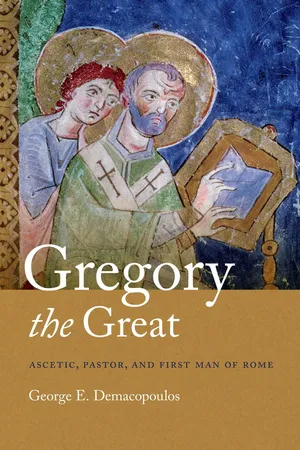
Gregory the Great (bishop of Rome from 590 to 604) is one of the most significant figures in the history of Christianity. His theological works framed medieval Christian attitudes toward mysticism, exegesis, and the role of the saints in the life of the church. The scale of Gregory's administrative activity in both the ecclesial and civic affairs of Rome also helped to make possible the formation of the medieval papacy. Gregory disciplined malcontent clerics, negotiated with barbarian rulers, and oversaw the administration of massive estates that employed thousands of workers. Scholars have often been perplexed by the two sides of Gregory—the monkish theologian and the calculating administrator. George E. Demacopoulos's study is the first to advance the argument that there is a clear connection between the pontiff's thought and his actions. By exploring unique aspects of Gregory's ascetic theology, wherein the summit of Christian perfection is viewed in terms of service to others, Demacopoulos argues that the very aspects of Gregory's theology that made him distinctive were precisely the factors that structured his responses to the practical crises of his day. With a comprehensive understanding of Christian history that resists the customary bifurcation between Christian East and Christian West, Demacopoulos situates Gregory within the broader movements of Christianity and the Roman world that characterize the shift from late antiquity to the early Middle Ages. This fresh reading of Gregory's extensive theological and practical works underscores the novelty and nuance of Gregory as thinker and bishop.
- 240 pages
- English
- ePUB (mobile friendly)
- Available on iOS & Android
eBook - ePub
About this book
Information
Publisher
University of Notre Dame PressYear
2015Print ISBN
9780268026219
9780268204334
eBook ISBN
9780268077860
Topic
Theology & ReligionSubtopic
Religious BiographiesPart One
Gregory as Ascetic Theologian
While the first part of this study will not be able to offer an exhaustive examination of all of Gregory’s theological commitments, it will assess those features that most informed his policies and show the extent to which he was a creative, if subtle, theologian in his own right. The idea that Gregory was a creative theologian has not always been the dominant view. For his harshest critics, Gregory’s intellectual crime was that he had inherited a rich and sophisticated religious outlook from Augustine, Jerome, and Ambrose, only to exchange it for a superstitious world full of mythical tales of saints, relics, and demons.1
Even those scholars who are more sympathetic to Gregory often view him as a derivative thinker. The majority of twentieth-century commentators, in fact, see Gregory as little more than a monastic sieve between Augustine and the Middle Ages. Robert Markus well characterized that interpretation when he noted that, despite the fact that Gregory read widely in the Latin fathers who preceded him, “in all essentials it was Augustine’s conceptual structures that shaped the world of his imagination.”2
Since the turn of the twenty-first century, however, a number of French, German, and Italian monographs have sought to show that Gregory was in fact a sophisticated thinker—even if he remained steadfastly within Augustine’s theological shadow. As noted in the introduction, these scholars have emphasized different aspects of Gregory’s theology—ranging from his eschatology to his exegetic style—to correct the Gibbonesque narrative that Gregory represents the intellectual decline into the Middle Ages. Even Gregory’s Dialogues, which had been the source of so many hostile interpretations,3 now routinely receive positive assessments.4
While Gregory’s appropriation of the hagiographical topoi that fill his corpus, especially his Dialogues, may not have been typical of the Latin theologians of the late fourth century, there is little reason to conclude that his literary decisions or fascination with the mystical realm demonstrate any intellectual or theological deficiency.5 On the contrary, part 1 will show that the use of these ascetic topoi well illustrate the extent to which Gregory was able to synthesize a variety of ideas to produce his own creative adaptation of literary and theological traditions in response to the various needs of those with whom he interacted.
THE ARGUMENT OF part 1 is that Gregory’s theological outlook was primarily shaped by his commitments to a specific form of ascetic practice that emphasized service to others.6 To claim that Gregory’s theological outlook is an ascetic one is not groundbreaking: Gregory’s personal monastic piety and his popularization of the legendary acts of Italian ascetics are well known. Thus, the purpose of this section is not so much to demonstrate that Gregory’s theological vision was ascetic in general terms as it is to show the important implications that individual subthemes within his particular vision of ascetic behavior have for other aspects of this theological thought and instruction.
To that end, this examination begins with a careful analysis of the specific dimensions of Gregory’s ascetic theology before moving on to consider more broadly some of the consequences of that outlook. In the later chapters of part 1 we will learn, for example, that Gregory’s ascetic commitments contributed greatly to what I have previously termed his “participationist” soteriology, a perspective that led him to advocate simultaneously for the necessity of grace and human initiative.7 We will also see the extent to which Gregory’s dedication to the ascetic topos of humility was incongruent with many of the claims of papal privilege that steadily increased during the fifth and sixth centuries. Gregory was not oblivious to or unconcerned with securing Roman ecclesiastical authority, but his rhetorical promotion of Roman claims was always in tension with an equally powerful discourse of ascetic humility. The resulting ecclesiological vision greatly differentiated Gregory from other bishops of Rome in the late-ancient period. Part 1 concludes with an analysis of some of the mystical characteristics of Gregory’s theology8—including his understanding of the function of miracles and his promotion of the cult of the saints—characteristics that further demonstrate his unique appropriation of and contributions to the ascetic and literary traditions of the late-ancient period.
CHAPTER ONE
A Theology of Asceticism
On November 30th of 591 or 592, Gregory delivered a brief homily to those who had assembled for the Feast of St. Andrew the Apostle. The Lectionary reading for the feast, appropriately enough, was Matthew 4:18–22 (Christ’s call for the four fishermen, Andrew, Peter, James, and John, to follow him). For Gregory, the meaning of the passage was clear: the saints, when called, abandon their desires in order to follow Christ. Using charity as a measuring stick for conviction, Gregory was distressed that people in his own time appeared to lack apostolic zeal, which left them unable to follow Christ truly. Anticipating those who might claim that they have no possessions to abandon, Gregory instructs his listeners that they need to sacrifice desire itself.1 How does one know if he has abandoned the desires of the world? Gregory asks rhetorically. We know it, he says, if we fear not for ourselves but for our neighbor; if we seek not our own gain, but the prosperity of those around us; if we desire the sufferings of our enemies to become our own; and if we offer our own souls as a sacrifice to God.2 Gregory concludes the homily with a turn, again, to the virtue of St. Andrew and enjoins his audience to begin the process of withdrawal from the world. Through ascetic discipline, he promises, they will advance “step by step,” as they progress from the abandonment of desire for another’s goods (i.e., greed) to the abandonment of desire for one’s own goods (i.e., charity), which ultimately leads to a willingness to suffer for others.3
While Gregory describes a linear progression from the abandonment of desire to the willingness to suffer for others, it is characteristic of his homilies that he would present action, motivation, and the grace that fuels them both as a mysteriously integrated and mutually implicated collection of forces. While Gregory could not control the mystical flow of divine grace, he could hope to inspire his audience to see that willfully serving others was the best way to answer the call of Christ.
On another occasion early in his pontificate, Gregory found himself preaching a similar message at the shrine of an unnamed martyr.4 The Lectionary passage for that day was John 15:12–16, a pericope of some Trinitarian significance but one from which Gregory chose to emphasize the relationship between the denial of self and the love of neighbor.5 The “ancient enemy,” Gregory warns, uses our envy and greed to drive a wedge between us and our neighbor. Whereas Christians should sacrifice all that they have, even for their enemies, most Christians resist their enemies because they fear the loss of possessions through enemies.6 To overcome this, Gregory reasons, Christians must learn to abandon their selfishness: only then will the desire for earthly things be transformed into a burning desire for the things of the Lord; only then will Christians be able to imitate the saints.7 Gregory concludes the homily by noting that although it is unlikely that his listeners will have the opportunity to suffer martyrdom like the saint for whom they have assembled, they should nonetheless conquer their souls, because such a sacrifice is pleasing to God. For Gregory, this sacrifice is a struggle or contest (certamen) of the heart.8 This is a “spiritual” contest, one that is won by forgiving enemies and those who have wronged us, but that also requires an indifference to material possession in the sense that only those who are indifferent to material loss can gladly forgive those who have taken from them.
I have chosen to begin my analysis of Gregory’s theology of asceticism with a snapshot of these two public homilies because they evince well the core presumptions underlying his commitment to the ascetic life. For Gregory, cultivation of ascetic practices was one of the most basic consequences—moral applications, if you will—of a Christian’s faith in Christ. While these particular examples emphasize the rejection of material possessions, Gregory’s ascetic register incorporated all of the typical forms of early Christian renunciation (including the regulation of food, the divestiture of money and family, and the rejection of sexual desire). Thus, Gregory reasoned, a moral or ascetic commitment was expected of everyone who believed that Christ was God.
To be clear, the term asceticism is largely a modern scholarly tag for a set of personal commitments that were often linked to specific physical and spiritual regimens. When I speak of Gregory’s “asceticism,” his “ascetic register,” or his “ascetic idiom,” I hope to convey the particular aspects of Gregory’s ascetic thinking. In general terms, many early Christians believed that their faith in God required them to limit those pursuits that led to temporal ends or fleeting pleasure (e.g., the acquisition of money, luxurious food, comfort, or fame). These adherents sought to rechannel their energies toward endeavors that they hoped would bring spiritual growth (e.g., fasting, charity, sexual renunciation, and humility). And, to be sure, both the renunciatory and aspirational dimensions of ascetic discipline could be physical or contemplative, and often they were some combination of the two. By the time of Gregory’s writing, ascetic writers had developed a sophisticated intellectual, hermeneutical, and physical apparatus for connecting what we might loosely call an “ascetic commitment” to their practice of Christianity. In the pages that follow, I will demonstrate the ways in which Gregory’s ascetic theology drew from these general tendencies but was also unique in key respects.
Indeed, the two homilies just reviewed do more than illuminate Gregory’s asceticizing hermeneutic (a characteristic that was typical of many exegetes of the period); they also demonstrate what was distinctive about Gregory’s theology of asceticism: its social dimension. Gregory, perhaps more than any other Latin author of the Patristic Era, consistently argued that the true ascetic was the one who cared so little about himself that he would willingly suspend his own enjoyment of the contemplative life to be of service to others. Indeed, within Gregory’s enormous corpus we find an embroidery of many ascetic threads, all of which advocate an asceticism for others.
Scripture, Knowledge of God, and an Asceticizing Hermeneutic
As we delve deeper in the “logic” of asceticism in Gregory’s thought, it is important to analyze the extent to which Gregory’s understanding of the ability of a Christian to have knowledge of God and to comprehend the revelation of God through the Scriptures was intrinsically linked to the pontiff’s own “asceticized” reading of the Scriptures.9 In her masterful Reading Renunciation: Asceticism and Scripture in Early Christianity, Elizabeth Clark elucidates the many ways in which late-ancient authors successfully “recontextualized” the words and verses of the Bible to endorse an ascetic reading of Scripture that was in line with and reinforced their own predispositions for the life of renunciation.10 “Professing to remain faithful to the biblical passages at hand, ascetically inclined church fathers nonetheless produced new meaning that made the entire Bible speak to the practical as well as theological concerns of Christian renunciants.”11 Though Pope Gregory lay beyond the chronological scope of Clark’s study, the pontiff’s inclination to interpret Scripture, history, and theology through the medium of his own ascetic commitments is readily discernable.12 And it is through this medium that his epistemological and hermeneutical perspectives converge.
Indeed, Gregory argues that the knowledge of God derives, primarily, from a study of the Scriptures. The Scriptures contain “divine speech”13 and provide “food and drink” for the soul.14 Not only are they the foundation of Christian beliefs, they also serve as the inspiration for a life in Christ.15 Although some of the truths contained in the Scriptures are beyond human comprehension,16 all Christians who strive for knowledge of God are able to gain something from the Bible. But Gregory’s theological topography (like that of other Christian intellectuals of the period) is hierarchical and axiological—meaning that some Christians are able to understand the Scriptures better than others. According to Gregory, those Christians who couple an exceptional deg...
Table of contents
- Title Page
- Copyright Page
- Contents
- Acknowledgments
- Introduction
- Part One. Gregory as Ascetic Theologian
- Part Two. Gregory as Pastoral Theologian
- Part Three. Gregory as “First Man” of Rome
- Conclusion: The Apostolic Steward
- Abbreviations
- Notes
- Bibliography
Trusted by 375,005 students
Access to over 1.5 million titles for a fair monthly price.
Study more efficiently using our study tools.
Frequently asked questions
Yes, you can cancel anytime from the Subscription tab in your account settings on the Perlego website. Your subscription will stay active until the end of your current billing period. Learn how to cancel your subscription
No, books cannot be downloaded as external files, such as PDFs, for use outside of Perlego. However, you can download books within the Perlego app for offline reading on mobile or tablet. Learn how to download books offline
Perlego offers two plans: Essential and Complete
- Essential is ideal for learners and professionals who enjoy exploring a wide range of subjects. Access the Essential Library with 800,000+ trusted titles and best-sellers across business, personal growth, and the humanities. Includes unlimited reading time and Standard Read Aloud voice.
- Complete: Perfect for advanced learners and researchers needing full, unrestricted access. Unlock 1.5M+ books across hundreds of subjects, including academic and specialized titles. The Complete Plan also includes advanced features like Premium Read Aloud and Research Assistant.
We are an online textbook subscription service, where you can get access to an entire online library for less than the price of a single book per month. With over 1.5 million books across 990+ topics, we’ve got you covered! Learn about our mission
Look out for the read-aloud symbol on your next book to see if you can listen to it. The read-aloud tool reads text aloud for you, highlighting the text as it is being read. You can pause it, speed it up and slow it down. Learn more about Read Aloud
Yes! You can use the Perlego app on both iOS and Android devices to read anytime, anywhere — even offline. Perfect for commutes or when you’re on the go.
Please note we cannot support devices running on iOS 13 and Android 7 or earlier. Learn more about using the app
Please note we cannot support devices running on iOS 13 and Android 7 or earlier. Learn more about using the app
Yes, you can access Gregory the Great by George E. Demacopoulos in PDF and/or ePUB format, as well as other popular books in Theology & Religion & Religious Biographies. We have over 1.5 million books available in our catalogue for you to explore.