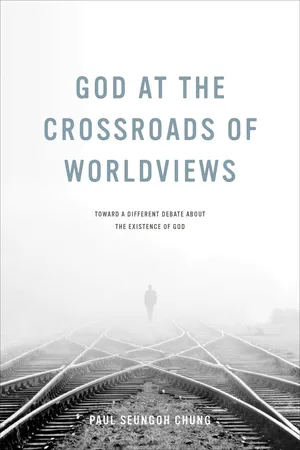
Debates about the existence of God persist but remain at an impasse between opposing answers. God at the Crossroads of Worldviews reframes the debate from a new perspective, characterizing the way these positions have been defined and defended not as wrong, per se, but rather as odd or awkward. Paul Chung begins with a general survey of the philosophical debate regarding the existence of God, particularly as the first cause, and how this involves a bewildering array of often-incommensurable positions that differ on the meaning of key concepts, criteria of justification, and even on where to start the discussion. According to Chung, these positions are in fact arguments both from and against larger, more comprehensive intellectual positions, which in turn comprise a set of rival "worldviews." Moreover, there is no neutral rationality completely independent of these worldviews and capable of resolving complex intellectual questions, such as that of the existence of God. Building from Alasdair MacIntyre's writings on rival intellectual traditions, Chung proposes that to argue about God, we must first stand at the "crossroads" of the different intellectual journeys of the particular rival worldviews in the debate, and that the "discovery" of such a crossroad itself constitutes an argument about the existence of God. Chung argues that this is what Thomas Aquinas accomplished in his Five Ways, which are often misunderstood as simple "proofs." From such crossroads, the debate may proceed toward a more fruitful exploration of the question of God's existence. Chung sketches out one such crossroad by suggesting ways in which Christianity and scientific naturalism can begin a mutual dialogue from a different direction. God at the Crossroads of Worldviews will be read by philosophers of religion, advanced undergraduate and graduate students, and theologians and general readers interested in the new atheism debates.
eBook - ePub
God at the Crossroads of Worldviews
Toward a Different Debate about the Existence of God
- 296 pages
- English
- ePUB (mobile friendly)
- Available on iOS & Android
eBook - ePub
God at the Crossroads of Worldviews
Toward a Different Debate about the Existence of God
About this book
Information
Topic
Theology & ReligionSubtopic
Epistemology in PhilosophyNOTES
ONE To Step Back: Rethinking the Question
1. This position, for example, is presented by Peter Winch, The Idea of a Social Science (New York: Humanities Press, 1958), regarding “non-scientific” belief in witchcraft by the Azande tribe.
2. It seems to me that the significance of this—that is, the question of who is crafting the parable—is seldom mentioned in the discussion of the famous article by Antony Flew, the opening of which my parable consciously mimics. Antony Flew, R. M. Hare, and Basil Mitchell, “Theology and Falsification,” in New Essays in Philosophical Theology, ed. Antony Flew and Alasdair MacIntyre (London: SCM Press, 1955), 96–108.
3. In David Brin, The Postman (New York: Bantam, 1985), a number of people in a postapocalyptic United States falsely believe that their central government is restored, because the main character acts as a postman. In George Orwell, Nineteen Eighty-Four (London: Secker and Warburg, 1949), the entire society is indoctrinated by its tyrannical, mind-controlling government to follow its leader, the “Big Brother,” who, the book reveals, may not even exist.
4. Note how these “evidences” may be phrased to be a kind of causal or design argument, such as the following: “Roads, postal service, schools, military, law enforcement, etc., exist, and are organized in this manner, because there is a nationally elected governing office that set them up,” rather like “the universe, order in nature, consciousness, etc., exist because there is an intelligent first cause that created and designed them.” Consider also how the difficulties of, or objections to, such arguments would parallel those that typically arise in the debate regarding the cosmological arguments and the various arguments about God from natural science.
5. Note how all of these features were present in some forms in the history of the United States during the nineteenth century. Consider also how such debate would likewise have interesting parallels to the debate regarding arguments from evil or unanswered prayers.
6. It seems an obvious point to observe that historically, non-Western cultures that encountered accounts of democratic political systems of the West did not seriously question whether a “ruler exists” in those societies. They did raise questions, but their primary question was whether the ideas of democracy and equality that those other societies believed in were workable, and if so, how those ideas could be applied to their own society. For examples of the history of democracy in the non-Western world, see Ainslie T. Embree and Carol Gluck, eds., Asia in Western and World History (New York: Armonk, 1997), and John Dunn, Democracy: The Unfinished Journey, 508 BC to AD 1993 (Oxford: Oxford University Press, 1992).
7. This would be a considerably more difficult question to answer for the explorers than one might expect. Imagine, for example, how one would perceive the differences between the lives of average working-class families and the members of Forbes 400 in a modern, democratic society, if the only categories one possessed to understand the differences were those of a feudal society.
8. Of course, it is possible that the natives are living in small tribal societies, or even in a state of anarchy, with no higher “ruler.” However, for these two explorers, this would require more than a mere refutation of this or that evidence for their respective positions; it would require a development or even construction of a hitherto utterly unimagined concept, with its own unique set of social features.
9. To be clear, I am not at all comparing the theist position to a democracy, or the atheist position to feudalism, or vice versa. Indeed, I could easily have switched the sociopolitical systems of the explorers to raise the same points I have so far outlined.
10. Alasdair MacIntyre, God, Philosophy, Universities (Lanham, MD: Rowman & Littlefield, 2009), 76–77. MacIntyre was giving an account of Thomas Aquinas’s position on the existence of God, which I will also give in greater detail in chapters 5 and 6.
11. Thomas S. Kuhn, The Structure of Scientific Revolutions, 3rd ed. (Chicago: University of Chicago Press, 1996; first published 1962), 114.
12. MacIntyre, Whose Justice? Which Rationality? (Notre Dame, IN: University of Notre Dame Press, 1988), 380.
TWO Where We Stand: The Contemporary Question
1. “Incommensurability” is a significant and complex concept, first introduced in philosophy of science by Thomas S. Kuhn and Paul Feyerabend independently in 1962. There are many definitions of this term, many of which are controversial. See Kuhn, Structure of Scientific Revolutions; also Paul K. Feyerabend, “Explanation, Reduction and Empiricism,” in Minnesota Studies in the Philosophy of Science, vol. 3, Scientific Explanation, Space, and Time, ed. H. Feigl and G. Maxwell (Minneapolis: University of Minnesota Press, 1962), 28–97. For our purpose, I am limiting what I generally mean by “incommensurability” to what I already described in chapter 1, which largely follows MacIntyre’s definition.
2. For one of the most recent examples, the disputes at the three levels are discussed in Herman Philipse, God in the Age of Science? A Critique of Religious Reason (Oxford: Oxford University Press, 2012). Philipse, who argues emphatically for atheism, contends that to build a rational case for the existence of God, an intellectually responsible theist needs arguments that follow a very particular type of reasoning similar to that of scientific disciplines. Thus, his position leads him to argue—though rather all too briefly—for very particular stances in all three levels of disputes.
3. “The Great Pumpkin” or, more recently, “The Invisible Pink Unicorn” is popularly used to parody theists for believing in something that atheists suggest is at least equally unconfirmed, and unconfirmable, and thus “believable.” Likewise the “Flying Spaghetti Monster” parodies the theist position that God created the world—though it targets primarily the proponents of Intelligent Design—which it suggests is no different, cognitively, from proposing that an invisible, undetectable, omnipotent “flying spaghetti monster” created the world.
4. Admittedly, I have organized and phrased the characterizations in a particular way here to reveal at least a sense of the radical nature of their differences. However, examples of these positions, in some form or variation, described, assumed, or argued, can be found throughout the history of the debate up to the present. Perhaps the diversity of positions and stark contrast between them can most readily be glimpsed in anthologies on philosophy of religion such as the following: Charles Taliaferro, Paul Draper, and Philip L. Quinn, eds., A Companion to Philosophy of Religion, 2nd ed. (Malden, MA: Wiley-Blackwell, 2010); Michael Peterson, William Hasker, Bruce Reichenbach, and David Basinger, eds., Philosophy of Religion: Selected Readings, 4th ed. (Oxford: Oxford University Press, 2010); Louis P. Pojman and Michael C. Rae, eds., Philosophy of Religion: An Anthology, 5th ed. (Belmont, CA: Wads-worth, 2008); Michael L. Peterson and Raymond J. VanArragon, eds., Contemporary Debates in Philosophy of Religion (Malden, MA: Blackwell, 2004).
5. Richard Swinburne’s theistic argument would be the most notable example of this position, which he presents in The Existence of God (Oxford: Clarendon Press, 2004; first published 1979).
6. Kai Nielson, Naturalism and Religion (Amherst, NY: Prometheus Books, 2001), 279, especially exemplifies this atheist position.
7. I believe a number of contemporary theists, such as D. Z. Phillips, hold positions similar to that of such a theist. An example of Phillips’s work that exemplifies this is Religion without Explanation (Oxford: Blackwell, 1976).
8. Richard Gale, On the Nature and Existence of God (Cambridge: Cambridge University Press, 1991), is a good example that examines the deductive arguments both against and for the existence of God. Inductive argument for the existence of God is exemplified in Swinburne, Existence of God. A more recent example of a likewise comprehensive case against the existence of God, including the critiques of the theist arguments, can be found in Nicholas Everitt, The Non-Existence of God (London: Routledge, 2004).
9. Yujin Nagasawa, The Existence of God: A Philosophical Introduction (New York: Routledge, 2011), offers a concise, historically nuanced account mainly of these three classes of arguments. Other significant arguments for the existence of God include the argument from consciousness, from morality, from religious experience, and from miracles. There are atheist arguments against the existence of God, the most significant being the argument from evil, in both deductive and inductive forms, and the deductive argument for the incoherence of the concept of God.
10. David Hume, Dialogues concerning Natural Religion, ed. Richard H. Popkin (Cambridge: Hackett, 1998; first published 1779).
11. Kant’s influential series of critiques against the three classes of theistic arguments, which he calls the ontological, cosmological, and the physicotheological proofs, can be found as a part of his discussion of “the Ideal of Pure Reason” in Critique of Pure Reason, trans. N. K. Smith (New York: St. Martin’s Press, 1965; first published 1781, 1787), specifically in book 2, chapter 3.
12. Everitt, Non-Existence of God, xiii.
13. Graham Oppy, Arguing about Gods (New York: Cambridge University Press, 2006), is a recent work that presents a fairly comprehensive list of the contemporary variations of ontological, cosmological, and teleological arguments, along with other arguments such as those from religious experience and morality, and the atheist argument from evil. His list is by no means exhaustive, but even the general descriptions there reveal numerous new forms of arguments.
14. Norman Malcolm, “Anselm’s Ontological Arguments,” Philosophical Review 69 (1960): 41–62; Charles Hartshorne, Anselm’s Discovery: A Re-Examination of the Ontological Proof for God’s Existence (La Salle, IL: Open Court, 1965); Alvin Plantinga, God, Freedom, and Evil (Grand Rapids: Eerdmans, 1974); and Plantinga, The Nature of Necessity (Oxford: Oxford University Press, 1974).
15. William Lane Craig, The Kalam Cosmological Argument (London: Macmillan, 1979).
16. Swinburne, Existence of God; William Wainwright, Mysticism: A Study of Its Nature, Cognitive Value, and Moral Implications (Madison: University of Wisconsin Press, 1981); William Alston, Perceiving God: The Epistemology of Religious Experience (Ithaca, NY: Cornell University Press, 1991).
17. Richard Taylor, Metaphysics (Englewood Cliffs, NJ: Prentice-Hall, 1963); Bruce Reichenbach, The Cosmological Argument (Springfield, IL: Thomas, 1972); William L....
Table of contents
- Cover
- Title Page
- Copyright
- Contents
- Preface
- One To Step Back: Rethinking the Question
- Two Where We Stand: The Contemporary Question
- Three The Road: Rationality and Worldviews
- Four At the Crossroads of Worldviews
- Five The Crossroad We Have Passed: The Project of Thomas Aquinas
- Six God at the Crossroads: What the Five Ways Do
- Seven The Fork: The Emergence of Modern Atheism as a Worldview
- Eight To Set Out: Arguing from the Crossroads to God
- Notes
- Bibliography
- Index
Trusted by 375,005 students
Access to over 1.5 million titles for a fair monthly price.
Study more efficiently using our study tools.
Frequently asked questions
Yes, you can cancel anytime from the Subscription tab in your account settings on the Perlego website. Your subscription will stay active until the end of your current billing period. Learn how to cancel your subscription
No, books cannot be downloaded as external files, such as PDFs, for use outside of Perlego. However, you can download books within the Perlego app for offline reading on mobile or tablet. Learn how to download books offline
Perlego offers two plans: Essential and Complete
- Essential is ideal for learners and professionals who enjoy exploring a wide range of subjects. Access the Essential Library with 800,000+ trusted titles and best-sellers across business, personal growth, and the humanities. Includes unlimited reading time and Standard Read Aloud voice.
- Complete: Perfect for advanced learners and researchers needing full, unrestricted access. Unlock 1.5M+ books across hundreds of subjects, including academic and specialized titles. The Complete Plan also includes advanced features like Premium Read Aloud and Research Assistant.
We are an online textbook subscription service, where you can get access to an entire online library for less than the price of a single book per month. With over 1.5 million books across 990+ topics, we’ve got you covered! Learn about our mission
Look out for the read-aloud symbol on your next book to see if you can listen to it. The read-aloud tool reads text aloud for you, highlighting the text as it is being read. You can pause it, speed it up and slow it down. Learn more about Read Aloud
Yes! You can use the Perlego app on both iOS and Android devices to read anytime, anywhere — even offline. Perfect for commutes or when you’re on the go.
Please note we cannot support devices running on iOS 13 and Android 7 or earlier. Learn more about using the app
Please note we cannot support devices running on iOS 13 and Android 7 or earlier. Learn more about using the app
Yes, you can access God at the Crossroads of Worldviews by Paul Seungoh Chung in PDF and/or ePUB format, as well as other popular books in Theology & Religion & Epistemology in Philosophy. We have over 1.5 million books available in our catalogue for you to explore.