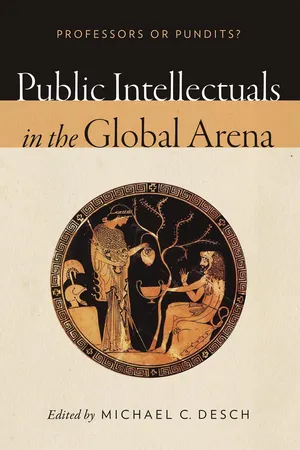
What is a public intellectual? Where are they to be found? What accounts for the lament today that public intellectuals are either few in number or, worse, irrelevant? While there is a small literature on the role of public intellectuals, it is organized around various thinkers rather than focusing on different countries or the unique opportunities and challenges inherent in varied disciplines or professions. In Public Intellectuals in the Global Arena, Michael C. Desch has gathered a group of contributors to offer a timely and far-reaching reassessment of the role of public intellectuals in a variety of Western and non-Western settings. The contributors delineate the centrality of historical consciousness, philosophical self-understanding, and ethical imperatives for any intelligentsia who presume to speak the truth to power. The first section provides in-depth studies of the role of public intellectuals in a variety of countries or regions, including the United States, Latin America, China, and the Islamic world. The essays in the second section take up the question of why public intellectuals vary so widely across different disciplines. These chapters chronicle changes in the disciplines of philosophy and economics, changes that "have combined to dethrone the former and elevate the latter as the preeminent homes of public intellectuals in the academy." Also included are chapters that consider the evolving roles of the natural scientist, the former diplomat, and the blogger as public intellectuals. The final section provides concluding perspectives about the duties of public intellectuals in the twenty-first century.
- 418 pages
- English
- ePUB (mobile friendly)
- Available on iOS & Android
eBook - ePub
About this book
Trusted by 375,005 students
Access to over 1.5 million titles for a fair monthly price.
Study more efficiently using our study tools.
Information
Topic
PhilosophySubtopic
Leadershipchapter six
THE PHILOSOPHER AS PUBLIC INTELLECTUAL
PATRICK BAERT
Right from the beginning of the street the crowd were pushing and shoving to get into the hall where Jean Pulse Heartre was going to give his lecture. People were using all kinds of tricks to needle through the eagle eye of the chastity belt of special duty policemen who had cut off the district and who were there to examine the invitation cards and tickets, because hundreds and thousands of forgeries were in circulation…. Others got themselves parachuted in by special plane. There were riots and fighting at Orly too to get on to the planes…. Others, in a desperate attempt, were trying to get in through the sewers…. The sewer rats took over from there. But nothing could dampen the spirits of these aficionados…. In the great hall on the ground floor … more and more people were gathering, and late-comers found they had to resort to standing on one foot at the back—the other being required to kick away any neighbours who got too close…. Heartre was getting ready to read his notes. An extraordinary radiance emanated from his ascetic athletic body and the throng, captivated by the overpowering charm of his slightest gesture, waited anxiously for the starting signal. Numerous were the cases of fainting due to intra-uterine exaltation which affected the female section of the audience in particular…. Jean Pulse opened his mouth…. The audience which had been fairly well-behaved until then began to get worked up and showed its admiration for Heartre by repeated shouts and acclamations after every word he said—which made perfect understanding of what he was saying rather difficult.1
This passage from Boris Vian’s novel L’Écume des jours is a thinly disguised critique of the furore around French existentialism at the end of World War II, with the characters Jean Pulse Heartre (Jean-Sol Partre, in the original French) and the Countess de Mauvoir (la Duchesse de Bovouard, in French) obviously based on its main protagonists. The depiction of the scene of Jean Pulse Heartre’s talk acts as an ironic commentary on Jean-Paul Sartre’s conference “L’Existentialisme est un humanisme,” which was held at the Palais des Congrès in Paris on a cold autumn night just after the war. But it is more than just a parody. For all its absurdity and grotesqueness, this passage captures something of the frenzy and excitement surrounding Sartre’s lecture of October 29, 1945. Indeed, in the actual lecture people also struggled to get in and to get a glimpse of the new prophet; and Sartre, like the character in the novel a charismatic speaker, managed to captivate his audience. Sartre spoke authoritatively without notes about a wide range of subjects. Leaving aside the slapstick of Vian’s depiction, it reveals the exhilaration and exaltation that Sartre’s lecture generated.
Indeed, the philosopher as public intellectual brings up images of, say, Sartre and Bertrand Russell speaking to huge crowds of students and affecting the politics in their respective countries and beyond. It is my contention that this type of public intellectual, epitomized by those two iconic characters, is no longer as viable today as it was in the middle of the twentieth century. But this is not to say that there is no scope today for philosophers as public intellectuals, or that there is less space for public intellectuals in general. As I will explain later on, too often commentators have mistaken the decline of a particular type of public intellectual for the fall of the public intellectual in general. It will become clear that the current climate encourages a type of public engagement, whether from philosophers or nonphilosophers, which is of a very different kind from the one exercised by the likes of Sartre and Russell. In what follows, I will try to outline this shift and provide some tentative explanations. I draw mainly on examples from France and the UK, but I would argue that my main points are applicable more broadly. Although I do recognize that cultural and national variations exist, the aim of this study is to present the broader picture.
Before I do this, I would like to make three qualifications. First, I would like to clarify that I will be talking here about public engagement, as in engagement outside the formal curriculum of the university structure. Of course, professors employed in universities, through the teaching of students, engage with wider society. This also applies to professional philosophers who simply by teaching their undergraduates and postgraduates can influence the broader societal and political realm. But when we mention public intellectuals, we are not talking about academics simply addressing a student audience within the contours of their regular courses. We are referring to primarily political engagement that goes beyond the limited setup of academic courses. This might involve engagement with students outside the normal curriculum, as in the case of Herbert Marcuse, who in the late 1960s became the guru of the student movement. It might even involve political interventions outside the academy altogether. The two public intellectuals whom I just mentioned—Sartre and Russell—typically addressed a broader audience well beyond the formal setup of the university structure. As a matter of fact, Sartre never held an academic position as such; he was a high school teacher for a while until the mid-1940s, when he decided that he could live off his royalties. Russell had to resign his fellowship at Trinity College Cambridge because of his stance towards World War I and subsequently taught sporadically at universities in the United States until that was cut short too because of his political stances. In sum, I am talking about this broader engagement, often political.
Second, I would like to introduce briefly my theoretical framework. I will be drawing loosely on positioning theory.2 According to this perspective, intellectuals use various devices to position themselves within the specific arenas in which they are operating. They position themselves through their books, lectures, newspaper articles, television and documentary film appearances, or blogs. What is positioning? It refers to the process through which intellectuals, like other people, attribute characteristics to themselves. For example, they might locate themselves as situated with the progressive pragmatist heritage of the United States, as Richard Rorty did in Achieving Our Country.3 Or they might position themselves as somehow Marxist-inspired critics of the contemporary constellation, as did Alain Badiou or Slavoj Žižek. Self-positioning often goes hand in hand with the positioning of other people or entities: Rorty’s positioned himself politically in juxtaposition to the American New Left and the Cultural Left, and Badiou’s and Žižek’s self-positioning rests on their fierce criticisms of capitalism today. Positioning is an ongoing practical achievement that requires considerable rhetorical skills and resources. Take Sartre, Camus, and Beauvoir, for instance, who used their journal Les Temps modernes to position themselves as dealing with issues of contemporary significance; indeed, they used the preface of the first issue to position themselves in opposition to those writers in the past who had failed to engage with the present.4 My underlying thread is that intellectuals, including public intellectuals, are constantly involved in various forms of positioning and, crucially, that new societal conditions encourage novel forms of positioning while discouraging others. I do not aim to elaborate on positioning theory in what follows, but my arguments will draw on the theory implicitly.
Third, it is worth mentioning that I will be using a rather restrictive notion of what it is to be a philosopher. Sometimes the notion of philosopher is used loosely to refer to scholars or writers who make broader theoretical claims. I will be talking instead about intellectuals who are formally trained within the discipline of philosophy and who, in addition, position themselves at least partly in relation to this formal training. The advantage of this more restrictive notion is that it allows me to identify more clearly who counts as a philosopher. Of course, the discipline of philosophy, and the training provided within it, differs from society to society and it also changes over time. This means that some of the people I will be talking about, in particular Sartre and Russell, might prima facie not have much in common. But I will try to argue that at some level those two do share certain characteristics—characteristics rarer now, for reasons I will explain.
So let’s return to the transition within public engagement I mentioned earlier. Let’s start with Sartre, the quintessential public intellectual in the eyes of many. Sartre came to public prominence just after the liberation of France. He was known beforehand but mainly to a specialized public. Between the middle of 1944 and the end of 1945, Sartre made a meteoric rise and managed to turn his dense philosophy into a digestible product for a mass audience. The autumn of 1945 was particularly crucial. Later portrayed as the “existentialist offensive,” it was during this period, September and October 1945, that Sartre turned himself into a public figure. The publication of the two volumes of L’Âge de raison, the launch of his flagship journal Les Temps modernes and his famous public lecture “L’existentialisme est un humanisme”—all contributed to his new persona as a public figure. But becoming famous as an intellectual does not make you a public intellectual. To be a public intellectual, you also need to be able to engage with broader issues of societal significance well beyond your specialized expertise. Sartre managed to do this straight away. Between 1944 and 1947 he wrote extensively on social and political issues relevant to the French at the time and helped them assimilate and come to terms with the recent past: he tried to portray the Resistance spirit, he made sense of what it was like to live under German occupation, or he depicted the mind-set of collaborators and anti-Semites. These writings and interventions were mainly reflecting on the recent past. They did so in ways that resonated with the public, which, as I have argued elsewhere, partly explains his sudden public status.5 But very soon Sartre would leave behind the experience of World War II and tackle present concerns, commenting on the postwar political situation in France and later on the Cold War, Algeria, the student movement, and so on. And it is these interventions, rather than the popularization of existentialism, that made him the public intellectual we still remember today.
Now, what kind of public intellectual was Sartre? He was what I call an “authoritative” public intellectual.6 This type relies on high cultural capital acquired from being trained in a high-profile discipline like philosophy and from being brought up in a very privileged background. They straddle neatly the inside–outside divide: they are so respected through privilege and intellectual achievement that they can oppose the establishment without ever substantially losing status or authority. They address a wide range of subjects without being experts as such. They speak from above—at, rather than with, their audience. And they have a strong moral voice, condemning, praising, and spurring people on to act.
Sartre was the archetypal authoritative public intellectual. Brought up in a highly educated upper-middle-class family, he was raised partly by his grandfather Karl Schweitzer, a considerable intellectual in his own right, who took it upon himself to educate his grandson when Jean-Paul’s mother moved back to the ancestral home after the premature death of her husband. His grandparents on both sides belonged to what one could, at least in the French context, legitimately call intellectual aristocracy. Not only did Sartre manage to gain entry at the École Normale—the elite institution par excellence—but he also studied philosophy, which was at that point the most revered academic discipline in France. Sartre drew on all this cultural capital to speak authoritatively about numerous topics on which he was not really an expert.7 His book about anti-Semitism, Réflections sur la question juive, was a case in point: relying on anecdotal evidence from his entourage and on his reading of anti-Semitic literature, Sartre not only generalized about the psychological dispositions of the anti-Semite, but he also centered the core of his argument in the remainder of the text around a dubious distinction between the authentic and inauthentic Jew. No systematic research or expertise underscored this book. But this dilettantism didn’t stop Sartre from speaking authoritatively about what it would be like, as a Jew, to live life authentically.8 The very same moral vigor—and, to a certain extent, lack of expertise—underscored his later interventions, whether about the Soviet Union or colonialism. Throughout his “public career,” Sartre was particularly adept at straddling the inside–outside divide: part and parcel of the establishment, he styled himself unequivocally as in opposition to it. Nothing more exemplifies how the security of privilege enabled Sartre to choose the position of outsider than his refusal to accept the Nobel Prize.
Sartre was not an isolated case, nor was his type of public intellectual exclusively French. Bertrand Russell, the eccentric British gent, was as much an authoritative public intellectual as Sartre was. Like Sartre, he came from a privileged background, raised in a rare intellectual microclimate within the otherwise anti-intellectual British aristocracy, with J. S. Mill as his godfather and an arsenal of private tutors at his disposal. Like Sartre he went through elite educational channels and made his name as an innovative philosopher, specializing in logic rather than the philosophy of existentialism. Just as Sartre’s existentialism was interwoven with the collective self-identity of the French intelligentsia, British intellectuals portrayed analytical philosophy as typically British, with its focus on logic and precision as a necessary antidote against the purported intellectual and political dangers of German philosophy. Russell too spoke with great authority about a whole range of issues in which he had little professional expertise—from marriage and the family to religion and race. Like his French counterpart he gained worldwide recognition, which also included the Nobel Prize. And like Sartre he used his platform of public notoriety—amplified through the emerging communication channels of radio, television, and televised public demonstrations—to take a moral stance and intervene in the politics of his day, from Vietnam to nuclear disarmament. Just like Sartre, Russell, the ultimate insider, managed to position himself as the antiestablishment figure, starting with his backing of conscientious objection during World War I and culminating in his anti–Vietnam War activities. In sum, Russell was as emblematic an authoritative public intellectual as Sartre was, equally successful in using his accomplishments within philosophy to legitimate his views on public and political issues that went well beyond it.9
If I mention these two pivotal figures, it is partly because commentators often invoke them when arguing that there are no longer public intellectuals today. The likes of Sartre and Russell are often used as yardsticks to judge the contemporary situation, in which, so it is argued, there is no longer space for public intellectual giants, as there undoubtedly was in earlier times. I agree, but only partly. I will show that a changing sociopolitical landscape has indeed made it more difficult for authoritative public intellectuals to emerge ...
Table of contents
- Cover
- Title Page
- Copyright
- Contents
- Acknowledgments
- Public Intellectuals: An Introduction
- Public Intellectuals in a Comparative Context
- Public Intellectuals across Disciplines
- Reflections
- Concluding Thoughts: Toward a Typology of Public Intellectuals
- List of Contributors
- Index
Frequently asked questions
Yes, you can cancel anytime from the Subscription tab in your account settings on the Perlego website. Your subscription will stay active until the end of your current billing period. Learn how to cancel your subscription
No, books cannot be downloaded as external files, such as PDFs, for use outside of Perlego. However, you can download books within the Perlego app for offline reading on mobile or tablet. Learn how to download books offline
Perlego offers two plans: Essential and Complete
- Essential is ideal for learners and professionals who enjoy exploring a wide range of subjects. Access the Essential Library with 800,000+ trusted titles and best-sellers across business, personal growth, and the humanities. Includes unlimited reading time and Standard Read Aloud voice.
- Complete: Perfect for advanced learners and researchers needing full, unrestricted access. Unlock 1.5M+ books across hundreds of subjects, including academic and specialized titles. The Complete Plan also includes advanced features like Premium Read Aloud and Research Assistant.
We are an online textbook subscription service, where you can get access to an entire online library for less than the price of a single book per month. With over 1.5 million books across 990+ topics, we’ve got you covered! Learn about our mission
Look out for the read-aloud symbol on your next book to see if you can listen to it. The read-aloud tool reads text aloud for you, highlighting the text as it is being read. You can pause it, speed it up and slow it down. Learn more about Read Aloud
Yes! You can use the Perlego app on both iOS and Android devices to read anytime, anywhere — even offline. Perfect for commutes or when you’re on the go.
Please note we cannot support devices running on iOS 13 and Android 7 or earlier. Learn more about using the app
Please note we cannot support devices running on iOS 13 and Android 7 or earlier. Learn more about using the app
Yes, you can access Public Intellectuals in the Global Arena by Michael C. Desch in PDF and/or ePUB format, as well as other popular books in Philosophy & Leadership. We have over 1.5 million books available in our catalogue for you to explore.