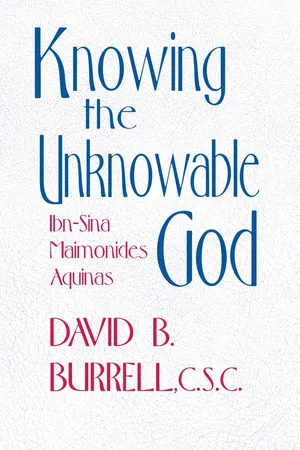
In Knowing the Unknowable God, David Burrell traces the intellectual intermingling of Muslim, Jewish, and Christian traditions that made possible the medieval synthesis that served as the basis for Western theology. He shows how Aquinas's study of the Muslim philosopher Ibn-Sina and the Jewish thinker Moses Maimonides affected the disciplined use of language when speaking of divinity and influenced his doctrine of God.
- 137 pages
- English
- ePUB (mobile friendly)
- Available on iOS & Android
eBook - ePub
About this book
Information
Publisher
University of Notre Dame PressYear
1992Print ISBN
9780268012267
9780268012250
eBook ISBN
9780268158996
Topic
Theology & ReligionSubtopic
Comparative Religion1. Picturing the Connection
BEFORE SCRUTINIZING THE distinction of God from the world it would seem best to consider their connection. Indeed, some would want us first to concern ourselves with establishing such a connection. And it is true that the vast majority of endeavors in philosophy of religion over the past few centuries in the west have been devoted to ways of confirming creation. That is, for the most part, what arguments purporting to exhibit God’s existence intend. Even those which pretend to proceed not from effect to cause but from interior analysis of the notion of divinity, will not only begin with beings as we find them, but must conclude to a being whose very being gives existence to all that is. As Kant showed how the more familiar “cosmological” arguments implicitly embodied the notion of God demanded by their “ontological” counterparts, so we might remind ourselves how these more recondite analyses presuppose as their conceptual background the notion of creator—or at least a One from which emanates all that is.1
Yet for all these efforts, the connection turns out to be less something we can establish than it is something which imposes itself on us. And that fact will become more comprehensible the better we grasp the distinction. Kant’s capstone concern whether—even were one successful—the first principle obtained would be a divinity we could worship, suggests one import of the distinction.2 A more metaphysical way of putting it would be to ask how one establishes what one deems to be the floor upon which one operates, and this logical query animates proposals reflecting a spectrum of philosophical tempers: from God as a “basic belief” to what is presupposed to a specific way of life.3
In any case, the “proofs” must invariably involve a reflexive moment, when one presumes to assess the way we consider whatever we consider, and this move cannot help but render them suspect as proofs.4 (Again understanding the distinction will clarify this moment.) As a result, many have taken refuge in a decision—or less coherently, a “fundamental option”—yet “decisions” of such moment represent more a cumulative awareness than a discrete action, so Newman’s notion of “converging lines of probable reasoning” comes more and more to the fore.5 And in such cases, it turns out that we seldom, if ever, reason to God’s existence, but rather retrospectively retrace our tracks to satisfy ourselves of the cogency of the individual steps which cumulatively brought us to where we are.
This essay, at any rate, will presume such a perspective on foundational matters and it will display that presumption by showing how a gathering awareness of the import of “the distinction” renders that perspective increasingly plausible. In fact, we shall find ourselves wondering how we (or so many others) had so long been captured by another. There remains, however, what I shall dare to call a yet more fundamental issue, though it is less strictly a conceptual one. I shall call it “picturing the connection.”
1.1 Background and Imagination
A theme common to attempts to convey the secular ethos of our time, especially by contrast to that of “premodern” times, highlights the absence of an enveloping tapestry in which we can locate ourselves.6 It is precisely the shift from a cosmology accessible to imagination—and rendered fruitfully present, say, by Dante—to one which leaves the imagination with a vast emptiness. We may fill the void, of course, with science fiction, or let that endeavor be fleshed out for us with archetypal themes—as in Tolkien—yet the fact remains that we are doing it. Some would trace this imaginative impasse to Galileo, and hence to the modes of conceptualization inherent to modern science and only accentuated by Einstein’s relativizing it all; others will find it focused in Freud, for whom a rootless individual must come to terms with a senseless cosmos.
In any case, the “crisis in meaning” which secularity represents, embodies a crisis of imagination which only dawns upon most of us when the events of our time cumulate to challenge our capacity to imagine evil. Auschwitz epitomizes what has become our preoccupation: how can we retain what we deem most precious—human life with human relationships—when that very gift can be systematically eliminated by totalitarian regimes, or made administratively to disappear by their authoritarian counterparts? And are not such callous “procedures” but the political consequence of our metaphysical malaise: how sustain our conviction that this is what is most precious—human life with its attendant relationships—when its origins and our imaginative hold on its sense vanish into a swirling void?7
Philosophers, and the philosopher in us all, will resist such vertiginous language, but does not our collective imagination—or our collective incapacity to imagine—hold us all in thrall? Are we not carried to that point where we must acknowledge the centrality of imagination in such ultimate (or religious) matters?8 Yet what can all this possibly have to do with that distinction of God from the world, which must certainly outreach our imaginations? Indeed, as we shall see, attempts to imagine the distinction invariably betray it. Furthermore, the effort to articulate this distinction, above all, has always been recognized to be a properly metaphysical task, especially by those skeptical of such endeavors, and Aquinas could not be more forceful in reminding us that entering upon metaphysics means entertaining discriminations quite beyond our capacity to imagine.9
I shall answer that question indirectly, by sketching the background picture shared by Jewish, Christian, and Muslim religious thinkers up to the thirteenth century, in an effort to invoke its power as a picture. What first appears to us as a collective piece of science fiction can suddenly refocus as an entirely plausible picture. Yet picture it remains; those who received it as an account, we shall see, could find refuge in it from the rigors of “the distinction.” It is not replaceable, certainly, but we will better appreciate how its absence can actually help us in our effort to formulate the distinction the more we realize the role that picture played. Aquinas’ part in the drama becomes the more crucial as we realize how his grasp of the distinction unravelled the pattern of the grand tapestry, even though Dante would still picture the pilgrim’s journey culminating in that “love which moved the sun and moon and all the stars.”10
1.2 An Imaginative Scheme
While logicians prefer to concentrate on “argument” as the primary means of advancing our understanding, structuralists have long been reminding us of the role which schemes or patterns play—often precisely in licensing or facilitating particular paths for inference to take.11 These are often less in evidence than are overt chains of reasoning; sometimes they are nothing more than the fashions of an age, which deem certain questions worth treating and others settled or irrelevant. More significantly, such patterns can represent the varying weight we give to different forms of argument, and so be illustrated by methodological reflections like Aristotle’s opening observations in the Ethics about the various meanings which ‘precise’ or ‘rigorous’ should assume as we undertake different sorts of inquiry. In this sense, we might consider the schemes I will be displaying as conveying what we value in inquiring.
What we may justly call “the classical scheme” grew out of that neo-platonic harmony of Aristotle with Plato legitimized by passing on Books I–II of the Enneads of Plotinus as the “Theology of Aristotle.” The result was an articulated emanation from the One of diverse levels of spiritual substances (more or less identified in the heavenly bodies) culminating in the Agent Intellect, whose role was to enlighten human beings regarding their place in the cosmos by illuminating them regarding all that lay above and below them. The levels of intelligences, moreover, offered a paradigm for those same human beings in their noblest practical endeavor: politics. So the scheme not only linked nature with spirit, the structure of the cosmos with a theory of knowledge, but provided a pattern for action as well by properly subordinating practical to speculative knowing.
Presented with such an elaboration, we are usually so puzzled as to ask: did they really believe this is how things are? What could they possibly have proffered as evidence? And curiously enough, they bring forth little by way of evidence; the Arabs in particular seem more concerned with elaborating the scheme than with establishing it, and it passed neatly from Alfarabi to Ibn-Sina with some minor alterations.12 They “took it on faith,” it seems, as embodying the teaching of “philosophy,” and as representing the connection between the first cause—primal being (or God)—and all that we see or know. Moreover, the ten cosmic spheres represented that connection mediately, so facilitating the move from One to many, all the while preserving the axiom: from One only one can come.13
Now the logical sleight of hand involved in reducing the scandal of many in the face of One by the simple ruse of adding intermediaries should alert us that something other than argument is going on here. In fact, as we shall see, it is less a matter of “how the world is” than it is how we should relate to what is. The cosmological components seem not to be important in themselves (as assertions of how things are) so much as in establishing a parallel between nature and knowing, so that the world, and especially our place in it, will be intelligible enough to lead us onto the proper return path to the One—by way of contributing to a virtuous city by actively imitating the pattern, or of consciously retracing the steps of emanation from the One so that we contemplate our origin as our goal. The scheme serves as an aid to self-consciousness by properly locating us in the overall scheme of things, and indicates how we should fulfill that self (our nature) by active or contemplative paths—a judicious blend of Plato’s Republic with Aristotle’s Politics.14
We are in the presence, then, of an intellectual scheme which purportedly speaks of the natures of things, designed rather to offer a background image of the connection between God and the world, and hence a pattern for our activity within that world and under that God. Such is the interpretation suggested by Joel Kraemer’s essay tracing the structural similarities among John of Damascene, Alfarabi, and Moses Maimonides in their elaboration of and the use to which they put a common scheme.15 Let Kraemer’s list of “what Alfarabi calls the things all the people of the virtuous city ought to know in common” (113) provide the scheme:
(1) The First Cause and all that by which It is characterized.
(2) The things separate from matter and how each one of them is characterized by attributes specific to it; and the hierarchy of things separate from matter leading ultimately to the Active Intellect, and the activity of each.
(3) The heavenly substances and how each is characterized.
(4) The natural bodies below them; how they come into being and pass away; that what transpires among them does so by precision, mastery, providence (’inaya: pronoia), justice, and wisdom; and that there is no neglect, deficiency or injustice within them in any way.
(5) The generation (or: existence) of man; how the faculties of the soul originate; how the Active Intellect causes an illumination to emanate upon them so that the primary intelligibles are attained; volition (irada: boulesis) and choice (ikhtiyar: proairesis).
(6) The First Ruler and how revelation comes about.
(7) The rulers who must succeed him if he does not exist at some time.
(8) The city and its people and the happiness their souls attain; and the cities opposed to it and what their souls revert to after death: some to misery and some to non-existence.
(9) The virtuous nation and those that oppose it (114).
These realities are divided by Alfarabi into theoretical—(1) to (5)—and voluntary—(6) to (9). The theoretical components correspond with John of Damascene’s outline in De fide orthodoxa:16
(1) Existence and nature of God: limitless and incomprehensible
(2) Creation: threefold division—invisible, visible, human being
(3) Angels: intellects with custody over earth and vision of God
(4) Visible creatures: heavens and four elements
(5) Paradise
(6) Creation of man “according to God’s image”: intellect and free will
Damascene emphasizes creation whereas Alfarabi presumes a necessary emanation, while Damascene’s insistence that “God does not belong to the existent beings, not because He does not exist, but because He transcends all existent beings and being itself” (Kraemer, 112) is not to be found in Alfarabi. While he “stresses … the distinctiveness of the deity from other existents, Alfarabi is not placing God beyond being, but rather the First Cause, Primal Being (al-mawjud al-awwal), the necessary existent and intellect in actu” (114–15).
While this particular difference between John of Damascene and Alfarabi will be of moment in a more detailed scrutiny of ways of formulating “the distinction,” it is noted here simply by way of contrast and not to suggest any direct lineage between the works. In fact, as scholars of the period note, there was a coincidence of interest and of form among Jews, Muslims, and Christians “who refuted philosophical opinions that destroyed the foundations of their law” (107). This observation of Maimonides (in the Guide 1.71) appears to follow Alfarabi’s views of the matter. Moreover, Kraemer maintains that there is a direct link between Alfarabi and Rabbi Moses, contending that “Maimonides conceived his role as that of Alfarabi’s philosopher-statesman …, whose function it was to posit correct opinions for the virtuous city, or religious community” (109). His aims, then, in the Foundations of the Torah will not be directly philosophical, but indirectly so, as in kalam literature, where the “techniques, patterns and themes … are aimed at the intellectual capacity of the members of a community who cannot be addressed … philosophically” (109).
Suffice it to note here that Kraemer has little difficulty in finding the major themes of the theoretical part of Alfarabi’s design in the Foundations of the Torah (126–32), and even more significantly, notes how Maimonides refers to this treatment of his, in the Guide (3.35), as containing “fundamental opinions” which the community needs to pursue its goal. Alfarabi’s “entire plan lays stress upon the hierarchy of existence, the great chain of Being suspended from the First, which should be represented for the people of the virtuous city by political symbols, i.e. the hierarchy of rulers and ruled; for the imitation of cosmic order is what induces political order and stability in the city” (135). Maimonides’ treatment parallels this, with closer attention to the gift which singles out his people: the Torah. Yet withal “contemplation of the hierarchy of the beings and God’s wisdom leads to love and fear of God and the desire to imitate his ways by righteous actions” (135).
Neither Alfarabi nor Maimonides had much use for Kalam when it had recourse to shoddy argument in defense of religion, yet neither felt such a task dispensable either (109). So it would not be implausible to find each engaged in a similar task when the needs of the community called for it. In that sense, one could propose the Guide to the Perplexed as a work of Kalam as well (108), through which “the apprehension of God, i.e. of his attributes that are His actions in the world, leads to political and ethical virt...
Table of contents
- Cover
- Title Page
- Copyright
- Dedication
- Contents
- Preface
- Introduction
- 1. Picturing the Connection
- 2. A Central Distinction: Essence/Existence
- 3. The Nature of Divinity
- 4. Names of God: Attributes of Divine Nature
- 5. God’s Knowledge of Particulars
- 6. Eternal Creator of Contingent Things
- Epilogue
- Notes
- Index
Trusted by 375,005 students
Access to over 1.5 million titles for a fair monthly price.
Study more efficiently using our study tools.
Frequently asked questions
Yes, you can cancel anytime from the Subscription tab in your account settings on the Perlego website. Your subscription will stay active until the end of your current billing period. Learn how to cancel your subscription
No, books cannot be downloaded as external files, such as PDFs, for use outside of Perlego. However, you can download books within the Perlego app for offline reading on mobile or tablet. Learn how to download books offline
Perlego offers two plans: Essential and Complete
- Essential is ideal for learners and professionals who enjoy exploring a wide range of subjects. Access the Essential Library with 800,000+ trusted titles and best-sellers across business, personal growth, and the humanities. Includes unlimited reading time and Standard Read Aloud voice.
- Complete: Perfect for advanced learners and researchers needing full, unrestricted access. Unlock 1.5M+ books across hundreds of subjects, including academic and specialized titles. The Complete Plan also includes advanced features like Premium Read Aloud and Research Assistant.
We are an online textbook subscription service, where you can get access to an entire online library for less than the price of a single book per month. With over 1.5 million books across 990+ topics, we’ve got you covered! Learn about our mission
Look out for the read-aloud symbol on your next book to see if you can listen to it. The read-aloud tool reads text aloud for you, highlighting the text as it is being read. You can pause it, speed it up and slow it down. Learn more about Read Aloud
Yes! You can use the Perlego app on both iOS and Android devices to read anytime, anywhere — even offline. Perfect for commutes or when you’re on the go.
Please note we cannot support devices running on iOS 13 and Android 7 or earlier. Learn more about using the app
Please note we cannot support devices running on iOS 13 and Android 7 or earlier. Learn more about using the app
Yes, you can access Knowing the Unknowable God by David B. Burrell C.S.C. in PDF and/or ePUB format, as well as other popular books in Theology & Religion & Comparative Religion. We have over 1.5 million books available in our catalogue for you to explore.