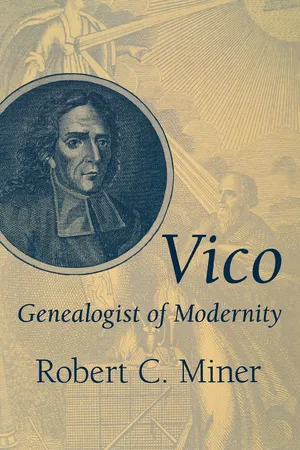
In this lucid and probing study, Robert C. Miner argues that Giambattista Vico (1668-1744) was the architect of a subversive, genealogical approach to modernity. Miner documents the genesis of Vico's stance toward modernity in the first phase of his thought. Through close examination of his early writings, centering on Vico's critique of Descartes and his elaboration of the 'verum-factum' principle, Vico, Genealogist of Modernity reveals that Vico strives to acknowledge the technical advances of modernity while unmasking its origins in human pride.
- 224 pages
- English
- ePUB (mobile friendly)
- Available on iOS & Android
eBook - ePub
Vico, Genealogist of Modernity
About this book
Information
Publisher
University of Notre Dame PressYear
2002Print ISBN
9780268013813
9780268105419
eBook ISBN
9780268159849
Topic
PhilosophySubtopic
History & Theory of PhilosophyPART 1
Humbling Modern Pride: Genealogy in the Early Vico
ONE
Ancients and Moderns
Modern thinkers, despite their considerable achievements, are full of pride. In love with their own accomplishments, they fail to acknowledge the possibility that, in some respects, their knowledge is inferior to that of the ancients. This theme runs throughout Vico’s oeuvre, culminating in the Scienza Nuova’s analysis of the “conceit of nations” and the “conceit of scholars.” It also lies at the center of the first book that Vico deemed worthy of publication, De nostri temporis studiorum ratione.
De ratione is not a crude antimodern polemic. It presents itself as a balance sheet designed to compare the advantages and disadvantages of modern method with those of antiquity. Vico’s professed aim in lining up the costs and benefits of modernity is “not to condemn the disadvantages of our age or those of antiquity, but to bring together the advantages of both.”1 With respect to technical advances in the natural sciences, Vico does not hesitate to admit the superiority of the moderns. Gadamer rightly contrasts Vico’s positive valuation of rhetoric with “the anti-rhetorical methodology of modern times,” but errs in making him speak from a “position of opposition to modern science.”2 The road taken by De ratione is more complex than that. Vico begins by acknowledging the considerable gains of modern natural science. He proceeds, however, to question the understanding of natural science adopted by proponents of the geometrical method and to raise the suspicion that the project of mastering nature is grounded in self-love. De ratione applies a similar mode of suspicion to versions of modern ethics that seek to minimize or eliminate the need for the virtues, especially practical wisdom (phronesis, prudentia).
That Vico admires the accomplishments of the new science is clear. Along with the modern inventions of the cannon, the sailing ship, the clock, and the suspended church-dome (to reproduce one of Vico’s many lists in De ratione), he admires the astronomy and physics of Galileo. He does not, however, find plausible the distinctively Cartesian reading of modern science. Its overvaluation of geometrical method leads to the boat constructed by Perot, whose proportions had been “carefully calculated beforehand according to the rules of analytical geometry” but which sank to the bottom of the sea as soon as it hit the water.3 Vico does not mention Descartes by name in De ratione. Instead, he speaks of those who strive to make exclusive use of the “critical art” (ars critica), seeking to deny all cognitive value to the “topical art” (ars topica)—the skill of reasoning from received commonplaces (topoi or loci communes) to a conclusion that best fits the situation at hand. Those who one-sidedly elevate the ars critica do so not because they possess a clear argument against the uselessness of rhetorical commonplaces, or because they understand the authentic method of modern science. What actually motivates the purveyors of the ars critica, Vico holds, is not the disinterested pursuit of truth, but the particular desire to rewrite the curriculum from the anti-rhetorical perspective that reduces eloquence to sophistry. By including only the texts and topics they favor, and thereby eliminating humanistic disciplines that train the mind in ways that cannot be quantified, Cartesian pedagogies may be unmasked as ideologies that seek to promote and perpetuate their own power.
It is important to distinguish Vico’s hostility to the ars critica, as promoted by Descartes and Arnauld, from opposition to critical thinking as such. In De ratione, Vico’s argument for the ars topica is primarily pedagogical. Only after immersion in the arts of painting, poetry, and rhetoric, arts that develop the memory and imagination, should one study logic, algebra, and geometry (though synthetic rather than analytic, as we will see). Learners who acquire the critical aptitude after education in the ars topica will be in a better position “to judge anew, using their own judgment on what they have been taught.”4 Those impressed with Vico’s defense of topics and his polemic against the approach embodied by the Port-Royal logic often tend to neglect the fact that he also maintains a large role for the ars critica in the attainment of truth.5 Minds that are fluent in topics but neglect criticism fall short because they “often latch on to falsehoods”; the reverse error is committed by those who “do not also consort with probabilities.”6 In De ratione and throughout his writings, Vico consistently attributes the capacity to attain truth to the faculty of critical judgment.7 The amplitude and fecundity of the ars topica must be checked by the precision and sobriety of the ars critica. A subtle but important departure from this model occurs in De antiquissima, which suggests a fusion of the two artes. As in De ratione, Vico distinguishes topica and critica according to function. “Topics discovers things and piles them up. Criticism divides the pile and removes some of it: and thus the topical wits are more fertile, but less true; the critical ones are truer, but are sterile.”8 But Vico now faults not only the moderns, but also the ancients, ascribing to them an artificial separation of discovery and judgment. “Neither invention without judgment, nor judgment without invention can be certain.”9 Topica and critica are ideally one: “topics itself will become criticism.”10
If Vico maintains a place for the ars critica, while exposing the pretensions of those who would use it to smother eloquence, he also pays tribute to modern science, which he judges to owe more to the experimental approach of Bacon and Galileo11 than to Descartes or the Port-Royal logic. Occasionally it is said that Vico had little appreciation for Galileo. Isaiah Berlin writes that he “seems to have had no notion of what Galileo had achieved, and did not begin to grasp the effect of the new science upon the lives of men.”12 This is plainly false. In the second chapter of De ratione, Vico does not mention Galileo by name, but credits astronomia with detecting the “multiple faults of the systematic universe of Ptolemy.”13 Later texts speak of “the great Galileo” whose success in explaining natural phenomena occurred “before the geometrical method was introduced into physics” and the “sublime Galileo” who is credited with the observation of Venus and other astronomical marvels.14 It is highly unlikely that Vico’s choice of title for his magnum opus bears no relation to the Due nuove scienze of Galileo.15
Vico is willing to give Galileo and “the English” (whom he takes to oppose the introduction of the geometrical method into physics) full credit for fruitful deployment of the experimental method. This approval of the experimental method is connected with his defense of the ars topica; Vico in fact sees the experimental method as a particular application of topical reasoning. Against his Cartesian critics, Vico commends Herbert of Cherbury’s De veritate on the ground that it is “truly nothing other than a topical art transported to the use of experimental physics.”16 The profitability of using topics in natural science is also a theme of De ratione. Vico attributes the success of modern chemistry, for example, to its ability to “faithfully, and so to speak, manually, reproduce a number of meteors and other physical phenomena.”17 What enables the genuine achievements of modern science is facility in making, rendered possible by an application of topical reasoning to the experimental domain. Thus Vico concludes the discussion of the ars topica in De ratione with an assertion that anticipates his famous verum-factum principle: “We demonstrate geometrical things because we make them; if we could demonstrate physical things, we would make them.”18
Where, then, does Vico oppose the pretensions of modern physics, if he seems to approve of its non-Cartesian forms? How can he be said to offer a “genealogy” of modern science, if his essential sympathies are with Bacon against Descartes? We must look more closely at the stance Vico assumes toward Bacon in De ratione. It is undeniable that Vico admires Bacon enormously, in texts early and late. Yet Vico thinks that Bacon too is inspired by motives that are far from pure. Opening the De ratione with Bacon’s name, Vico praises the De augmentis scientiarum for pointing to a world of new sciences that ought to be pursued. Yet he immediately adds that Bacon’s procedure is informed by a desire for what is enormous and infinite. This desire, unregulated by prudence, has caused him to behave “in matters of learning in the same way as the rulers of the biggest empires, who once having obtained sovereignty in human affairs, try to outwit the things of nature herself, attempting to pave the seas with rocks, to sail through the mountains, and other such futile endeavors which are, just the same, forbidden by nature. For indeed everything that is given to man to know is finite and incomplete, like man himself.”19 Because Bacon lacks a sense of finitude and seeks to expand his own power without limit, he is driven to aim beyond what human industry can or should attain.
Against the Baconian lust for power, Vico holds that “we must exert ourselves to study physics as philosophers, so that we might order the soul. In this let us surpass the ancients, who cultivated the zeal for these things, in order to contend impiously with the gods for happiness.”20 The kind of vanity exemplified by Bacon is not uniquely modern. It is also present, Vico suggests, in pagan culture. This is only one of many loci, in writings early and late, in which Vico detects hidden points of contact that link secular modernity with ancient paganism. To study nature “philosophically” is “to quell human arrogance, if we indeed seek the truth in these things, which we desire so much. And if we do not find it, the desire for the truth will itself take us by the hand and lead us to God, who alone is the way and the truth.”21
How can Vico be so critical of Bacon’s motives, if he admires the works that he thinks a Baconian approach is able to generate? Vico consistently adheres to the principle that ugly roots can generate beautiful flowers; his interpretation of mathematics in De antiquissima will show this to be true in a different context. Another discourse of mastery that Vico seeks to expose as illegitimately ambitious, disrespectful of natural contraints, is the attempt to reduce the life of ethical praxis to manuals or compilations of moral rules. Vico invokes an Aristotelian topos: “the deeds of men cannot be assessed by a straight and unbending rule of the mind; they must be viewed according to the supple Lesbic rule, which does not conform bodies to it, but alters itself according to them.”22 No matter how comprehensive our ethical manuals, practical life will present situations where no rules are at hand, or where there is a single rule whose particular application is unclear, or where there are many conflicting rules which might apply, or where the rule that usually applies demands an exception. There is no method that can reliably bridge the gap between universal and particular in the ethical life. Systematized routines, embodied in the artes that Vico admires and associates with the moderns, are no substitute for the virtues, better understood by the ancients.23 “For in those things regulated by practical wisdom, it makes no difference whether you have many artes or only a few.”24 Practical wisdom (prudentia) “takes its deliberations from the circumstances of things, which are infinite; hence any comprehension of them, however wide, is never sufficient.”25 At best, rules will furnish access to the general features of a situation. But in practical affairs, wisdom is a matter of insight into particulars.
Attention to the particular and the contingent implies an acceptance of probability. “With respect to prudence in civil life, we should remember that occasion and choice are the mistresses of human affairs, and are most uncertain, governed for the most part by simulation and dissimulation, things which are exceptionally deceitful.”26 Only prudentia and its ally sensus communis, which “arises from probabilities,” are sound guides in the active life.27 Those who fail to see this point, perhaps having spent too much time in the classroom, “accustom themselves to clinging to general precepts: in actuality we find that nothing is more useless.”28 Vico paints a vivid portrait of the imprudent savant (doctus imprudentis) who approaches ethics as if it were a manual of adamantine propositions. He contrasts the type of the expert with three other types: the fool (stultus), the astute ignoramus (illiteratus astutus), and the wise person (sapiens).29 The fool lacks knowledge of either general or particular. Theory and practice escape him alike; he “constantly pays the penalty for his rashness.”30 The astute ignoramus knows how to succeed in temporal affairs. But his ignorance of the most important things, evidenced by his consistent preference for the utile over the honestum, ensures failure. In Aristotelian terms, he does not possess phronesis, but only its counterfeit, deinotes. Only the wise person possesses both practical and theoretical wisdom, knowing how to rise from lowly occasions and chance opportunities to the highest good. “Wise people (sapientes), who through all the obliquities and uncertainties of human actions aim for eternal truth, follow roundabout ways, because they cannot take straight ones; and they execute plans which in the long run are for the best, as far as the nature of things allows.”31
By contrast, the distinguishing marks of the imprudent savant are slowness in decision, arrogance in behavior, and incapacity for persuasive speech. Because he lacks experience in situations where plausible arguments can be made in utramque partem,32 his choices come slowly, often too slowly. Vico scorns the critics who, “when something doubtful is presented to them, say: ‘Let me think about it.’”33 Vico does not disguise his distaste for the physicians of his time who would suspend action, waiting for the disease ...
Table of contents
- Cover
- Title Page
- Copyright
- Dedication
- Contents
- Note on Texts
- Preface
- Part 1 Humbling Modern Pride: Genealogy in the Early Vico
- Part 2 The Development of Modern Historical Consciousness in the Diritto universale
- Part 3 The Moral Genealogy of the Scienza nuova
- Conclusion
- Notes
- Bibliography
- Index
Trusted by 375,005 students
Access to over 1.5 million titles for a fair monthly price.
Study more efficiently using our study tools.
Frequently asked questions
Yes, you can cancel anytime from the Subscription tab in your account settings on the Perlego website. Your subscription will stay active until the end of your current billing period. Learn how to cancel your subscription
No, books cannot be downloaded as external files, such as PDFs, for use outside of Perlego. However, you can download books within the Perlego app for offline reading on mobile or tablet. Learn how to download books offline
Perlego offers two plans: Essential and Complete
- Essential is ideal for learners and professionals who enjoy exploring a wide range of subjects. Access the Essential Library with 800,000+ trusted titles and best-sellers across business, personal growth, and the humanities. Includes unlimited reading time and Standard Read Aloud voice.
- Complete: Perfect for advanced learners and researchers needing full, unrestricted access. Unlock 1.5M+ books across hundreds of subjects, including academic and specialized titles. The Complete Plan also includes advanced features like Premium Read Aloud and Research Assistant.
We are an online textbook subscription service, where you can get access to an entire online library for less than the price of a single book per month. With over 1.5 million books across 990+ topics, we’ve got you covered! Learn about our mission
Look out for the read-aloud symbol on your next book to see if you can listen to it. The read-aloud tool reads text aloud for you, highlighting the text as it is being read. You can pause it, speed it up and slow it down. Learn more about Read Aloud
Yes! You can use the Perlego app on both iOS and Android devices to read anytime, anywhere — even offline. Perfect for commutes or when you’re on the go.
Please note we cannot support devices running on iOS 13 and Android 7 or earlier. Learn more about using the app
Please note we cannot support devices running on iOS 13 and Android 7 or earlier. Learn more about using the app
Yes, you can access Vico, Genealogist of Modernity by Robert C. Miner in PDF and/or ePUB format, as well as other popular books in Philosophy & History & Theory of Philosophy. We have over 1.5 million books available in our catalogue for you to explore.