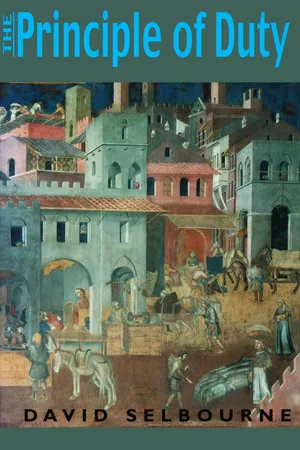
- 344 pages
- English
- ePUB (mobile friendly)
- Available on iOS & Android
eBook - ePub
About this book
The First American edition of a British best-seller In The Principle of Duty
Information
SEVEN
The Principle of Duty in General (1)
The principle of duty defined – duty and liberty – self-restraint and self-harm – duty to self and to others – reciprocal obligation – duties to the civic order in general – duties to nature and to the past – duties of public service – democracy and active citizenship – Jerusalem and Athens – arguments of the religious – duty and right – the principle of duty as an ethical principle – the moral sense and moral knowledge – duty, reason and utility – civic coherence – equity – summary of argument – rejection of idea of covenant or contract – duty voluntarily undertaken and duty by imposition.
154. The principle of duty, the sovereign ethical principle of the civic order, demands both general and particular duties of the citizen – to himself, to his fellows, and to the civic order as a whole – and, likewise, general and particular duties of the civic order, and of its instrument the state, to its members. Such duties have their ground in ethics, reason, and utility. In their application to the citizen, they comport not obedience to power but co-responsibility for the well-being of others and of the civic order in general; have ethical precedence over the rights, benefits, and privileges with which the citizen is vested as a member of such civic order; and, fulfilled, signify that the individual who fulfils them is playing his citizen’s part.
The principle of duty is, in the first instance, that principle which regulates the relation between citizen and citizen, and the relation between the citizen and the civic order to which he belongs. It is, further, the fundamental principle of the civic bond and the heart of its ethic; that ethic, voluntarily assumed but sustained by law, which dictates to citizens that they compose a single civic order for whose well-being they are responsible in the common interest. The function of the principle of duty, whether its dictates are voluntarily assumed or enforced and reinforced by law, is the protection and maintenance of such civic bond, and thus of the civic order which it in turn upholds.
155. To observe the ethical and practical dictates of the principle of duty as they apply to the citizen is neither weakness nor strength in such citizen, but a moral imperative, a rational undertaking, and a practical necessity. For such observance is a precondition of any civic order whatever. In conditions of accelerating civic disaggregation, as in the corrupted liberal order, the imperative of the principle of duty is greatly increased; even where such conditions do not exist, the principle of duty is required to be observed, as the ground of the moral and practical relations between citizen and civic order. But where consciousness of the civic bond has waned, where citizens have turned strangers by the thousands and millions, and where obligation of all kinds – to oneself, to one’s familiars, to the community, to the civic order – is contemplated with increasing discomfort, or is neglected, or is refused entirely, the resurrection of the principle of duty, that great neglected rule, itself becomes a civic obligation.
Here, I emphasise such principle, but do not invent it; in fulfilment of my own duty, remind the civic order and its members of it; and give such principle its due place within a general political and moral theory of the civic order.
156. In the corrupted liberal order, under the present rule of dutiless right, it could be argued that such reassertion of the principle of duty is a minimum in extremis; and, as a ‘mere’ moral notion, can provide in itself no more than what Hegel called the ‘inkling of right ethical life’ as it applies to individual conduct in the civic order. But, as I show in Chapters Nine and Ten, such moral principle dictates particular and practical duties; and, as I show in Chapter Eleven, many of such duties can, and must, be enforced and reinforced by sanction. Moreover, as I show in Chapter Twelve, the principle of duty must stand at the centre of a new civic social-ist doctrine and movement, capable of arresting the process of civic disaggregation in the corrupted liberal orders.
The political and moral lessons taught us by the ancients and their early modem legatees, cited here, can guide us only so far; for all their philosophical and practical preoccupations with the wellbeing of the civic order, they do not provide us with a systematic theory of duty in and to such civic order. Antique fidelities and pieties, for all their ethical example and practical force, do not provide an adequate model for a modern political theory of duty in the corrupted and disaggregating liberal orders. Nor can the obligations of the citizen which have been left to him after the democratic supersession and just overthrow of feudal authority – as to pay taxes, to take out licences, (in some civic orders) to vote, or (in some cases) to serve for a limited period in the armed forces – be themselves the ground of a sufficient civic relation between citizen and civic order.
157. The principle of duty, the ‘great neglected rule’ and sovereign ethical principle of the civic order, is an expression of the constraints of membership of the civic order. The duties which such principle dictates constitute the first, and main, limitation upon the citizen’s claims to dutiless right. Moreover, the principle of duty, sustained by law, not only helps to define the bounds of licence but, in so doing, simultaneously to demarcate the proper scope of individual freedom and to protect it.
The principle of duty is also an ethical and practical check to the risks posed to the civic order by the ‘losing gamble of liberty’ [sect. 30], and a similar counterweight to the disappointments of the assumption of reason [sects. 40-6]. Further, the power (not right) of ‘free choice’ in the corrupted liberal order is limited by constraints, which the principle of duty dictates, upon what, and how much, may be chosen. The principle of duty additionally aids the cure of that extreme form of ‘individualism’, or egoism, which is found in the citizens of the corrupted liberal orders, and which deprives such citizens of civic sense; that is, of a sense of duty to their fellows and to the civic order, and even, paradoxically, of a sense of duty to themselves.
158. The principle of duty becomes a principle of compulsion only where the individual’s duty to self, others and the civic order to which he belongs is not fulfilled of his own free will; as when such individual is moved to comply with it not from conscience or from within, but from fear of sanction.
As Kant argues (Lectures on Ethics, p. 48), to carry out an obligation which is dictated by the principle of duty is not an unfree act; the fulfilment of a moral obligation is not, in itself, a restraint upon the free will, but may be, and is at its best, the fullest expression of it. Indeed, the assumption and fulfilment of obligation on the part of the individual not only presupposes such individual’s exercise of freedom, but, in contributing to the maintenance of the civic bond, enhances the possibility of liberty in the civic order.
159. The individual’s observance of the principle of duty represents such individual’s contribution to the common ethical direction of the civic order to which he belongs, and as such is a further practical contribution to the conditions necessary to his own and others’ exercise of the citizen’s rights and freedoms. Hence, the principle of duty is not merely compatible with the (uncorrupted) liberal ideal but essential to its preservation; as it is fitted also to be the main constituent of a new social-ist ethics and practice, or civic social-ism.
Moreover, in observing the principle of duty, and not only in exercising his rights, the citizen acts the citizen’s part. And in accepting, whether voluntarily or under sanction, the bounds to licence and the limits upon his own freedom which the principle of duty dictates, the citizen helps to make real not only the civic sense but the sense of proportion and limit which is of the essence of justice.
160. Of the universal duties to self which the citizen-member of a civic order owes, the duty of self-restraint in the making of demands upon such civic order stands at the head.
For the virtues and advantages to be found in civic association themselves demand, if such virtues and advantages are to be sustained to the well-being of all, the moderation of our desires in regard to them; we not only must, but can, so moderate them. As Locke declared (Two Treatises of Civil Government, Bk. II, para. 44), man is ‘master of himself and proprietor of his own person and the actions or labour of it’; he has, therefore, the power to do what the principle of duty commands in this respect.
Furthermore, it is only under the rule of such self-restraint that the imposition of the civic order’s prohibitions can be averted, and that in a free society the exercise of freedom can be ‘in harmony with itself, as Kant puts it (Lectures on Ethics, p. 124), and not ‘come into collision with itself. It is, above all, lack of civic sense which makes us blind to the relationship between our self-restraint and the well-being of the civic order as a whole; lack of awareness of where our ‘private’ interest lies plays a related part.
Nor are we any more permitted by the principle of duty to harm ourselves, as members of the civic order, than we are permitted to harm the civic order to which we belong. ‘I have set before you life and death, blessing and cursing’, it is declared in Deuteronomy (XXX, 19), ‘therefore choose life, that both thou and thy seed may live’; both an ethical injunction and an early acknowledgment of free will. ‘We shrink in horror from suicide’, argues Kant (Lectures on Ethics, pp. 150-1), ‘because all nature seeks its own preservation . . . How, then, could man make of his freedom, which is the acme of his life and constitutes its worth, a principle for his own destruction? Nothing more terrible can be imagined . . . humanity in one’s person is something inviolable.’ But if a man may not ethically ‘use his freedom against himself, and, in particular, not in order to ‘destroy himself, no more may he use his freedom against his fellows, or in order to destroy the civic order to which he belongs.
‘It is obvious’, Kant further argues (ibid., p. 118), ‘that nothing can be expected from a man who dishonours his own person. He who transgresses against himself – as occurs on an increasing scale under the rule of dutiless right and demand-satisfaction in the corrupted liberal orders – ‘becomes incapable of doing his duty towards his fellows . . . The prior conditions of our duty to others is our duty to ourselves.’ The citizen-turned-stranger who has lost his citizen identity and, often in the persona of the universal plebeian, has also lost his self-esteem – that same self-esteem which Kant believed ‘should be the principle of our duties to ourselves’ (ibid.) – can only be brought back to both his civic sense and his self-esteem by the imposition of the principle of duty. Having ‘cast away his personality’, as Kant puts it (ibid., p. 121), or made himself an ‘object of contempt’ (The Metaphysics of Morals, tr. M. Gregor, Cambridge, 1991, p. 217), he will not otherwise or voluntarily fulfil such duty.
161. It is a further moral aspect of the duty of self-restraint in the member of the civic order that he should judge himself by a strict standard. (‘Even if the whole world tells you that you are a tsadik [righteous person]’, declares Amiel (Ethics and Legality in Jewish Law, p. 26), ‘you should view yourself as a rasha [wicked person].’) Egoism, and (worse) that which is animal-in-man – being given increasing freedom and legitimacy under the helpless rule of dutiless right and in conditions of accelerating civic disaggregation – must be tempered not only by the imposition of the principle of duty but by the restraint, if necessary under sanction, of individual claims and material demands made as if of right, and from habit, upon the civic order; that is, claims and demands made upon fellow-members of the civic order.
This is without derogation from the principle of duty as it applies to the responsibilities of the civic order, and its instrument the state, for the well-being of its citizen-members.
162. The moral and practical nexus between duty to self and duty to others in the civic order is plain. ‘It is wisdom that thou look to thine own wealth’, says Thomas More (Utopia, Bk. II, Chap. 6), ‘and to do the same for the commonwealth is no less than thy duty, if thou bearest any reverent love or any natural zeal and affection to thy native country.’ Or, ‘while you are of the same community and the same kindred with me, shall you be careless of yourself,' asks Epictetus (Discourses, III. i, 4), ‘and show yourself a bad citizen to the city, a bad kinsman to your kindred, and a bad neighbour to your neighbourhood?’
Under the principle of duty, there are many instances where duty to self and duty to others dictate the same actions. The duties, for example, to pursue a livelihood and to make oneself informed (as far as possible) are duties both to self and to others. Moreover, the fulfilment of our ethical and practical duties to ourselves is not only conducive to the raising of our own self-esteem, but of that of others also. Conversely, as Kant argues harshly, ‘the less inner worth a man has, the less esteem does he deserve . . . We should so conduct ourselves as to be worthy of honour’ (Lectures on Ethics, p. 49). Such self-respect is enhanced not only in those to whom respect is shown, but is itself a possible, and even probable, effect of having shown respect to others. Thus, to fulfil duty to self may fulfil, at the same time, a duty to others; duty to others fulfilled, in enhancing respect for self, fulfils a duty to self also.
163. Duties to self which are also duties to others are duties which, in Cicero’s words, ‘flow from society’ (Offices, I, lxiii), albeit that they may appear to flow, or be argued to flow, from an autonomous moral imperative alone. The duty to work and to pursue a livelihood is one such duty which ‘flows from society’, as is made clear even in the most Hebraic of ascriptions of such duty to ‘God’s will’. Thus, Locke’s declarations (Two Treatises of Civil Government, Bk. II, paras. 32, 34) that ‘God when He gave the world in common to mankind, commanded man also to labour’ and that ‘He gave it to the use of the industrious and rational’ contain a plain social injunction; that is, an injunction derived from the general interest of the civic order and its well-being. So derived, likewise, is the Jewish proverb: ‘If each one sweeps before his own door, the whole street is cleaned.’
164. Indeed, Cicero thought (Offices, I, lxiii...
Table of contents
- Cover
- Half title
- About the author
- Title
- Copyright
- Dedication
- Contents
- Epigraphs
- Preface to The American Edition
- Preface to The Second English Edition (1997)
- I: INTRODUCTION The Function and Duty of the Political Philosopher
- Preliminary Aspects of the Argument
- The Losing Gamble of Liberty
- II: THE CIVIC ORDER The Civic Order in Principle
- The Civic Order in Crisis
- III: THE PRINCIPLE OF DUTY Law, Justice, and Civic Order
- The Principle of Duty in General (1)
- The Principle of Duty in General (2)
- IV: PARTICULAR DUTIES The Particular Duties of the Civic Order
- The Particular Duties of the Citizen
- The Sanctions of Duty
- V: CONCLUSION Social-ism and the Civic Order
- References
- Index
Trusted by 375,005 students
Access to over 1.5 million titles for a fair monthly price.
Study more efficiently using our study tools.
Frequently asked questions
Yes, you can cancel anytime from the Subscription tab in your account settings on the Perlego website. Your subscription will stay active until the end of your current billing period. Learn how to cancel your subscription
No, books cannot be downloaded as external files, such as PDFs, for use outside of Perlego. However, you can download books within the Perlego app for offline reading on mobile or tablet. Learn how to download books offline
Perlego offers two plans: Essential and Complete
- Essential is ideal for learners and professionals who enjoy exploring a wide range of subjects. Access the Essential Library with 800,000+ trusted titles and best-sellers across business, personal growth, and the humanities. Includes unlimited reading time and Standard Read Aloud voice.
- Complete: Perfect for advanced learners and researchers needing full, unrestricted access. Unlock 1.5M+ books across hundreds of subjects, including academic and specialized titles. The Complete Plan also includes advanced features like Premium Read Aloud and Research Assistant.
We are an online textbook subscription service, where you can get access to an entire online library for less than the price of a single book per month. With over 1.5 million books across 990+ topics, we’ve got you covered! Learn about our mission
Look out for the read-aloud symbol on your next book to see if you can listen to it. The read-aloud tool reads text aloud for you, highlighting the text as it is being read. You can pause it, speed it up and slow it down. Learn more about Read Aloud
Yes! You can use the Perlego app on both iOS and Android devices to read anytime, anywhere — even offline. Perfect for commutes or when you’re on the go.
Please note we cannot support devices running on iOS 13 and Android 7 or earlier. Learn more about using the app
Please note we cannot support devices running on iOS 13 and Android 7 or earlier. Learn more about using the app
Yes, you can access The Principle of Duty by David Selbourne in PDF and/or ePUB format, as well as other popular books in Politique et relations internationales & Philosophie politique. We have over 1.5 million books available in our catalogue for you to explore.