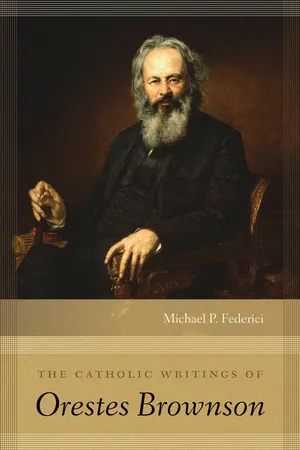
This collection of thirteen original essays by Orestes Augustus Brownson (1803–1876), a major political and philosophical figure in the American Catholic intellectual tradition, presents his developed political theory in which he devotes central attention to connecting Catholicism to American politics. These writings, which date from 1856 to 1874, cover not only his conversion to Catholicism after experimenting with a variety of religious and political beliefs but also slavery, the Civil War, Reconstruction, the era of Jacksonian democracy, and a host of social, political, and economic issues. During this time, Brownson became one of the nation's leading thinkers and critics. Although faced with a dominant Protestant culture, Brownson argued for a political and social culture influenced by his deeply held Catholic faith. He defended Catholicism from the common charge that it was incompatible with American constitutionalism and, in fact, argued that it was the only spiritually viable foundation for American politics. He defended the political theory and institutions of the American framers, applauding their realistic view of human nature and the importance of both virtue in political leaders and checks and restraints in their constitutional structures. He opposed the rising influence of populist democracy by explaining its flawed assumptions about human nature and the possibilities of politics. Michael P. Federici's well-written introduction situates these essays within a coherent theme and explains how these essays are especially relevant to contemporary debates about populism, race, American exceptionalism, and the relationship between religion and politics. The book will interest students and scholars of American political thought, as well as those with an interest in religion and politics.
- 442 pages
- English
- ePUB (mobile friendly)
- Available on iOS & Android
eBook - ePub
The Catholic Writings of Orestes Brownson
About this book
Information
Topic
PhilosophySubtopic
Political Philosophy1
THE DAY-STAR OF FREEDOM
April 1856
“The Day-Star of Freedom” is a review of a book by G. L. L. Davis that claims first, that Maryland was a model colony (i.e., the daystar of American freedom) in regard to religious liberty for Catholics and second, that it influenced the spread of religious liberty in other colonies. Brownson disputes both claims. Of particular interest to Brownson is Davis’s description of religious toleration in Maryland, especially for Catholics. Religious toleration is not the same as religious liberty. Maryland embraces the former but not the latter. The state can revoke religious toleration but not religious liberty, a natural right, because it is prior to and independent of the state. Lord Baltimore created the Maryland colony as a refuge for oppressed Catholics, but the intent was not to create a Catholic colony. By contrast, the New England Puritans created a colony exclusively for their religious sect, which gave control of spiritual matters to the church, not the state. Their objective was religious liberty, not religious toleration. The Puritans did not deny individuals of other faiths the liberty to exercise their religions; they did, however, exclude them from their colony. The Maryland Toleration Act was aimed at a different end that falls short of religious liberty. Brownson celebrates the US Constitution’s embrace of religious liberty as an inalienable right. The state is not indifferent to religion but is obligated to protect religious liberty and religious institutions without interfering with religious conscience. The state is obligated, for example, to protect Catholic laws regarding marriage and divorce. What will most ensure religious liberty for Catholics in America is the rising influence of their voices in the culture.
This long title very accurately describes the purpose and character of the very interesting volume before us,—a volume marked by much patient research, minute information, and kindly feeling. It is a monument erected to state pride, and is well calculated to keep alive the flame of patriotic feeling in the breast of the Marylander. Each of the older states has a history of its own, which ought not to be lost in the history of the Union,—a local history, full of incident not unmingled with romance, which it is well to rescue from oblivion, and which must be studied by every one who would become acquainted with the scenes and events, the acts and the influences that have formed the peculiar, though diversified character of the American people. We smile at some of the pretensions put forth by Mr. Davis in behalf of his native state, but we thank him, nevertheless, for his contribution to early colonial history, and assure him that we appreciate and respect his motives, while we are pleased with his goodnatured gossip about the “Pilgrims” of Maryland, both as an American and as a Catholic.
The assumption that the Maryland colony was “the Day-star of American Freedom,” enables the author to give a poetical title to his volume, but it has very little historical foundation. We should not make that assumption exclusively for any one of the colonies, and, least of all, for a colony which, however respectable in itself, exerted no leading influence on its sister colonies. Never in our colonial days was Maryland the heart and soul of the Anglo-American colonies. We have a high esteem for the first settlers of Maryland, and in elevation of character, nobility of sentiment, and private and domestic virtue, they were unsurpassed, if not unrivalled, by the first settlers of any other colony; but we cannot learn from history that they were propagandists, that they sent out missionaries and teachers to the other colonies, or that these were induced by their efforts or example to adopt the free institutions they founded. Even if Maryland had the advantage of priority of time, we could not award her the claim Mr. Davis sets up in her behalf. The leading colonies—those which exerted the greatest influence in moulding others, and determining the character of American institutions—were unquestionably Virginia and Massachusetts. Maryland, in her general colonial action, followed Virginia, and even now belongs to the Virginia family of states. We say not this in disparagement of Maryland, to which we are attached by the strongest of ties, but in vindication of simple historical truth.
But the first government of Maryland was not founded on the distinctive principles of American freedom. It was a feudal government; and the charter instituting it provided for a colonial aristocracy by subinfeudation. It recognized religious toleration; but toleration is not a principle of American freedom. The American principle is religious liberty, not religious toleration. The charter secured to the freemen of the colony a voice in the government, and so far it was democratic; but the general spirit and tendency of the colonial constitution were to an aristocracy, into which it would have developed, if a political aristocracy could have taken root in our New World, colonized by English commoners. But without underrating the popular character of the Maryland charter government, it certainly was not so democratic as the government of the Plymouth colony, or that of Massachusetts Bay, the northern source of American freedom, as Virginia was the southern. We, however, are not disposed to enter further into this question. Comparisons, as Dogberry says, are odorous. Few of the colonists, we apprehend, except those of New England and New Netherlands, were, in our present American sense, republicans when leaving the mother country, but nearly all gradually became so; and when the struggle came for national independence, none were more patriotic or more ready to devote themselves to the cause of American liberty than those of Maryland. She holds an honorable place in the Union, and has contributed her full share to the glory and prosperity of the republic. Mr. Davis shows very clearly and conclusively that the act of the colonial assembly authorizing religious toleration was passed by Catholics, and that its merit, be it more or be it less, belongs to members of our church. It was the first instance of religious toleration by legislative enactment on this continent. He shows, also, that it was faithfully observed so long as the Catholics remained in the ascendency, and was violated, or repealed, as soon as the Protestants became predominant. We think this fact highly creditable to the Catholic colonists of Maryland; but we think too much has been made of it by our Catholic friends in arguing against those who accuse the church of being unfavorable to religious liberty. Nothing is more fallacious than to argue from the conduct of individual Catholics to the Catholic Church. In treating of Protestantism we must argue from the conduct of individuals; for it has no authoritative standards, and recognizes the right of private judgment. Protestantism varies with each individual Protestant, and is for each what he holds it to be. We have really no means of ascertaining what it is, but the profession and conduct of individual Protestants. With Catholics, however, the case is widely different, since Catholicity is of catholic, not private interpretation. It is authoritatively and publicly defined, and individuals are to be tried by it, not it by them. Till we have determined the church’s authorized teaching on the subject, we can no more infer, from the acts of Lord Baltimore and his colonial assembly, that she favors, than from the severities of Louis XIV against the Huguenots that she opposes, religious toleration. As an historical fact, and as illustrative of their personal views and character, the conduct on this delicate question of the Catholic settlers of Maryland, is interesting, and worthy of commemoration; but as touching the question of the tolerant or intolerant principles of the church, we consider it, with all deference to our Maryland friends, as quite unimportant.
But, passing over this, we must beg leave to remark, that toleration is not liberty, and the act of the Maryland assembly does not assert religious liberty. It tolerates all Christian denominations holding the divinity of our Lord, and belief in the ever adorable Trinity; but it does not recognize this liberty as a right prior to, and independent of, the civil power. The civil power grants or confers the right; it does not recognize it as an existent right which the state cannot take away, and which it is bound to respect and protect for each one and all of its citizens. In this respect, the Puritans of Massachusetts really went further in the assertion of religious liberty than the Catholics of Maryland. Maryland was not founded exclusively by Catholics, or for Catholic purposes. It seems pretty evident that the majority, a very large majority, of the first settlers were Catholics; but there certainly were several Protestant settlers who came over in the Ark and Dove. It was no part of the plan of the first or the second Lord Baltimore to found a Catholic colony. His plan was to found a colony in which Catholics, then oppressed and persecuted in England, might profess their religion in peace, and enjoy equal rights and privileges with any other class of citizens. Neither aimed at any thing more; and, whatever might have been their abstract convictions as Catholics, it is evident that, as founders of a colony, they could claim no exclusive privileges for the church, and must concede to Protestants if the so-called Orthodox sects what they attempted to secure to the followers of their own religion. Intolerance, or exclusion, would have been in direct violation of their plan, directly opposed to the very idea of such a colony as they contemplated. But the case was different with the Puritans. They had no intention of founding a general colony, open to settlers from all creeds and nations. They had their peculiar notions of Christianity. Right or wrong, true or false, they were theirs; and they fled to the wilderness in order to found a community in which they could enjoy them in peace and tranquility. They did not invite those who differed from them to join with them in their enterprise; they professedly excluded them. They sought not to enforce their peculiar views upon others; but they thought they had, as against others, the right to hold them for themselves, and to found a state for themselves and their children in accordance with them, and from which all others should be excluded. They were not persecutors in principle. They did not deny to others the liberty they claimed for themselves; they only denied to those who differed from them the right to come and settle in their community. What they did when persons of different notions came among them, was, to warn them off. If they did not go, they sent them out of the colony; if they returned, they punished them, not for their heresies, but for being found in a colony from which they had been banished. Their right to do so depends on their right to be Puritans. If they had a right to be Puritans, they had the right to found in the wilderness a Puritan commonwealth, and to exclude from it all not Puritans. You may or you may not approve their policy, but you cannot say that they were persecutors, any more than you are a persecutor for turning out of doors a troublesome fellow that you do not choose to have in your house. Their condemnation is, that they were Puritans; not that, being Puritans, they did as they did.
But aside from this notion of founding an exclusive Puritan commonwealth, the New England Puritans asserted, what the Catholics of Maryland in their Toleration Act did not assert, the absolute independence of the church, and the incompetency of the state in spirituals, the foundation of all true religious freedom. In the Puritan commonwealth the magistrates had no authority in any spiritual matter, and whenever they had to act on a matter which involved a spiritual question, they were bound to take the decision of that question from the ministers, the alleged expounders of the word of God. The incompetency of the state in spirituals was a fundamental principle with the old Puritans; and this is the fundamental principle of that religious freedom, not granted, but recognized, by the American people in their institutions. It is the Puritan doctrine of the spiritual incompetency of the state and the freedom and independence of the church, rather than the doctrine of toleration of the Maryland assembly, that has prevailed, and become incorporated into the fundamental institutions of the country.
We are quite willing to concede this, Catholic as we are, because the Puritan doctrine thus far, save in its application, was borrowed from the church and is unquestionably that of the Holy Scriptures. The pretense that religious liberty was first understood and applied by Lord Baltimore and his colonists, we look upon as ridiculous, notwithstanding it is supported by names we cannot but respect. We believe there was an emperor of Rome, named Constantine, sometimes, Constantine the Great, usually reckoned as the first Christian emperor. Well, this Constantine issued an edict, giving liberty to Christians, and allowing at the same time the free exercise of the old worship to the pagans. Constantine, if we mistake not, lived some time before Lord Baltimore. There is a very strong assertion of religious liberty in its true sense earlier still, which it is not well to overlook. Certain magistrates commanded Peter and John, apostles of our Lord, to teach no more in the name of Jesus. These refused to obey, and answering, said: “If it be just in the sight of God to harken unto you rather than unto God, judge ye.” We have a profound respect for Lord Baltimore and the Maryland colonists, and cherish in many respects the memory of our Puritan ancestors, but both came quite too late into the world to be regarded as the inventors either of religious liberty or of religious toleration.
The question of religious liberty, though always asserted by the church, has, we concede, been more fully recognized by our government than by any that had preceded it. The modern political world holds as to most of its principles from the ancient Roman world. In that old world, under paganism, the civil power and the spiritual were united and vested in the same hands. Caesar was imperator, or supreme civil ruler, and pontifex maximus, or supreme pontiff, and the temporal government has always, down to the American revolution, had a tendency to perpetuate the union of the two powers in the person of Caesar, and has warred almost constantly against the separation and independence of the spiritual authority. It has struggled almost without interruption to rule men’s souls as well as men’s bodies, and to be supreme in spirituals as well as in temporals. It has never willingly recognized the freedom of religion, and has seldom been forced to do more than to concede it as a favor, as a franchise, not as a right, anterior to the state, and which it is bound to recognize and protect. It would never unequivocally confess its own incompetency in spirituals, and leave all spiritual questions to be settled by the church or individual conscience. Hence it has seldom left conscience free, and accountable to God alone. It has sometimes left it free as to some points, but seldom, if ever, free throughout. This has caused the existence of religious tyranny and oppression. When the church existed alone as the only religion, she was oppressed by the state, and when there were various sects existing along with her, then she, or some one of them, was favored by the state and the others were tyrannized over by it, though in general she far more than they.
Among the American colonists the first to protest energetically and practically against this assumption of spiritual authority on the part of the state, were the first settlers of New England, the rigid old Puritans. They left England and her church to get rid of the tyranny exercised by the state over conscience. So far were they from suffering the state to oppress conscience, they, not having the true religion, ran to the opposite extreme, and tyrannized through their associated churches over the state. Lord Baltimore and his colonists, without disavowing the right of the state to exercise spiritual authority, did, as a fact, in the name of the state, grant freedom to Catholics and trinitarian Protestants. The American revolution came in time, and with it American independence. In organizing the government and founding the republic, or rather a confederacy of republics, the principle of the incompetency of the state in spirituals was recognized, and frankly conceded. This is the case with the federal government, and with all the state governments, except that of New Hampshire, which is officially Protestant, and only tolerates the Catholic religion. Here for the first time, we will not say, has religious liberty been asserted, or toleration conceded; but has the state frankly, fully, and unequivocally abandoned the reminiscences of pagan Rome, and acknowledged its own spiritual incompetency. In doing this it leaves religion perfectly free, and therefore fully and distinctly recognizes religious liberty as a right of American citizens, and its duty to protect it.
The practical question which it has been attempted to solve by an appeal to the early colonial history of Maryland is, Does the church approve this religions liberty, and is she satisfied in her own case with its simple protection by the state? That she approves it is evident from the fact that she has always asserted it, demanded it, and never ceased by all the means in her power to struggle for it, as her whole history shows, and as her enemies allege even as a fact against her. That she asks no more of the state than the simple protection of this liberty, is evident again from the fact that she allows no conscience to be forced, claims to be a kingdom complete in herself, and to possess, without going out of herself, all the positive means necessary to fulfil her mission, and forbids through her doctors and councils the forcing of any one, by other than moral means, to receive the faith. All she asks is her freedom to be herself, and protection against material violence, which is more than she has ever had, except in a particular locality for a brief time. The church has just concluded a concordat with the emperor of Austria, with which she seems quite content; but a careful analysis of that concordat will show that she has less from Austria than is promised to her by the fundamental law of the American state. If she has in Austria certain advantages that she has not here, they are more than compensated by certain concessions made to the government.
What can the church want that our fundamental law, if observed, does not secure her? In the first place she exists here by right, and not by sufferance; and in the second place, the government is bound to protect her in the free and full enjoyment of that right. But the sects exist here by the same right so far as the state can take cognizance of it. Be it so. The recognition and protection of their right does not interfere with her enjoyment of her right. If she employ violence against them, the state is no doubt bound to protect them against her; but that does not disturb her, because she has no disposition to use violence against them. But must not she ask the state to suppress them? If they deny her equal right, and by their physical violence seek to prevent her from peaceably enjoying that right, she undoubtedly will ask the government to protect her; and it already acknowledges its obligation to do so. Beyond, she asks nothing of the government against sects, here or anywhere; for, if they oppose her only by moral or spiritual weapons, she holds that she is perfectly competent to defend herself. Against the moral action or moral influence of heretics the church has never appealed to the secular arm, and she has appealed to it only against their violence, their spoliation, usurpation of her property, desecration of her churches and altars, and riotous or murderous attacks on Catholics. We venture to say then, without fear of contradiction, that if our government will recognize and protect the religious liberty it asserts, she will ask nothing more of it, although it do precisely as much for the sects as it does for her. If then the principle held by the American people, and incorporated into our institutions be the principle of religious liberty, there can be no question that the church approves religious liberty and asks nothing more.
In this reasoning we assume that the government in recognizing religious liberty, declares simply its incompetency in spirituals, not its hostility to religion. The American state is not an infidel or a godless state, nor is it indifferent to religion. It does not, indeed, as the state, profess any particular form of Christianity, but it recognizes the importance and necessity of religion, and its obligation to respect and protect the religion of its citizens. It does not assume that it has the right to ignore their religion, and pursue a policy of its own, regardless of its effect on the forms of religion they profess. In all spiritual questions the teachings of the church, in dealing with Catholics, and of each sect in dealing with its members, is its law in so far as protecting the claims of one is compatible with those of the others. The state must recognize and protect the doctrine and discipline of the church in all cases where they exact of it nothing inconsistent with the equal rights of the sects. This obligation to protect the religion of the citizen, in so far as it demands nothing against the equal rights of others, rests on the principle that all citizens are equal before the state. Our government is founded on the principle that all men have certain inalienable rights, which they do not hold as grants from civil society, and revocable by it, but from a source above and anterior to it. These rights are, in some cases, enumerated and prefixed to the constitution of the state in what is called a “bill of rights,” which the government is bound to recognize, to protect, and, when occasion demands, to vindicate against the domestic or the foreign aggressor. These rights again, are equal, equally the rights of all citizens; and among them is the right of each citizen to choose his own religion, and to worship God according to the dictates of his own conscience, providing he does nothing, under plea of conscience, contra bonos mores, and to interfere with the same right in others. Hence my religion is my right, my property as a citizen, not dependent on the will of the state, but, so far as I am concerned, my liberty and its law. The state is bound to protect me in the free, full, and peaceable enjoyment of my religion, because it is bound to protect me in the free, full, and peaceable enjoyment of all my rights, held independently of its concessions, and not subject to its will. For this reason, it must recognize the entire freedom, and afford full protection to my church according to her own constitution, doctrine, and discipline. It is my right, an element of my liberty, and, therefore, of its duty. As the Catholic Church, it can claim nothing from the state; but as the church of American citizens, it can claim full freedom and protection. The principle is my equal rights as a citizen. If my church is not protected, or if not placed on a footing of perfect equality with the sects, my equal rights as a citizen are denied me, and the boasted equality, recognized as the American principle, is outraged. My equality is denied in the denial of the equality of my church. I have the right, within the limits already mentioned, to have whatever I hold sacred respected and protected by the state....
Table of contents
- Half Title
- Title Page
- Copyright
- Contents
- Acknowledgments
- Abbreviations
- Editor’s Introduction
- 1 The Day-Star of Freedom (April 1856)
- 2 The Church and the Republic; or The Church Necessary to the Republic, and the Republic Compatible with the Church (July 1856)
- 3 Mission of America (October 1856)
- 4 The Convert; or, Leaves from My Experience (September 1857)
- 5 The Great Rebellion (July 1861)
- 6 State Rebellion, State Suicide (April 1862)
- 7 The Federal Constitution (January 1864)
- 8 The President’s Message and Proclamation (January 1864)
- 9 Liberalism and Progress (October 1864)
- 10 Beecherism and Its Tendencies (January 1871)
- 11 The Papacy and the Republic (January 1873)
- 12 The Democratic Principle (April 1873)
- 13 Constitutional Guaranties (April 1874)
- Index
Trusted by 375,005 students
Access to over 1.5 million titles for a fair monthly price.
Study more efficiently using our study tools.
Frequently asked questions
Yes, you can cancel anytime from the Subscription tab in your account settings on the Perlego website. Your subscription will stay active until the end of your current billing period. Learn how to cancel your subscription
No, books cannot be downloaded as external files, such as PDFs, for use outside of Perlego. However, you can download books within the Perlego app for offline reading on mobile or tablet. Learn how to download books offline
Perlego offers two plans: Essential and Complete
- Essential is ideal for learners and professionals who enjoy exploring a wide range of subjects. Access the Essential Library with 800,000+ trusted titles and best-sellers across business, personal growth, and the humanities. Includes unlimited reading time and Standard Read Aloud voice.
- Complete: Perfect for advanced learners and researchers needing full, unrestricted access. Unlock 1.5M+ books across hundreds of subjects, including academic and specialized titles. The Complete Plan also includes advanced features like Premium Read Aloud and Research Assistant.
We are an online textbook subscription service, where you can get access to an entire online library for less than the price of a single book per month. With over 1.5 million books across 990+ topics, we’ve got you covered! Learn about our mission
Look out for the read-aloud symbol on your next book to see if you can listen to it. The read-aloud tool reads text aloud for you, highlighting the text as it is being read. You can pause it, speed it up and slow it down. Learn more about Read Aloud
Yes! You can use the Perlego app on both iOS and Android devices to read anytime, anywhere — even offline. Perfect for commutes or when you’re on the go.
Please note we cannot support devices running on iOS 13 and Android 7 or earlier. Learn more about using the app
Please note we cannot support devices running on iOS 13 and Android 7 or earlier. Learn more about using the app
Yes, you can access The Catholic Writings of Orestes Brownson by Michael P. Federici in PDF and/or ePUB format, as well as other popular books in Philosophy & Political Philosophy. We have over 1.5 million books available in our catalogue for you to explore.