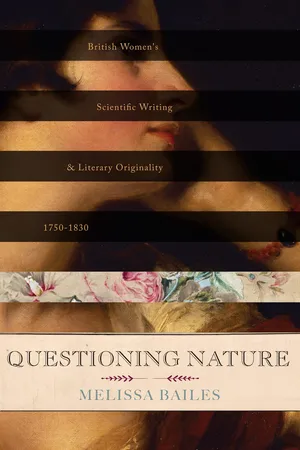
Questioning Nature
eBook - ePub

Questioning Nature

British Women's Scientific Writing and Literary Originality, 1750–1830

  1. 272 pages
  2. English
  3. ePUB (mobile friendly)
  4. Available on iOS & Android
eBook - ePub

Questioning Nature

British Women's Scientific Writing and Literary Originality, 1750–1830

About this book

In the mid-eighteenth century, many British authors and literary critics anxiously claimed that poetry was in crisis. These writers complained that modern poets plagiarized classical authors as well as one another, asserted that no new subjects for verse remained, and feared poetry's complete exhaustion. Questioning Nature explores how major women writers of the era—including Mary Shelley, Anna Barbauld, and Charlotte Smith—turned in response to developing disciplines of natural history such as botany, zoology, and geology.

Recognizing the sociological implications of inquiries in the natural sciences, these authors renovated notions of originality through natural history while engaging with questions of the day. Classifications, hierarchies, and definitions inherent in natural history were appropriated into discussions of gender, race, and nation. Further, their concerns with authorship, authority, and novelty led them to experiment with textual hybridities and collaborative modes of originality that competed with conventional ideas of solitary genius.

Exploring these authors and their work, Questioning Nature explains how these women writers' imaginative scientific writing unveiled a new genealogy for Romantic originality, both shaping the literary canon and ultimately leading to their exclusion from it.

Frequently asked questions

Yes, you can cancel anytime from the Subscription tab in your account settings on the Perlego website. Your subscription will stay active until the end of your current billing period. Learn how to cancel your subscription.
No, books cannot be downloaded as external files, such as PDFs, for use outside of Perlego. However, you can download books within the Perlego app for offline reading on mobile or tablet. Learn more here.
Perlego offers two plans: Essential and Complete
  • Essential is ideal for learners and professionals who enjoy exploring a wide range of subjects. Access the Essential Library with 800,000+ trusted titles and best-sellers across business, personal growth, and the humanities. Includes unlimited reading time and Standard Read Aloud voice.
  • Complete: Perfect for advanced learners and researchers needing full, unrestricted access. Unlock 1.4M+ books across hundreds of subjects, including academic and specialized titles. The Complete Plan also includes advanced features like Premium Read Aloud and Research Assistant.
Both plans are available with monthly, semester, or annual billing cycles.
We are an online textbook subscription service, where you can get access to an entire online library for less than the price of a single book per month. With over 1 million books across 1000+ topics, we’ve got you covered! Learn more here.
Look out for the read-aloud symbol on your next book to see if you can listen to it. The read-aloud tool reads text aloud for you, highlighting the text as it is being read. You can pause it, speed it up and slow it down. Learn more here.
Yes! You can use the Perlego app on both iOS or Android devices to read anytime, anywhere — even offline. Perfect for commutes or when you’re on the go.
Please note we cannot support devices running on iOS 13 and Android 7 or earlier. Learn more about using the app.
Yes, you can access Questioning Nature by Melissa Bailes in PDF and/or ePUB format, as well as other popular books in History & Early Modern History. We have over one million books available in our catalogue for you to explore.
INDEX
images
Abrams, M. H., 84, 152, 198; Natural Supernaturalism, 169–70
Addison, Joseph, 5
Aesop, 110, 115
Agassiz, Louis, 227n82
Aikin, John, 31, 93; Barbauld and, 23, 33–34; correspondence with Pulteney, 209n32; Essay on the Application of Natural History to Poetry, 7, 10, 11, 23–29, 39, 44, 98, 109, 112, 220n17, 222n88; Essay on the Plan and Character of Thomson’s Seasons, 210n50; Evenings at Home contributions, 24; on originality, 113, 114, 115; on travel literature, 47
Aikin, Lucy, 104
American Revolution, 52, 116, 128, 144
Anderson, John M., 86
Andrews, Corey E., 215n86
Anning, Mary, 201
Aristotle, 205n6
Armstrong, Isobel, 188
Backscheider, Paula, 86, 220n32
Banks, Joseph, 8, 110, 123, 141, 145, 207n61
Barbauld, Anna, 2, 3; Aikin and, 7, 23–24, 28–29, 33–34; “The Caterpillar,” 42–44; Darwin and, 39–40, 201; descriptive and lyric poetry distinguished, 41–42; descriptive specificity and, 29–30; early life and education, 31, 33–34, 209nn32–33; “Eighteen Hundred and Eleven,” 209n28; Essay on Akenside’s Poem on the Pleasures of Imagination, 30; gender attacks on, 37, 39; humor of, 209n34; Hymns in Prose for Children, 30–33; “The Invitation,” 34, 44–45, 185; Lamb’s criticism of, 23, 24, 39, 44; “Lesson in the Art of Distinguishing,” 24–25, 29; Lessons for Children, 30, 208n4; male poets influenced by, 44–46; “On Female Studies,” 23, 34–35, 37, 44, 209n32; “On Plants,” 32; Pennant’s influence on, 57; Poems, 37, 39; “Prefatory Essay” to The Poetical Works of Mr. William Collins, 41–42; “The Rights of Woman,” 210n41; Royal Institution lectures attended by, 209n35; scientific prose distinguished from poetry, 12, 23–31, 46, 47, 54, 201–2; “To a Lady, With Some Painted Flowers,” 36–37; “T...

Table of contents

  1. Cover Page
  2. Title Page
  3. Copyright
  4. Contents
  5. Acknowledgments
  6. Introduction: Questioning Science, Questioning Originality
  7. I. Gender and Nationalism: Describing and Defining Literary Naturalism
  8. II. Poetic and Biological Forms: Plagiarism, Originality, and Hybridity
  9. III. Revolution and Geological Sciences: Translations, Beginnings, and Endings
  10. Conclusion: Felicia Hemans, Geological Bodies, and the Fate of Originality
  11. Notes
  12. Bibliography
  13. Index