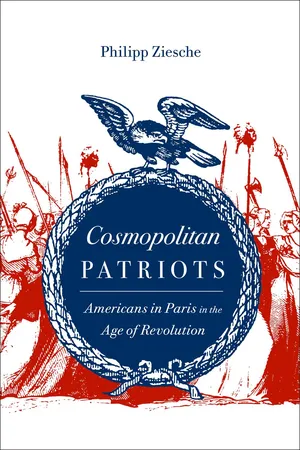
This truly transnational history reveals the important role of Americans abroad in the Age of Revolution, as well as providing an early example of the limits of American influence on other nations. From the beginning of the French Revolution to its end at the hands of Napoleon, American cosmopolitans like Thomas Jefferson, Gouverneur Morris, Thomas Paine, Joel Barlow, and James Monroe drafted constitutions, argued over violent means and noble ends, confronted sudden regime changes, and negotiated diplomatic crises such as the XYZ Affair and the Louisiana Purchase. Eager to report on what they regarded as universal political ideals and practices, Americans again and again confronted the particular circumstances of a foreign nation in turmoil. In turn, what they witnessed in Paris caused these prominent Americans to reflect on the condition and prospects of their own republic. Thus, their individual stories highlight overlooked parallels between the nation-building process in both France and America, and the two countries' common struggle to reconcile the rights of man with their own national identities.
- 256 pages
- English
- ePUB (mobile friendly)
- Available on iOS & Android
eBook - ePub
About this book
Information
Subtopic
Early American HistoryIndex
History1
Exporting American Revolutions
Exporting American Revolutions
GOUVERNEUR MORRIS, THOMAS JEFFERSON, AND THE DEBATE ABOUT THE FRENCH CONSTITUTION, 1789
On 7 December 1791, Gouverneur Morris sat down at his desk at the Hôtel Richelieu in Paris to spend some time on a personal project. As he later noted in his diary, “This Morning employ myself in preparing a Form of Government for this Country.” The following day, Morris received a visit from a French gentleman who informed him that he knew America “perfectly well tho he has never seen it,” and was convinced that the “American Constitution is good for Nothing.” The visitor, who had studied the subject of constitutions for fifty years, had been kind enough to write a letter to President Washington, enclosing a new constitution. As a central figure in both the Continental Congress and the Constitutional Convention, Morris was himself an old hand at constitution-making, and the encounter left him with the disconcerting feeling of having met his French double. “I get Rid of him as soon as I can,” Morris wrote, “but yet I cannot help being struck with the Similitude of a Frenchman who makes Constitutions for America and an American who performs the same good Office for France. Self Love tells me that there is a great Difference of Persons and Circumstances but Self Love is a dangerous Counsellor.”1
In this moment of uncharacteristic humility, Morris encapsulated the predicament of Americans in revolutionary Paris. Like many of his compatriots, Morris assumed that the American experience of revolution and nation-building was universally relevant and that he had some important lessons to teach to the French. He was therefore disconcerted to find that while the French revolutionaries did take great interest in the American precedent, they were apt to use it in their own particular ways, and, in this instance, even turn the tables on their would-be teachers.
The French Revolution forced Americans abroad to wrestle with ambiguities within their own revolutionary tradition that most of their compatriots at home had not yet carefully examined. Although there was no consensus in the United States about the meaning of the American Revolution, Americans in Paris generally agreed that its lessons were universally applicable. However, at the same time that they extolled the universalism of American ideas and accomplishments, they also believed that these accomplishments reflected particular qualities of the American people, and that the successful application of these ideas elsewhere would require the same qualities in other nations.
This chapter examines the ambiguity in the American revolutionary tradition of universalism and particularism by using as an example the activities of Gouverneur Morris and Thomas Jefferson in Paris in 1789. During the first crucial phase of the French Revolution, from the convening of the Estates-General in May 1789 to the October Days, Morris and Jefferson, the American minister to France, were the most prominent representatives of the new American nation in Paris. Their reputations as political theorists and revolutionaries caused both liberal and conservative French reformers to seek out their advice in the heated debates about the new French constitution.
Morris's biographers like to emphasize the contrast between the boisterous New Yorker and the soft-spoken Virginian, using Jefferson's idealistic naïveté as a foil for Morris's worldly pragmatism. Although Jefferson and Morris brought to Europe two fundamentally different interpretations of the meaning of the American Revolution, they were equally enthusiastic about providing guidance to their French hosts based on their respective interpretations. Yet at the same time, both men worried that the national character of the French would impede their ability to follow in American footsteps.2
American nation-builders had learned from Montesquieu that to be sustainable any government had to correspond to the spirit of the people under its rule. Morris never questioned the right of the French to reshape their political system, but he concluded from the violence he witnessed in the streets of Paris that the French needed the guidance of a strong, centralized government even more than the American people. Jefferson came to believe in the mutability of the French national character, whose deformed state he attributed to the oppressive power of a despotic state, and he accepted revolutionary violence as the first articulation of a popular political consciousness. Still, Jefferson also questioned whether it was truly possible for any people to break completely with their past.
Since he understood the French national character to be unchangeable for the foreseeable future, Morris chiefly concerned himself with devising a constitutional division and balance of powers that would most likely ensure the stability of the French state. Jefferson's belief in the malleability of national character was closer to the view that came to dominate the French National Assembly, according to which the new constitution was a tool of nation-building. Drafting a new national constitution entailed not only an institutional rearrangement but also a profound recasting of the French nation's social and political life. This meant, however, that the ambiguity of the term “constitution” as both a fundamental state of being (reflecting a particular national character) and as the act of establishing a new government (based on universal principles) was compounded by the nationalist paradox of creating a new constitution in the name of the very same nation that the new constitution would bring into existence.3
Jefferson's and Morris's adherence in their constitutional recommendations to Montesquieu's doctrines of national character and moderation proved to be a major point of contention in their interactions with the French revolutionaries. The denizens of Parisian salon society, as well as members of the National Assembly, initially welcomed the Americans’ presence and regarded their expertise as highly relevant to the French nation-building process. The political factionalism that increasingly divided the Assembly in the summer of 1789 at first elevated the position of the Americans as allies who could lend international cachet to a political program. But as the dialectic of action and reaction between the monarchien and Patriot factions continued, the mediating position that both Jefferson and Morris had sought to occupy was progressively marginalized, and most of their advice on the constitution was ultimately ignored.
Unfortunately, while Jefferson and Morris left rich accounts of their discussions with political figures in Paris, French commentary on the two Americans is much harder to find. French revolutionaries regularly made reference to the United States in public debates, but seldom recorded private encounters with the Americans in their midst. This imbalance is not surprising. The Americans had ample opportunity to muse about the French Revolution's implications for their infant nation. Meanwhile, the French were struggling daily to keep pace with the revolution's rapid changes and myriad problems. In the case of post-revolutionary memoirs, this neglect might also reflect French disenchantment with the American revolutionary model that developed over the course of the 1790s.
Nonetheless, the two Americans, with their very different concepts of the meaning of the American Revolution, served the French revolutionaries as catalysts for formulating and justifying their own political principles and choices. In turn, their reception in Paris reinforced Jefferson's and Morris's belief in the vanguard role that the American republic was destined to assume in the world, yet also confronted them with the limits of American influence abroad.
When Gouverneur Morris reached Paris in late January 1789, the city was in the grip of a particularly long and cold winter. “And this is the smiling European Spring of which so much is said and sung,” he noted with characteristic sarcasm in the diary he began to keep shortly after his arrival in France.4 Morris took up lodgings at the Hôtel Richelieu on one of Paris's most elegant streets, near the Palais Royal, and within a week presented himself at the Hôtel de Langeac, the residence of the American minister plenipotentiary, Thomas Jefferson. The two men had “only a slight Acquaintance,” as Morris put it, but Jefferson had already been informed of Morris's mission to salvage his friend Robert Morris's tobacco business, help him sell western land tracts to French speculators, and find private investors to purchase the American war debt from the insolvent French government.5
Remembering the “severe seasoning” of his own first months in Paris five years earlier, Jefferson tried to help Morris through the culture shock caused by the scale, noise, and incessant activity of the most populous city in Europe. Morris was grateful to have found a guide to the city's social and political networks, just as Jefferson had earlier depended on Benjamin Franklin's contacts and advice. By the early summer, the two Americans had formed high opinions of each other's abilities.6
Unlike Jefferson, who preferred to receive small groups of visitors at his home, Morris threw himself with abandon into the social circles of the Parisian nobility. As he made the rounds of his new acquaintances, Morris was naturally drawn into the political conversations that dominated all social gatherings. The announcement of the summoning of the Estates-General in July 1788, coupled with the end of centuries of prepublication censorship, had turned Paris into what Jefferson described as a world gone “politically mad,” where “men, women, and children” talked about nothing but politics.7 How were the deputies to the Estates-General to be chosen? And how was the assembly to be organized when it met? Would the three estates comprising it–the clergy, the nobility, and the commoners–meet and vote separately, which would allow the two privileged estates to dominate the proceedings? Or would they form one common body in which votes would be counted by head?
Morris's opinions were much in demand, as he already enjoyed a reputation as an expert on politics and international finance, due to letters that his late friend the marquis de Chastellux had circulated among French officials. Chastellux had also praised both Morris and Jefferson in his Voyages de M. le marquis de Chastellux dans l'Amérique septentrionale (1786).8 Morris benefited from the French nobility's fascination with all things American, and both relished and resented the stereotypical expectations of his hosts. But Morris was also extremely sensitive to real and imagined slights by French aristocrats, and suspected that the flattering attention he received from noblewomen like the duchesse d'Orléans amounted to nothing more than a faddish exoticism.9
Initially, Morris was reluctant to express political beliefs openly, lest he encroach on the American minister's territory. He also found that his ideas were “too moderate” for Jefferson's liberal friends, like Madame de Tessé and Madame de Lafayette, who were quick to label him an “Aristocrat.” But eventually Morris was overcome by what James Madison called his notorious “fondness for saying things and advancing doctrines that no one else would.” Moreover, in July he began an affair with a noblewoman, Adélaïde de Flahaut, called Adèle, who repeatedly used Morris as an intermediary between her friends at court and deputies in the National Assembly.10
Adèle also served as the hostess of a small but select salon at the Louvre, which for Morris became an invaluable source of information, gossip, and contacts. Its guests ranged from high-ranking officials like the foreign minister the comte de Montmorin, and diplomats like the comte de Ségur, to writers, scientists, and philosophes including the comte de Buffon, the marquis de Condorcet, Antoine-Laurent Lavoisier, and Madame de Staël. Like other salonnières (salon hostesses), Adèle created a space of cosmopolitan sociability where she facilitated dialogue between men of different nationalities and political persuasions. Americans in Paris had long expressed their suspicion of the ease with which the French, and especially French women, mixed liaisons and friendships with politics and patronage, and Morris and Jefferson were no exception.11 Still, they depended on these half-public, half-private channels as the primary means through which they as foreigners could hope to influence French politics. And yet even a salon like Adèle's, for all its freedom of debate and variety of opinions, also served as a filter, limiting the Americans’ understanding of events on the streets beyond its beautifully decorated walls.12
Due to his official position as U.S. minister, Jefferson in particular walked a fine line between conversing with friends about current events and intervening in the affairs of a foreign state. The day after the opening of the Estates-General in Versailles on 5 May, Jefferson wrote to Lafayette to express his concern about Lafayette's divided loyalties between the instructions of his noble constituents and his support for the demands of the Third Estate. In clear violation of diplomatic protocol, Jefferson urged Lafayette to disregard the directives of his constituents and propose a compromise in the form of a bicameral legislature. At the end of these detailed recommendations, however, Jefferson reminded his French apprentice that he “must not consider this as advice,” but merely as “the effusion of…sincere friendship.” Morris likewise justified his interventions as the result of his emotional attachment to Lafayette and the French people: “I took the liberty in some late conversations to give you my sentiments on public affairs. I know the folly of offering opinions, which bear the appearance of advice, but a regard for you and the sincerest wishes for the prosperity of this kingdom pushed me beyond the line, which caution would have drawn for one of less ardent temper.”13
Even though Morris was among those who thought that the social and political change following the American Revolution had gone too far, he was profoundly inspired by the political fervor he encountered in Paris. In a letter to his friend the comte de Moustier, the French minister in New York, shortly after his arrival, Morris expressed his delight to find “on this Side of the Atlantic a strong resemblance to what I left on the other–a Nation which exists in Hopes, Prospects, and Expectations. The reverence for ancient Establishments gone, existing Forms shaken to the very Foundation, and a new Order of Things about to take Place in which even to the very names, all former Institutions will be disregarded.” The “strong resemblance” that Morris perceived between the prospects for reform in France and the challenges that American revolutionaries had confronted only a few years earlier bolstered his confidence that he had something valuable to contribute to the debates raging all over Paris. In fact, these debates could easily be interpreted as a flattering acknowledgment of America's own political achievements. Jefferson had a few weeks earlier excitedly reported to Madison that American state and federal constitutions, and especially their bills of rights, were widely read and imitated in the French capital: “Every body here is trying their hands at forming declarations of rights. You will see that [Lafayette's draft] contains the essential principles of ours accommodated as much as could be to the actual state of things here.”14
In addition to the validation that French imitation bestowed on American accomplishments, Morris and Jefferson had more pragmatic reasons for wanting to point the French reform movement in the right direction. A regenerated French nation would be a strong ally against America's former colonial masters, while the collapse of French power might embolden Britain to wreak revenge on the new republic. Combining self-interest and altruism, Morris explained to George Washington: “We have I think every Reason to wish that the Patriots may be successful. The generous Wish which a free People must form to disseminate Freedom, the grateful Emotion which rejoices in the Happiness of a Benefactor, and a strong personal Interest as well in the Liberty as in the Power of this Country all conspire to make us far from indifferent Spectators. I say we have an Interest in the Liberty of France.” Eager to win the respect of their Parisian hosts, convinced of the relevance of the American precedent, and concerned about the possible disintegration of the French state, Jefferson and Morris regarded it as their cosmopolitan and patriotic duty to take an active role in the French Revolution.15
While their motives were similar, Jefferson's and Morris's understanding of the nature of the American constitutional model, as well as their ideas about its implications for France, were strikingly different. Morris arrived in Paris fresh from the Constitutional Convention, where he had argued for a strong central government capable of containing the hostility between the rich and the poor intrinsic to a market economy. The antagonism between a popular lower house and a patrician upper house would secure a voice for freeholders while limiting popular “excesses,” and control the usurpations of the wealthy while tying their interests to the welfare of the government. The executive needed to be as independent as possible and endowed with an absolute veto on legislation to be able to fulfill its role as the guardian of the people against “legislative tyranny.” Although in the end the powers of the president did not fully live up to Morris's expectations, and despite his strong reservations about the compromise with state interests over slavery, he considered “the present plan as the best that was to be attained.” These concessions never caused Morris to question the validity of his constitutional principles, which he saw as equally applicable to Philadelphia and Paris.16
Commenting on the deliberations in Philadelphia from Paris, Jefferson worried that men like Morris–those “gentry” who would like to turn the American president into “a bad copy of the Polish king”–needed to shed their colonial mentality by coming to Europe, “to see something of the trappings of monarchy.” This would make them realize that, “with all the defects of our constitutions, whether general or particular, the comparison of our governments with those of Europe are like a comparison of heaven and hell.” The centralized government that Morris tirelessly championed on the floor of the convention would not only pose a threat to civil liberties and states’ rights but also tarnish America's progressive image among reformers in France. Since Jefferson had observed the troubles of the Confederation period from afar through letters and European newspapers, his defining experience of the American Revolution remained the Continental Cong...
Table of contents
- Cover Page
- Title Page
- Copyright Page
- Dedication Page
- Contents
- Note on Translation and Dates
- Acknowledgments
- Introduction
- 1. Exporting American Revolutions: Gouverneur Morris, Thomas Jefferson, and the Debate about the French Constitution, 1789
- 2. “Was Ever Such a Prize Won with so Little Innocent Blood?”: Political Violence and the Global Stakes of the French Revolution, 1790–1792
- 3. Cosmopolitan Sensibilities and National Regeneration: The Work of Joel Barlow, 1792–1794
- 4. “Strange, that Monroe should Warn us against Jacobins!”: The Problem of Popular Sovereignty in Thermidorian Paris and Federalist America, 1794–1796
- 5. The End of a Beautiful Friendship: Anti-Cosmopolitanism, Anti-Americanism, and Public Diplomacy, 1796–1799
- 6. From Sister Republics to Republican Empires: The Jeffersonian Divorce from France and the Louisiana Purchase, 1800–1805
- Epilogue
- Notes
- Bibliography
- Index
Trusted by 375,005 students
Access to over 1.5 million titles for a fair monthly price.
Study more efficiently using our study tools.
Frequently asked questions
Yes, you can cancel anytime from the Subscription tab in your account settings on the Perlego website. Your subscription will stay active until the end of your current billing period. Learn how to cancel your subscription
No, books cannot be downloaded as external files, such as PDFs, for use outside of Perlego. However, you can download books within the Perlego app for offline reading on mobile or tablet. Learn how to download books offline
Perlego offers two plans: Essential and Complete
- Essential is ideal for learners and professionals who enjoy exploring a wide range of subjects. Access the Essential Library with 800,000+ trusted titles and best-sellers across business, personal growth, and the humanities. Includes unlimited reading time and Standard Read Aloud voice.
- Complete: Perfect for advanced learners and researchers needing full, unrestricted access. Unlock 1.5M+ books across hundreds of subjects, including academic and specialized titles. The Complete Plan also includes advanced features like Premium Read Aloud and Research Assistant.
We are an online textbook subscription service, where you can get access to an entire online library for less than the price of a single book per month. With over 1.5 million books across 990+ topics, we’ve got you covered! Learn about our mission
Look out for the read-aloud symbol on your next book to see if you can listen to it. The read-aloud tool reads text aloud for you, highlighting the text as it is being read. You can pause it, speed it up and slow it down. Learn more about Read Aloud
Yes! You can use the Perlego app on both iOS and Android devices to read anytime, anywhere — even offline. Perfect for commutes or when you’re on the go.
Please note we cannot support devices running on iOS 13 and Android 7 or earlier. Learn more about using the app
Please note we cannot support devices running on iOS 13 and Android 7 or earlier. Learn more about using the app
Yes, you can access Cosmopolitan Patriots by Philipp Ziesche in PDF and/or ePUB format, as well as other popular books in History & Early American History. We have over 1.5 million books available in our catalogue for you to explore.