![]()
1
Introduction
I own I am not a friend to a very energetic government. It is always oppressive.
—Thomas Jefferson to James Madison, December 20, 1787
WHEN THE AMERICAN colonists fought for independence from Britain, they justified their action to themselves and to the world as a struggle to protect the liberty of the people from the power of an oppressive government. Later in the 1780s when they argued fiercely among themselves over what kind of national government to construct and in the 1790s when they contended over how to translate the sparse language of the Constitution into practice, the debate once again was phrased in terms of power and liberty. Opponents of a more powerful national government described it as a threat to liberty. Its advocates, whatever other good things they expected of energetic government, first had to reassure people it would not pose a threat to liberty. They had to challenge the widely shared assumption that was put into words by Thomas Jefferson when he wrote to James Madison that any “energetic” government posed a direct threat to liberty; they had to argue instead that it was sometimes possible to make government more powerful without making the governed less free.1
Their burden of proof was especially heavy in arguing for powerful national government. Compared to the state governments, the national government was more distant and represented a greater total accumulation of power; furthermore it was much newer than the state authorities and its effects on liberty more difficult to foresee. Anyone prone to be suspicious of power as such was likely to be particularly suspicious of national power. For this reason those hoping to establish an energetic national government had to address both the general suspicion of power and the special level of distrust directed against national power.
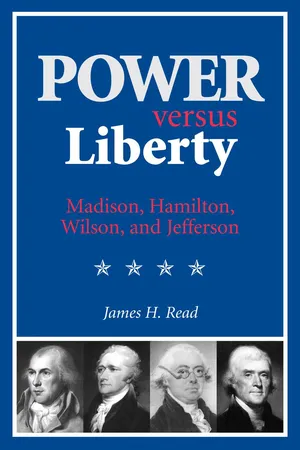
This book is a study of the way in which four theorists-statesmen of the age wrestled with this problem. Three of them—James Madison, Alexander Hamilton, and James Wilson—challenged in different ways the widely held assumption that all governments tend to augment their power at the expense of liberty. Madison in a letter to Jefferson called this assumption “not well-founded.”2 But Madison, Hamilton, and Wilson challenged the assumption in very different ways, and the differences among them are as important as their shared opposition to the Jeffersonian view. This was not an argument that had only two sides.
Thomas Jefferson is included in this study for purposes of contrast, for he shared and reinforced the view that the others attempted to challenge. For Jefferson there was a permanent and irreducible antagonism between power and liberty: all governments tend to expand their power at the expense of the liberty of the governed, and for this reason their powers must be subjected at all times to close restraints.
Strategically, of course, as fellow architects and advocates of the Constitution, Madison, Hamilton, and Wilson had to argue against any simple opposition between power and liberty; for if a more powerful government meant a people less free, the Constitution was doomed from the start. But their theorizing about power and liberty neither began nor ended with the drafting and ratification of the federal Constitution. Therefore this study examines the trajectory of each man's action and thought from about the mid-1780s through the 1790s (and in some instances into the 1800s). The great divergence between Madison and Hamilton in the 1790s—which is almost routinely misrepresented by historians and biographers—is as central to this study of power and liberty as is their collaboration on The Federalist. James Wilson's opinions as a Supreme Court justice and his Law Lectures of the early 1790s are as important as his contributions at the Federal Convention. And Jefferson, too, must be studied over time; the Declaration of Independence may be the finest single expression of his thought, but the principles articulated in the Declaration do not explain Jefferson's initial reservations about the Constitution or why he was so suspicious of national power throughout the 1790s.
One of the purposes of this work is to underscore the wide range of political and theoretical possibilities available in republican thought in the 1780s and 1790s and to resist attempts to reduce that diversity to some single line of ideological division—such as democracy versus oligarchy, republicanism versus liberalism, agrarianism versus commercialism. Those divisions are there, of course, but they do not fully explain what these men supported and opposed and why. Wilson, for example, was as democratic as Jefferson and as nationalist as Hamilton; their respective commitments on questions of national power do not directly reflect their degree of commitment to democracy, or vice versa. Hamilton was probably the least democratic of the four men studied here, but to treat his commitment to national power as a function of his suspicion of democracy is to fundamentally misunderstand what he was trying to accomplish.
Another problem with the attempt to fit the theorists-statesmen of the age into prefabricated categories like “democracy,” “oligarchy,” “republican,” and “liberal” is that this overlooks the degree to which the power of government itself was an independent problem that had to be addressed on its own terms. Jefferson advocated a thoroughgoing jealousy of governmental power, while Hamilton asked for a generous measure of trust; this is not a quarrel that can be obviously reduced to democracy versus oligarchy (even though Jefferson may have thought so). The preoccupation with the power of government characteristic of the age was not just a form in which other political, social, and economic conflicts were played out; it existed in addition to these other conflicts, shaped them, and sometimes took precedence over them.
This fixation on the power of government as such, in a way that crowds out other kinds of problems and de-emphasizes other kinds of power, may appear odd to modern readers. The preoccupation with governmental power was so strong that in the eighteenth century “power” was typically used as a shorthand expression for the power of government. In the twentieth century we have become much more sensitive to forms of social and economic power that do not fit easily into a narrowly governmental model. Works of social and economic history published in the last thirty years or so have made us much more aware of the kinds of social and economic power exercised in the past over women, paupers, debtors, indentured servants, slaves, and Native Americans (among others) by people who were not necessarily in government or directly involved in carrying out its policies.3 For this reason the eighteenth-century preoccupation with governmental power might appear perverse, and a work of scholarship that takes that preoccupation on its own terms might appear old-fashioned.
The Founding era's fixation on the power of government may have been excessive; indeed it appeared so to those of the age who attempted to challenge the assumptions underlying it. But for better or worse it was there, in the political language and hopes and fears of the age. And those who believe that an excessive preoccupation with the power of government is a relic of eighteenth-century political discourse might take another look at present-day American politics.
I
This work takes the form of a four-way comparison structured by a set of interlocking themes and problems, all of which branch off from the basic question of how to reconcile the power of government with the liberty of citizens in a republican political order. Each of the four central chapters takes one of the four theorists-statesmen as its subject and can be read as a self-contained essay. But at the same time each individual portrait is an entry in a larger conversation about power and liberty.
In calling it a conversation, I mean this sometimes in a literal sense and sometimes in a figurative sense. Although there probably was no moment when Madison, Hamilton, Wilson, and Jefferson all sat down together and conversed about the power of government and the liberty of citizens, there were many particular exchanges among two or three of the men—sometimes in letters, sometimes at public or private gatherings, occasionally in shrill pamphlets of the kind Jefferson and Hamilton fired at each other in the 1790s. Perhaps it is stretching the term to call Jefferson's and Hamilton's battle a conversation; but when Hamilton said, “You must place confidence” and Jefferson wrote, “Free government is founded in jealousy, and not in confidence,” there was an implicit exchange of ideas taking place even across an abyss.4
Madison's and Jefferson's long friendship and voluminous correspondence is well known.5 The degree of intimacy and trust displayed in their letters to one another and their fundamental agreement on many issues (such as religious liberty) can easily cause us to overlook their very significant disagreements on other issues. Even when they took the same side politically (as they did in the 1790s in opposition to Hamilton), they often did so for different reasons. The present study concerns one of those matters upon which they disagreed, quite openly and respectfully.
Madison, Hamilton, and Wilson were three of the men most directly responsible for drafting the Constitution and arguing for its ratification, and this too was mediated by conversations. At the convention itself Madison was the single most influential figure in shaping the document, but Wilson was a close second and was clear and specific on a number of issues (such as the executive) about which Madison had no clear ideas coming into the convention. Early in the convention (May and June 1787) when fundamental questions of political principle were on the table, there was an impressive degree of cooperation among Madison, Wilson, and Hamilton, suggesting that each was responding to and building upon the thoughts of the others.6
Wilson, Hamilton, and Madison carried the ideological torch in the ratification struggle, Wilson doing so first in the key state of Pennsylvania. Wilson's crucial role in the ratification contest is overlooked in many histories of the period but was obvious to contemporaries. (Bernard Bailyn points out that Wilson's State House Yard speech of October 6, 1787, generated far more contemporary commentary and response than did The Federalist Papers.)7 Wilson was the one most responsible for putting the idea of popular sovereignty at the center of the Federalist case for the Constitution. In Federalist No. 84 Hamilton borrowed Wilson's argument about the superfluity of a bill of rights under a constitution based on delegated powers. Jefferson, in complaining to Madison on December 20, 1787, about the lack of a bill of rights in the Constitution, explicitly mentioned Wilson's argument and criticized it; Madison, describing to Jefferson on October 17, 1788, his own change of position on a bill of rights, again mentioned Wilson by name and compared his own view with that of Wilson.
This work does not attempt to reconstruct every direct or indirect exchange among these four men. Instead their conversations function as a starting point, a way of identifying questions and problems that are then developed through the use of a wide range of sources. The advantage of a four-way comparison like the one presented here (as opposed to a full-length treatment of one of the figures that merely mentions the others in passing) is that certain kinds of problems can be fully understood only through comparison. One cannot, for example, adequately understand either Madison or Hamilton without comprehending how they could have worked together so closely in framing the Constitution and arguing for its ratification and then opposed one another so fundamentally on its application to practice in the 1790s.
Or to take another example, one cannot appreciate the significance of Jefferson's hostility to energetic national government and his endorsement of a strong version of state sovereignty unless one knows that James Wilson articulated an equally democratic but strongly national alternative. Whether Wilson's nationalist version of democracy could have taken hold then the way Jefferson's did is an open question; Wilson wholly lacked the capacity for Jefferson's style of political leadership. But the comparison demonstrates, at the very least, that Jefferson's suspicion of national power and his understanding of the Constitution as a compact among sovereign states did not directly follow from his belief in popular sovereignty, or his faith in the people, or from the alleged influence of Scottish moral philosophy on his political thought, for these faiths and beliefs likewise characterized James Wilson, whose political commitments were so different from Jefferson's.8
II
The conversations and arguments about power and liberty examined in this work take place against a background of Lockean political principles—best encapsulated in the Declaration of Independence. They also build upon, as well as transform, a tradition of oppositional Whig thought originating in eighteenth-century England. Both the shared Lockean principles and the oppositional Whig tradition shaped the way in which problems of power and liberty were raised, but they did so in very different ways. It is not that they conflicted, exactly, but rather that they addressed different kinds of problems.9
This is exemplified in the ambiguous relation between the Lockean principles of the Declaration of Independence and Jefferson's wider political thought. All four of the figures studied here—Hamilton no less than the rest—shared the principles articulated in the Declaration. None of them, however, shared Jefferson's view that energetic government is always oppressive.
The Declaration is Jefferson's most famous piece of writing, and no interpretation of his political thought can ignore it.10 Yet for purposes of the present study, the Declaration poses some peculiar interpretive problems. It is, and was intended by Jefferson to be, not the statement of an individual but of the entire patriot cause: “Neither aiming at originality of principle or sentiment, nor yet copied from any particular and previous writing, it was intended to be an expression of the American mind, and to give to that expression the proper tone and spirit called for by the occasion.”11 Thus Jefferson would have deliberately suppressed any views and premises that did not command common consent (and Congress pared away at them even further when it edited Jefferson's draft). On the other hand, what remains in the document is certainly in accordance with Jefferson's own views and moreover—in Jefferson's own mental universe—is connected via certain well-oiled tracks with wider aspects of his thought that might not have enjoyed the common consent of the signers. The power of the document—and consequently Jefferson's fame—would have been significantly diminished if more of Jefferson's own views had been incorporated in it. It succeeds because it leaves so many questions open.
The Declaration dissolves a government without setting up another. It says nothing about how to set up another form of government, nothing about how to design and balance its powers so as to best preserve liberty, nothing about the appropriate distribution of power in a federated system. It merely declares the right of the people to establish a government based on consent while remaining silent about the form.
Nor does it say anything about how best to guard liberty during “normal” times. The Declaration is directed explicitly toward an extreme political case rather than the ordinary workings of government: a case in which there was a clear and radical choice between two fundamentally different sets of political principles. It thus provides no guidance about how to reconcile liberty and power during times when revolution is not the appropriate remedy.
One of the fundamental premises of Jefferson's political philosophy taken as a whole—testified to in scores of letters and especially in his draft of the 1798 Kentucky Resolutions—is the idea that there exists a permanent antagonism between the power of government and the liberty of citizens, an unequal contest in which the “natural progress of things is for liberty to yield, and government to gain ground.”12 But there is no statement to this effect, either direct or implicit, in the Declaration. It does not pretend to diagnose what flaws in the English constitution or what negligence on the part of the people set in process the chain of events culminating in the violation of the Americans' most fundamental rights. Instead it catalogs the violations themselves in order to assert the right of revolution. Jefferson certainly had his own views of what tendencies in English government had led to the crisis—he was well steeped in the thought of the oppositional Whigs—but there is nothing about this in the Declaration itself. The document does presuppose that a watchful people can distinguish between “light and transient causes” and “a long train of abuses and usurpations pursuing invariably the same object.” Yet it does not explain the distinction; it lists the clear and present abuses but does not say anything about what early warning signs indicate a shift from “light and transient causes” to a “design” on liberty. If Jefferson had incorporated his own answer to this question in the draft, he might have encountered much disagreement with his fellow delegates.13
Jefferson's wider political philosophy makes a principle of “jealousy of power”: every increment of power in government is dangerous. The Declaration, too, is implicitly about jealousy, but in a much more restricted and formal sense. To assert that “a people” has a right to alter or abolish an existing form of government when it becomes abusive of the rights it was designed to protect clearly implies that people practice a kind of watchfulness toward government; otherwise there would be no way of enforcing the principle. But to practice principled watchfulness is not necessarily to treat every increment of government power as a threat to liberty, nor does it necessitate the rejection of confidence in government officials under ordinary circumstances.
More generally, the Declaration of Independence is concerned not necessarily with powerful government but with abusive government. The practical relation between the amount of power vested in government and the possibility of its abuse is left entirely open.
It is also worth noting that the Declaration, although it asserts the right of “a people” to alter or abolish forms of government and establish new ones, leaves entirely open the question of whether there exists a single American people or thirteen separate peoples engaged in a strategic alliance against the British Empire. The opening of the document speaks of “one people” dissolving the political bands that have connected them with another, but the conclusion of the document asserts that the “united colonies are & of right ought to be free & independent states”—in the plural.14 The people are sovereign, but whether the Declaration speaks in the name of a single sovereign American people or in the name of the various sovereign peoples of Virginia, Massachusetts, New York, etc., is a question upon which the Declaration is silent. How much power one is willing to vest in national government depends among other things upon whether one regards the United States as a single people or a coalition of peoples.
III
If the fundamental principles set forth in the Declaration offer little practical guidance for the conduct of government and protection of liberty in normal times, that gap was filled to a certain extent by the oppositional Whig tradition of thought in which Americans of the Revolutionary age had steeped themselves and whose importance has been underscored in a number of histories of the Revolutionary and constitutional period.15 Political writers in this tradition whose influence was greatest in America would include Trenchard and Gordon (authors of Cato's Letters), James Burgh, and—though he was not really a Whig—Bolingbroke. Specific concerns addressed in thes...