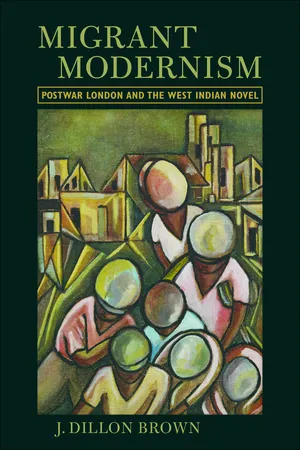
In Migrant Modernism, J. Dillon Brown examines the intersection between British literary modernism and the foundational West Indian novels that emerged in London after World War II. By emphasizing the location in which anglophone Caribbean writers such as George Lamming, V. S. Naipaul, and Samuel Selvon produced and published their work, Brown reveals a dynamic convergence between modernism and postcolonial literature that has often been ignored. Modernist techniques not only provided a way for these writers to mark their difference from the aggressively English, literalist aesthetic that dominated postwar literature in London but also served as a self-critical medium through which to treat themes of nationalism, cultural inheritance, and identity.
- 256 pages
- English
- ePUB (mobile friendly)
- Available on iOS & Android
eBook - ePub
About this book
Information
Subtopic
English Literary CriticismIndex
Literature1 At the Scene of the Time
Postwar London
But the Movement is interesting. It is interesting, like other movements, not only in itself, but because of the light which it throws upon the work of writers who are outside of it, perhaps opposed to it.
—J. D. Scott, “In the Movement”
Early in his 1960 volume of essays, The Pleasures of Exile, George Lamming fixes his sharply analytical eye on “an English critic, Mr. Kingsley Amis, discussing West Indian novelists in the Spectator” (28). The discussion in question, Amis's 1958 “Fresh Winds from the West,” treats eight recently released books by Caribbean authors and stands as a testament to the high visibility of Windrush writing on the British cultural scene at the time. However, Lamming is not particularly pleased by the type of attention represented by Amis's article, which he dismisses as ill considered and virtually bereft of literary discernment. Lamming's irritation attaches most strongly to his impression that Amis, despite occupying a high cultural position as novelist, critic, and university teacher, displays the “type of mind [that] cannot register the West Indian writer as a subject for intelligent and thoughtful consideration” (29). Aggrieved at this lack of intellectual seriousness, Lamming proceeds to dissect Amis's critical assumptions, revealing a great deal about the obstacles facing West Indian authors in Britain in the process. For example, Lamming rebukes Amis's comfortable conceptions of Englishness and its inherent superiority, describing how Amis accepts “the privilege so natural and so free of being the child and product and voice of a colonising civilisation” (30). Amis's lack of political engagement and maturity is bitingly condemned, characterized as an ethos of “shouting, in mockery, the adolescent privileges that are the theme of any Mr. Don't-really-care-a-damn-except-to-be-as-decent-as-possible” (30). Lamming also hints at the tacit racism of such a view, imagining that a black writer expressing the pallid decency Amis advocates might be “regarded as a simple, articulate boy,” based on the British assumption of colonialism “as a development and later as an improvement on slavery” (30). The lengthy example from Amis's article with which Lamming begins his caustic assessment suggests one final point of disagreement—one regarding literary form. The passage included by Lamming is the article's opening paragraph, an extended diatribe on literary experiment, a stylistic practice Amis dismisses as risibly fraudulent and misguided. Although Lamming does not explicitly address this aspect of Amis's article, the very style of The Pleasures of Exile (not to mention the four novels Lamming had published by this time) stands in a relation of silent but poignant dissent from Amis's dismissal of the usefulness of experimental prose. Lamming's implicit disagreement points to an important dynamic in postwar literary London, in which younger writers were rebelling against the techniques of prewar modernists such as Woolf and Joyce (both derisively referred to in the passage of Amis's Lamming provides). Lamming's brief excursus on Amis in The Pleasures of Exile in fact encapsulates some of the most crucial issues confronting Windrush writers in Britain, issues revolving around social privilege, politics, race, and—refracted through all of these—literary form. Although Lamming, even here, generally disavows any meaningful interest in Amis, or indeed any other English critics, his very inclusion of Amis in the text suggests the role the British cultural field had in helping shape West Indian literary production in the postwar years.1
As Kenneth Ramchand observes in his seminal study The West Indian Novel and Its Background, during these formative postwar years London “is indisputably the West Indian literary capital” (63), and certainly, following Ramchand, the awkward irony of such an important generation of anticolonial writers working in the metropolitan heart of empire has frequently been noted. However, beyond simple acknowledgment, critics have focused relatively little attention on the ramifications arising from the fact that this pioneering generation of West Indian authors lived and published almost exclusively in London. Most critical accounts that do focus on Windrush writing in London, such as John Clement Ball's Imagining London: Postcolonial Fiction and the Transnational Metropolis or John McLeod's Postcolonial London: Rewriting the Metropolis, concentrate their discussion on how this influx of migrant writers affected British literature and culture. They do not extensively consider the ways London, in turn, worked to mold these writers’ literary output.2 And while a good deal of attention has rightly been put on the BBC's Caribbean Voices by insightful commentators like Laurence Breiner and Glyne Griffith, their accounts tend to emphasize the separate, Caribbean-oriented community in the heart of empire that the show's production worked to form rather than examining interactions between Windrush writers and the surrounding British literary culture.
More recently, critics such as Peter Kalliney and Gail Low have focused scholarly attention on the important ways in which the demands and politics of publishing affected West Indian writing in the metropolitan setting of London.3 Focusing on the Windrush writers’ alignments within the British literary system, Kalliney and Low both insist on viewing that system as a malleable, if unavoidably constitutive, feature of West Indian literary production, rather than merely a sinister or oppressive force. This emphasis is fruitful: it acknowledges that the institutional and geographical placement of the Windrush generation has more than a passing thematic or historical significance to an understanding of their work and hence the emergence of postwar Anglophone Caribbean literature itself. Taken in this context, these novelists can be seen working toward the goals of cultural and political autonomy in the Caribbean—as they surely were—but doing so within the formidable constraints imposed by the London literary landscape. As this chapter hopes to show, this landscape is one that became increasingly influenced by the prerogatives of a group of writers originally referred to as the Movement.4 Composed of English writers such as Amis, Donald Davie, Phillip Larkin, and John Wain, the Movement had cultural convictions—proudly philistine, aggressively nationalist, and anxiously concerned with the changing dynamics of class (not race) within Great Britain proper—that were largely antithetical to the concerns of the Windrush writers. If, as this chapter's epigraph suggests, the Movement can be of interest “not only in itself, but because of the light which it throws upon the work of writers who are outside of it, perhaps opposed to it” (J. D. Scott, “In the Movement,” 400), considerable light can be thrown upon the Windrush writers active in London simultaneous with the rise of the Movement. Indeed, a close examination of the combative field of postwar literary London suggests that these pioneering West Indian writers overtly occupied positions both outside and in opposition to the Movement.5 An analytic emphasis on London—undoubtedly the center from which postwar West Indian writing emanated—thus brings the transnational sophistication of the Windrush writers’ achievements more properly into view, showing how, even in its most overtly nationalist stage, Anglophone Caribbean literature was inescapably imbricated (but not imprisoned) in metropolitan circuits of exchange and reception.
It should be emphasized here that Windrush literary production cannot be reduced solely to a reflexive response to the London literary world's governing tastes. Certainly, in Bourdieu's terms, the field is not an inert, impersonal force, but a flexible social space continually constituted via an accumulation of individual actions. These actions, of course, are themselves structurally informed by the all but imperceptible dispositions individuals bring to bear on their choices, a concept for which Bourdieu employs the term habitus.6 In abstract terms, the mutually constitutive interactions between field and habitus—delicately balanced between determinant structure and individual choice—are the process whereby social life unfolds in Bourdieu's system of thought. In more particular terms, this necessitates an acknowledgment that Windrush writers did not come to London as blank screens upon which the modes and mores of the metropole were straightforwardly projected. Certainly, there already existed a legacy of modernist literary practice from the region, embodied in the work of authors such as Alejo Carpentier, Aimé Césaire, Claude McKay, Jean Rhys, and Eric Walrond. Although the Windrush writers manifest little if any overt knowledge of such a cultural inheritance, its very existence suggests that what Dash describes as “the spirit of intellectual dissidence, imaginative restlessness, and dialectical struggle” (Other America, 15) characteristic of the region's modernism emanates from a far-reaching array of influences in both spatial and temporal registers. A multitude of thinkers—including Sidney Mintz, Tzvetan Todorov, and most importantly C. L. R. James—have considered the Caribbean itself to be the inaugural ground of what we think of today as modernity, such that the region can be conceived as a space in which the social forces of alienation, disjuncture, rootlessness, and denaturalization often thought to catalyze modernist aesthetics are present long before the formation of European modernism.7 Along these lines, David Scott's description of (C. L. R. James's depiction of) Toussaint l'Oeverture as a tragic figure of modernity might double as a relatively fitting description of a (male) modernist writer: “inescapably modern as he is obliged by the modern conditions of his life to be, he must seek his freedom in the very technologies, conceptual languages, and institutional formations in which modernity's rationality has sought his enslavement” (Conscripts of Modernity, 168). In some ways, then, as critics such as Dash, Gikandi, and Scott suggest, the critical self-reflexivity characteristic of modernist aesthetics resonates with long-established strategies of Caribbean self-expression and survival.8
At a more individual level, it is clear that Lamming, Mais, Mittelholzer, and Selvon had already established (in various ways, to differing degrees) a self-aware, antibourgeois, oppositional disposition characteristic of their modernist predecessors while living in the Caribbean. Lamming, for example, seems to have developed his proclivity for literary iconoclasm well before he arrived in London in 1950. As he has remarked in interviews, his reading tastes were formed in his teacher Frank Collymore's private library, largely in reaction to the school curriculum, which Lamming describes as “Jane Austen, some Shakespeare, Wells's novel Kipps, and so on…whatever the Cambridge Syndicate demanded” (interview, by Munro and Sander, 6).9 In opposition to this curriculum, one of the most important discoveries Lamming made at this age, in his account, was of Joseph Conrad, whose writing he consistently names as an influence, one that inculcated “a reinforcement of that relation to the word, the word as instrument of exploration,” rather than a merely transparent vehicle of already created thought (“George Lamming Talks,” 11).10 Lamming's early letters to Collymore from Trinidad likewise suggest a keen interest in literary revolt, mentioning his close study of earlier models of rebellion such as T. S. Eliot and William Wordsworth, while drawing comparisons between them and the expressly experimental aims of himself and his peers. In another letter, he invokes the term enfantes terribles to describe his generation of West Indian authors, specifically identifying them as conscious inheritors of a tradition of modernist insurrection.11
Alison Donnell's Twentieth-Century Caribbean Literature demonstrates the similarly domestic development of Mais's rebellious literary sensibility, via his critical contention with a locally influential Jamaican poet, J. E. C. McFarlane. For Donnell, Mais's disagreement with McFarlane prompts him into the “recasting of a culturally relevant modernist manifesto” (43) for his own aims. Citing passages from a 1940 article Mais wrote in Public Opinion, “Where the Roots Lie,” Donnell observes Mais “echoing the fierce guidelines of Ezra Pound in ‘A Few Don'ts by an Imagiste’” (48). In this literary call to arms, Mais, like Lamming, is interested in repudiating complacent understandings of “the school syllabus,” identifying heretical energies in the English literary canon itself: “If only you would wake up for long enough to give the matter some thought you would realise that these men in their day were the last syllable in modernity! Chaucer broke new ground and a lot of traditions, so did Milton, so did Shakespeare” (quoted in Donnell, Twentieth-Century Caribbean Literature, 48). Early examples of aesthetic philosophizing from Selvon, such as his 1947 Evening News (Trinidad) column, “Michael Wentworth Contends,” or Mittelholzer's recollections in A Swarthy Boy—which closes with the pugnacious artistic credo of his youth, “Victory or death!” (151)—also underscore that the Windrush writers’ aesthetic nonconformism was inaugurated in the Caribbean, well before they arrived in London.12
Nevertheless, in the examples above, the fact that both Lamming and Mais figure their acts of literary insurgence through reference to British forebears introduces an important, if familiar, complication to the perceived autochthony of these writers’ aesthetics. As the shared allusions to the educational system also underscore, the Caribbean space in which the Windrush generation became literate, let alone literary, was thoroughly permeated by a British-derived view of cultural value.13 The habitus these writers brought with them to London, then, appears as a complicated mixture of reverence for the literary tradition of England and animosity (enhanced by the racism encountered on arrival) toward the imperial attitudes such a tradition continued to underwrite. The affective ambivalence of the Windrush writers’ position is captured in Lamming's formulation of “the dubious refuge of a metropolitan culture” to which his generation migrated (Pleasures of Exile, 22) and later by a pessimistic description of the limited choice he and his peers faced between the “eternal dispossession” of exile in London and “the ignorant sneer of a Victorian colonial outpost” back home (47).14 As Lamming famously observed in this same essay, the West Indian writer (at least during the postwar era he was describing) “writes always for the foreign reader” (43). To take this claim merely at face value would be a mistake—Lamming clearly envisions the eventual emergence of a home audience as both possible and desirable. To write it off entirely, on the other hand, would be to ignore Lamming's point about how powerfully geopolitical and economic forces structured the ways in which West Indian culture could at that time be produced. The concentration on London in the pages that follow, then, is not meant to suggest that the Caribbean is unimportant to these writers, whether as an originating source or as an ultimate horizon of value. It is, however, an acknowledgment that the underlying structural features of the British literary field cannot be lightly dismissed. Indeed, it is only through a negotiation of this field that the Windrush writers were able to establish the basis of what we now think of as Anglophone Caribbean literature, a fact emblematic not of cultural subjugation or defeat, but rather of the complex, mutually constitutive nature of the relation between British and West Indian, in the cultural (not to mention the economic and political) sphere.15
Caribbean Voices in the Belly of the Beast
The arrival of the SS Empire Windrush—a decommissioned troop transport ship officially carrying 492 Caribbean passengers—at Tilbury docks on 22 June 1948 has become an iconic moment in British history, symbolizing the inauguration of large-scale migration from the territories of the British Empire that led inexorably to Britain's contemporary self-presentation as a multicultural polity.16 Although the Caribbean was not the only region to experience considerable emigration to the “mother country” during this time, its migrants (estimated at around 250,000 in total) attracted a great deal of the attention accorded this population of newcomers to England in the postwar period, and the “Jamaicans,” as they were often erroneously generalized, tended to dominate the media portrayals of England's changing demographics.17 The United Kingdom to which Windrush migrants arrived, however, was most certainly not the proud, invincible nation that had traditionally been promulgated abroad for the edification of Britain's colonial subjects. Ravaged by the war, and deeply in debt to both its colonial holdings and the United States, Britain was uncomfortably coming to terms with the emerging Cold War powers’ eclipse of its previously unrivaled international influence in matters economic and political. As the British historian John Montgomery somberly observed in 1965, the nation's share of worldwide trade by 1955 had been more than halved to 15 percent since 1899, and there seemed little hope of stemming the decline. Such economic vulnerability manifested itself throughout the 1950s by recurrent hard currency crises that threatened the nation's solvency and undermined national confidence. Norman Mackenzie, writing in 1959, captures his generation's sense of beleaguered bewilderment that Britain's world position was far different from its accustomed dominance: “Two world wars, punctuated by a great depression, have made it impossible for the British to compete on equal terms with America or Russia, or even to hold what they have” (Conviction, 12). Long accustomed to a leading role on the international stage, the United Kingdom after World War II was in a palpably precarious position, rapidly losing influence around the world while finding itself without the financial or military resources to preserve even a semblance of its old preeminence.18
Internal to the country, circumstances were likewise uncertain and unstable in the postwar years. Wartime rationing continued well into the 1950s for several basic commodities, and the destructive effects of the Blitz on the nation's housing stock remained visible and acute. Moreover, between the years 1945 and 1951, Clement Attlee's Labour government was engaged in its historic attempt to break down the traditional barriers of British class privilege by instituting a host of innovative social and economic programs, including the creation of the National Health System; the vast expansion of access to a university education through scholarships and the establishment of new “redbrick” universities; and the nationalization of many key industries such as transport, utilities, coal, communications, and banking. Although the ultimate effects of this attempt at dislodging the entrenchment of upper-class hegemony should not be overestimated, concrete social and economic effects were certainly felt, and the subsequent uncertainty resulting from a partial unmooring of status markers was more or less inevitable.19 As Malcolm Bradbury asserts, “in the aftermath of war Britain went through a deep and fundamental revolution, a shift of social power” (Modern British Novel, 269).
This potent combination of external and internal destabilization, it is generally agreed, led to a social world that was unsettled, uncertain, and shot through with a shifting mass of competing cultural, political, and economic agendas that left the British populace struggling to reconsolidate a viable image of national identity. Historian David Childs describes the mood of the country upon Winston Churchill's return as prime minister in 1951 as markedly unstable, noting that “in this changing world Britain experienced difficulty in finding its place, clarifying its position and renewing its identity” (Britain since 1945, 55). Swinging from the social-reform-minded age of austerity immediately after the war to the age of consumer affluence that Tory prime minister Harold Macmillan confidently proclaimed by the end of the 1950s, British life in the early postwar years appears as unusually unpredictable and unsettling, experienced at the time as “a diffuse social unease, as an unnaturally accelerated pace of social change, ...
Table of contents
- Cover Page
- Title Page
- Copyright Page
- Dedication Page
- Contents
- Acknowledgments
- Introduction
- 1. At the Scene of the Time: Postwar London
- 2. “Child of Ferment”: Edgar Mittelholzer's Contrary Tradition
- 3. Engaging the Reader: The Difficulties of George Lamming
- 4. A Commoner Cosmopolitanism: Sam Selvon's Literary Forms
- 5. The Lyrical Enchantments of Roger Mais
- Coda: Kamau Brathwaite, Wilson Harris, and V. S. Naipaul's Caribbean Voice
- Notes
- Bibliography
- Index
Trusted by 375,005 students
Access to over 1.5 million titles for a fair monthly price.
Study more efficiently using our study tools.
Frequently asked questions
Yes, you can cancel anytime from the Subscription tab in your account settings on the Perlego website. Your subscription will stay active until the end of your current billing period. Learn how to cancel your subscription
No, books cannot be downloaded as external files, such as PDFs, for use outside of Perlego. However, you can download books within the Perlego app for offline reading on mobile or tablet. Learn how to download books offline
Perlego offers two plans: Essential and Complete
- Essential is ideal for learners and professionals who enjoy exploring a wide range of subjects. Access the Essential Library with 800,000+ trusted titles and best-sellers across business, personal growth, and the humanities. Includes unlimited reading time and Standard Read Aloud voice.
- Complete: Perfect for advanced learners and researchers needing full, unrestricted access. Unlock 1.5M+ books across hundreds of subjects, including academic and specialized titles. The Complete Plan also includes advanced features like Premium Read Aloud and Research Assistant.
We are an online textbook subscription service, where you can get access to an entire online library for less than the price of a single book per month. With over 1.5 million books across 990+ topics, we’ve got you covered! Learn about our mission
Look out for the read-aloud symbol on your next book to see if you can listen to it. The read-aloud tool reads text aloud for you, highlighting the text as it is being read. You can pause it, speed it up and slow it down. Learn more about Read Aloud
Yes! You can use the Perlego app on both iOS and Android devices to read anytime, anywhere — even offline. Perfect for commutes or when you’re on the go.
Please note we cannot support devices running on iOS 13 and Android 7 or earlier. Learn more about using the app
Please note we cannot support devices running on iOS 13 and Android 7 or earlier. Learn more about using the app
Yes, you can access Migrant Modernism by J. Dillon Brown in PDF and/or ePUB format, as well as other popular books in Literature & English Literary Criticism. We have over 1.5 million books available in our catalogue for you to explore.