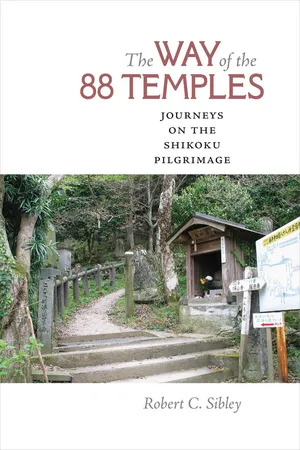
Compelled to seek something more than what modern society has to offer, Robert Sibley turned to an ancient setting for help in recovering what has been lost. The Henro Michi is one of the oldest and most famous pilgrimage routes in Japan. It consists of a circuit of eighty-eight temples around the perimeter of Shikoku, the smallest of Japan's four main islands. Every henro, or pilgrim, is said to follow in the footsteps of K?b? Daishi, the ninth-century ascetic who founded the Shingon sect of Buddhism. Over the course of two months, the author walked this 1,400-kilometer route (roughly 870 miles), visiting the sacred sites and performing their prescribed rituals.Although himself a gaijin, or foreigner, Sibley saw no other pilgrim on the trail who was not Japanese. Some of the people he met became not only close companions but also ardent teachers of the language and culture. These fellow pilgrims' own stories add to the author's narrative in unexpected and powerful ways. Sibley's descriptions of the natural surroundings, the customs and etiquette, the temples and guesthouses will inspire any reader who has longed to escape the confines of everyday life and to embrace the emotional, psychological, and spiritual dimensions of a pilgrimage.
- 208 pages
- English
- ePUB (mobile friendly)
- Available on iOS & Android
eBook - ePub
About this book
Trusted by 375,005 students
Access to over 1.5 million titles for a fair monthly price.
Study more efficiently using our study tools.
Information
Topic
Theology & ReligionSubtopic
Philosophy of Religion1
Bells

A holy person
met so soon
on this pilgrimage.
—SHŪJI NIWANO
I stumbled up the bell tower steps, grasped the rope, and hauled the long wooden pole back as far as possible in its cradle. Then I swung the rope forward and slammed the pole against the bronze bell. A loud bong echoed through the courtyard of Shōsanji temple and across the mountain valley. It was, I thought, a satisfying way to announce my presence to the presiding deities and, presumably, scare away any evil spirits lurking in the surrounding forest. As it was, I flushed a flock of pigeons from the temple roof, sending them flapping into the drizzling sky. The bell’s echoes faded and the birds returned to their roost, but I lingered in the shelter of the tower’s gabled roof.
Across the gravel expanse of the courtyard, a flagstone walkway cut between two rows of tall cedars to the main hall of the temple. The gray-tile roof shone in the rain. Tendrils of incense smoke curled from the urn in front of the hall. Even at this distance the sweet odor permeated the damp air. Nearby, half a dozen bus pilgrims, dressed in traditional white robes and wide-brimmed straw hats, prayed in the small hall dedicated to the Buddhist saint Kōbō Daishi, their heads bowed as they chanted.
I caught snatches of the Hannya Shingyō, or Heart Sutra—the short prayer that is said to articulate the essence of Buddhism: “Gyate, gyate, hara gyate, hara so gyate, boji sowaka.” I didn’t understand the language, but I’d heard the prayer so often during the past three days that the words were beginning to stick in my head. And so they should. As a henro, or pilgrim, I wore the hakui, a white robe or vest, carried the kongō-tsue, a walking staff, and possessed the nōkyōchō, the book in which every henro has a temple seal stamped as a testament to their visit. I even had my pack of osamefuda, or name slips, on which to write my name and address before depositing them in special bins at the temples. And I, too, intended to complete the Henro Michi, the oldest and most famous Buddhist pilgrimage route in Japan.
What set me apart from most other henro was that, unlike the majority who take buses or drive cars, I was going to walk 1,400 kilometers, visiting each of the eighty-eight temples that are strung out like beads on a rosary around the perimeter of Shikoku, the smallest of Japan’s four main islands. The route supposedly follows the footsteps of Kōbō Daishi, the ninth-century ascetic who founded the Shingon Buddhist sect. The saint, according to tradition, accompanies all pilgrims as a spiritual companion.
The Shikoku pilgrimage is probably the best known of Japan’s many hundreds of pilgrimage routes. It’s certainly popular among the Japanese. An estimated 15,000 henro a year performed the pilgrimage in the 1960s, whether on foot or by car or bus. By the late 1980s that number had increased to 80,000. These days, however, an estimated 150,000 engage in the pilgrimage—on foot, by bicycle, or by vehicle— thanks in part to three huge bridges built in recent decades linking Shikoku to the larger island of Honshu across the Inland Sea. The Shikoku pilgrimage, with its white-robed henro and picturesque temples, has also become popular with the Japanese media. Television reports, news paper articles, and magazine features, as well as documentaries and plays, have embedded the pilgrimage in Japan’s popular culture.1
Arguably, though, this popularity reflects something deeper. Ian Reader, a British scholar of Japanese religion, writes that for many Shikoku pilgrims, the pilgrimage provides “a reaffirmation of their social and cultural identity and a way of consolidating the religious outlooks that underpin their existence.”2 In researching the pilgrimage, I’d read that religion no longer plays a significant role in the lives of most Japanese. Yet they still turn to the local Buddhist temple to bury the dead, and most homes—as I would discover—have a butsudan, a family altar that contains memorials to ancestors and on which family members set flowers, burn incense, or place food and drink. Millions of Japanese also pray each day at the neighborhood Buddhist temple or Shinto shrine before going to work or school.3 That said, some of the major temples in, say, Nara and Kyoto no longer seem to reflect or sustain a living religion. While they remain beautiful, they have become tourist sites or, at most, nostalgic reminders of Japan’s past. I had visited some of Kyoto’s famous temples before my pilgrimage. Shuffling along with the other tourists, I felt I was seeing beautiful shells, forms without substance.
It was different on Shikoku. The temples have a decidedly lived-in look, perhaps because, as one of my guidebooks put it, “the 88 temples are still alive for the pilgrims themselves.”4 I had decided that if I was to undertake a two-month religious pilgrimage, I would at least participate in the formalities even if I didn’t understand their meaning or significance or, for that matter, wasn’t very good at being religious. Perhaps not surprisingly, I found that by going through the motions— visiting the sacred sites, trying to recite the Heart Sutra, following in the steps that thousands of others have taken for hundreds of years—I was absorbed by the pilgrimage. The spirit of Kōbō Daishi, it seemed, laid a claim on my psyche.
During the two months of my pilgrimage I heard many reasons for enduring the route’s hardships. Some regarded the trek, in its evocation of ancient traditions, as a means to affirm their sense of being Japanese. Still others saw the route as a zone of meditation, a spiritual space that allowed them the time and place for reflection, a chance to slow down and enjoy nature’s beauty, a means of escape from the madhouse of modernity. These motives were familiar to me from my research on the Henro Michi. Reader, who has studied the Shikoku pilgrimage for years, observes that it often serves as “a means of escape from society,” a way to step aside from the ordinary and “the often restrictive patterns of everyday life in Japan.”5
I tended to put myself in the escapist category, at first anyway. I was only too happy to abandon the confines of everyday life. But then I also hesitated to ascribe spiritual motives to myself. I wasn’t a Buddhist. I was a Westerner with all the psychological and cultural overlay of the West’s Judeo-Christian heritage, along with the resulting confusions of a modern secularist education that denied much veracity to spiritual sentiments. But by the end of my walk, I found that I’d become so emotionally and psychologically attached to the pilgrimage that I was doubting my own skepticism. The Henro Michi opened me to a hitherto unsuspected spiritual sensibility.
It takes between forty-five and sixty days to perform the Shikoku pilgrimage. It took me fifty-four days, from the last week of March to late May, most of the time walking. Japan is heavily urbanized, and trekking through Shikoku’s four prefectures, or provinces— Tokushima, Kōchi, Ehime, and Kagawa—I tromped along too many traffic-heavy highways and through too many long dark tunnels, which, as I discovered, are the main complaints that pilgrims have about the temple route.6 I hiked six to eight hours a day with an always too heavy pack and endured blistered feet that hobbled me and leg muscles so sore that I would be whimpering by day’s end. There were also times as I crawled up some rock-strewn slope that I thought I was going to have a heart attack.
But I also had a wonderful, enchanted time. I wandered deep into Shikoku’s verdant valleys, stood on mountain ridges that offered timeless panoramas of sea and sky and landscape, and strolled through thatch-roofed villages that hadn’t changed in their essentials for centuries. I fell in love with things Japanese—the traditional inns, with their tatami-covered floors and sliding wood-and-paper shōji panels that opened onto gardens of sculptured trees and burbling ponds; temples with their gracefully terraced, spire-topped roofs and peaceful atmosphere; the bathing rituals of o-furo where I soaked away the day’s aches and pains. I met friendly, helpful people—from hairdressers to postal clerks—who, surprised at the sight of a foreign henro, treated me with great generosity and tolerated my fractured Japanese phrases and ignorance of their customs. Best of all, I acquired friends who shared my journey and made it much more enlightening.
I started out thinking of my pilgrimage trek as little more than an adventure—a “secular journey to sacred places,” as a Japanese sociologist puts it.7 But walking twenty to thirty kilometers a day for two months has both physical and psychological consequences. By the end of my trek, I was no longer able to dismiss the spiritual dimensions of the Henro Michi, including the presence of Kōbō Daishi, as mere folk superstitions. There were too many serendipitous situations and synchronistic circumstances for me not to wonder if someone, or something, was watching over me. I set out on one kind of journey but ended up on a very different one. This, of course, was not unusual. Pilgrims are often subject to “psychosomatic sensations,” and these sensations “are often the most significant aspects of pilgrimage in the view of the participants themselves.”8

I knew none of this as I sheltered from the rain beneath the shōrō, or bell tower, at Shōsanji temple. I was just grateful to have reached the twelfth of Shikoku’s eighty-eight temples. I’d visited the first eleven temples during my first two days of walking. It had seemed easy. But this day, my third, was a killer. I walked—staggered—for nearly nine hours, covering fourteen kilometers along a trail that climbs and descends three mountain ranges. By late afternoon, when I reached the final steep staircase that climbs to Shōsanji, I was trembling with exhaustion. My leg muscles burned and my back ached from the load of my pack. I was seeing spots in front of my eyes. Worse, the worm of uncertainty had crawled into my mind: the prospect of two months on the road was suddenly daunting. Rational or not, ringing the temple bell was a gesture of defiance against the demons of doubt as well as an expression of thanks to whatever deities might exist for having delivered me from my inadequacy. It was also an appeal, superstitious though it might have been, for the gods’ help in the weeks to come. Standing beneath the shōrō, looking across the temple courtyard to the distant mountains, with my thigh muscles twitching in relief, I thought I would need it.
The pilgrim group was breaking up, its recitations complete. I watched as one by one each henro climbed the steps to ring the acorn-shaped brass bell, or waniguchi, hanging from the eaves above the entrance to the small hall, the daishidō, where, as in every temple, a statue of Kōbō Daishi was enshrined. Several paused to bow and roll the string of nenju beads between the palms of their hands as they recited prayers or offered homage to the saint. When they finished, they tossed a few coins in the off ertory bin and dropped their osamefuda into another bin. They then hustled to the temple office to have their nōkyōchō and temple scrolls signed and stamped.
Most of the pilgrims were older women, some barely taller than their walking sticks. Several glanced at me as they shuffled past the bell tower, their eyes widening in surprise at the sight of a mud-spattered, red-faced gaijin, or foreigner. I would get used to that look. During my two months on the pilgrimage trail, I didn’t see another non-Japanese henro. The Japanese were surprised, even flattered, that a Westerner would walk the temple route.
I bowed to the women and smiled. “Konnichi wa. Yoku omairi-deshita. Gokurō-sama,” I said. “Good afternoon. Nice of you to offer a prayer. Bless you.” I had memorized this and several other phrases in preparing for my trip. By their reaction I assumed I hadn’t butchered the language too badly. My fractured phrases garnered a burst of giggles and smiles and even a few instinctive bows. One woman hauled out a camera and snapped my picture.
When the women were gone, I stumbled down the belfry’s stairs, grabbed my backpack that I’d dumped inside the temple gate, and made my way to the temple halls. I intended to carry out the temple rituals as best I could. Perhaps, after a month, the rituals and mantras, words of spiritual power, would become meaningful. Substance would follow style. Form would acquire content.
I performed the re...
Table of contents
- Cover
- Title
- Copyright
- Contents
- Acknowledgments
- 1. Bells
- 2. Companions
- 3. Blessings
- 4. Spirits
- 5. Dreams
- 6. Enchantments
- 7. Blossoms
- Epilogue
- Notes
- Bibliography
- Index
Frequently asked questions
Yes, you can cancel anytime from the Subscription tab in your account settings on the Perlego website. Your subscription will stay active until the end of your current billing period. Learn how to cancel your subscription
No, books cannot be downloaded as external files, such as PDFs, for use outside of Perlego. However, you can download books within the Perlego app for offline reading on mobile or tablet. Learn how to download books offline
Perlego offers two plans: Essential and Complete
- Essential is ideal for learners and professionals who enjoy exploring a wide range of subjects. Access the Essential Library with 800,000+ trusted titles and best-sellers across business, personal growth, and the humanities. Includes unlimited reading time and Standard Read Aloud voice.
- Complete: Perfect for advanced learners and researchers needing full, unrestricted access. Unlock 1.5M+ books across hundreds of subjects, including academic and specialized titles. The Complete Plan also includes advanced features like Premium Read Aloud and Research Assistant.
We are an online textbook subscription service, where you can get access to an entire online library for less than the price of a single book per month. With over 1.5 million books across 990+ topics, we’ve got you covered! Learn about our mission
Look out for the read-aloud symbol on your next book to see if you can listen to it. The read-aloud tool reads text aloud for you, highlighting the text as it is being read. You can pause it, speed it up and slow it down. Learn more about Read Aloud
Yes! You can use the Perlego app on both iOS and Android devices to read anytime, anywhere — even offline. Perfect for commutes or when you’re on the go.
Please note we cannot support devices running on iOS 13 and Android 7 or earlier. Learn more about using the app
Please note we cannot support devices running on iOS 13 and Android 7 or earlier. Learn more about using the app
Yes, you can access The Way of the 88 Temples by Robert C. Sibley in PDF and/or ePUB format, as well as other popular books in Theology & Religion & Philosophy of Religion. We have over 1.5 million books available in our catalogue for you to explore.