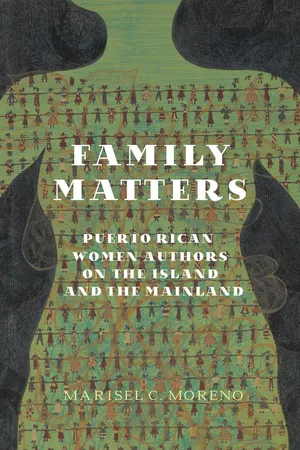
Adopting a comparative and multidisciplinary approach to Puerto Rican literature, Marisel Moreno juxtaposes narratives by insular and U.S. Puerto Rican women authors in order to examine their convergences and divergences. By showing how these writers use the trope of family to question the tenets of racial and social harmony, an idealized past, and patriarchal authority that sustain the foundational myth of la gran familia, she argues that this metaphor constitutes an overlooked literary contact zone between narratives from both sides. Moreno proposes the recognition of a "transinsular" corpus to reflect the increasingly transnational character of the Puerto Rican population and addresses the need to broaden the literary canon in order to include the diaspora. Drawing on the fields of historiography, cultural studies, and gender studies, the author defies the tendency to examine these literary bodies independently of one another and therefore aims to present a more nuanced and holistic vision of this literature.
eBook - ePub
Family Matters
Puerto Rican Women Authors on the Island and the Mainland
- 248 pages
- English
- ePUB (mobile friendly)
- Available on iOS & Android
eBook - ePub
About this book
1. The Literary Canon and Puerto Rican National Culture
There are many Puerto Ricos, united by a Möbius strip that enters and leaves our diverse national consciousness. The Puerto Rico of which literature produced on the Island bears testimony is very different from the one produced in the continent. Neither is more or less authentic; the combination of both is the most important thing, because it provides a comprehensive vision of our people.1
—Rosario Ferré
“At its inception national culture is really literary in nature,” asserts the critic Gregory Jusdanis, reminding us of the power of literature to create the illusion of unity among the various and disparate groups that constitute any given nation (xi). Literature is often seen as a “mirror” of the nation, to the extent that it succeeds in generating “stories about [the nation’s] identity” (46). Yet how, we need to ask, do particular works become central to the construction of the nation while others are discarded and rendered nonessential? What are the criteria for the classification of texts as either dispensable or indispensable to the national project? Or, to put it more simply, how does a work become part of the national literary canon?
Unfortunately, there are no straightforward answers to any of these questions since the criteria for canon formation vary across cultures and fluctuate through time. What is clear, however, is the pivotal role that such canons play in the “survival of societies and traditions,” which in turn “depends not only on memory to retain the past but above all on the formation of a hierarchy of prized texts transmitted through time” (Jusdanis 60). The canon, as “a publicly available body of writing, representative of certain national and social interests,” primarily seeks to promote the perception of unity among disparate societal elements (Jusdanis 66). In doing so, the power differentials inscribed in the selection process tend to be eclipsed by the canon’s success in imagining “unity.” Jusdanis foregrounds this problematic caveat when he observes, “The mechanisms of canonicity conceal the classificatory strategies at work to preserve texts by making survival appear natural, self-evident, and deserved. They disguise the struggle waged by social groups over the power to classify” (63). Seen in this light, canon formation constitutes a highly politicized process; while trying to mirror the nation, the canon reveals the internal fractures that undermine its own ideal of unification. For this reason, examining a particular canon, as well as the silences created by those texts omitted from it, can reveal much about a particular culture/nation at any given historical juncture.
In the case of Puerto Rican literature, Rubén Ríos-Ávila argues, “the search for identity is without a doubt the organizing paradigm of the Puerto Rican literary canon” (201).2 Examining the silences and fluctuations of this highly political canon can help us unravel the racial, class, and gender hierarchies that were at play on the island throughout the twentieth century, and which were the result of its complex colonial history. In fact, Puerto Rico’s persistent colonial status and the fact that the mainland population presently outnumbers that of the island have contributed to the highly politicized nature of its canon.3
The connection between literature and politics underlying national culture is evident since the moment of consolidation of the Puerto Rican canon, which most critics agree took place in the 1930s (Barradas 2003; Gelpí 1993). While a sense of cultural distinctiveness had begun to emerge on this Spanish colony during the nineteenth century, the process was interrupted—and eventually refueled—by the transferring of the island to the United States as a result of Spain’s defeat in the Spanish-Cuban-American War of 1898. Through the 1920s, a new generation of intellectuals born under U.S. rule (Antonio S. Pedreira, Luis Muñoz Marín, Pedro Albizu Campos, Luis Palés Matos) came to envisage “Puerto Rico as a national project truncated by the invasion of 1898” (Ayala and Bernabé 90). In the absence of a literary establishment, “the formation of a canon through the identification of classical texts became part of the objectives of the young authors of the 1920s as they matured during the following decade into what came to be known as the generación del treinta” (Ayala and Bernabé 91).
Three decades of U.S. colonialism took a toll and “ironically led to the crystallization of a desire for national affirmation among a significant sector of Puerto Rico’s rising literary generation” (Ayala and Bernabé 93). The search for the definition of Puerto Rican identity became the primary goal of the generación del treinta, albeit conducted from a variety of ideological positions.4 Deployed mainly against the perceived threat of U.S. influence on the island, the canon’s symbolic role as national bulwark was geared to generating a sense of unity among Puerto Ricans. In searching for that common denominator that embodied anti-U.S. resistance, members of the generación del treinta turned their gaze backward to the island’s Spanish past, which they posited as the true essence of Puerto Rican culture.
Thus Hispanophilia became a privileged site in the consolidation of the canon. In this process, several totalizing metaphors, such as the family and the house, became instrumental in evoking the perception of unity that literary traditions often strive to achieve (Gelpí 5). The patriarchal myth of la gran familia reemerged as a foundational narrative that continues to inform Puerto Rican letters even to this day.5 The myth has been conceptualized along three primary tenets: (1) a unified nation built on racial democracy and harmony; (2) the glorification of the island’s agrarian, precapitalist past under Spanish rule; and (3) the cult of patriarchy, embodied by a benevolent father figure. An inquiry into how each of these precepts intersects with Puerto Rican narratives produced by female authors will shed new light on the relevance that la gran familia continues to have in contemporary identity discourses. With that purpose in mind, I examine the inherent ambiguities in this myth: its paradoxical impulse to create a semblance of unity and homogeneity while erecting intrafamilial borders as it is revealed in Puerto Rican women’s narratives.
Contesting the Canon: Female Authors Claiming Their Space in the Family
In Literatura y paternalismo, Juan Gelpí decries one of the most blatant omissions in Puerto Rican literary history, that is, the systematic exclusion of women authors from the canon (3). This absence from official literary histories, a fate also shared by black and other minority writers, is firmly cemented on the rhetoric of paternalism that envelops the cult of la gran familia. The subordinate position of women and children to a dominant father figure, a hierarchical structure that consolidated sexism as inherent to puertorriqueñidad (Puerto Ricanness), has thus been replicated in the terrain of culture. In other words, the silencing of women became pivotal to the defense of the nation among the white male elites, who condemned the more active role that women began to play in twentieth-century Puerto Rican society. For instance, this posture became evident when “the gains of the early-twentieth-century feminists and suffragists alarmed patriarchal writers such as Blanco and Pedreira,” whose vision was decidedly antifeminist, according to María Barceló Miller (Matos Rodríguez, “Women’s” 11).
While women had been silenced within literary circles, with the exception of those who ascribed to the traditional model of the “poetess” or those who in contrast broke away from such constrictive paradigms—such as Luisa Capetillo—they found ways to make their voices heard in other arenas. The first few decades of the twentieth century witnessed myriad transformations in Puerto Rican society, among them, the emphasis on education and the establishment of co-education as a method of Americanization, despite the fact that women’s educational inequality continued to be imposed (Azize-Vargas 175).
At the same time, “women’s oppression in the needlework and tobacco industries [had] contributed to the conditions for the emergence of class and feminist consciousness” (Azize-Vargas 177). By 1904 women had begun organizing in unions; by 1920, the Socialist Party organized the Asociación Feminista Popular, which established links with American feminists (Azize-Vargas 180). Such connections would prove pivotal in the struggle for women’s voting rights as they paved the way for Puerto Rican suffragists to appeal directly to U.S. colonial authority in their quest for their civil rights (Jiménez-Muñoz 145).
If the strides made by feminists in the first decades of the twentieth century had elicited strong reactions from conservative circles, the reshaping of gender roles brought about by Operation Bootstrap and industrialization during the 1940s and 1950s, explored in more detail below, proved to have an even greater impact among those who defended the patriarchal values that had characterized preindustrial social relations. As Edna Acosta-Belén puts it, “The changes that occur in the traditional role of the Puerto Rican woman and her more visible role in society as a result of industrialization and modernization are simplistically viewed as a direct consequence of a harmful U.S. influence and adoption of an Anglo-Saxon-style matriarchy” (“Ideology” 130). One of the most strident voices to condemn women’s advancement as an “ill effect” of Americanization was the prominent Puerto Rican author, essayist, and playwright René Marqués (Acosta-Belén 1986; Solá 1979).
In his essay “El cuento puertorriqueño en la promoción del cuarenta” Marqués states, “It was [with the democratizing gale wind that began] in the forties that Puerto Rican society made a rapid turn toward the Anglo-Saxon–style matriarchy. The cultural and ethical patterns of a social structure based on the tradition of the paterfamilias rapidly deteriorated [and succumbed vertiginously]” (Docile 78).6 As this passage illustrates, Marqués’s deep-seated anti-Americanism led him to assert Puerto Rican patriarchal values, which in his view dovetailed with his conceptions of patriotism and puertorriqueñidad.7 Like other male elite figures who viewed certain societal changes as manifestations of U.S. cultural infiltration, Marqués deployed the myth of la gran familia puertorriqueña as a strategy of resistance against U.S. colonialism not only in his creative writings and essays but also in the scores of government-sponsored cultural materials that he produced during his tenure with the División de Educación de la Comunidad, addressed later in this chapter (Acosta-Belén, “Ideology” 94).8
In contrast to earlier feminist waves in Puerto Rico, which had emerged out of suffragist (petit bourgeois) and proletariat (working-class) struggles, by the 1970s a number of feminist groups joined forces in the fight for social justice for all women (Vélez Camacho 15). Women’s oppression—and the acknowledgment that its roots lay at home—became the pivotal cause that linked and continues to unite diverse feminist groups in the last few decades.
The developments of feminist, racial, and class consciousness propelled the conditions that facilitated the challenging of the myth of la gran familia puertorriqueña, which was then placed under scrutiny as marginalized segments of the population, such as feminist writers and critics (including some men) and homosexual authors, began to question its assumptions and to challenge the paternalistic canon (Gelpí 36).9 Authors such as Rosario Ferré, Ana Lydia Vega, Manuel Ramos Otero, Magali García Ramis, Carmelo Rodríguez Torres, Carmen Lugo Filippi, Luis Rafael Sánchez, Edgardo Rodríguez Juliá, and Olga Nolla were among those who systematically questioned both this foundational myth and the canonical works it inspired. By unveiling the national fictions this myth has produced, their works often propose a more complex and nuanced articulation of the nation-family.
Undeniably, the civil rights and feminist movements were pivotal to the substantial transformations undergone by Puerto Rican letters on the island during the 1970s, which included but were not limited to the emergence of female prose writers, the development of central female characters, an interest in the working class and the use of popular language and musical expressions, the vindication of blackness as a core element of Puerto Rican culture, the questioning of patriarchy and traditional structures of power, and the defiance of stylistic and generic literary norms.10 In addition to the direct impact of the civil rights movement, Puerto Rican letters were greatly influenced by the development of the nueva historia (new history), which promoted the study of marginalized sectors traditionally excluded from official histories. Women, Matos Rodríguez reminds us, “were among the neglected and marginalized groups that the new historians were supposed to incorporate into the mainstream” (“Women’s” 13).11 In 1970 the Centro para el Estudio de la Realidad Puertorriqueña (CEREP), or Center for the Study of Puerto Rican Reality, was organized under the direction of Ángel Quintero Rivera. “As they retrieved the history of forgotten labor struggles and initiatives,” Ayala and Bernabé point out, “‘new historians’ also denounced the antilabor, sexist, and racist views held by some of the most admired figures both of the independentista tradition and of the literary canon built by the generación del treinta” (252). The revolutionary postures that emerged from the conflation of factors such as the effects of the feminist and civil rights movements and la nueva historia led a new generation of writers to openly denounce the androcentrism, racism, classism, and homophobia underlying dominant discourses of national identity.
These factors converged to facilitate the emergence of female prose writers, without a doubt one of the greatest sociocultural and literary achievements taking place in Puerto Rico during the late 1970s. Until then, the presence and recognition of female literary figures had been mainly circumscribed to the genre of poetry, and lyrical poetry at that. For this new generation of budding writers (most were university students) who had been deeply influenced by recent social transformations, the current literary establishment did not offer a forum for development and exposure. Taking the matter into their own hands, and guided by their mentors Ángel Rama and Marta Traba, Rosario Ferré—with the collaboration of Manuel Ramos Otero and her cousin Olga Nolla, among others—founded the antiestablishment literary journal Zona de carga y descarga.12 During its brief run, which lasted from September 1972 until June 1975, Zona emerged as a key, and the first, venue of expression for many of the young writers who would later become widely recognized literary figures.
Although a detailed analysis of Zona is beyond the scope of the present study, it is imperative to highlight the role that the journal played in the dissemination of works by feminist writers and critics, as well as its commitment to challenging the patriarchal and paternalist establishment that had silenced them (Gelpí 1993; Ramos Rosado 1999). In an interview with Carmen Dolores Hernández, Ferré reflects on the feminist vision of the journal: “A fully achieved goal of Zona carga y descarga’s was to allow woman’s authentic voice to be known, given that until then its creative expression had been silenced by patriarchal society. In Zona, we women, who were the majority from the beginning, broke our silence and achieved full expression” (“Mientras” 104).13 The journal’s pro-feminist, pro-homosexual, and anticolonial stances provoked a backlash from conservative circles and generated a significant amount of debate, ironically one of the main aims behind its publication. The posture of previous generations was crystallized in a letter that René Marqués sent to Ferré, and which Zona published in 1975. Marqués’s letter, written in a sarcastic and condescending tone (evident beginning with the salutation, “Querida Rosarito,” or “Dear Rosarito”), admonishes Ferré for her journal’s “pornographic” materials and content, its profanity, and, above all, its feminist (i.e., Americanized) ideology. For example, he writes, “By the way, regarding the so-called Women’s Liberation Movement, how should I address you? By Srta., Sra., Mrs., or Ms.? We poor men are somewhat confused regarding this point.… Not that I am a ‘chauvinistic pig.’ I accept any positive changes in soc...
Table of contents
- Title Page
- Copyright Page
- Contents
- Acknowledgments
- Introduction: Family Matters
- 1. The Literary Canon and Puerto Rican National Culture
- 2. Our Family, Our Nation: Revisiting la gran familia puertorriqueña
- 3. Retrieving the Past: The “Silenced” Narrate
- 4. Patriarchal Foundations: Contesting Gender/Sexual Paradigms
- Epilogue
- Notes
- Bibliography
- Series List
Trusted by 375,005 students
Access to over 1.5 million titles for a fair monthly price.
Study more efficiently using our study tools.
Information
Publisher
University of Virginia PressYear
2012Topic
LiteraturePrint ISBN
9780813933313
eBook ISBN
9780813933337
Index
LiteratureFrequently asked questions
Yes, you can cancel anytime from the Subscription tab in your account settings on the Perlego website. Your subscription will stay active until the end of your current billing period. Learn how to cancel your subscription
No, books cannot be downloaded as external files, such as PDFs, for use outside of Perlego. However, you can download books within the Perlego app for offline reading on mobile or tablet. Learn how to download books offline
Perlego offers two plans: Essential and Complete
- Essential is ideal for learners and professionals who enjoy exploring a wide range of subjects. Access the Essential Library with 800,000+ trusted titles and best-sellers across business, personal growth, and the humanities. Includes unlimited reading time and Standard Read Aloud voice.
- Complete: Perfect for advanced learners and researchers needing full, unrestricted access. Unlock 1.5M+ books across hundreds of subjects, including academic and specialized titles. The Complete Plan also includes advanced features like Premium Read Aloud and Research Assistant.
We are an online textbook subscription service, where you can get access to an entire online library for less than the price of a single book per month. With over 1.5 million books across 990+ topics, we’ve got you covered! Learn about our mission
Look out for the read-aloud symbol on your next book to see if you can listen to it. The read-aloud tool reads text aloud for you, highlighting the text as it is being read. You can pause it, speed it up and slow it down. Learn more about Read Aloud
Yes! You can use the Perlego app on both iOS and Android devices to read anytime, anywhere — even offline. Perfect for commutes or when you’re on the go.
Please note we cannot support devices running on iOS 13 and Android 7 or earlier. Learn more about using the app
Please note we cannot support devices running on iOS 13 and Android 7 or earlier. Learn more about using the app
Yes, you can access Family Matters by Marisel C. Moreno in PDF and/or ePUB format, as well as other popular books in Literature & Latin American & Caribbean Literary Criticism. We have over 1.5 million books available in our catalogue for you to explore.