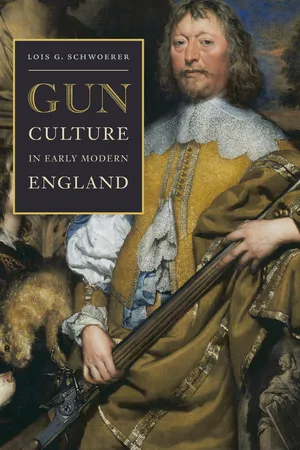
Gun Culture in Early Modern England
eBook - ePub

Gun Culture in Early Modern England

  1. 272 pages
  2. English
  3. ePUB (mobile friendly)
  4. Available on iOS & Android
eBook - ePub

Gun Culture in Early Modern England

About this book

Guns had an enormous impact on the social, economic, cultural, and political lives of civilian men, women, and children of all social strata in early modern England. In this study, Lois Schwoerer identifies and analyzes England's domestic gun culture from 1500 to 1740, uncovering how guns became available, what effects they had on society, and how different sectors of the population contributed to gun culture.

The rise of guns made for recreational use followed the development of a robust gun industry intended by King Henry VIII to produce artillery and handguns for war. Located first in London, the gun industry brought the city new sounds, smells, street names, shops, sights, and communities of gun workers, many of whom were immigrants. Elite men used guns for hunting, target shooting, and protection. They collected beautifully decorated guns, gave them as gifts, and included them in portraits and coats-of-arms, regarding firearms as a mark of status, power, and sophistication. With statutes and proclamations, the government legally denied firearms to subjects with an annual income under £100—about 98 percent of the population—whose reactions ranged from grudging acceptance to willful disobedience.

Schwoerer shows how this domestic gun culture influenced England's Bill of Rights in 1689, a document often cited to support the claim that the Second Amendment to the United States Constitution conveys the right to have arms as an Anglo-American legacy. Schwoerer shows that the Bill of Rights did not grant a universal right to have arms, but rather a right restricted by religion, law, and economic standing, terms that reflected the nation's gun culture. Examining everything from gunmakers' records to wills, and from period portraits to toy guns, Gun Culture in Early Modern England offers new data and fresh insights on the place of the gun in English society.

Frequently asked questions

Yes, you can cancel anytime from the Subscription tab in your account settings on the Perlego website. Your subscription will stay active until the end of your current billing period. Learn how to cancel your subscription.
No, books cannot be downloaded as external files, such as PDFs, for use outside of Perlego. However, you can download books within the Perlego app for offline reading on mobile or tablet. Learn more here.
Perlego offers two plans: Essential and Complete
  • Essential is ideal for learners and professionals who enjoy exploring a wide range of subjects. Access the Essential Library with 800,000+ trusted titles and best-sellers across business, personal growth, and the humanities. Includes unlimited reading time and Standard Read Aloud voice.
  • Complete: Perfect for advanced learners and researchers needing full, unrestricted access. Unlock 1.4M+ books across hundreds of subjects, including academic and specialized titles. The Complete Plan also includes advanced features like Premium Read Aloud and Research Assistant.
Both plans are available with monthly, semester, or annual billing cycles.
We are an online textbook subscription service, where you can get access to an entire online library for less than the price of a single book per month. With over 1 million books across 1000+ topics, we’ve got you covered! Learn more here.
Look out for the read-aloud symbol on your next book to see if you can listen to it. The read-aloud tool reads text aloud for you, highlighting the text as it is being read. You can pause it, speed it up and slow it down. Learn more here.
Yes! You can use the Perlego app on both iOS or Android devices to read anytime, anywhere — even offline. Perfect for commutes or when you’re on the go.
Please note we cannot support devices running on iOS 13 and Android 7 or earlier. Learn more about using the app.
Yes, you can access Gun Culture in Early Modern England by Lois G. Schwoerer in PDF and/or ePUB format, as well as other popular books in History & Early Modern History. We have over one million books available in our catalogue for you to explore.
NOTES
Abbreviations
BC Burney Collection of Seventeenth- and Eighteenth-Century Newspapers (digitized), British Library
BL British Library
CJ Parliament, Great Britain, Journals of the House of Commons, 11 volumes
CSPD Calendar of State Papers, Domestic Series, 1553–1714
DNB H. C. G. Matthew and Brian Harrison, eds., Oxford Dictionary of National Biography, 60 volumes
HEHL Henry E. Huntington Library, San Marino, California
HMSO Her or His Majesty’s Stationery Office
NA National Archives, London
OED Oxford English Dictionary
SP State Papers
SR Alexander Luders et al., eds., Statutes of the Realm, 11 volumes
Introduction
1. A gun founder worked in a gun foundry casting artillery (cannon). A gunmaker (either a man or a woman) put together the parts of a firearm—the barrel, the stock, and the lock—to make a gun.
2. Bert S. Hall, Weapons and Warfare in Renaissance Europe: Gunpowder, Technology, and Tactics (Baltimore: Johns Hopkins University Press, 1997), 99. Howard L. Blackmore, Hunting Weapons from the Middle Ages to the Twentieth Century (Mineola, NY: Dover Publications, Inc., 2000), 217.
3. SR, 3: 132. A mark was worth about two-thirds of a pound (OED, s.v. “mark”).
4. Lawrence Stone, Crisis of the Aristocracy 1558–1641 (Oxford: At the Clarendon Press, 1965), 239–40.
5. The word “gunner” means two things: first, a man who fires a cannon; second, a man who fires a handgun (OED, s.v. “gunner”).
6. Abigail Kohn, “Their Aim Is True. Taking Stock of America’s Real Gun Culture,” Reason Magazine Online, May 2001. http://reason.com/archives/2001/05/01/ their-aim-is-true.
7. Peter Burke, Varieties of Cultural History (Ithaca, NY: Cornell University Press, 1997), chaps. 1, 3, 8, and 11.
8. J. R. Hale, “Gunpowder and the Renaissance: An Essay in the History of Ideas,” in From the Renaissance to the Counter-Reformation, ed. Charles H. Carter (New York: Random House, 1965), 113–44.
9. Lisa Jardine, The Awful End of Prince William the Silent (London: Harper Collins, 2005), 85–92.
10. I presented a paper on this material at the Renaissance Society of America meeting in 2008 and hope to publish it in the future.
11. Henry J. Webb, Elizabethan Military Science: The Books and the Practice (Madison: University of Wisconsin Press, 1965) is the classic study.
12. Lady Sherley’s name is spelled variously. I have followed the spelling preferred by Sheila R. Canby, Shah ‘Abbas The Remaking of Iran (London: British Museum Press, 2009), 57.
13. Howard L. Blackmore, Gunmakers of London 1350–1850 (York, PA: George Shumway, 1986). Blackmore, Gunmakers of London, Supplement 1350–1850 (Bloomfield, Ontario: Museum Restoration Service, 1999).
14. Charles Ffoulkes, The Gun-Founders of England: With a List of English and Continental Gun-Founders from the XIV to the XIX Centuries (Cambridge: Cambridge University Press, 1937); J. F. Hayward, “The Huguenot Gunmakers of London,” Journal of Arms and Armour Society 6, no. 4 (1968): 117–43; A. N. Kennard, Gunfounding and Gunfounders (London: Arms and Armour Press, 1986); R. E. G. Kirk and Ernest F. Kirk, eds., Return of Aliens Dwelling in the City and Suburbs of London (Aberdeen: University Press for the Huguenot Society of London, 1902); W. E. May, “Some Board of Ordnance Gunmakers,” Journal of Arms and Armour Society 6, no. 7 (1969): 201–4; W. Keith Neal and D. H. W. Back, Great British Gunmakers 1540–1740 (London: Lund Humphries, 1984); and Richard W. Stewart, The English Ordnance Office 1585–1625: A Case Study in Bureaucracy (London: Royal Historical Society/Boydell Press, 1996).
15. Natalie Deibel, then a graduate student in History at the George Washington University, first constructed the spreadsheets, and Adrienne Shevchuk, then a staff member of the Institute at the Folger Shakespeare Library, maintained and expanded them.
16. David Cressy, Saltpeter: The Mother of Gunpowder (Oxford: Oxford University Press, 2013). Jack Kelly, Gunpowder: Alchemy, Bombards, and Pyrotechnics (New York: Basic Books, 2004).
1. Re-creating and Developing a Gun Industry
1. Neither J. S. Scarisbrick (Henry VIII [London: Eyre & Spottiswoode, 1970]) nor John Guy (Tudor England [Oxford: Oxford University Press, 2008]) mentions the matter. David Starkey (Henry: Virtuous Prince [London: Harper Press, 2008], 314, 316) and Lucy Wooding (Henry VIII [London: Routledge, 2009], 69) note Henry’s concern. Howard L. Blackmore credits the king with advancing the gun industry in Gunmakers of London 1350–1850 (York, PA: George Shumway, 1986), 11–12.
2. Their choice of name shows that the word Gunmaker was descriptive of a craft and also bore a generic ...

Table of contents

  1. Cover Page
  2. Title Page
  3. Copyright
  4. Contents
  5. Acknowledgments
  6. Introduction
  7. One: Re-creating and Developing a Gun Industry
  8. Two: Economic Opportunities for Men and Women
  9. Three: Regulating Domestic Guns with “Good and Politic Statutes”
  10. Four: Domestic Gun Licenses Issued “As if under the Great Seal”
  11. Five: Military Service: A Pathway to Guns
  12. Six: London: The Gun Capital of England
  13. Seven: “Newfangled and Wanton Pleasure” in the Many Lives of Men
  14. Eight: Guns: A Challenge to the Feminine Ideal?
  15. Nine: Guns and Child’s Play
  16. Ten: An Individual Right to Arms?: The Bill of Rights (1689)
  17. Conclusion: Defining Gun Culture in Early Modern England
  18. Appendix A What Is a Gun?
  19. Appendix B Naming the Gun
  20. Notes
  21. Bibliography
  22. Index