Chasing Shadows
eBook - ePub

Chasing Shadows

The Nixon Tapes, the Chennault Affair, and the Origins of Watergate

  1. 240 pages
  2. English
  3. ePUB (mobile friendly)
  4. Available on iOS & Android
eBook - ePub

Chasing Shadows

The Nixon Tapes, the Chennault Affair, and the Origins of Watergate

About this book

The break-in at Watergate and the cover-up that followed brought about the resignation of Richard Nixon, creating a political shockwave that reverberates to this day. But as Ken Hughes reveals in his powerful new book, in all the thousands of hours of declassified White House tapes, the president orders a single break-in--and it is not at the Watergate complex. Hughes's examination of this earlier break-in, plans for which the White House ultimately scrapped, provides a shocking new perspective on a long history of illegal activity that prolonged the Vietnam War and was only partly exposed by the Watergate scandal.

As a key player in the University of Virginia's Miller Center Presidential Recordings Program, Hughes has spent more than a decade developing and mining the largest extant collection of transcribed tapes from the Johnson and Nixon White Houses. Hughes's unparalleled investigation has allowed him to unearth a pattern of actions by Nixon going back long before 1972, to the final months of the Johnson administration. Hughes identified a clear narrative line that begins during the 1968 campaign, when Nixon, concerned about the impact on his presidential bid of the Paris peace talks with the Vietnamese, secretly undermined the negotiations through a Republican fundraiser named Anna Chennault. Three years after the election, in an atmosphere of paranoia brought on by the explosive appearance of the Pentagon Papers, Nixon feared that his treasonous--and politically damaging--manipulation of the Vietnam talks would be exposed. Hughes shows how this fear led to the creation of the Secret Investigations Unit, the "White House Plumbers," and Nixon's initiation of illegal covert operations guided by the Oval Office. Hughes's unrivaled command of the White House tapes has allowed him to build an argument about Nixon that goes far beyond what we think we know about Watergate.

Chasing Shadows is also available as a special e-book that links to the massive collection of White House tapes published by the Miller Center through Rotunda, the electronic imprint of the University of Virginia Press. This unique edition allows the reader to move seamlessly from the book to the recordings' expertly rendered transcripts and to listen to audio files of the remarkable--and occasionally shocking--conversations on which this dark chapter in American history would ultimately turn.

Trusted by 375,005 students

Access to over 1.5 million titles for a fair monthly price.

Study more efficiently using our study tools.

Information

Year
2014
Print ISBN
9780813936635
eBook ISBN
9780813936642
NOTES
1. “The President’s Address to the Nation Announcing Steps to Limit the War in Vietnam and Reporting His Decision Not to Seek Reelection,” 31 March 1968, Public Papers of the Presidents of the United States: Lyndon B. Johnson, 1968 (Washington, DC: GPO, 1970), www.presidency.ucsb.edu/ws/?pid=28772 (hereafter PPPUS: Johnson, 1968).
2. The popular vote in 1968 was 31,770,237 for Republican Nixon (43.4 percent), 31,270,533 for Democrat Humphrey (42.72 percent), and 9,906,141 for independent candidate George C. Wallace (13.53 percent). The remaining candidates received 239,908 votes (0.35 percent) (see Theodore H. White, The Making of the President 1968 [New York: HarperCollins, 1969], Kindle edition, chap. 12, “The Election: Passage in the Night,” 462). In 1960, it was 34,221,463 for Democrat Kennedy (49.72 percent) and 34,108,582 for Nixon (49.55 percent). Other candidates got 502,773 votes (0.73 percent) (see Theodore H. White, The Making of the President 1960 [New York: HarperCollins, 1961], Kindle edition, chap. 14, “To Wake as President,” 350).
3. Conversation 525-001, 17 June 1971, 5:15–6:10 p.m., Oval Office. All Nixon White House tapes come from the collections of the Nixon Presidential Library.
4. Conversation 519-001, 14 June 1971, 8:49–10:04 a.m., Oval Office.
5. Nixon revealed the “highly unusual channel” from Kissinger to his presidential campaign in his 1978 memoir (Richard M. Nixon, RN: The Memoirs of Richard Nixon [New York: Touchstone, 1978], 323–26).
6. Conversation 525-001, 17 June 1971, 5:15–6:10 p.m., Oval Office.
7. “As William Bundy, the Assistant Secretary of State in charge of the negotiations, has written, I had no access to information on the negotiations,” Kissinger wrote in 2003 (Henry Kissinger, Ending the Vietnam War: A History of America’s Involvement in and Extrication from the Vietnam War [New York: Simon and Schuster, 2003], 585n2). Kissinger cites William Bundy, A Tangled Web: The Making of Foreign Policy in the Nixon Presidency (New York: Hill and Wang, 1998), 39–40, to back him up. Unfortunately, Bundy wrote something different from what Kissinger claimed. “Even if one or more members of a disciplined delegation was ready to confide in a former colleague, there was simply no useful ‘inside information’ at that point,” Bundy wrote. In other words, Bundy’s argument was not that Kissinger lacked access to inside information on the negotiations during his 18–22 September 1968 visit to Paris, but that there wasn’t any useful inside information for him to access.
Bundy was mistaken. Right before Kissinger arrived in Paris, President Johnson personally briefed the lead American negotiator, Ambassador W. Averell Harriman, on the administration’s negotiating position on the bombing halt (see three Memoranda of Conversations from 17 September 1968, in Foreign Relations of the United States [FRUS], 1964–1968: Vietnam, September 1968–January 1969, ed. Kent Sieg [Washington, DC: GPO, 2003], 7: Document 19, Document 20, and Document 21 [hereafter FRUS 1964–1968, 7]). The president personally spelled out three demands, saying that he could stop the bombing of the North only as long as the Communists (1) respected the demilitarized zone dividing Vietnam, (2) entered peace talks that included representatives of the South Vietnamese government as well as Americans, and (3) stopped shelling the civilian populations of Southern cities (Memorandum for the Record by Walt W. Rostow, ca. 17 September 1968, “Memos to the President re Bombing Halt 9/30–10/22/1968” folder, National Security File, Country File, Vietnam, Box 137, Lyndon B. Johnson Library [hereafter LBJL], http://gateway.proquest.com/openurl?url_ver=Z39.88-2004&res_dat=xri:dnsa&rft_dat=xri:dnsa:article:CVI02165). This was part of a renewed diplomatic initiative by Johnson that included enlisting the influence of the Soviet Union, the largest supplier of military aid to Hanoi. On 16 September 1968, the day before LBJ briefed Harriman, National Security Adviser Rostow handed Soviet Ambassador Anatoly Dobrynin a memorandum that spelled out Johnson’s three demands as well: “the simple fact is that the President could not maintain a cessation of the bombing of North Vietnam unless it were very promptly evident to him, to the American people, and to our allies, that such an action was, indeed, a step toward peace. A cessation of bombing which would be followed by abuses of the DMZ, Viet Cong and North Vietnamese attacks on cities or such populated areas as provincial capitals, or a refusal of the authorities in Hanoi to enter promptly into serious political discussions which included the elected government of the Republic of Vietnam, could simply not be sustained” (“Memorandum from the Government of the United States to the Government of the Soviet Union,” 16 September 1968, Foreign Relations of the United States [FRUS], 1964–1968: Soviet Union, ed. David C. Humphrey and Charles S. Sampson [Washington, DC: GPO, 2001], 14: Document 299). Johnson’s true negotiating position on the bombing halt was, of course, precisely the kind of information that was most valuable to candidate Nixon. If the president wasn’t willing to back down from any of his three demands—and he wasn’t—that made a bombing halt much less likely before Election Day, and that information was very relevant to Nixon’s prospects for winning the race. So Bundy’s assertion that there “was simply no useful ‘inside information’ at that point” for Kissinger to get his hands on just doesn’t hold up under scrutiny.
Nixon defended Kissinger from the charge that he had provided the campaign classified information before anyone had the chance to level it. “Kissinger was completely circumspect in the advice he gave us during the campaign. If he was privy to the details of negotiations, he did not reveal them to us,” Nixon wrote. A campaign memo, however, shows that Kissinger did not have...
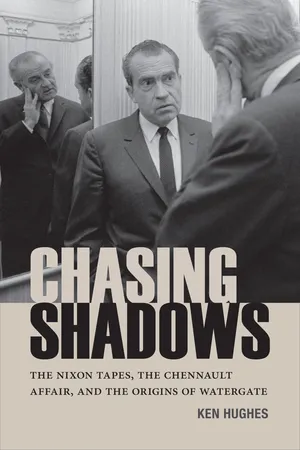
Table of contents

  1. Cover
  2. Half Title
  3. Title Page
  4. Copyright
  5. Dedication
  6. Contents
  7. Introduction
  8. Half Title
  9. Chasing Shadows
  10. The Chennault Affair
  11. Johnson v. Humphrey
  12. Nixon v. Nixon
  13. On the Case
  14. “Hold On”
  15. Election Eve
  16. “I Let You Down”
  17. “Time to Blow the Whistle”
  18. The United Front
  19. “Candid and Forthright”
  20. The Man Who Knew Too Little
  21. “All the Documents”
  22. The Huston Plan
  23. Nixon Tapes
  24. Tricia’s Wedding
  25. The Pentagon Papers
  26. The Secret Bombing of Cambodia
  27. Leaks
  28. The Wrong Men
  29. “Charge Gelb”
  30. LBJ Cracks the Case
  31. Ellsberg’s Decision
  32. Fear of a Damaging Disclosure
  33. Legal Action
  34. The Diem Chapter
  35. “Destroy the Times”
  36. Illegal Action
  37. “A Natural Enemy”
  38. Lord High Executioner
  39. Supreme Court Rules
  40. 1969 Documents
  41. “Break In and Take It Out”
  42. “Rumors and Reports of a Conspiracy”
  43. Imitation of the Enemy
  44. Special Investigations Unit
  45. “All These Harvard People”
  46. The Economic Conspiracy Theory
  47. “Are They All Jews?”
  48. “They’re All Over”
  49. “Somebody Sits on High”
  50. Counting Ivy Leaguers
  51. Counting Jews
  52. Above the Law
  53. “Pretty Much Carte Blanche”
  54. “One Little Operation”
  55. The CIA Bluff
  56. The Smoking Gun
  57. “I Don’t Kiss and Tell”
  58. Dean Testifies
  59. The X Envelope
  60. The White House Tapes
  61. Acknowledgments
  62. Notes
  63. Index
  64. A Note on the Links in This Ebook

Frequently asked questions

Yes, you can cancel anytime from the Subscription tab in your account settings on the Perlego website. Your subscription will stay active until the end of your current billing period. Learn how to cancel your subscription
No, books cannot be downloaded as external files, such as PDFs, for use outside of Perlego. However, you can download books within the Perlego app for offline reading on mobile or tablet. Learn how to download books offline
Perlego offers two plans: Essential and Complete
  • Essential is ideal for learners and professionals who enjoy exploring a wide range of subjects. Access the Essential Library with 800,000+ trusted titles and best-sellers across business, personal growth, and the humanities. Includes unlimited reading time and Standard Read Aloud voice.
  • Complete: Perfect for advanced learners and researchers needing full, unrestricted access. Unlock 1.5M+ books across hundreds of subjects, including academic and specialized titles. The Complete Plan also includes advanced features like Premium Read Aloud and Research Assistant.
Both plans are available with monthly, semester, or annual billing cycles.
We are an online textbook subscription service, where you can get access to an entire online library for less than the price of a single book per month. With over 1.5 million books across 990+ topics, we’ve got you covered! Learn about our mission
Look out for the read-aloud symbol on your next book to see if you can listen to it. The read-aloud tool reads text aloud for you, highlighting the text as it is being read. You can pause it, speed it up and slow it down. Learn more about Read Aloud
Yes! You can use the Perlego app on both iOS and Android devices to read anytime, anywhere — even offline. Perfect for commutes or when you’re on the go.
Please note we cannot support devices running on iOS 13 and Android 7 or earlier. Learn more about using the app
Yes, you can access Chasing Shadows by Ken Hughes in PDF and/or ePUB format, as well as other popular books in History & North American History. We have over 1.5 million books available in our catalogue for you to explore.