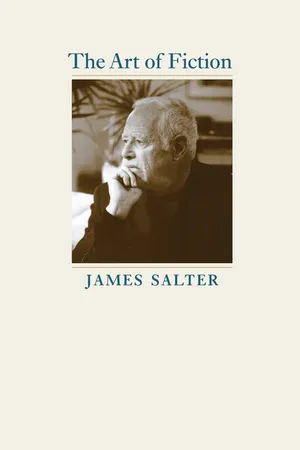
![]()
INTRODUCTION
John Casey
If you haven’t read any books by James Salter, should you read these lectures first? Maybe. Certainly the first one, “The Art of Fiction.” You would get a sense of his voice, of his rhythm—his perfectly timed abruptnesses, which are agreeable surprises—that is, you agree to stop and let the echo clarify.
The first lecture is in the main about several great works of fiction. They are works Salter took to heart, his major allegiances. In the case of Isaac Babel, Salter mentions how he first heard of him. Salter was forty-four. “Up until the time I met Robert Phelps, everything I knew I had learned by myself. I had formed my tastes by myself, and he refined them by introducing me to new writers and resituating many of the old. I trusted him.”
This is a generous acknowledgement. Salter was a generous man, but precise in his generosity. When it comes to some other authors of books on Salter’s list of exemplary writers he is wittily precise. Of Hemingway Salter notes—not in the lecture—that Hemingway was “a man whose habit, both in writing and in life, was not to pass up an insult.”
Salter took Phelps’s recommendation of these Babel stories. “ ‘Read this one first,’ he said. It was the story called ‘My First Goose.’ ”
Phelps was wiser than I was when I assigned to a graduate seminar all of the Red Cavalry stories and some of the drastic Odessa stories all in one week. It was too much for them—not the number of pages, but the shock of terrible violence written with terrible beauty. Salter, who had been a fighter pilot in the Korean War, “read Babel’s stories again and again.” He describes how Babel “is somehow able to look down on the mayhem happening all about him with the forbearance of God.”
Salter was pigeonholed for some time as a “writers’ writer.” That could be a compliment. It is true that Salter has fervent admirers from the honor roll of his well-qualified literary contemporaries. But that phrase “writers’ writer” isn’t a blurb that attracts browsers in bookstores or online. It also has an unfortunate resonance with “gentleman’s gentleman.” Richard Ford, God bless him, agreed with Salter not to introduce each other to a sold-out audience at the 92nd Street Y, simply to say their own name and begin. As Salter rose to the lectern, Ford said in an audible aside to Jim, “no one is going to say ‘writers’ writer’ anymore.”
“I hope not,” Salter replied.
THE Kapnick Distinguished Writer-in-Residence position was intended to reinstitute a position held by William Faulkner in the mid-1950s, an idea suggested by the endower’s daughter. It occurred to me that it would also be good and compatible to use the Norton Lectures at Harvard as a model, rather than to use the appointment as an additional faculty member of our already existing Master of Fine Arts staff. Faulkner was not a faculty member, nor are the Norton lecturers. One decanal notion was that the appointment be for three to five years and that it should be awarded to a Nobel Prize winner or close to it. I made some preliminary informal inquiries. One emphatic answer was, “I don’t want a job! But I’ll be happy to consider a shorter visit, give a series of lectures. And a reading or two. And talk to students.” We compiled or were given lists of prizewinners. Prize committees don’t always get it right, not the Nobel, not the Booker, not the Pulitzer nor the National Book Award. Whom do we love? James Salter.
That idea got a lot of collateral support. For the first Salter lecture the hall was filled, and for the second and third lectures, standing room only. For the public reading we needed a bigger theater.
The three of us who introduced the lectures each picked a favorite Salter book of fiction. Mark Saunders, a novelist and director of the University of Virginia Press, picked A Sport and a Pastime, a book whose singular doubleness he delights in. Christopher Tilghman picked Dusk, a book he acknowledged as pivotal in his own development as a writer. I chose Light Years. It was the first Salter book I read, in the early 1980s, and I’d been bowled over. I was about to learn, halfway through Salter’s first lecture, that it “turned out not to be a success. It was published but had a devastating, followed by a second, indifferent, review in the Times.” Now, on page 9 of the typed-up lecture, I have added in the margin, “Until later!” It was first published in 1975 and has been in print ever since. It will be for years to come. I’ve reread it twice, gone back to it many more times to find favorite passages and to figure out how Salter managed to be so clear so succinctly.
I’ve read A Sport and a Pastime three times. The first time I liked it but I didn’t really get it all. I was dazzled by the energy of the erotic scenes. The next time I loved it, chiefly for the ode to France, her smaller cities, towns, and countryside. It was the third time, after listening carefully to Mark Saunders over a long lunch, that the whole thing came together for me—its “singular doubleness.” There is a love affair, but there is the first-person narrator who is an envious friend of the man having the affair. The narrative is imagined, imagined but eerily knowing.
Salter loved France and French literature—he is as good at explicating a crucial passage in Balzac’s Old Goriot as Erich Auerbach is in his critical masterpiece Mimesis. A Sport and a Pastime is a very French novel and an American one as well. The two American men, both the lover and the imaginer, are linked to America by invisible transatlantic cables. Each has found a kind of refuge in France, but neither one is a refugee. The French woman has a link, but it is a dream: that her lover will take her to a new life in the new world. The novel was rejected. It was George Plimpton who saw what it was and arranged its publication. The coincidental catalyst was that they met in Paris.
Salter’s life was full of coincidences. This is in part because he lived in many different places and was involved in various kinds of activities (West Point, the army air corps of World War II and the air force in Korea and after, literary New York, Middleburg and Upperville, Virginia, Paris, mountain climbing in the French Alps, skiing in the Swiss Alps, moviemaking in America and Italy, a conversational evening with Nabokov in Montreux). The coincidences come in greater part because he was curious, observant, and had a prodigious memory both visual and verbal. He was also open to his friendly impulses. Burning the Days, his memoir, has many short paragraphs about meeting someone that end with “I liked him immediately,” or “she was authentic.”
MANY years ago I drove up to Washington to hear Salter lecture. Afterwards I went up to him to say how much I liked his talk and to ask him a question. He said, “Why don’t you come to dinner with us?”
I read more of his books over the next decade or two.
It came time to invite our first Kapnick Distinguished Writer-in-Residence. I got his address from my agent. One of my paragraphs began, “You may not remember . . .” He wrote back saying he was interested in coming to the university, and he remembered our meeting well. “You drove us to the restaurant. You said to yourself, ‘The traffic isn’t fluid,’ implying some time spent in Italy.” Yes. My Italian friends often grumbled, “Il trafico non è fluido.”
I read Burning the Days. On page 24: “at a luncheon, I sat next to a green-eyed young woman, a poet, who declared loftily that you learned nothing from books, it was life you learned from, passion, experience. The host, a fine old man in his seventies, heard her and disagreed. His hair was white. His voice had the faint shrillness of age. ‘No, everything I’ve ever learned,’ he said, ‘has come from books. I’d be in darkness without them.’ ”
I had heard that fine old man’s voice with the “faint shrillness of age.” I knew how he read. It sounded like Uncle Courty, my favorite uncle-in-law.
I stopped reading and sent Salter a note quoting the passage that had stopped me. I added “Courty Barnes?” The reply: “Yes. I liked him. I liked him even more for what he said.”
All this would have been confirmed had I read the next paragraph:
“I didn’t know if he was speaking of Balzac or Strindberg or even John O’Hara, to whom his sister had been married.”
It was a novelistic pleasure to find myself caught on an outer strand of James Salter’s web of coincidences. It was, more important, a bond. I had loved Courty Barnes. A shared friendship is a good start. Shared books. In Charlottesville, where Salter took up his Kapnick residency in 2014, my wife and I were blessed with an Indian summer and a fall full of congenial companionship with him and Kay, on our back porch or in the house he and Kay rented.
Jim told stories very well. Easily and succinctly. His own stories and ones he’d heard or read. His own voice not shrilled by age but softened. A story from Out of Africa, Isak Dinesen and the French sommelier. The sommelier is intent on hiking into the bush, a suicidal notion. He stops at Isak Dinesen’s house to say goodbye. She brings out her best bottle of wine. An almost whispered punch line, the word the Frenchman says after his first sip, “Fameux.” It is the second meaning of “ fameux”: first rate, magnificent.
When I gave Jim a book of my own essays on the art of fiction, I mentioned that one of them dealt with how to keep two narrative lines going simultaneously.
“Oh?”
“I found four good examples. In Nabokov, Flaubert, Chekhov, and Salter.”
“What are those other guys doing in there?”
For some reason that reminded me of remarks Jim remembered and recorded from his days in Korea. MIGs appear behind two US planes.
Wingman to leader: “Lead, they’re shooting at us!”
Lead: “That’s OK, they’re allowed to do that.”
Aplomb is something Jim admires. One of the many things.
IT IS sometimes disconcerting to read a fiction writer’s memoir. It can become dense with names. I also found that I didn’t want to know the factual origins of the story, at least not before reading the story.
In Burning the Days there are a couple of anecdotes that later become full art, but most sections are as taut as Salter’s fiction. The straightforward autobiography in the parts about West Point, about learning to fly and to fly in combat, are riveting. The Hunters, Salter’s first novel, about the air war over the Yalu River, is very good, but eclipsed by the seventy pages in Burning the Days of what it was like for him in full first person. The pages begin: “Late in the summer of 1951 I entered at last the realm long sought and was sent to Presque Isle, Maine, to the 75th fighter squadron. . . . I felt I was born for it.” These pages end with, “Once at a dinner party I was asked by a woman what on earth I had ever seen in military life. I couldn’t answer her, of course.” But then with memory and reflection, he tells us.
Another theme: friendship. Salter loved Irwin Shaw. The chapter title is “Forgotten Kings.” Shaw’s books were widely read fifty or sixty years ago. I remember my parents and uncles and aunts talking about them. Shaw was on top. In Hemingway’s eyes Shaw was a rival, perhaps as much for manliness as for literary reputation.
Shaw took up Salter. Their second meeting was for lunch at Shaw’s Paris apartment. Lunch for three: Shaw, his wife, Marian, and Salter. “There was the ease and implication of French life, unseen gatherings all about us. . . . It was the end of the fifties, the years of the Sulzbergers, the Matthiessens, Plimpton, Teddy White. A family lunch, and I was already seeing him as a kind of father—my own was gone—a father like Dumas or an ex-boxing champion, something in him extravagant, never to be taken away.”
Salter pays many tributes to the man, remembers his generosity, the size of his life. There are also examples of Shaw losing his temper; Shaw once hit a man who said to him repeatedly, “You’re a good writer, why are you such a whore?”
Or a cruel remark. “ ‘Well, I’ve done it again,’ a writer who’d had great early success remarked to him. ‘Don’t say that,’ Irwin said. ‘You didn’t do it the first time.’ ”
About a film Salter made of a story by Shaw, Shaw said that Salter was a lyric and Shaw a narrative writer. “ ‘Lyric’ seemed a word he was uncomfortable with. It seemed to mean something like callow.”
The end of the chapter is on the end of Irwin Shaw’s life. Salter grieves for him. The last three pages are heartfelt, painful elegy. Of a visit to Shaw near the end: “He lay in bed thinking, like a blind sailor remembering the sea.”
SALTER ended up with a low opinion of the movie business. That part of Burning the Days is hectic with meetings, most of which are inconsequential except for memorable names (Maximilian Schell, Maggie Smith, Vanessa Redgrave, Roman Polanski). He likes them and admires them. They stand out from those scurrying and jostling, even those scurriers and jostlers who achieve meteoric success. “I’ve always rejected the idea of actor as hero, and no intimacy has changed that. Actors are idols. Heroes are those with something at stake.”
Salter did have a genuine liking for Robert Redford, with whom he made a good movie, Downhill Racer. Salter admired the way that Redford did something useful every day. He liked Redford b...