While the academic study of religion has increased almost exponentially in the past fifty years, general theories of religion have been in significant decline. In his new book, Carl Raschke offers the first systematic exploration of how the postmodern philosophical theories of Jacques Derrida, Gilles Deleuze, Alain Badiou, and Slavoj Žižek have contributed significantly to the development of a theory of religion as a whole. The bold paradigm he uses to articulate the framework for a revolution in religious theory comes from semiotics—namely, the problem of the sign and the "singularity" or "event horizon" from which a sign is generated.
eBook - ePub
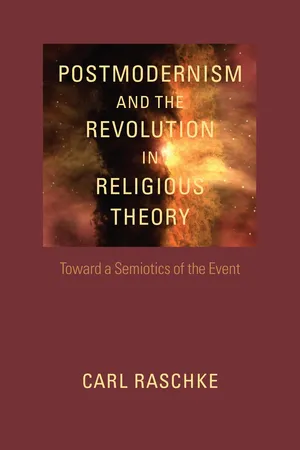
Postmodernism and the Revolution in Religious Theory
Toward a Semiotics of the Event
- 248 pages
- English
- ePUB (mobile friendly)
- Available on iOS & Android
eBook - ePub
About this book
Information
Topic
Theology & ReligionSubtopic
Philosophy of ReligionPart I

THE REVOLUTION OF THE SIGN
1
RELIGION AND THE SEMIOTIC REVOLUTION
The content of consciousness, the entire manifestation of mind, is a sign resulting from inference.
— C. S. Peirce, “Some Consequences of Four Incapacities”
AFTER THE postmodern turn seems to have come full circle and we find ourselves yearning to know what “comes next,” we continue to be confronted foursquare with the aporia of the religious. Postmodern philosophy has exfoliated in hundreds of different directions, and “postmodern theology” has leveraged this development to pose a variety of questions and a profusion of problemata that both challenge and reaffirm the historical arcs for its trajectories of thinking. But postmodernism as a movement has skirted the question of “religion,” or the “religious,” even while it has constantly called attention to it. This avoidance may stem from the reluctance of Jacques Derrida, who at his death was truly the movement’s grand old man, to confront the religious as religious, even while in his later years he made the religious an operative theme in his writings and infused the vocabulary of postmodernism with various words and phrases that hint at the “mysteries” of religion — faith, the messianic, the secret, the gift — without actually going there. Religion must be avoided because it is at once “the clearest and most obscure,” as Derrida says, of subject matters. It cannot really be amenable to any “phenomenology” of religion, because it does not “appear” as phenomena are supposed to do along any surfaces or in any guises. The religious is a curious “alliance” of the “calculable and incalculable.”
While the ubiquity of religious faith and praxis is evident worldwide, a burgeoning population of ordinary believers, particularly in third world nations, defies decades-old expectations of triumphal secularity. In addition, as a metastasis of religious violence somewhat tendentiously characterized as “terrorism” spreads fatally and unpredictably, religion as a theoretical challenge becomes ever elusive and murky. At the same time that theological conversation has paled into political and ideological wrangles posing as substantive theory, academic research in the area has shattered into a muddle of sociocultural methodologies with no common thread except a vague interest in res religiosa, or “matters religious.”
The Deposition of the Sign
Although “religious studies” as a field has sought for several generations to become a Religionswissenschaft, or “science of religion,” the outcome has been something disturbingly to the contrary. The nineteenth-century concept of “religion” in the grand sense flowered from the assumption that wherever the venerable term occurred, a shared situs for speech could be located, and the “phenomenon” itself mapped and assessed. The “classical theories” of religion, elaborated by such intellectual giants as Weber, Levi-Bruhl, Durkheim, Otto, van der Leuw, and Robertson-Smith, were launched from this very proposition. The establishment of the academic field and intellectual pursuit of “religious studies,” deriving historically from the merger of liberal Protestant theology and comparative religions, carried this trend further under a rising regime of the social sciences.
Yet in the past generation the search for what might be considered a general consensus concerning the meaning of such words as “God,” “the sacred,” the “divine,” and even the “religious” itself has petered away. “Theological” inquiry, which at one time focused on the meaning of the word “God” (Greek theos), has been undercut by the strident contention that such an undertaking is inherently sectarian and incapable of comprehending the limitless diversity of religious experiences and faith stances. Inquiry into religion as a whole, which a generation ago ignited endless discussion and the writing of monographs, has for the most part given up the ghost. In contrast, academic attention has been concentrated on enlarging the gamut and complexity of what are conventionally called “area studies,” on outlining perspectives on familiar religious or cultural motifs without asking the uncomfortable question of why these topics matter in the first place. It is as if medieval historians were to deliberate constantly on arcane concerns about papal legitimacy, feudal sovereignty, guild practices, and mercantile economies without ever seeking to understand what the phrase “Middle Ages” connotes, or what “history” itself might signify. The theory of theos has been reduced to a surface grammar of banal rubrics of classification.
Much blame for this dissipation of research, at least by cultural conservatives, has been hastily heaped on “postmodernism.” The cultural and institutional sources of this changeover are complex and probably await a new “sociology of knowledge” that charts twentieth- and twenty-first-century ideology as a function of the nascent knowledge economy. Postmodernism in many ways has simply served as a convenient descriptor for the intellectual trends of the last thirty or forty years, and whatever worth, or lack of worth, one may attribute to the movement reflects the attitudes one already had toward these events anyway. Nonetheless, postmodernism, whether one protests or not, is the full firmament for intellectual inquiry nowadays. It is not one alternative among many, any more than a dedication to inductive science was merely an option at its height in the nineteenth century.
The preponderance of the cultural debate on postmodernism, however, has ignored the philosophical, and by extension the theological, imperatives that have brought about the demolition of the modernistic template. The common image of postmodernism has been created by certain eccentricities of style and sloganeering adopted by its most prolific proponents. The most visible envoy of postmodernist belles lettres, of course, is Derrida. But Derrida has only carried forth a special program in late modern philosophy that has its genesis in the writings of Nietzsche. The project itself germinates in Husserlian phenomenology, finds a pragmatic outlet in “structural” and “poststructural” linguistics, and comes to fruition in both the later Heidegger and the work of Gilles Deleuze. This venture may be characterized as the deposition of the sign. And it is the “deposition of the sign” that, contrary to all the characterizations or profilings that suffuse the endless literature on postmodernism, expresses the “revolution” in religious theory that has been underway for some time.
To “depose” means to remove from a certain place or position, particularly a “high position.” It also connotes a “written testimony.” It was Derrida who discovered that writing alters all vectors in the act of signification. The grapheme, or “grammatological” reference, is severed from the pristine presence of the spoken utterance, or phoneme. In writing, the unity of signifier and signified is broken. Writing opens up a terrain of difference that cannot be sublated by reflective thought. The text and the name have entirely different genealogies. However, it was not the theory of inscription, from which derives the view that textualization amounts to a “deconstruction” of the idealistic architecture of modern philosophy, that brought to light the possibility of a new thinking about the sign apart from the act of denotation.
The antecedents to deconstruction can be discerned in both C. S. Peirce’s doctrine of “thirdness” and Husserl’s concept of intentionality. Peirce launched the “science” of semiotics by characterizing the sign as “a third mediating between the mind addressed and object represented.”1 The sign interrupts the pure continuity of word and thing and raises the problem of the “other” to which an expression is directed. Because language is not “representational” but social or intersubjective, the semiotic model of the sign challenges the centuries-old principle that “what is” somehow always coordinates with whatever mirrors or “represents” it. Most accounts of signification in philosophy from Descartes to the mid-twentieth century are simply sophisticated variations on Plato’s doctrine of mimesis. Although he had no relationship with Peirce, Husserl in his own tortuous elaboration of the “phenomenological method” argued that what the former called the “trichotomic” nature of sign operations actually can be considered tetradic. Husserlian phenomenology showed how signification has a fourfold constituency — the subjective or agential relationship to the object supplemented by the action and the scenario.
Thus in Husserl the “structure” of a constellation of meanings always varies with the aim and outcome of a semantic undertaking. This undertaking remains independent of any logical nexus between the sign and the signified. The realization that, when one is thinking or speaking, one is also in the presence of “other minds” with whom it becomes vital to communicate has crystallized many of the philosophical perplexities pursued, often obscurely, by such figures as Jean-Paul Sartre and Maurice Merleau-Ponty. Derrida would later stress that writing is the premier system of communication and thus makes us aware that the sign has been jarred from its original socket of reference, that it has been deposed. The deposition of the sign is the root of what postmodernists have in mind when they engage in a critique of “correlative” doctrines of signification, or what Heidegger and Derrida have termed “ontotheology.”
Consequences for Religious Thought
The deposition of the sign in postmodernism has intricate consequences for both religious thought and religious studies. The impact on theological research has already been extensive. But the effect on the study of religion as a whole has been negligible. The study of religion as a whole for generations remained beholden to both functionalist anthropology and a kind of descriptivist, or literary-textual, idealism most obviously evinced in the work of Eliade. In recent years the study of religion has become more vaguely polymethodological, and has incorporated the varieties of cultural critique and methodologies that have risen and fallen as fashions within the academy. Yet the failure to appropriate in any easily recognizable way the postmodernist revolution in philosophy and letters — other than the sundry “theologians” and philosophers of religion who are not really doing any theory of religion — is still quite pronounced.
Increasingly, descriptivism wears a trendier and more ideologically correct mask, particularly what we call “identity theory.” The descriptivism of religious studies has a long “colonial” history, as critics such as Jonathan Z. Smith have argued. The descriptivist bias stems from the origin of “comparative religions” in the exotic narratives, ethnographies, and travelogues of missionaries and explorers, and has been reinforced in recent years by polemics of the “new historicists,” who extol cultural particularities over the universalizing statements of earlier, Eurocentric writers.
But the hegemony of the descriptivist hermeneutic in the study of religion, according to Smith, also masks a kind of cultural imperialism that secretly privileges the Greco-Christian metaphysical outlook while purporting to delegitimate it. Cultural radicalism turns out to be simply the program of a new generation scrabbling for the unclaimed perquisites of the ancien régime. The contemporary study of religion as a mythic terrain invested with numinous qualities “welcomes the foreign if only to show, by some allegorizing or rationalizing procedure, that it is, in fact, the ‘same.’ ”2 A similar point applies to the profusion of present-day articles and essays that touch on the “social” and “political” import of familiar, or bizarre, types of religious belief and practice. Inside the planetary curiosity shop that merchandises the religious life of the human race we find the persistent prejudices of the West’s intellectual elites. It is colonialism with a compassionate face. The ever-fashionable narratives of exploitation and victimization are increasingly crafted neither to “raise consciousness” in the classic, Marxist manner nor to propound a strategy of liberation. Too often the exemplary topics are either recondite or historically inconsequential.
The true aim is to flaunt the hermeneutical privileges of the particular religious scholar by demonstrating his or her eye for the other, and by displaying the vast archipelago of social powers and influences that render all religious matters as comparable manifestations of one’s own critique. The same point has already been made by Jean Baudrillard in his acid commentary on the anthropological imagination in postwar Europe. The multicultural sentimentality is “rivaled only by the profound contempt it is designed to conceal. For ‘We respect the fact that you are different’ read: ‘You people who are under-developed would do well to hang on to this distinction because it is all you have left.’ Nothing could be more contemptuous — or more contemptible — than this attitude.”3
If the deposition of the sign in the realm of theory constitutes an insurrection against the totalizing scepter of the metaphysical, it likewise becomes apparent that a criticism of the current “metanarrative” of the sacred is absolutely necessary. Such a criticism would expose the constraints of the “celebration” of difference and would unmask the real game that is played in such a casino of constructivism and contrarian accounts of the religious world in which we are immersed. The scholarly academy fears such a move because it would call into court its hidden, sectarian, and antitheoretical agendas. The political hermeneutic of religion is perennially tempting, because it offers a semblance of the theoretical without doing the hard work of excavating the phenomenon that the study of religion poses as a question. The study of religion can only be approached as a foray into the phenomenon of religiosity, and such a foray is impossible without mobilizing the instrumentalities of theory. Such theory invariably entails a transaction within the matrix of signification we call interpretation. And every theory must be germane to its topic area. It must be more than merely reading one set of signs as something thoroughly alien.
Thus a biology of politics — what is fashionably now after Michel Foucault known as biopolitics — is conceivable, but a politics of biology does not really attain to what the “life sciences” are all about. Any biopolitics remains a type of politics and answers none of the pertinent questions about the “biological” per se. The same can be said for a political investigation of the religious. It has little in fact to do with the religious. It is not accidental that in all previous cultural epochs the academic study of religion is tantamount to what we call “theology,” or that it is intertwined with what we loosely comprehend as the “philosophical.” This observation holds not only in the “Christian West” but in the Islamic and “Oriental” worlds as well. Theological speculation may take somewhat different paths with a variety of emphases, but in every instance it is tantamount to a “scientific” attempt to make sense out of what the particular culture considers worthy of unqualified devotion. An Islamic jurist seeking a determination on an item of the sharia, for instance, is not by any stretch of the imagination endeavoring to make some kind of covert “social statement.” That perspective is radically secularist and belies not only his intent but his “intentionality” in the phenomenological sense. The critique requires a rereading of postmodern literature not simply as differentialism but as deposition.
The deposition is not a confusion of predicative specifications, as positivists and rationalists of all stripes protest; nor is it simply a dislocation of syntax, as deconstructionists insist. The deposition amounts to a disjunction in the virtual dyad of presence and representation, at once warranting the trace that can be pronounced as the “other” (das Andere, l’autre). Gavin Hyman contends that the warranting of the trace serves also to warrant theology. Theology after all, according to Hyman, is the discourse that enfolds the trace and alchemizes it from what is strange to what becomes intelligible as divinity. But this line of analysis, while provocative, is misleading. Hyman, who seems more sympathetic to radical orthodoxy than he wants to admit, lets the trace suffice as kind of incarnational episode within a curious sort of para-ontology. A grammar of traces, while rhetorically defensible, is philosophically inconceivable. The explanation is str...
Table of contents
- Cover
- Title Page
- Copyright
- Dedication
- Contents
- Acknowledgments
- Introduction
- Part I: The Revolution of the Sign
- Part II: Sources
- Conclusion: Toward a Revival of Religious Theory
- Notes
- Index
Trusted by 375,005 students
Access to over 1.5 million titles for a fair monthly price.
Study more efficiently using our study tools.
Frequently asked questions
Yes, you can cancel anytime from the Subscription tab in your account settings on the Perlego website. Your subscription will stay active until the end of your current billing period. Learn how to cancel your subscription
No, books cannot be downloaded as external files, such as PDFs, for use outside of Perlego. However, you can download books within the Perlego app for offline reading on mobile or tablet. Learn how to download books offline
We are an online textbook subscription service, where you can get access to an entire online library for less than the price of a single book per month. With over 1.5 million books across 990+ topics, we’ve got you covered! Learn about our mission
Look out for the read-aloud symbol on your next book to see if you can listen to it. The read-aloud tool reads text aloud for you, highlighting the text as it is being read. You can pause it, speed it up and slow it down. Learn more about Read Aloud
Yes! You can use the Perlego app on both iOS and Android devices to read anytime, anywhere — even offline. Perfect for commutes or when you’re on the go.
Please note we cannot support devices running on iOS 13 and Android 7 or earlier. Learn more about using the app
Please note we cannot support devices running on iOS 13 and Android 7 or earlier. Learn more about using the app
Yes, you can access Postmodernism and the Revolution in Religious Theory by Carl Raschke in PDF and/or ePUB format, as well as other popular books in Theology & Religion & Philosophy of Religion. We have over 1.5 million books available in our catalogue for you to explore.